Matt Turck writes about venture capital, data and AI on mattturck.com, and in one post discloses that FirstMark is an investor in Cockroach Labs. The items below are things Turck wrote in blog posts about being a VC, fundraising, data network effects, AI startups, working with large companies and getting into venture. — “The Power of Data Network Effects,” Matt Turck (mattturck.com, January 4, 2016).
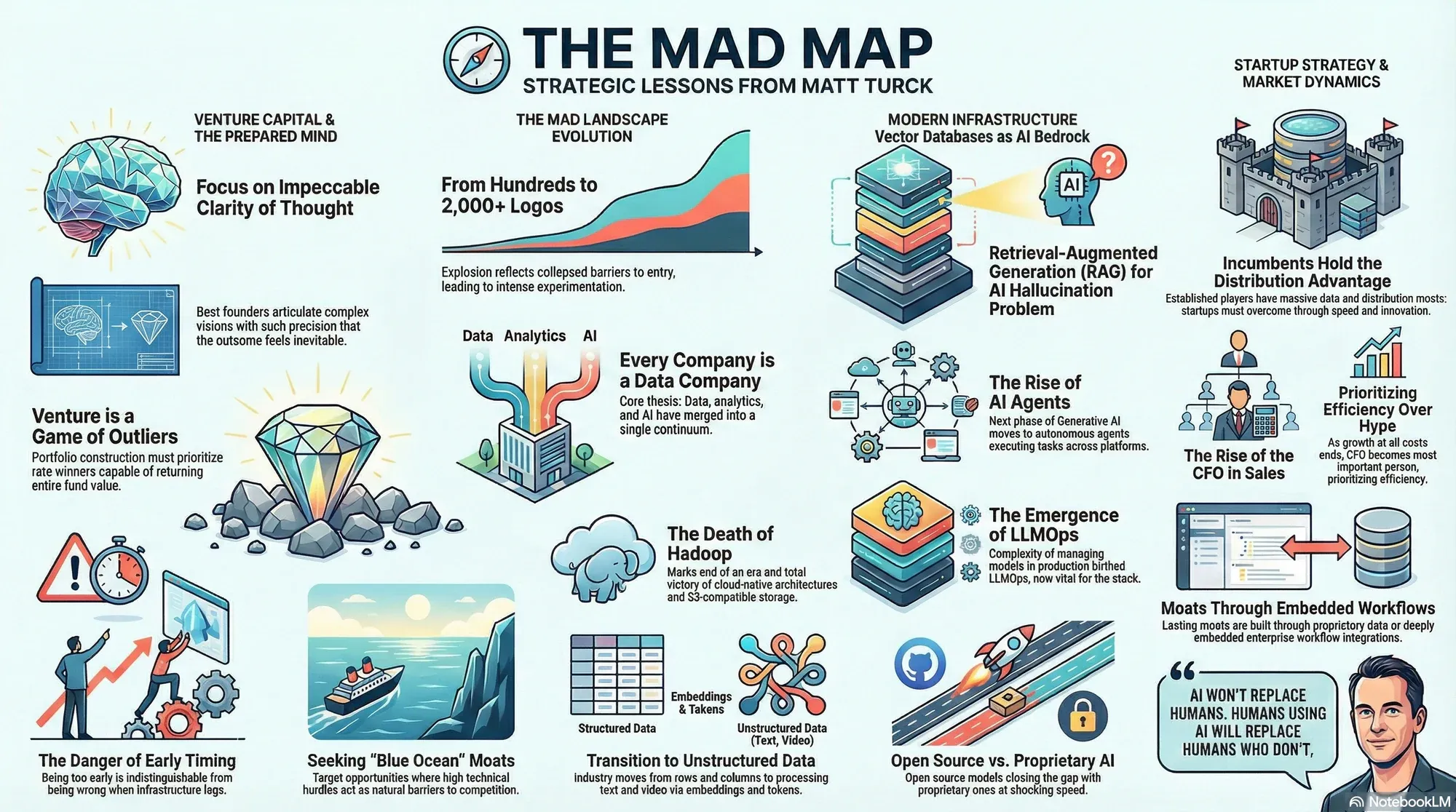
Part 1: Venture Capital & The Prepared Mind
- On Making Few Investments: In the blog post “A Few Non-Obvious Things I Learned as a New VC” (October 19, 2014), Turck wrote: "the biggest shock to the system was the realization that one gets to make very, very few investments – basically two or three a year". — “A Few Non-Obvious Things I Learned as a New VC,” Matt Turck (mattturck.com, October 19, 2014).
- On Storytelling and Conviction: In the blog post “A Few Non-Obvious Things I Learned as a New VC” (October 19, 2014), Turck wrote: "the reality is that investment decisions are mostly about storytelling and forming personal conviction – painting a vision of the world where a company becomes hugely important". — “A Few Non-Obvious Things I Learned as a New VC,” Matt Turck (mattturck.com, October 19, 2014).
- On Scarce Data Points: In the blog post “A Few Non-Obvious Things I Learned as a New VC” (October 19, 2014), Turck wrote: "Early stage VCs (seed and Series A) operate in a daunting scarcity of data points". — “A Few Non-Obvious Things I Learned as a New VC,” Matt Turck (mattturck.com, October 19, 2014).
- On Arguing Either Way: In the blog post “A Few Non-Obvious Things I Learned as a New VC” (October 19, 2014), Turck wrote: "most investment decisions can be argued either way, and they often are". — “A Few Non-Obvious Things I Learned as a New VC,” Matt Turck (mattturck.com, October 19, 2014).
- On Deal Dynamics: In the blog post “A Few Non-Obvious Things I Learned as a New VC” (October 19, 2014), Turck wrote: "the intrinsic merits of the opportunity is only a part of the equation". — “A Few Non-Obvious Things I Learned as a New VC,” Matt Turck (mattturck.com, October 19, 2014).
- On Raising Money: In the blog post “A Few Non-Obvious Things I Learned as a New VC” (October 19, 2014), Turck wrote: "VCs spend an awful lot of time raising money". — “A Few Non-Obvious Things I Learned as a New VC,” Matt Turck (mattturck.com, October 19, 2014).
- On Seeing the Deal: In the blog post “Fundraising: “Always Be Raising” vs “Heads Down”” (November 20, 2019), Turck wrote: "VCs are in the business of “seeing the deal”". — “Fundraising: “Always Be Raising” vs “Heads Down”,” Matt Turck (mattturck.com, November 20, 2019).
- On an Information and Salesmanship Game: In the blog post “Fundraising: “Always Be Raising” vs “Heads Down”” (November 20, 2019), Turck wrote: "Venture capital is an information and salesmanship game where getting early access to the best investment opportunities is essential to success in a hyper-competitive environment". — “Fundraising: “Always Be Raising” vs “Heads Down”,” Matt Turck (mattturck.com, November 20, 2019).
- On a Board Member: In the blog post “Fundraising: “Always Be Raising” vs “Heads Down”” (November 20, 2019), Turck wrote: "getting a new board member is “marriage with no possibility of divorce”". — “Fundraising: “Always Be Raising” vs “Heads Down”,” Matt Turck (mattturck.com, November 20, 2019).
Part 2: The MAD Evolution
- On Pull Mode: In the blog post “Fundraising: Push vs Pull” (January 7, 2020), Turck wrote: "there’s more of an opportunity for founders to be in “pull” mode, a situation where investors come to you and do the courting and convincing". — “Fundraising: Push vs Pull,” Matt Turck (mattturck.com, January 7, 2020).
- On Owning the Narrative: In the blog post “Fundraising: Push vs Pull” (January 7, 2020), Turck wrote: "if VCs will be looking for your digital exhaust and taking it as signal, you might as well own the narrative". — “Fundraising: Push vs Pull,” Matt Turck (mattturck.com, January 7, 2020).
- On a Cottage Industry: In the blog post “Fundraising: Push vs Pull” (January 7, 2020), Turck wrote: "Venture used to be a cottage industry where VCs had the upper hand in their relationships with founders". — “Fundraising: Push vs Pull,” Matt Turck (mattturck.com, January 7, 2020).
- On Social Proof: In the blog post “Fundraising: Push vs Pull” (January 7, 2020), Turck wrote: "Anything providing social proof is great". — “Fundraising: Push vs Pull,” Matt Turck (mattturck.com, January 7, 2020).
- On Early Feedback From Investors: In the blog post “Fundraising: “Always Be Raising” vs “Heads Down”” (November 20, 2019), Turck wrote: "Get early feedback on what investors like or don’t like about your business". — “Fundraising: “Always Be Raising” vs “Heads Down”,” Matt Turck (mattturck.com, November 20, 2019).
- On Heads Down: In the blog post “Fundraising: “Always Be Raising” vs “Heads Down”” (November 20, 2019), Turck wrote: "founders should be “heads down” in between financing rounds, focused on “building the business” (hiring, sales, product development)". — “Fundraising: “Always Be Raising” vs “Heads Down”,” Matt Turck (mattturck.com, November 20, 2019).
- On Knowing Potential Board Members: In the blog post “Fundraising: “Always Be Raising” vs “Heads Down”” (November 20, 2019), Turck wrote: "Build a relationship and get to know potential board members over a longer period of time". — “Fundraising: “Always Be Raising” vs “Heads Down”,” Matt Turck (mattturck.com, November 20, 2019).
- On Always Be Raising: In the blog post “Fundraising: “Always Be Raising” vs “Heads Down”” (November 20, 2019), Turck wrote: "One line of thought (typically favored by VCs) is that founders should “always be raising”". — “Fundraising: “Always Be Raising” vs “Heads Down”,” Matt Turck (mattturck.com, November 20, 2019).
Part 3: Modern Data Infrastructure
- On Data Network Effects: In the blog post “The Power of Data Network Effects” (January 4, 2016), Turck wrote: "Data network effects occur when your product, generally powered by machine learning, becomes smarter as it gets more data from your users". — “The Power of Data Network Effects,” Matt Turck (mattturck.com, January 4, 2016).
- On the Data Flywheel: In the blog post “The Power of Data Network Effects” (January 4, 2016), Turck wrote: "the more users use your product, the more data they contribute; the more data they contribute, the smarter your product becomes". — “The Power of Data Network Effects,” Matt Turck (mattturck.com, January 4, 2016).
- On Automated Learning: In the blog post “The Power of Data Network Effects” (January 4, 2016), Turck wrote: "Data network effects require at least some level of automated productization of the learning". — “The Power of Data Network Effects,” Matt Turck (mattturck.com, January 4, 2016).
- On Not Needing to Be Google: In the blog post “The Power of Data Network Effects” (January 4, 2016), Turck wrote: "you don’t need to be Google to put in place the core infrastructure and learning loops to benefit from data network effects". — “The Power of Data Network Effects,” Matt Turck (mattturck.com, January 4, 2016).
- On Combining Network Effects: In the blog post “The Power of Data Network Effects” (January 4, 2016), Turck wrote: "“standard” network effects and data network effects can absolutely be found in the same company". — “The Power of Data Network Effects,” Matt Turck (mattturck.com, January 4, 2016).
Part 4: The Generative AI Frontier
- On Humans in Early AI Products: In the blog post “When is AI not AI?” (July 23, 2020), Turck wrote: "Having humans involved in the early days of building an AI product is a feature, not a bug. Whether you can “fire” those humans over time or not determines whether you have a business or not". — “When is AI not AI?,” Matt Turck (mattturck.com, July 23, 2020).
- On AI Startups Versus SaaS: In the blog post “When is AI not AI?” (July 23, 2020), Turck wrote: "One key thing to understand about AI startups is that they are not like your regular SaaS startups". — “When is AI not AI?,” Matt Turck (mattturck.com, July 23, 2020).
- On Deeply Technical Endeavors: In the blog post “When is AI not AI?” (July 23, 2020), Turck wrote: "For all the stories about commodization of AI, they remain deeply technical endeavors, which require substantial R&D effort". — “When is AI not AI?,” Matt Turck (mattturck.com, July 23, 2020).
- On Mostly Human, a Little AI: In the blog post “When is AI not AI?” (July 23, 2020), Turck wrote: "in the early days of an AI startup, you often find that the product is powered in large part by humans, with a little bit of AI". — “When is AI not AI?,” Matt Turck (mattturck.com, July 23, 2020).
- On AI Trainers: In the blog post “When is AI not AI?” (July 23, 2020), Turck wrote: "AI trainers are people that help build the data set, label the data, and/or resolve problems when the AI wasn’t able to succeed by itself". — “When is AI not AI?,” Matt Turck (mattturck.com, July 23, 2020).
Part 5: Startup Strategy & Scaling
- On Pitching a Big Company: In the blog post “Working with big companies: 10 practical tips for startup founders” (April 19, 2012), Turck wrote: "Unlike an investor pitch, a pitch to a big company is not about you and how awesome your product is. It’s about how you can help the big company solve a specific problem". — “Working with big companies: 10 practical tips for startup founders,” Matt Turck (mattturck.com, April 19, 2012).
- On Founders as Initial Salespeople: In the blog post “Working with big companies: 10 practical tips for startup founders” (April 19, 2012), Turck wrote: "founders should be the initial sales people at their startups: there’s no better way to get market feedback and fine tune your value proposition". — “Working with big companies: 10 practical tips for startup founders,” Matt Turck (mattturck.com, April 19, 2012).
- On Avoiding Politics: In the blog post “Working with big companies: 10 practical tips for startup founders” (April 19, 2012), Turck wrote: "Be transparent, keep everyone in the loop, don’t make comments about people, don’t take sides". — “Working with big companies: 10 practical tips for startup founders,” Matt Turck (mattturck.com, April 19, 2012).
- On Rarely Hearing No: In the blog post “Working with big companies: 10 practical tips for startup founders” (April 19, 2012), Turck wrote: "large companies, just like some VCs, rarely actually say “no”". — “Working with big companies: 10 practical tips for startup founders,” Matt Turck (mattturck.com, April 19, 2012).
- On an Internal Champion: In the blog post “Working with big companies: 10 practical tips for startup founders” (April 19, 2012), Turck wrote: "you’ll want to quickly find an internal champion, preferably someone who has P&L responsibility". — “Working with big companies: 10 practical tips for startup founders,” Matt Turck (mattturck.com, April 19, 2012).
- On Hiring Finance Early: In the blog post “VP of Finance: The Non-Obvious Hire” (August 2, 2020), Turck wrote: "I’ve never heard a startup CEO say after the fact that they regretted hiring a VP of Finance too early". — “VP of Finance: The Non-Obvious Hire,” Matt Turck (mattturck.com, August 2, 2020).
- On Organizational Debt: In the blog post “VP of Finance: The Non-Obvious Hire” (August 2, 2020), Turck wrote: "Avoid accumulating “organizational debt”: any unaddressed deficiency around accounting, finance, processes, operations, etc accumulates and compounds over time". — “VP of Finance: The Non-Obvious Hire,” Matt Turck (mattturck.com, August 2, 2020).
- On Cash Cycles: In the blog post “VP of Finance: The Non-Obvious Hire” (August 2, 2020), Turck wrote: "I’ve seen companies go under because the CEO didn’t understand how their cash cycle evolved as the company grew". — “VP of Finance: The Non-Obvious Hire,” Matt Turck (mattturck.com, August 2, 2020).
Part 6: Enterprise Dynamics & Market Shifts
- On Time at Big Companies: In the blog post “Working with big companies: 10 practical tips for startup founders” (April 19, 2012), Turck wrote: "Getting stuff done with a big company takes time". — “Working with big companies: 10 practical tips for startup founders,” Matt Turck (mattturck.com, April 19, 2012).
- On Patience Without Waiting Forever: In the blog post “Working with big companies: 10 practical tips for startup founders” (April 19, 2012), Turck wrote: "Being patient doesn’t mean that you should wait around forever". — “Working with big companies: 10 practical tips for startup founders,” Matt Turck (mattturck.com, April 19, 2012).
- On Dressing for the Meeting: In the blog post “Working with big companies: 10 practical tips for startup founders” (April 19, 2012), Turck wrote: "there’s very little upside to showing up in a hoodie and sneakers at a meeting where most people are going to wear ties and business suits". — “Working with big companies: 10 practical tips for startup founders,” Matt Turck (mattturck.com, April 19, 2012).
- On Listening to Feedback: In the blog post “Working with big companies: 10 practical tips for startup founders” (April 19, 2012), Turck wrote: "Listen to their feedback and ideas if they offer them". — “Working with big companies: 10 practical tips for startup founders,” Matt Turck (mattturck.com, April 19, 2012).
- On Corporate Politics: In the blog post “Working with big companies: 10 practical tips for startup founders” (April 19, 2012), Turck wrote: "large companies are fraught with politics and as an outsider, it’s unlikely you’re going to be able to play them right. So stay away as much as you can". — “Working with big companies: 10 practical tips for startup founders,” Matt Turck (mattturck.com, April 19, 2012).
- On a Head of Finance: In the blog post “VP of Finance: The Non-Obvious Hire” (August 2, 2020), Turck wrote: "founders should consider hiring a head of finance earlier than most would think". — “VP of Finance: The Non-Obvious Hire,” Matt Turck (mattturck.com, August 2, 2020).
Part 7: Community, Content & Culture
- On an Unstructured Startup World: In the blog post “Playing “fake VC” (or the portfolio approach to getting a job in venture capital)” (September 16, 2015), Turck wrote: "the startup world is very unstructured". — “Playing “fake VC” (or the portfolio approach to getting a job in venture capital),” Matt Turck (mattturck.com, September 16, 2015).
- On Overall Excellence: In the blog post “Playing “fake VC” (or the portfolio approach to getting a job in venture capital)” (September 16, 2015), Turck wrote: "VC firms look for overall excellence and for people who have been “in and around” startups a lot". — “Playing “fake VC” (or the portfolio approach to getting a job in venture capital),” Matt Turck (mattturck.com, September 16, 2015).
- On Doing More Than the Next Job: In the blog post “Playing “fake VC” (or the portfolio approach to getting a job in venture capital)” (September 16, 2015), Turck wrote: "Because there’s no linear career progression, you need to do more than just getting the next job that will eventually get you into VC". — “Playing “fake VC” (or the portfolio approach to getting a job in venture capital),” Matt Turck (mattturck.com, September 16, 2015).
- On Startup-Related Activities: In the blog post “Playing “fake VC” (or the portfolio approach to getting a job in venture capital)” (September 16, 2015), Turck wrote: "a lot of people who ultimately become VCs tend to do a bunch of startup-related things". — “Playing “fake VC” (or the portfolio approach to getting a job in venture capital),” Matt Turck (mattturck.com, September 16, 2015).
- On Starting a Community: In the blog post “Celebrating 10 years of Data Driven NYC” (December 15, 2021), Turck wrote: "on a whim on a November Sunday night, I logged on Meetup.com and created a group". — “Celebrating 10 years of Data Driven NYC,” Matt Turck (mattturck.com, December 15, 2021).
- On a Ten-Year Journey: In the blog post “Celebrating 10 years of Data Driven NYC” (December 15, 2021), Turck wrote: "And so started a 10-year journey of community and network building, and an immensely fun and rewarding chapter of my professional life". — “Celebrating 10 years of Data Driven NYC,” Matt Turck (mattturck.com, December 15, 2021).
- On Asking for a Room: In the blog post “Celebrating 10 years of Data Driven NYC” (December 15, 2021), Turck wrote: "I asked if I could have access to one of the rooms there. They said yes". — “Celebrating 10 years of Data Driven NYC,” Matt Turck (mattturck.com, December 15, 2021).
- On Deal Data Lagging: In the blog post “The Great VC Pullback of 2022” (April 28, 2022), Turck wrote: "deal data is a trailing indicator – financings are often announced months after they closed". — “The Great VC Pullback of 2022,” Matt Turck (mattturck.com, April 28, 2022).
- On Venture as an Assembly Line: In the blog post “The Great VC Pullback of 2022” (April 28, 2022), Turck wrote: "Venture tends to work as an assembly line, with each investor depending on the next stage (either a next round of financing or a public company IPO exit) for their short term success". — “The Great VC Pullback of 2022,” Matt Turck (mattturck.com, April 28, 2022).
Part 8: The Global & Geopolitical Tech View
- On a Gap Between Perception and Reality: In the blog post “The French Startup Ecosystem: At a Tipping Point” (June 25, 2014), Turck wrote: "there’s a huge gap between perception and reality, when it comes to the French startup ecosystem". — “The French Startup Ecosystem: At a Tipping Point,” Matt Turck (mattturck.com, June 25, 2014).
- On Overcoming a Negative Reputation: In the blog post “The French Startup Ecosystem: At a Tipping Point” (June 25, 2014), Turck wrote: "it takes a long time to overcome a negative reputation". — “The French Startup Ecosystem: At a Tipping Point,” Matt Turck (mattturck.com, June 25, 2014).
- On Graduates Choosing Startups: In the blog post “The French Startup Ecosystem: At a Tipping Point” (June 25, 2014), Turck wrote: "many graduates of those schools are increasingly choosing to go work for startups (or start one) instead of choosing a career at Bain, Goldman". — “The French Startup Ecosystem: At a Tipping Point,” Matt Turck (mattturck.com, June 25, 2014).
- On Catching Up to the Hype: In the blog post “The NYC Tech Ecosystem: Catching Up to the Hype” (July 13, 2016), Turck wrote: "New York is in the process of catching up to the hype. That doesn’t make for splashy headlines, and takes a long time". — “The NYC Tech Ecosystem: Catching Up to the Hype,” Matt Turck (mattturck.com, July 13, 2016).
- On Ecosystems as Living Organisms: In the blog post “The NYC Tech Ecosystem: Catching Up to the Hype” (July 13, 2016), Turck wrote: "an ecosystem is fundamentally a living and breathing organism". — “The NYC Tech Ecosystem: Catching Up to the Hype,” Matt Turck (mattturck.com, July 13, 2016).
- On Network Effects Petering Out: In the blog post “The NYC Tech Ecosystem: Catching Up to the Hype” (July 13, 2016), Turck wrote: "network effects can just as easily peter out as they can get stronger". — “The NYC Tech Ecosystem: Catching Up to the Hype,” Matt Turck (mattturck.com, July 13, 2016).
- On a Beginner’s Guide: In the blog post “A Guide to the Berlin Tech Ecosystem” (January 30, 2013), Turck wrote: "This is meant to be a “beginner’s guide” for outsiders like me, not the ultimate reference on the topic". — “A Guide to the Berlin Tech Ecosystem,” Matt Turck (mattturck.com, January 30, 2013).
- On Berlin Not Being Germany: In the blog post “A Guide to the Berlin Tech Ecosystem” (January 30, 2013), Turck wrote: "Just like New York or San Francisco are not like the rest of the U.S., Berlin is not like the rest of Germany". — “A Guide to the Berlin Tech Ecosystem,” Matt Turck (mattturck.com, January 30, 2013).
- On a Sudden Pullback: In the blog post “The Great VC Pullback of 2022” (April 28, 2022), Turck wrote: "We’ve rapidly, perhaps brutally, transitioned from a hyper frothy VC environment to a world where many deals are not getting done". — “The Great VC Pullback of 2022,” Matt Turck (mattturck.com, April 28, 2022).