Lessons from Matt Webb
Matt Webb is a London-based designer and writer who co-founded the studio BERG and co-authored Mind Hacks. His work explores how computing can live inside everyday physical objects, from early networked hardware like the Little Printer to the generative Poem/1 clock. This profile gathers his thoughts on product design, the open web, and how we interact with technology.
Part 1: Design and Physical Computing
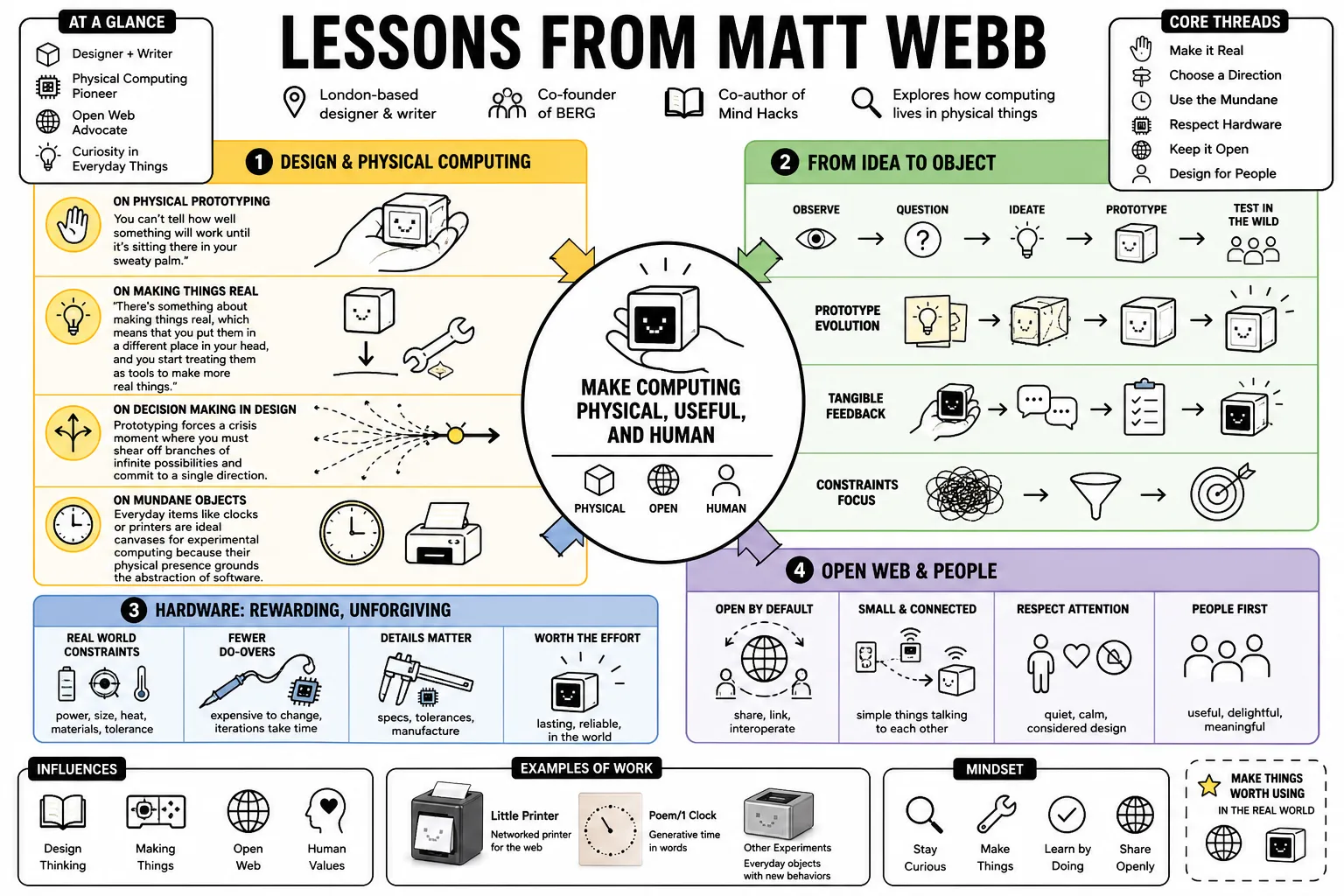
- On physical prototyping: "You can't tell how well something will work until it's sitting there in your sweaty palm." — Source: [BERG London]
- On making things real: "There's something about making things real, which means that you put them in a different place in your head, and you start treating them as tools to make more real things." — Source: [Decrypt]
- On decision making in design: Prototyping forces a crisis moment where you must shear off branches of infinite possibilities and commit to a single direction. — Source: [BERG London]
- On mundane objects: Everyday items like clocks or printers are ideal canvases for experimental computing because their physical presence grounds the abstraction of software. — Source: [Acts Not Facts]
- On hardware development: The hardware process is unforgiving compared to software; once a physical product is manufactured, updating its core functionality requires a fundamentally different mindset. — Source: [Fast Company]
- On playful utility: A product does not have to be strictly utilitarian to be valuable; whimsy and delight are legitimate design requirements. — Source: [Cooper Hewitt]
- On the scale of manufacturing: Finding the right scale for hardware production means navigating the space between bespoke crafting and massive industrial runs, a challenge for independent studios. — Source: [GigaOM]
- On embedded intelligence: The future of technology involves placing software behavior directly into our physical environment rather than keeping it trapped behind glass screens. — Source: [Icon Eye]
- On tactile interaction: Physical buttons and thermal paper provide a distinct sensory feedback loop that cannot be replicated by swiping a touchscreen. — Source: [Dezeen]
Part 2: The Internet of Things and Connected Products
- On connected objects: "Now if you look through the Argos catalogue, there are thousands of products that are artificially intelligent." — Source: [Icon Eye]
- On Little Printer: "Each information source we think of as a personalised 'publication' that you subscribe to from a kind of 'app store for paper,' collated into a delivery that arrives at a chosen time." — Source: [Fast Company]
- On BERG Cloud: The goal of BERG Cloud was to provide a platform that allowed companies to easily validate and bring their connected product ideas to life. — Source: [Forbes]
- On early IoT promises: The initial excitement around the Internet of Things often ignored the ongoing costs and complexities of maintaining cloud infrastructure for physical goods. — Source: [Interconnected]
- On quiet technology: Connected devices should respect human attention, delivering information calmly rather than constantly demanding engagement through notifications. — Source: [BERG London]
- On software in the home: Bringing the internet into domestic spaces requires a different aesthetic and interaction model than designing software for the workplace. — Source: [Uses This]
- On subscription models for hardware: Providing ongoing digital services to a physical object is the only way to sustain the business model of connected hardware over time. — Source: [Fast Company]
- On ambient awareness: Connected products work best when they provide a peripheral sense of what is happening in the world, rather than requiring direct focus. — Source: [Cooper Hewitt]
- On materializing data: Turning digital streams into physical artifacts, like a printed receipt of news, gives data a tangible weight and presence. — Source: [Dezeen]
- On the lifespan of connected devices: When the servers supporting a connected product shut down, the physical object is often left entirely useless, highlighting a major flaw in the IoT ecosystem. — Source: [Interconnected]
Part 3: Artificial Intelligence and Poem/1
- On embedded AI: "Maybe this is what our AI future will be like: embedded AI, which brings the world to life in small amounts, but doesn't feel like something we need to speak to, or feel like a system." — Source: [Fast Company]
- On generative behavior: "Poem/1 is often profound, as it should be because I wrote that in the prompt to the AI. But it is also often weirdly motivational, and sometimes very odd, referring to the cosmos..." — Source: [Forbes]
- On AI personalities: He designed the Poem/1 clock to occasionally sound "like a LinkedIn influencer, like a tiny, tiny Sam Altman telling me to like..." — Source: [JWP News]
- On mundane genius: AI does not need to be an omniscient oracle; it can be applied to mundane tasks, acting as a small, specialized form of intelligence within a household object. — Source: [Acts Not Facts]
- On algorithmic hallucinations: When generating rhymes for a clock, language models will sometimes invent words or display incorrect times merely to satisfy the structural constraints of the poem. — Source: [Dexerto]
- On AI as a material: Machine learning should be treated as a new type of design material with its own grain, unpredictability, and texture. — Source: [Interconnected]
- On the interface of AI: We should move away from chat windows as the default interface for artificial intelligence and explore how it can inhabit physical spaces. — Source: [Approach Studio]
- On humor in technology: A device that tells time through surreal poetry introduces a necessary element of levity into the otherwise serious domain of consumer tech. — Source: [Forbes]
- On prototyping with language models: ChatGPT allows designers to rapidly simulate software behaviors that would have previously required massive engineering resources. — Source: [Decrypt]
- On the limitations of AI timekeeping: "Don't rely on this clock in situations where timekeeping is vital," acknowledging the inherent unreliability of generative text. — Source: [Dexerto]
Part 4: The Web, Platforms, and Blogging
- On platform lock-in: "Feeding your words to a platform is a vote for its values, whether you like it or not." — Source: [Simon Willison's Weblog]
- On the performance of blogging: "Blogging as a kind of Amish performance of a better life." — Source: [Simon Willison's Weblog]
- On owning your audience: Platforms often roach-motel users by controlling their distribution, making the initial bump in discovery a poor trade for the loss of true ownership. — Source: [Cybercultural]
- On standing on shoulders: Building on the open web allows creators to use existing infrastructure rather than wasting time "pissing around cleaning up malformed things." — Source: [Petafloptimism]
- On the longevity of personal sites: A personal blog serves as a continuous, searchable archive of thought that outlives the ephemeral nature of social media feeds. — Source: [Interconnected]
- On algorithmic feeds: Chronological feeds are inherently more respectful of a reader's time than algorithmic timelines designed to maximize engagement. — Source: [Interconnected]
- On the indie web: Maintaining independent websites is a necessary counterbalance to the consolidation of the internet by a few major tech corporations. — Source: [Interconnected]
- On hypertext: The fundamental power of the web lies in its ability to connect disparate ideas through simple links, a feature that walled gardens try to suppress. — Source: [Interconnected]
- On digital permanence: Writing on your own domain is a deliberate act of digital preservation against the inevitable decay of third-party services. — Source: [Interconnected]
- On web services: The early promise of APIs was about interoperability and sharing capabilities, a culture that has largely been replaced by protective data silos. — Source: [Interconnected]
Part 5: Mind Hacks and Cognitive Science
- On understanding the brain: Cognitive neuroscience can be made accessible to the public by framing it as a series of actionable experiments and "hacks." — Source: [Mind Hacks]
- On perception: Our brains actively construct our reality through shortcuts and assumptions, rather than acting as passive cameras recording the world. — Source: [O'Reilly Media]
- On attention: Human attention is a sharply limited resource; understanding its constraints is necessary for designing better software and environments. — Source: [Wikipedia]
- On bridging disciplines: There is immense value in translating academic psychological research into practical insights for interaction designers and technologists. — Source: [BeFreed]
- On memory: Human memory is reconstructive and highly fallible, which explains why user interfaces must rely on recognition rather than recall. — Source: [Mind Hacks]
- On visual processing: The brain processes visual information through multiple separate pathways, determining what an object is separately from where it is located. — Source: [O'Reilly Media]
- On physical intuition: We navigate the world using deeply ingrained motor routines and spatial awareness, which can be applied in hardware design. — Source: [Mind Hacks]
- On automatic processes: Many of our daily actions are driven by sensory routines operating below the level of conscious awareness. — Source: [Mind Hacks]
- On cognitive limits: Recognizing the biological limits of human cognition should prevent designers from building overly complex, demanding interfaces. — Source: [Mind Hacks]
Part 6: Problem Solving and Process
- On sudden clarity: "I can puzzle over a thing until I am in a state of utter confusion, giving it up, and then suddenly have the answer leap into my mind without an apparent reason." — Source: [The Jaymo]
- On the value of percolation: Stubborn problems often require stepping away and allowing the subconscious mind to work through the variables in the background. — Source: [The Jaymo]
- On open-mindedness: Exposing yourself to radically different ideas is necessary for creative work, even if those ideas initially seem confusing or irrelevant. — Source: [McGee's Musings]
- On iterative development: You cannot solve a complex design problem purely through theory; you have to build rough versions and test them in reality. — Source: [BERG London]
- On navigating constraints: The physical limits of hardware or the cognitive limits of the user are not obstacles, but rather the boundaries that give a project its shape. — Source: [Interconnected]
- On synthesis: The most interesting solutions arise when you combine insights from entirely different domains, such as poetry and horology, or cognitive science and software design. — Source: [Acts Not Facts]
- On embracing the weird: When a prototype behaves strangely or unexpectedly, it is often a signal that you have uncovered a new interaction model worth exploring. — Source: [Interconnected]
- On writing as thinking: The act of writing a blog post or weeknote is a way to structure messy thoughts into coherent arguments and strategies. — Source: [Interconnected]
- On managing risk: Running a creative studio requires balancing long periods of steady work with occasional, calculated leaps into high-risk experimentation. — Source: [Snarkmarket]
Part 7: Culture and Organizations
- On organizational aspiration: "My aspiration is that at BERG we learn to think big, to invent culture!" — Source: [BERG London]
- On alumni: "I said once that our experimental rockets are our people and that I'm always proud to see what BERG alumni move onto and accomplish." — Source: [BERG London]
- On financial transparency: "I attempt to run the company perpetually at medium-risk, with occasional forays into high-risk to grow." — Source: [Snarkmarket]
- On studio closures: "Folks, I've got some news about Berg to share. We're wrapping up for this incarnation. Our partnerships and our services, they're done. A few things left, then hibernation." — Source: [Dezeen]
- On the nature of consultancies: A design consultancy naturally transitions between client services and self-directed product development, creating a constant tension in resource allocation. — Source: [Fast Company]
- On weeknotes: Publishing internal company updates publicly fosters a culture of accountability and helps a studio articulate its evolving identity to the outside world. — Source: [Interconnected]
- On collaborative spaces: The physical layout of a studio should prioritize serendipitous conversations and the casual sharing of half-finished work. — Source: [Uses This]
- On the rhythm of work: Creative output cannot be treated linearly; it requires oscillating periods of intense focus and necessary slack. — Source: [Interconnected]
- On ending projects gracefully: Knowing when to wrap up an endeavor and put a company or project into hibernation is as important as knowing how to launch one. — Source: [Dezeen]
Part 8: The Future of Technology
- On ubiquitous computing: The ultimate goal of technology is to disappear into the background, becoming a seamless part of our environment rather than a screen we stare at. — Source: [Cooper Hewitt]
- On post-screen interfaces: As technology matures, we will rely less on glowing rectangles and more on physical, tactile interfaces that communicate through subtle cues. — Source: [Approach Studio]
- On the lifespan of hardware: Future consumer electronics must be designed with an end-of-life plan that does not rely entirely on the persistence of a corporate server. — Source: [Interconnected]
- On local AI: Running artificial intelligence models locally on hardware, rather than in the cloud, is the necessary next step for preserving privacy and device longevity. — Source: [Acts Not Facts]
- On poetic technology: We will see a shift toward technology that prioritizes emotional resonance, humor, and poetry over raw efficiency and productivity. — Source: [Forbes]
- On the decentralization of the web: A return to personal websites, RSS feeds, and chronological timelines is the most viable path away from the algorithmic control of massive platforms. — Source: [Interconnected]
- On agency in technology: Users must retain the ability to repair, modify, and understand their devices, pushing back against the trend of sealed, black-box products. — Source: [Interconnected]
- On the changing internet: The web is transitioning from a space of static documents to a dynamic environment where media is continuously generated and ephemeral. — Source: [Interconnected]
- On the long view: The current era of centralized platforms is a historical anomaly; the natural state of the internet is decentralized, messy, and independently operated. — Source: [Cybercultural]