Lessons from Matthew Prince
Matthew Prince co-founded Cloudflare in 2010 to protect websites from attacks and speed up load times. As CEO, he built the company on the idea that internet infrastructure should operate as a neutral utility. This collection covers his approach to managing the corporate crises and free speech debates that followed, along with his recent arguments for how AI agents will alter web traffic.
Part 1: The Founding & Mission
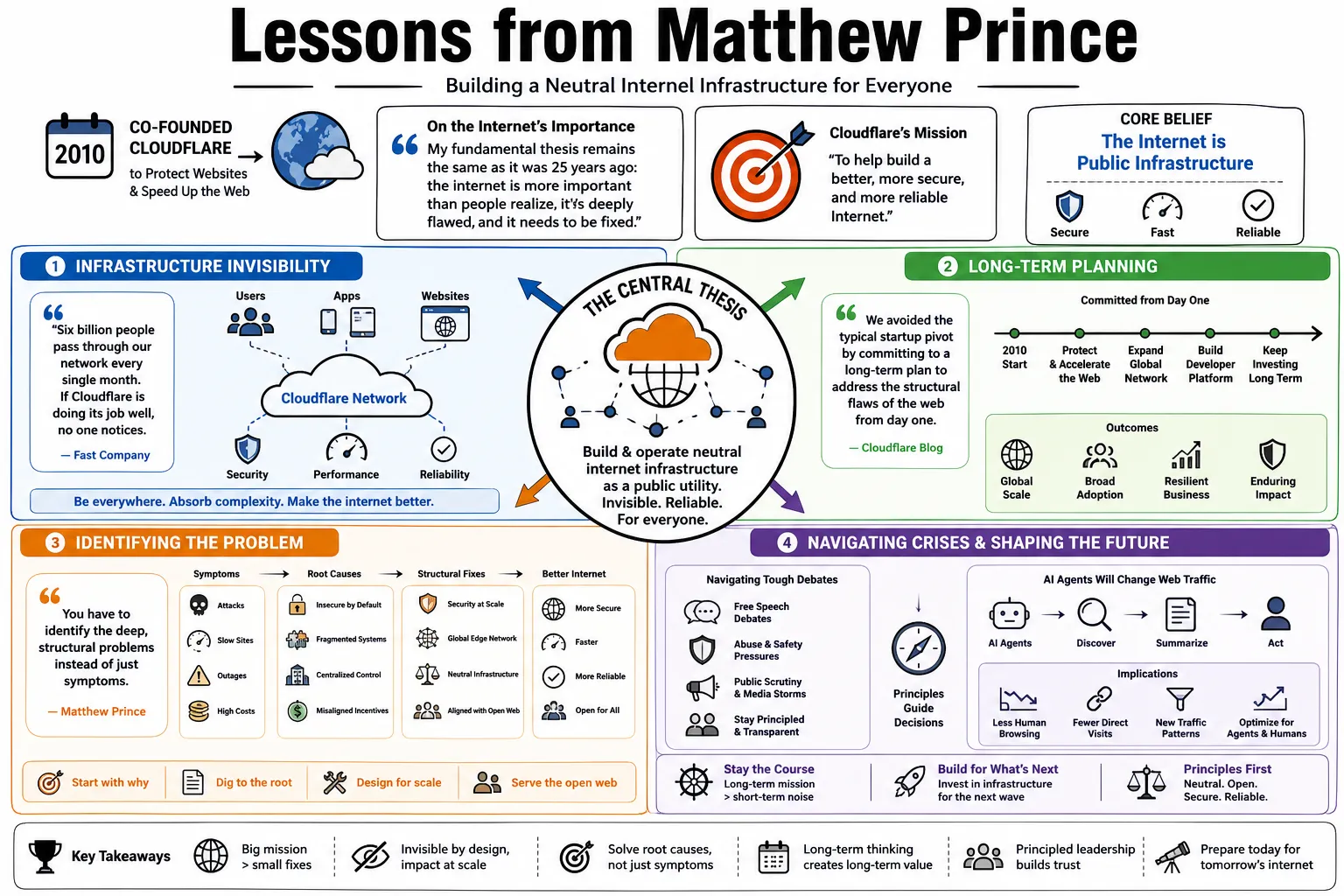
- On the Internet's Importance: "My fundamental thesis remains the same as it was 25 years ago: the internet is more important than people realize, it's deeply flawed, and it needs to be fixed." — Source: Nick Grossman
- On Cloudflare's Mission: "To help build a better, more secure, and more reliable Internet." — Source: Cloudflare Blog
- On Infrastructure Invisibility: "Six billion people pass through our network every single month. If Cloudflare is doing its job well, no one notices." — Source: Fast Company
- On Long-Term Planning: "We avoided the typical startup pivot by committing to a long-term plan to address the structural flaws of the web from day one." — Source: Cloudflare Blog
- On Identifying the Problem: "You have to identify the deep, structural problems in your field and build the infrastructure needed to solve them." — Source: Nick Grossman
- On the Company Name: "Too long, hard for English speakers to say Cluh and Fluh next to each other so becomes Cloudfare, multiple ways to spell flare/flair." — Source: Business Insider
- On Early Bandwidth Pricing: "If we charged for bandwidth then it would cause customers to potentially avoid routing traffic through us. That goes against the core value that we provide: effectively a neighborhood watch for the Internet." — Source: Reddit
- On the Neighborhood Watch: "We always envisioned Cloudflare as a collective defense mechanism where one site's attack data helps protect the entire network." — Source: Cloudflare Blog
- On Structural Flaws: "The internet wasn't built with security in mind; it was built for trust, which means security has to be retrofitted at the infrastructure layer." — Source: Cloudflare Blog
- On Building for the Future: "We are constantly anticipating the next fundamental shift in the internet's ecosystem so we can build the necessary infrastructure before it becomes a crisis." — Source: Stratechery
Part 2: The Future of the Internet & AI
- On the Shift in Web Traffic: "The frame that you're going to view content through is going to be through your helpful AI agent. But what's different about it is for the first time, it's going to pull the information back to you as opposed to pushing you to the information." — Source: Bankless
- On the Bot Takeover: "Welp, that happened faster than I predicted. Agentic traffic is growing so fast that bots have now passed human traffic online for the first time in the Internet's history." — Source: India Times
- On AI Business Models: "I think this is the most interesting question over the next five years: What is the future business model of the internet going to be?" — Source: Fast Company
- On Small Businesses and AI: "Imagine you're a small business and you're trying to convince an agent to buy from you. How do you do that? I think it's incredibly hard." — Source: Let's Data Science
- On the End of Search: "These aren't search engines anymore, they're answer engines. The economics and rules are very different. We have to strike a new deal." — Source: Business Insider
- On the Agentic Internet: "We are transitioning to an agentic internet, where AI handles the interactions and the underlying infrastructure must adapt to secure and route non-human traffic efficiently." — Source: Yahoo Finance
- On Content Scraping: "The web cannot survive if generative AI companies scrape content without compensating the original creators who provide the value." — Source: Big Technology Podcast
- On Neutrality in AI: "Cloudflare operates as a middleman that doesn't have a dog in the fight, which allows us to enforce standards like provenance and rate-limiting fairly." — Source: Digiday
- On the Future of Clicks: "The era of maximizing pageviews and clicks is dying; the future is about providing high-value answers directly through AI interfaces." — Source: Stratechery
- On Recognizing Structural Shifts: "Leaders must look at the data and recognize when the fundamental economic models of their industry are breaking under the weight of new technology." — Source: YouTube
Part 3: Edge Computing & Infrastructure
- On the Killer App for Edge: "AI is the killer app for edge computing. The architecture we've built over the last decade positions us perfectly for this moment." — Source: Substack
- On Speed as Icing: "Speed is the icing on the cake, but it's not, for most applications, an initial requirement. Focusing only on it is a mistake that will doom edge computing platforms to obscurity." — Source: Cloudflare Blog
- On the Cold Start Problem: "Edge computing platforms can actually make the cold start problem worse because they spread the computing workload across more servers in more locations." — Source: Telerik
- On Network Economics: "Our interconnect economics allow us to offer compute in a highly competitive way, making agent compute economically feasible at the edge." — Source: Substack
- On Data Sovereignty: "Edge computing is no longer just about latency; it is essential for meeting regulatory demands for data sovereignty and local processing." — Source: Substack
- On Replacing the CDN: "The traditional CDN model is giving way to comprehensive edge compute platforms that serve as the on-ramps for AI inference." — Source: Om.co
- On Distributing Compute: "You have to move the compute as close to the user as possible to satisfy the stringent latency requirements of modern, voice-based AI models." — Source: Substack
- On Infrastructure as Code: "The true power of the edge is unlocked when developers can deploy global infrastructure entirely through code without worrying about regions." — Source: Cloudflare Blog
- On the Economics of Bandwidth: "By driving the marginal cost of bandwidth down, we change the math for developers building distributed applications." — Source: Cloudflare Blog
Part 4: Security & The Bad Guys
- On the Security Community: "We prioritize being smart and helpful, often cooperating with others in the security community even when it isn't to our immediate short-term commercial benefit." — Source: Reddit
- On Facing Threats: "A core cultural lesson at Cloudflare is the refusal to adopt a 'that's not our problem' attitude when dealing with bad actors." — Source: Reddit
- On Protecting the Vulnerable: "Our mission requires us to provide enterprise-grade security to those who normally couldn't afford it, leveling the playing field against attackers." — Source: Cloudflare Blog
- On the Evolution of DDoS: "Attackers constantly evolve, which means our network must be a living immune system that learns from an attack on one node to defend all nodes." — Source: Cloudflare Blog
- On Encryption: "Encrypting the web isn't a premium feature; it is a fundamental right that must be accessible to every website by default." — Source: Cloudflare Blog
- On Threat Intelligence: "The sheer volume of traffic we see gives us an unparalleled view into the real-time mechanics of internet threats." — Source: Cloudflare Blog
- On Bot Mitigation: "You can't just block all bots; the challenge is accurately distinguishing between malicious scrapers and helpful crawlers without degrading the user experience." — Source: Cloudflare Blog
- On the Security Arms Race: "It's an asymmetric war where attackers only need to find one flaw, but defenders must secure every vulnerability." — Source: Cloudflare Blog
- On Vulnerability Disclosure: "We believe in responsible disclosure and working quietly with vendors to patch vulnerabilities before they become headline crises." — Source: Cloudflare Blog
Part 5: Content Moderation & Free Speech
- On Websites as Speech: "A website is speech. It is not a bomb." — Source: Cloudflare Blog
- On Due Process: "Removing sites from the internet without a legal process only slows their performance and makes them more vulnerable, rather than addressing the root issue." — Source: Cloudflare Blog
- On Arbitrary Power: "Literally, I woke up in a bad mood and decided someone shouldn't be allowed on the Internet. No one should have that power." — Source: Cloudflare Blog
- On the First Amendment: "The only relevance of the First Amendment in this case and others is that it allows us to choose who we do and do not do business with; it does not obligate us to do business with everyone." — Source: Cloudflare Blog
- On the Rule of Law: "Jurisdictions should determine what content is illegal based on their own norms and legal frameworks, rather than relying on private tech companies to act as global police." — Source: Cloudflare Blog
- On Vigilante Moderation: "We must resist pressure from vigilante groups and public mobs to deplatform sites, as it subverts due process and gives unchecked power to corporate executives." — Source: Cloudflare Blog
- On Infrastructure Providers: "Infrastructure providers must remain content-blind to avoid becoming the internet's arbiter of truth." — Source: Cloudflare Blog
- On Nuance in Moderation: "We do not view ourselves as free speech absolutists; we recognize the complexities of hosting and the responsibilities of private companies in extreme cases." — Source: Cloudflare Blog
- On the Danger of Precedent: "When we terminate a customer, we worry deeply about the precedent it sets for governments to demand similar censorship for political reasons." — Source: Cloudflare Blog
- On the Hierarchy of the Internet: "Content moderation decisions should happen at the platform layer where context exists, not at the deep infrastructure layer where actions are blunt and absolute." — Source: Cloudflare Blog
Part 6: Leadership & Management
- On Curiosity and Empathy: "The two traits I look for that cannot be taught are curiosity and empathy; technical skills can always be learned." — Source: Substack
- On Employee Performance: "When the fish are jumping right in the boat, you don't need to be a very good fisherman. But at the risk of mixing water metaphors, as the tide goes out, you get a clear view who's not wearing shorts." — Source: Inc. Magazine
- On Rapid Growth: "Adding more employees too quickly can erode the foundations of company culture." — Source: University of Chicago
- On Transparency: "Founders must own the difficult moments and deliver bad news directly, rather than filtering it through layers of management." — Source: Cloudflare Blog
- On Empathy in Hard Times: "Acting with empathy is not about avoiding difficult decisions, but rather about how you treat people when those decisions are inevitably made." — Source: Cloudflare Blog
- On Startup Mode: "We have to maintain an operational agility that allows us to go back to startup mode, even at a massive global scale." — Source: HR Chief Magazine
- On Rethinking Operations: "As AI capabilities improve, leaders must fundamentally rethink internal processes and the roles of middle management to stay efficient." — Source: Programmable Mutter
- On Direct Communication: "I prefer to address the company directly when making strategic pivots to ensure the logic is never lost in translation." — Source: Cloudflare Blog
- On Building Trust: "Trust is built by consistently showing up and being honest about both your successes and your operational failures." — Source: Cloudflare Blog
Part 7: The Economics of the Web
- On Content Incentives: "The problem is that as the web shifts from a search-driven interface to an AI-driven interface, fewer and fewer people are going to consume the original content. And that means that the incentives for creating content go away." — Source: Time
- On the Google Problem: "Almost every reasonable AI company that's out there is saying, listen, if it's a fair playing field, then we're happy to pay for content. The problem is that all of them are terrified of Google." — Source: Reddit
- On Pay-Per-Crawl: "We need mechanisms like pay-per-crawl to ensure that the creators who train AI models are fairly compensated for their data." — Source: Digiday
- On the Attention Economy: "The legacy web monetized attention through ads; the future web must figure out how to monetize intent and answers." — Source: Bankless
- On Data Value: "Publishers are beginning to realize their archives are essentially training gold, and they must protect that asset from unchecked scraping." — Source: Big Technology Podcast
- On Market Dominance: "If one major player gets content for free while everyone else pays, innovation in the AI space will be severely constrained by anti-competitive economics." — Source: Stratechery
- On Evolving the Deal: "The implicit contract of the web, free content in exchange for traffic, is broken; a new commercial arrangement is necessary to sustain the ecosystem." — Source: Business Insider
- On Infrastructure Pricing: "Disruptive infrastructure companies win by taking previously expensive, metered resources and turning them into flat-rate commodities." — Source: Cloudflare Blog
- On Creator Rights: "We must build tools that give power back to website owners, allowing them to explicitly negotiate how their data is consumed by language models." — Source: Cloudflare Blog
Part 8: Entrepreneurship & Culture
- On Naivety: "A certain degree of naivety is a superpower for entrepreneurs; if you fully understand the complexity of a problem, you might never start." — Source: Reddit
- On the Slow Hunch: "Great companies rarely start with a sudden epiphany; they evolve from a slow hunch about a persistent problem that nobody else wants to fix." — Source: Nick Grossman
- On Making Small Bets: "A culture of curiosity requires making small bets; exploring niche problems often reveals the next massive business opportunity." — Source: Nick Grossman
- On Solving Boring Problems: "The most valuable startups often tackle the unglamorous, foundational plumbing of an industry rather than building flashy consumer apps." — Source: Stratechery
- On Mission Alignment: "When your team deeply understands that their work keeps the internet online during crises, motivation takes care of itself." — Source: Cloudflare Blog
- On Ignoring the Playbook: "Sometimes you have to ignore standard Silicon Valley advice, like charging for bandwidth, if it directly contradicts the core value you are trying to provide." — Source: Reddit
- On Radical Ambition: "We didn't just want to build a security tool; we wanted to architect a fundamentally better version of the internet from the ground up." — Source: Cloudflare Blog
- On Adapting to Scale: "The hardest part of entrepreneurship is recognizing that the management tactics that worked at fifty people will actively break the company at five thousand." — Source: Inc. Magazine
- On Long-Term Conviction: "You have to hold onto your core thesis tightly, even when market trends tempt you to chase short-term fads." — Source: Stratechery