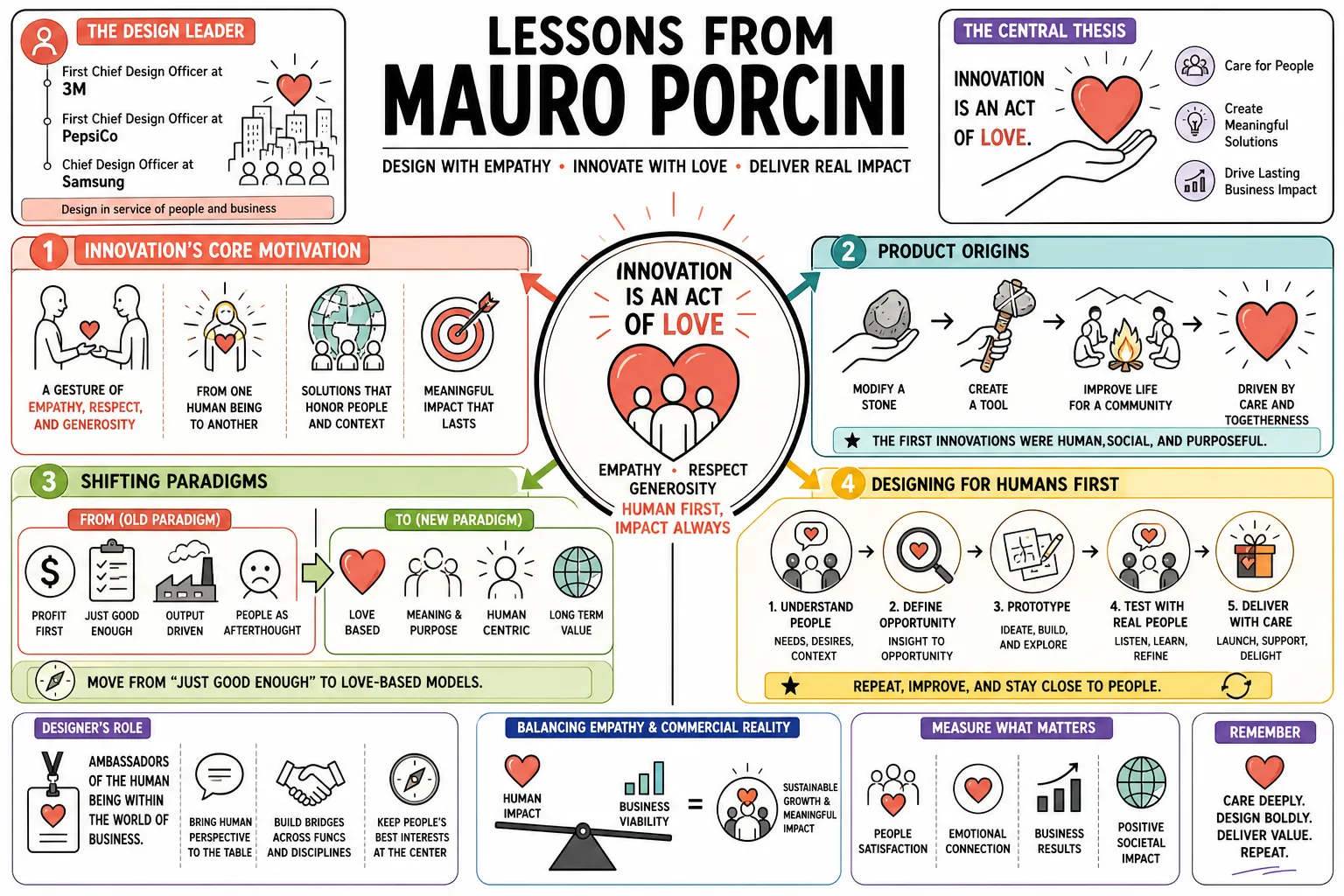
Lessons from Mauro Porcini
Mauro Porcini was the first Chief Design Officer at 3M and PepsiCo before taking the same role at Samsung. He argues that corporate design only works when driven by people who actually care about others, an approach he summarizes as "innovation is an act of love." This profile collects his practical lessons for balancing that empathy with commercial reality in large organizations.
Part 1: The Human-Centric Philosophy
- On Innovation's Core Motivation: "Innovation should be a gesture of empathy, respect, and generosity from one human being to another." — Source: [Inside Outside Innovation]
- On the True Function of Design: "Designers must act as the ambassadors of the human being within the world of business." — Source: [Adam Mendler Interviews]
- On Product Origins: "The earliest forms of human innovation, like modifying a stone into a tool, were intended to improve life and driven by care for a community." — Source: [Inside Outside Innovation]
- On Shifting Paradigms: "We must move away from profit-first 'just good enough' approaches and return to love-based models of creating products." — Source: [Solid Branding]
- On Designing for Humans First: "Once the needs and desires of the individuals we want to innovate for have been understood, we are ready to prototype." — Source: [Leadership Freak Blog]
- On Financial Success as a Byproduct: "Try to do something because it's going to create value for the people you're serving—and then financial value will come." — Source: [Creative Boom]
- On Empathy as a Strategy: "Empathy is nothing more than the capacity to understand the person you are innovating for in an authentic and profound way." — Source: [The Human Side of Innovation]
- On 24/7 Observation: "To truly understand and meet human needs, design teams must act like 24/7 ethnographers." — Source: [Masters of Scale Podcast]
- On Rethinking Needs: "Innovation is not just about what technology can enable; it must be driven by deep empathy for what people actually dream of." — Source: [Interni Magazine]
- On Elevating the Utilitarian: "Turning everyday, utilitarian office products like tape dispensers into objects viewed as 'desk art' maintains functionality while elevating the human experience." — Source: [Dezeen]
Part 2: Love as an Engine for Innovation
- On the Definition of Innovation: "Innovation is an act of love." — Source: [Masters of Scale Podcast]
- On the Three Forms of Love: "Successful innovation requires three distinct forms of love: love of the craft, love of coworkers, and love of the target audience." — Source: [Creative Boom]
- On Loving the Process: "If you do not have a genuine love for the craft and the work itself, you cannot sustain the energy required for true innovation." — Source: [The Human Side of Innovation]
- On Loving the Team: "The second essential form of love is the love of the people you work with, which builds the trust necessary to execute difficult ideas." — Source: [Creative Boom]
- On Loving the Consumer: "You must genuinely love the people you are designing for, or else your solutions will lack the care required to be exceptional." — Source: [The Human Side of Innovation]
- On the Secret Ingredient: "Unicorn employees who truly love people are the secret ingredient to successful innovation, often more important than the actual processes or tools." — Source: [Adam Mendler Interviews]
- On Love vs. Process: "Process is important, but a process executed by people who lack passion and empathy will only yield mediocre results." — Source: [McKinsey Interviews]
- On Emotional Sustainability: "Products created from a place of genuine care inherently possess an emotional durability that prevents them from being discarded quickly." — Source: [Interni Magazine]
- On Designing for Joy: "The ultimate goal of adding aesthetic value to a functional item is to introduce a moment of joy into an otherwise routine task." — Source: [Dezeen]
- On the Ethical Use of Technology: "As we integrate new technologies, they must be shaped by emotional intelligence and a desire to amplify humanity." — Source: [Dezeen]
Part 3: The Traits of a "Unicorn"
- On Unicorn Terminology: "Unicorns are not mythical creatures, but rather a special category of employees who combine deep vision with precise execution." — Source: [The Human Side of Innovation]
- On Dreaming and Doing: "A unicorn must be both a dreamer who lives in their imagination and an executor capable of landing those dreams in reality." — Source: [Adam Mendler Interviews]
- On Protecting the Inner Child: "A hallmark of a unicorn is the ability to protect their inner child, which sustains their creativity and ability to think big." — Source: [HCA Magazine]
- On Kindness as a Skill: "Kindness is a competitive edge; it allows unicorns to navigate complex organizations and build consensus without creating friction." — Source: [The Human Side of Innovation]
- On Relentless Optimism: "Unicorns possess a distinct optimism that prevents them from being defeated by the inevitable failures of the innovation process." — Source: [Adam Mendler Interviews]
- On Lifelong Curiosity: "We should all be students of life, students for life." — Source: [Adam Mendler Interviews]
- On Valuing Missteps: "Unicorns view every experience, encounter, and even misstep as an opportunity to learn and grow their perspective." — Source: [Adam Mendler Interviews]
- On Humility in Design: "Humility is required to truly listen to the user; arrogance blinds designers to what people actually need." — Source: [The Human Side of Innovation]
- On Storytelling Abilities: "Beyond technical skills, unicorns must be adept storytellers to translate complex ideas into compelling narratives that others can follow." — Source: [Solid Branding]
- On the Scarcity of Talent: "The biggest bottleneck in modern corporate innovation is not funding, but finding and nurturing these rare unicorn individuals." — Source: [McKinsey Interviews]
Part 4: Meaningful Design
- On Evolving Mantras: "We must move beyond 'form follows function' to a world where form and function follow meaning." — Source: [Interni Magazine]
- On the Fundamental Need: "A meaningful design must be both valuable to the user on a human level and innovative in its approach." — Source: [PepsiCo News]
- On the Clarifying Need: "Design must be relative to its context, poetic in its expression, and ultimately worth telling a story about." — Source: [PepsiCo News]
- On the Enabling Need: "True design enables sustainability across multi-sensory, functional, emotional, intellectual, social, and financial dimensions." — Source: [PepsiCo News]
- On Building Stories: "Designers do not just create objects; they define the codes and languages through which meanings take shape." — Source: [Interni Magazine]
- On Expressive Design: "In an era of AI, design must become highly expressive, reflecting human identity, diversity, and individual values." — Source: [Dezeen]
- On Experience Portfolios: "Transforming a brand requires looking beyond the core product to integrated experiences, like pairing hydration apps with smart dispensers." — Source: [Masters of Scale Podcast]
- On Design as Translation: "The role of design is to translate abstract human insights into tangible, meaningful products and experiences." — Source: [Adam Mendler Interviews]
- On the Nuances of Execution: "Success and failure are ultimately defined by the details, by the nuances of execution, and by reading between the lines." — Source: [Dezeen]
Part 5: The Three Pillars of Design Thinking
- On Desirability: "The first dimension of design thinking is desirability: discovering what people actually need and want." — Source: [Adam Mendler Interviews]
- On Feasibility: "The second dimension is feasibility: understanding exactly what current technology can enable and execute." — Source: [Masters of Scale Podcast]
- On Viability: "The final dimension is viability: ensuring that the beautiful, technologically sound idea actually makes business sense." — Source: [Samsung Design Seminars]
- On Balancing the Pillars: "A successful product exists exactly at the intersection of desirability, feasibility, and viability; neglecting one leads to market failure." — Source: [McKinsey Interviews]
- On the Danger of Feasibility-First: "When engineers drive without design, you get products that are highly feasible but lack any real human desirability." — Source: [The Human Side of Innovation]
- On the Trap of Viability-First: "Starting only with what is financially viable often results in incremental, boring updates rather than true innovation." — Source: [Creative Boom]
- On Design's Connecting Role: "Design is the discipline uniquely positioned to act as the bridge connecting human desirability with engineering and business constraints." — Source: [Adam Mendler Interviews]
- On the Iterative Loop: "Balancing the three pillars is not a linear process, but a continuous loop of prototyping and refining." — Source: [Inside Outside Innovation]
- On Solving Hard Problems: "I think differently because I think like a designer. No matter how hard the problem, we put ourselves in other people's shoes to find a better solution." — Source: [PepsiCo News]
Part 6: Leadership and Mentorship
- On the Role of the CDO: "The Chief Design Officer's ultimate responsibility is to be the ambassador of the human being in the boardroom." — Source: [Adam Mendler Interviews]
- On Building Culture: "We need to realize that innovation is all about culture. It's all about people." — Source: [McKinsey Interviews]
- On the Metamentor Concept: "A metamentor is an extraordinary mentor, or a combination of multiple individuals, who can inspire others to become unicorns." — Source: [Medium]
- On Hiring Strategies: "Leaders must focus on hiring for traits like curiosity and kindness, as technical skills can be taught more easily than inherent passion." — Source: [HCA Magazine]
- On Fostering Excellence: "You must actively nurture your talent to foster a culture of excellence and purposeful, design-driven growth." — Source: [The Human Side of Innovation]
- On Evolving Leadership Focus: "My approach shifted over time from strictly implementing new processes to focusing deeply on purpose-driven brands and team sustainability." — Source: [Adam Mendler Interviews]
- On Protecting Creatives: "A key role of design leadership in a large corporation is to act as an umbrella, protecting the creative team from bureaucratic friction." — Source: [Masters of Scale Podcast]
- On Recognizing Talent: "Leaders must learn how to identify the subtle markers of a unicorn, which often look different than traditional corporate success indicators." — Source: [The Human Side of Innovation]
- On Cultivating Trust: "Without a foundational layer of trust built through genuine care for your coworkers, ambitious design projects will collapse under pressure." — Source: [Creative Boom]
Part 7: Navigating Corporate Culture
- On Making Design Normal: "My ambition, ever since I joined a massive corporation, has always been to make design normal." — Source: [PepsiCo News]
- On Speaking the Language of Business: "They do not accept design as a cultural value essential to society; you have to filter it through business to get buy-in." — Source: [PepsiCo News]
- On Building Design Capability: "When introducing design to a technology-driven company, you must first prove its value through highly visible, successful pilot projects." — Source: [McKinsey Interviews]
- On the Challenge of Scale: "Executing a personalized consumer experience like a touchscreen soda fountain across thousands of locations requires blending minimalist aesthetics with massive operational scale." — Source: [Masters of Scale Podcast]
- On Ergonomics and Aesthetics: "Redesigning iconic structural packaging, like a 2-liter bottle, requires balancing human-centered grip ergonomics with strict manufacturing constraints." — Source: [PepsiCo News]
- On Strategic Collaborations: "Brand collaborations allow heritage companies to tap into new cultural aesthetics without abandoning their core identity." — Source: [PepsiCo News]
- On Overcoming Resistance: "Resistance to design in corporate environments usually stems from a misunderstanding of design as mere decoration rather than a strategic tool." — Source: [Inside Outside Innovation]
- On Transforming Legacy Brands: "To modernize a legacy brand, you must treat design not as a marketing afterthought, but as a central driver of the brand's future meaning." — Source: [Interni Magazine]
- On Cross-Functional Harmony: "Designers must be diplomats who can align the competing priorities of marketing, engineering, and finance behind a single human-centric vision." — Source: [Adam Mendler Interviews]
Part 8: Success, Value, and the Future
- On the Definition of Success: "Success is not fame. It's not money. Success is personal happiness. You need to be sure that you love what you do." — Source: [Creative Boom]
- On the Age of Excellence: "In a modern, hyper-connected world, companies have no choice but to create extraordinary, human-centric solutions to survive the 'Age of Excellence.'" — Source: [Dezeen]
- On Shaping the Unknown: "Design is the practice of shaping an unknown future through experiential learning and iterative making." — Source: [Medium]
- On Artificial Intelligence: "AI is a tool that should be used to create adaptive, personalized systems that actively improve the quality of human life." — Source: [Samsung Design Seminars]
- On Amplifying Humanity: "Rather than replacing human connection, advanced technology must be leveraged to free us to be more deeply human." — Source: [Dezeen]
- On the Long View of Value: "Financial value is a lagging indicator of how well you have served the human needs of your audience." — Source: [The Human Side of Innovation]
- On Design as a Lifelong Pursuit: "Being a designer is not a job title; it is a fundamental lens through which you view the world and interact with humanity." — Source: [Adam Mendler Interviews]
- On Continuous Reinvention: "The brands that survive the next decade will be those that constantly reinvent their visual and experiential codes without losing their core meaning." — Source: [Interni Magazine]
- On Leaving a Legacy: "The greatest legacy a designer can leave is not a physical product, but a culture of empathy that outlasts their tenure at the company." — Source: [The Human Side of Innovation]