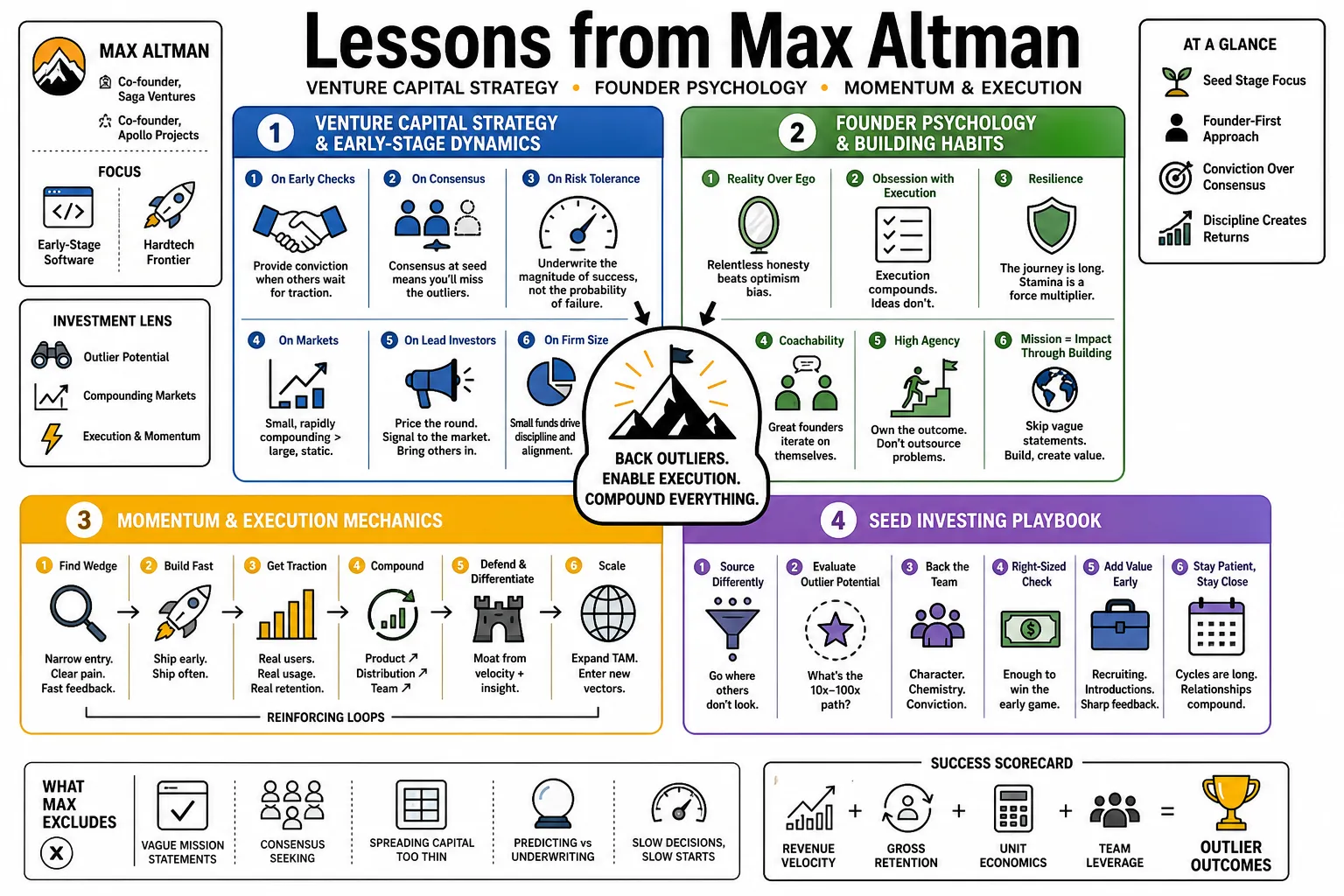
Lessons from Max Altman
Venture capitalist Max Altman co-founded Saga Ventures and Apollo Projects to back early-stage software and hardtech startups. He regularly argues that tech companies should drop their vague mission statements and focus entirely on execution and growth. This profile collects his views on the mechanics of seed investing, founder psychology, and startup momentum.
Part 1: Venture Capital Strategy & Early-Stage Dynamics
- On early checks: "The earliest check has moved beyond mere capital; it requires providing conviction when everyone else is waiting for traction." — Source: [Saga Ventures]
- On consensus: "If you require consensus at the seed stage, you are going to miss the outliers." — Source: [20VC]
- On risk tolerance: "Early-stage investors must underwrite the magnitude of the success rather than the probability of failure." — Source: [Venture Unlocked]
- On evaluating markets: "A small but rapidly compounding market is frequently more valuable than a static, massive one." — Source: [Something Ventured]
- On lead investors: "Founders need someone willing to price the round and signal to the broader market that the company is worth backing." — Source: [Forbes]
- On firm size: "Keeping a fund size small forces discipline and prevents the lazy deployment of capital." — Source: [20VC]
- On portfolio construction: "You cannot build a generational venture firm by indexing the entire market. You have to take concentrated bets." — Source: [Business Insider]
- On speed: "The best founders move with a velocity that breaks traditional diligence timelines, and investors must adapt to that pace." — Source: [This Week in Startups]
- On board dynamics: "An early-stage board member's primary job is to help the founder see around corners, rather than managing daily operations." — Source: [Saga Ventures]
Part 2: The Importance of High Growth & Winning
- On choosing a startup: "Don't care about the product. Don't care about anything, just go work at the fastest growing company. Because winning feels great." — Source: [Business Insider]
- On the momentum effect: "Growth solves nearly every internal company problem, while stagnation magnifies them." — Source: [20VC]
- On talent magnetism: "The most capable engineers naturally gravitate toward organizations where the trajectory is unmistakably upward." — Source: [Something Ventured]
- On competitive drive: "A culture that apologizes for wanting to dominate its market will inevitably lose to one that embraces the competition." — Source: [This Week in Startups]
- On operating rhythm: "High-growth environments require a fundamentally different metabolic rate from management and employees alike." — Source: [Forbes]
- On the feeling of success: "The psychological reward of being part of a winning team often outweighs theoretical alignment with a product category." — Source: [Business Insider]
- On ruthless prioritization: "When a company grows fast, the ability to ignore fires that do not threaten the core business becomes a survival skill." — Source: [Venture Unlocked]
- On scaling teams: "You cannot simply hire ahead of growth. You have to let the pain of the work dictate the hiring schedule." — Source: [20VC]
- On market dominance: "Being the undisputed leader in a category creates compounding advantages that the second-place player can never replicate." — Source: [Saga Ventures]
Part 3: Founder Psychology & Evaluating Talent
- On founder resilience: "The defining characteristic of a great founder is their capacity to absorb immense amounts of stress without losing clarity." — Source: [Apollo Projects]
- On self-awareness: "The best entrepreneurs know precisely what they are bad at and hire people who overcompensate for those flaws." — Source: [This Week in Startups]
- On founder evolution: "The person who hacks together a prototype is rarely the same person who can manage an executive team, unless they actively rewire their brain." — Source: [20VC]
- On evaluating drive: "We look for founders pulled toward their idea by an absolute obsession, rather than pushed into it by a desire for status." — Source: [Saga Ventures]
- On communication: "Clarity of thought is best demonstrated by how simply a founder explains a complex technical problem." — Source: [Venture Unlocked]
- On handling rejection: "A strong founder treats a rejection from an investor as a data point regarding the pitch, not a verdict on the business." — Source: [Something Ventured]
- On reality distortion: "Founders need enough conviction to bend reality for their early hires, combined with enough intellectual honesty to know when the metrics are bad." — Source: [Forbes]
- On founder disputes: "Most co-founder breakups are the result of unexpressed expectations compounding over time, rather than sudden betrayals." — Source: [20VC]
- On the obsession metric: "The most successful founders cannot stop thinking about their business, even when they actively try to shut it off." — Source: [Business Insider]
Part 4: Apollo Projects & Funding Moonshots
- On the purpose of Apollo: "We wanted to back companies attempting things that are fundamentally hard, where the technical risk is the primary barrier to entry." — Source: [Apollo Projects]
- On hardtech investing: "Software has dominated for decades, yet the physical world requires capital patient enough to wait for scientific breakthroughs." — Source: [Forbes]
- On the biotech frontier: "Biological manufacturing has the potential to rewrite the global supply chain, provided we can scale the underlying infrastructure." — Source: [Business Insider]
- On energy innovation: "Non-carbon energy generation extends beyond environmental needs. It represents the most significant economic opportunity of the century." — Source: [Apollo Projects]
- On technical founders: "Moonshot companies require CEOs who understand the physics of their product, rather than just the financial modeling." — Source: [20VC]
- On capital intensity: "Hardtech startups inherently require more upfront capital. Investors must be comfortable underwriting significant dilution before product-market fit." — Source: [Venture Unlocked]
- On regulatory friction: "When you build in the physical world, navigating government compliance is as important as engineering the actual product." — Source: [This Week in Startups]
- On timelines: "You cannot force a decade-long scientific discovery into a standard three-year venture return cycle." — Source: [Apollo Projects]
- On hardware iteration: "The cost of a mistake in atoms is exponentially higher than in bits. This forces a completely different approach to prototyping." — Source: [Forbes]
- On global ambition: "The goal of these companies is never to create a niche feature. They exist to alter human capabilities and physical infrastructure." — Source: [Business Insider]
Part 5: Navigating the AI & Market Cycles
- On generative AI demand: "Market demand in the AI sector has frequently far exceeded our most aggressive expectations." — Source: [36kr]
- On the intention era: "We are transitioning out of a keyword-based computing model into an era where software understands and executes user intent." — Source: [36kr]
- On AI infrastructure: "The initial wave of value capture naturally flows to the hardware and model providers before the application layer fully matures." — Source: [20VC]
- On defensive moats: "A thin wrapper around an API is not a business. Founders must build proprietary workflows or datasets to survive." — Source: [Saga Ventures]
- On market exuberance: "During hype cycles, capital becomes entirely commoditized. The only differentiator for an investor is actual operational help." — Source: [This Week in Startups]
- On platform shifts: "Mobile changed how we consume data. Generative AI is fundamentally changing how we produce work." — Source: [Venture Unlocked]
- On deployment speed: "The velocity at which AI products ship means that holding a feature back for perfection is a guaranteed way to lose." — Source: [Something Ventured]
- On legacy software disruption: "Every traditional software category is vulnerable to being rewritten from the ground up with AI-native architecture." — Source: [Forbes]
- On pricing power: "AI products must deliver undeniable, immediate returns to justify their compute costs and retain enterprise budgets." — Source: [Business Insider]
- On timeline expectations: "The true impact of AI will be measured in back-office efficiency gains long before it results in sentient general intelligence." — Source: [20VC]
Part 6: Rethinking the Silicon Valley Ecosystem & Firm Building
- On launching Saga Ventures: "We wanted to build a firm that operates beyond the traditional echo chamber of Silicon Valley, focusing purely on execution." — Source: [Forbes]
- On the shifting geography: "Austin and other emerging hubs are proving that you can build world-class enterprise software companies outside the Bay Area." — Source: [This Week in Startups]
- On firm culture: "A venture firm must have a culture as distinct and intense as the startups it hopes to fund." — Source: [Saga Ventures]
- On remote work realities: "While distributed teams can maintain software, the early days of finding product-market fit almost always require in-person friction and collaboration." — Source: [20VC]
- On the role of a partner: "A true venture partner signs the check and immediately commits their entire network to help a founder close a hard hire." — Source: [Something Ventured]
- On venture capital as a service: "Founders increasingly view capital as a baseline requirement. They demand tangible, operational support from their cap table." — Source: [Venture Unlocked]
- On ecosystem groupthink: "When everyone in the Valley chases the exact same thesis, the alpha is usually found in the spaces they are actively ignoring." — Source: [Business Insider]
- On fund economics: "The pressure of a massive fund size often forces firms to abandon early-stage discipline in favor of deploying large checks indiscriminately." — Source: [20VC]
- On institutional knowledge: "Building a successful firm requires capturing the tacit knowledge of past failures and systematizing it for the next generation of founders." — Source: [Forbes]
- On long-term alignment: "We structure our partnerships so that our incentives are tied entirely to the actual realized returns of the founders we back." — Source: [Saga Ventures]
Part 7: Moving Beyond Empty "Mission-Driven" Narratives
- On industry self-delusion: "The technology industry lost its way by focusing too heavily on vague, mission-driven goals instead of building great, successful businesses." — Source: [Business Insider]
- On on-demand services: "Claiming that delivering food faster is going to save the world is a fundamental misrepresentation of what a business actually does." — Source: [Dagens]
- On corporate authenticity: "Employees respect leadership that admits the goal is to build a highly profitable enterprise, rather than masking it in pseudo-altruism." — Source: [20VC]
- On the burden of purpose: "Forcing a grand moral narrative onto a simple software utility creates internal confusion and misallocates resources." — Source: [This Week in Startups]
- On the definition of impact: "True impact comes from generating wealth and solving real inefficiencies. It does not come from drafting a corporate manifesto." — Source: [Forbes]
- On investor signaling: "Investors who prioritize mission statements over unit economics are doing a disservice to their limited partners and the ecosystem at large." — Source: [Something Ventured]
- On focusing on the customer: "If you spend all your time trying to save the world, you will likely forget to solve the immediate problem your user is paying you for." — Source: [Venture Unlocked]
- On cultural resets: "The current market correction is actively purging companies that relied on narrative over revenue. This is a net positive for the industry." — Source: [Saga Ventures]
- On operational excellence: "The most virtuous thing a company can do is operate efficiently and outcompete its rivals." — Source: [Business Insider]
Part 8: Long-Term Brand Building & The Business of VC
- On venture branding: "Your brand as an investor is ultimately defined by what founders say about you when you are not in the room." — Source: [SamAltman.com]
- On founder references: "Being validated as a top investor happens when the founders you previously backed actively recommend you to the next generation of entrepreneurs." — Source: [20VC]
- On reputation management: "It takes a decade to build a reputation that founders trust, and a single bad board meeting to completely destroy it." — Source: [This Week in Startups]
- On value add: "Firms build a brand by consistently doing the unglamorous work of helping portfolio companies recruit, rather than running marketing campaigns." — Source: [Saga Ventures]
- On the persistence of capital: "The greatest competitive advantage an investor can have is the ability to remain patient during a founder's inevitable dark periods." — Source: [Venture Unlocked]
- On the feedback loop: "A strong firm brand acts as a gravitational pull. It attracts the best deals before they ever reach the open market." — Source: [Forbes]
- On the limits of capital: "Money is a commodity. The true currency of venture capital is trust and a track record of candor." — Source: [Something Ventured]
- On network deployment: "An investor's network only has value if they are willing to ruthlessly curate it and deploy it at the exact moment a founder needs it." — Source: [Business Insider]
- On generational success: "The ultimate metric for a venture capitalist is not the return of a single fund, but the enduring legacy of the companies they helped capitalize." — Source: [SamAltman.com]