Max Freeman joined Ramp as its first sales hire in 2020 and is now VP of Sales. He helped build the company's early sales motion by prioritizing high-volume outbound testing, tight product feedback loops, and hiring domain experts over traditional salespeople. This profile covers his lessons on finding initial product-market fit, structuring early sales processes, and recruiting a product-first revenue team.
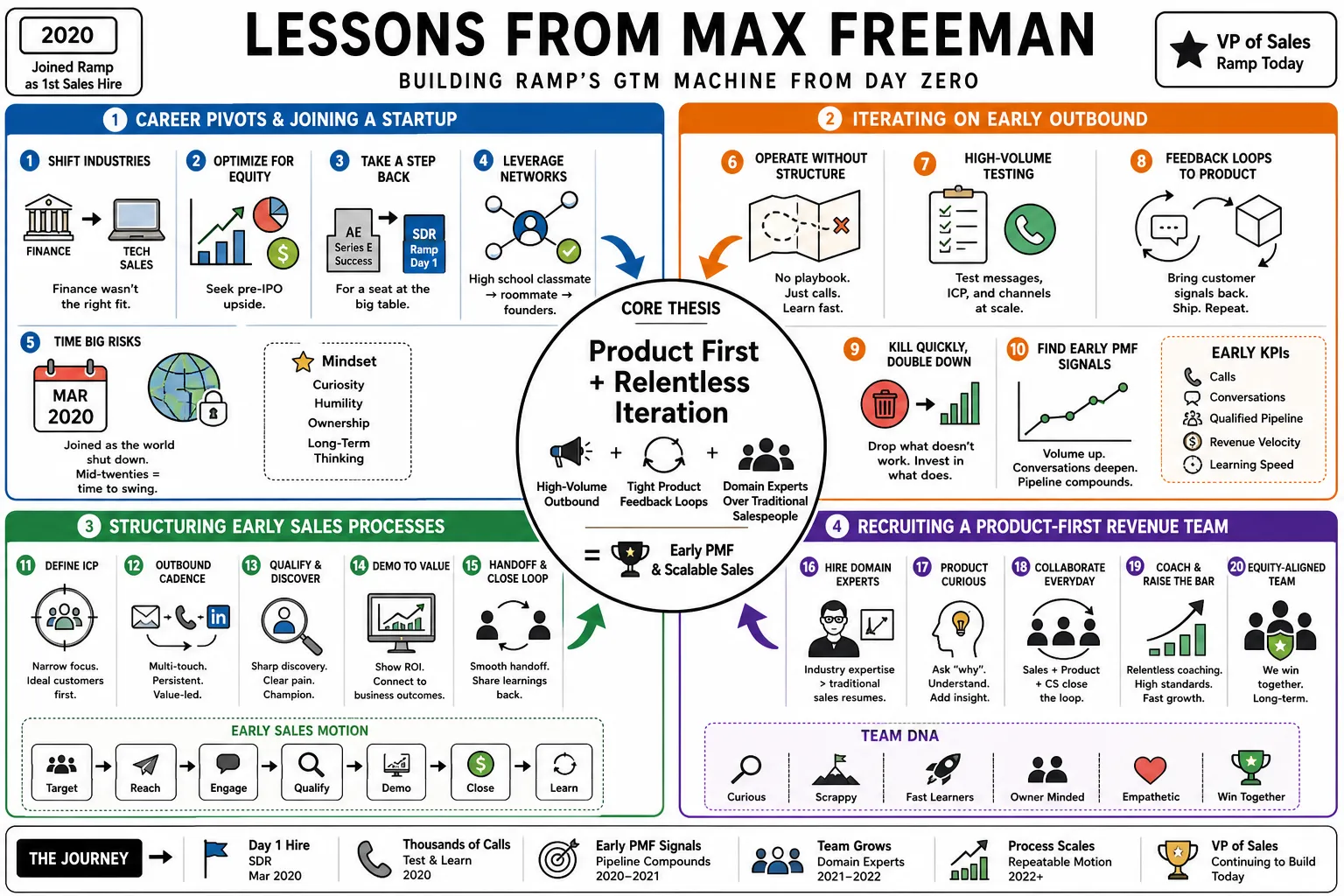
Part 1: Career Pivots and Joining a Startup
- On shifting industries: Realizing finance wasn't the right fit early in his career, he moved into tech sales, using a challenging role selling payroll software in a saturated market as a training ground. — Reference: Building Ramp's GTM Machine
- On optimizing for equity: After observing how venture upside works during a stint in banking, he actively searched for pre-IPO opportunities where early equity could become deeply meaningful. — Reference: Building Ramp's GTM Machine
- On taking a career step back: To get a seat at the table at a high-potential startup, he voluntarily left a successful mid-market account executive role at a Series E company to become Ramp's very first sales development representative. — Reference: Building Ramp's GTM Machine
- On leveraging networks: He secured his early position at Ramp by persistently reaching out and eventually connecting through a high school classmate whose roommate knew the founders. — Reference: Max Freeman ’13 Talks About his Start-up Success...
- On timing big risks: He accepted his initial offer at Ramp in March 2020 just as the global pandemic began shutting the world down, reasoning that his mid-twenties was the exact right time to take a major professional swing. — Reference: Building Ramp's GTM Machine
Part 2: Iterating on Early Outbound
- On operating without structure: When he joined as the first sales hire, the team had no established processes; he was simply handed a laptop and a LinkedIn Premium account and told to figure out who might use the product. — Reference: Building Ramp's GTM Machine
- On surviving early outbound struggles: His first month of cold outreach yielded only three or four meetings, but by his third month, he had increased his booking rate tenfold by combining sheer outreach volume with refined messaging. — Reference: Building Ramp's GTM Machine
- On adjusting the target profile: Instead of pitching massive tech companies that required complex system integrations, the sales team found their early traction by targeting Series A and Series B startups that were just beginning to scale. — Reference: Building Ramp's GTM Machine
- On waiting for statistical significance: Before drastically scaling up email volume, he waited until the response and meeting acceptance rates proved that their core messaging was actually working. — Reference: Building Ramp's GTM Machine
- On segmenting outreach: To scale volume effectively, he separated prospects by role, sending high-volume outreach to accounting staff while reserving highly customized communication for executives. — Reference: Building Ramp's GTM Machine
- On counterintuitive positioning: He recognized that pitching a corporate credit card that actively helps companies spend less money is counterintuitive, but believed this model would ultimately capture more market share over a long horizon. — Reference: Max Freeman ’13 Talks About his Start-up Success...
Part 3: Cross-Functional Alignment
- On capturing customer feedback: Before the company adopted call-recording software, he joined every single sales meeting to take live notes on feature requests and objections. — Reference: Building Ramp's GTM Machine
- On sales and product cohesion: He participated in weekly stand-ups with the engineering, product, and design teams, which gave him the technical understanding necessary to sell the product more effectively. — Reference: Building Ramp's GTM Machine
- On listening to the user: The major turning point in early meeting conversions came when the team adjusted their pitch to reflect the exact reasons customers were choosing their product. — Reference: Building Ramp's GTM Machine
- On early AI adoption: He attributes part of the product's edge to embedding AI into the platform as early as 2020, long before the major industry tailwinds hit the market. — Reference: Max Freeman ’13 Talks About his Start-up Success...
Part 4: Hiring and Scaling the Sales Team
- On non-traditional hiring: When building the sales organization, they specifically avoided typical sales backgrounds, prioritizing raw intelligence, domain knowledge, and a deep understanding of the product. — Reference: Building Ramp's GTM Machine
- On recruiting domain experts: To sell financial software, he recruited former investment bankers from top firms who possessed the financial acumen to speak credibly with finance buyers. — Reference: Building Ramp's GTM Machine
- On paying above market: Hiring domain experts required paying well above typical market rates, but the unit economics worked because the output of those early hires was roughly five times that of an average sales rep. — Reference: Building Ramp's GTM Machine
Part 5: Treating Outbound as an Engineering Problem
- On hiring for self-sufficiency: Early-stage teams cannot spend scarce time teaching every basic habit, so he looked for people who could take good tools, understand the goal, and execute without constant supervision. — Reference: Building Ramp's GTM Machine
- On pairing strong sellers with a strong product: Ramp favored account executives who had learned to win while selling imperfect products, reasoning that those same operators could become exceptional when given a product customers genuinely loved. — Reference: Building Ramp's GTM Machine
- On observing before automating: Two growth engineers spent weeks watching his outbound workflow click by click before deciding what software should automate. — Reference: Building Ramp's GTM Machine
- On automating outcomes rather than activity: The engineering work eventually produced personalized outbound that could generate positive prospect replies without requiring him to perform every manual step. — Reference: Building Ramp's GTM Machine
- On making growth technical work: Ramp treated outbound capacity as an engineering challenge instead of assuming that every increase in pipeline required a proportional increase in sales headcount. — Reference: Building Ramp's GTM Machine
- On motivating engineers with company impact: Engineers became more willing to work on sales systems when leadership connected that work directly to company growth, equity value, and leverage for the whole organization. — Reference: Building Ramp's GTM Machine
Part 6: Incentives, Transparency, and Hiring Tests
- On hiring for the ability to figure things out: He preferred intelligence, hustle, and comfort with ambiguity over candidates whose experience came entirely from selling behind a famous enterprise brand. — Reference: Building Ramp's GTM Machine
- On compensating for quality: Ramp moved beyond paying SDRs only for meetings booked and added incentives tied to qualified opportunities and closed-won outcomes. — Reference: Building Ramp's GTM Machine
- On making successful outreach visible: A company-wide Slack channel showed every booked outbound meeting, the prospect involved, and the message that worked, turning individual wins into shared learning. — Reference: Building Ramp's GTM Machine
- On testing reasoning instead of polish: Rather than relying on a standard mock cold call, he gave SDR candidates an intentionally vague exercise about breaking into several accounts and examined how they structured the problem. — Reference: Building Ramp's GTM Machine
- On probing under pressure: Interviewers challenged the assumptions in a candidate's account plan to see whether the person could absorb objections and improve the reasoning in real time. — Reference: Building Ramp's GTM Machine
- On evaluating account executives differently: For AE candidates, Ramp combined the ambiguous business case with a mock call to test both problem-solving and command of a structured sales process. — Reference: Building Ramp's GTM Machine
- On correcting early incentive design: Looking back, he would have tied SDR rewards to pipeline quality from the first day rather than beginning with meeting volume alone. — Reference: Building Ramp's GTM Machine
- On avoiding premature enterprise pursuit: He would also have spent less time chasing very large accounts before the product could support their systems and focused more tightly on the customers Ramp was ready to serve. — Reference: Building Ramp's GTM Machine
Part 7: AI and the Future of Sales Development
- On which SDR work AI will replace: He expects automation to displace average sequence-loading work while making excellent sellers more capable rather than eliminating them. — Reference: Building Ramp's GTM Machine
- On using AI to find timing signals: Ramp applies AI to notes, call transcripts, and contract-timing triggers so sellers can identify accounts with a concrete reason to engage now. — Reference: Building Ramp's GTM Machine
- On dividing work between software and people: AI should handle research, list building, repetitive preparation, and message support so salespeople can spend more time in substantive conversations. — Reference: Building Ramp's GTM Machine
- On keeping human judgment in outreach: The value of a strong SDR increasingly lies in choosing the right account, interpreting context, and building a relationship rather than operating the mechanics of a sequence. — Reference: Building Ramp's GTM Machine
Part 8: Growing from First SDR to Sales Leader
- On earning scope through ownership: Freeman says he advanced by tackling problems as they appeared instead of repeatedly asking for a promotion or a larger title. — Reference: Building Ramp's GTM Machine
- On admitting what you do not know: He paired intense commitment with a willingness to ask for help and be candid about the gaps in his own knowledge. — Reference: Building Ramp's GTM Machine
- On hiring people who can outshine you: As his organization grew, he deliberately recruited leaders with stronger analytical skills or deeper large-account experience than his own. — Reference: Building Ramp's GTM Machine
- On managing more experienced people: His leadership promise is not to have every answer but to be transparent, remove blockers, and provide the product context, buyer knowledge, and resources experienced hires need to excel. — Reference: Building Ramp's GTM Machine
Part 9: AI-Assisted Sales Execution
- On connecting AI to operating data: At scale, useful sales AI has to connect directly to the company's underlying data sources rather than asking reps to maintain yet another isolated system. — Reference: How Ramp Accelerated its Sales Pipeline with Rox
- On delivering guidance in the flow of work: The best sales assistance surfaces context and next steps when a rep needs them, without forcing the rep to search across tabs, dashboards, and Slack threads. — Reference: How Ramp Accelerated its Sales Pipeline with Rox
- On automating administrative exhaust: Background CRM updates and embedded workflows preserve selling time by removing routine upkeep rather than merely generating more tasks for the team. — Reference: How Ramp Accelerated its Sales Pipeline with Rox
- On using AI to improve preparation: Freeman's test for an execution copilot is whether it helps sellers enter meetings with better information, less preparation time, and more confidence. — Reference: How Ramp Accelerated its Sales Pipeline with Rox
- On measuring automation by sales outcomes: The meaningful result of an AI sales system is not how much content it produces but whether reps ramp faster, leaders gain visibility without micromanaging, and the team closes more business. — Reference: How Ramp Accelerated its Sales Pipeline with Rox
Part 10: Customer Outcomes at Scale
- On caring less about valuation than usefulness: When Ramp first reached unicorn status, Freeman emphasized that the milestone mattered less than the customer obsession and operating discipline that produced it. — Reference: Max Freeman on Ramp's First Unicorn Milestone
- On executive participation in customer work: He highlighted a culture where product leaders handled support tickets and joined discovery calls while the CEO still sent cold emails to companies Ramp could genuinely help. — Reference: Max Freeman on Ramp's First Unicorn Milestone
- On making growth dependent on customer economics: Freeman framed Ramp's growth as sustainable only when customers continued to save measurable time and money. — Reference: Max Freeman on Ramp's First Unicorn Milestone
- On demanding substance from AI products: He positioned AI as useful when it improves vendor pricing, expense reporting, audits, transaction coding, receipt collection, accountability, and bottom-line productivity—not when it merely adds hype. — Reference: Max Freeman on Ramp Intelligence
- On applying AI across an entire workflow: Rather than treating AI as one isolated feature, Ramp spread it across related finance tasks so each automation reinforced a broader operating system. — Reference: Max Freeman on Ramp Intelligence
- On preserving customer quality while shipping quickly: Freeman viewed launching more than 200 features and crossing 30,000 customers as meaningful because Ramp also retained strong customer satisfaction and retention. — Reference: Max Freeman on Ramp's 2024 Product Velocity
- On scaling complexity without exporting it to users: In describing Notion's rollout, he argued that an enterprise finance platform should support multinational, multi-entity rigor while making the end-user experience dramatically simpler. — Reference: Max Freeman on Notion's Ramp Rollout