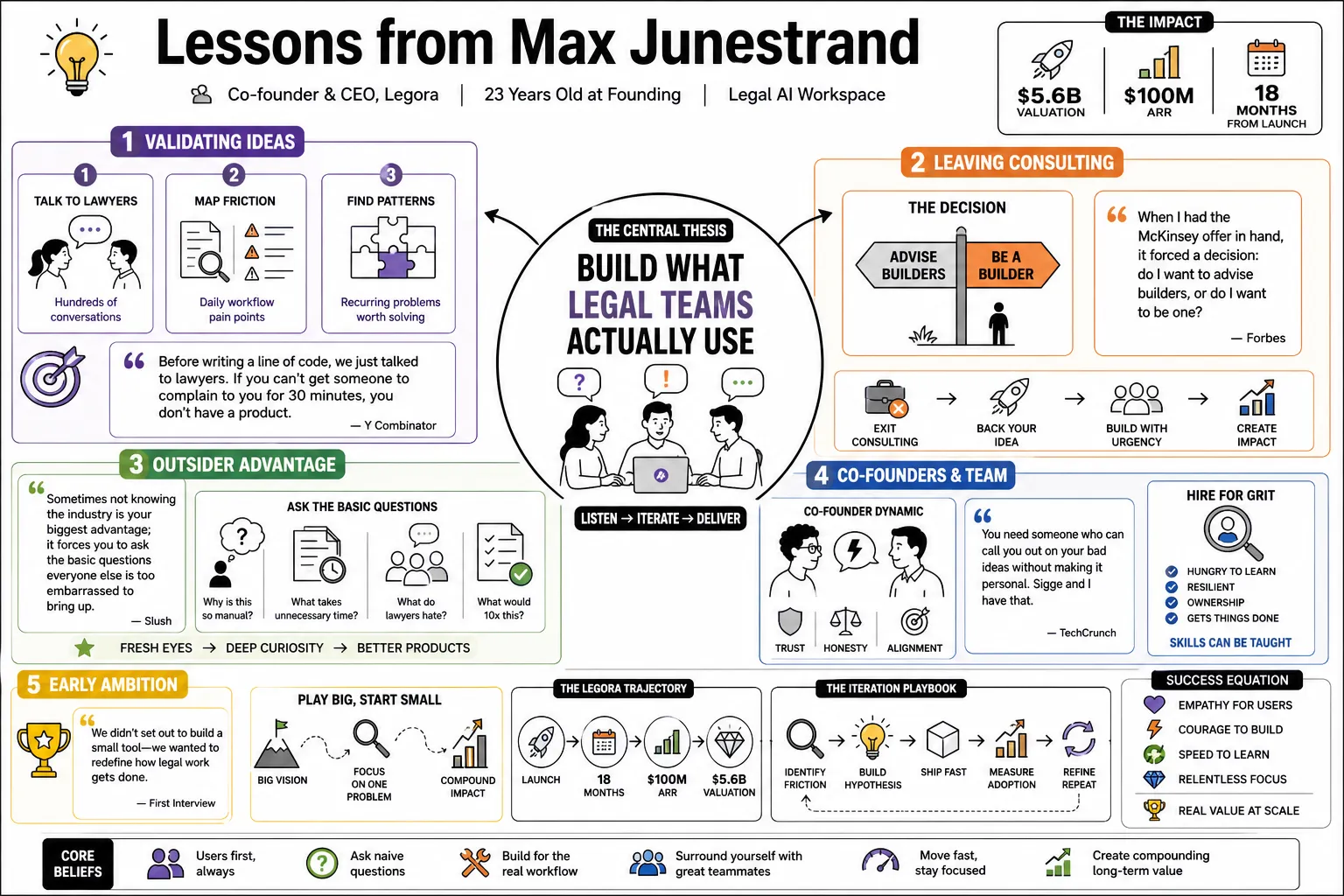
Max Junestrand is the co-founder and CEO of Legora, a legal AI workspace that reached a $5.6 billion valuation and $100 million in ARR within 18 months of its launch. He started the company at 23 without a legal background, opting instead to interview hundreds of lawyers to map their daily workflow friction. This collection details his approach to rapid iteration, hiring for grit, and building tools that legal teams actually adopt.
Part 1: The Founding Mindset
- On Validating Ideas: "Before writing a line of code, we just talked to lawyers. If you can't get someone to complain to you for 30 minutes, you don't have a product." — Source: Y Combinator
- On Leaving Consulting: "When I had the McKinsey offer in hand, it forced a decision: do I want to advise builders, or do I want to be one?" — Source: Forbes
- On Industry Experience: "Sometimes not knowing the industry is your biggest advantage; it forces you to ask the basic questions everyone else is too embarrassed to bring up." — Source: Slush
- On Co-founders: "You need someone who can call you out on your bad ideas without making it personal. Sigge and I have that." — Source: TechCrunch
- On Early Ambition: "We didn't set out to build a small feature. We wanted to build the entire workspace where legal work actually happens." — Source: Business Insider
- On Building Fast: "Speed is the only real defense an early-stage startup has against incumbents with massive distribution channels." — Source: Y Combinator
- On User Empathy: "Interviewing 100 lawyers wasn't just market research; it was about learning their vocabulary so we could speak their language." — Source: LegalTech News
- On Risk: "Taking the safe job felt riskier to my long-term happiness than failing at a startup." — Source: Sifted
- On Resilience: "The first fifty conversations will tell you your idea is terrible. The fifty-first will give you the pivot that makes it work." — Source: Digg
- On Focus: "It's easy to get distracted by cool technology. We had to constantly remind ourselves that lawyers don't buy AI; they buy time." — Source: Artificial Lawyer
Part 2: Finding Product-Market Fit
- On Problem Selection: "We didn't look for an AI problem. We looked for a workflow problem that AI just happened to be uniquely positioned to solve." — Source: Y Combinator
- On the First Iteration: "If your first prototype doesn't embarrass you, you spent too long on it. We put something ugly in front of lawyers just to see where they clicked." — Source: Slush
- On Value Proposition: "If you showed up with a legal AI product, it had to be better than the foundation models. Otherwise, they were just gonna say, 'Why are you deserving of my dollars?'" — Reference: BigGo Finance summary of Uncapped with Jack Altman and Max Junestrand
- On Customer Feedback: "Users will tell you what they hate about your product, but they are terrible at telling you how to fix it. That's your job." — Source: Forbes
- On Iteration Speed: "We measured our progress not by revenue in the early days, but by how many times we could iterate the product in a single week based on user complaints." — Source: TechCrunch
- On Niche Markets: "Law seems like a niche until you realize every major corporation on earth runs on contracts. Then it becomes the biggest market in the world." — Source: Sifted
- On Adoption: "Lawyers are naturally risk-averse. To get them to adopt new tech, the product had to feel instantly familiar." — Source: LegalTech News
- On Early Adopters: "Finding your first champion inside a law firm is harder than raising your seed round, but infinitely more valuable." — Source: Artificial Lawyer
- On Pilot Programs: "We never did unpaid pilots. If the problem is painful enough, they will pay you something, even if the product is half-baked." — Source: Business Insider
- On Scaling PMF: "Product-market fit isn't a destination. The moment you hit it, the market shifts, and you have to find it all over again at the next scale." — Source: Y Combinator
Part 3: Hiring the Right Team
- On Interviewing: "I still interview everyone, so I ask quite brutal questions about, 'Why take a hard job? You could go work somewhere else.'" — Source: Business Insider
- On Team Alignment: "I try to create missionaries, not mercenaries... And I think we've successfully done that." — Source: Business Insider
- On Work Ethic: "We look for people with raw grit. The kind of people who treat a roadblock as an insult to their capability." — Source: Business Insider
- On Backgrounds: "Experience in legal tech is often a negative indicator for us. We want people who haven't learned the industry's bad habits." — Source: Work at a Startup
- On Early Hires: "The first ten people you hire dictate the culture for the next thousand. You cannot compromise on those." — Source: Sifted
- On Transparency: "During interviews, I actively try to talk candidates out of joining by explaining how hard the next six months will be." — Source: Slush
- On Intelligence: "We don't just screen for IQ; we screen for the velocity of learning. How fast can you adapt when the models update overnight?" — Source: TechCrunch
- On Autonomy: "If I have to tell a senior hire what to do every week, I've made a hiring mistake." — Source: Lambham
- On Scaling Teams: "Growing from 10 to 500 people means you have to constantly break and rebuild your own communication structures." — Source: Forbes
- On Firing: "The hardest lesson as a first-time founder is realizing that letting someone go quickly is the most empathetic thing you can do for both them and the team." — Source: Digg
Part 4: Operating at Hypergrowth
- On Revenue Milestones: "Hitting $100M ARR in 18 months wasn't a goal; it was a byproduct of being obsessive about solving a singular, painful workflow." — Source: Y Combinator
- On Planning Horizons: "At Legora, we don't do yearly planning. We plan for about one Quarter ahead. We have long-term roadmap initiatives, but we plan for a Quarter because AI is moving so fast." — Source: Artificial Lawyer
- On Momentum: "Startups die when they lose momentum. Our entire operating cadence is designed to prevent stagnation." — Source: Business Insider
- On Prioritization: "When everything is growing exponentially, saying 'no' to good ideas becomes your most critical operational skill." — Source: Slush
- On Customer Support: "At our scale, support isn't a cost center; it's our most high-fidelity product feedback loop." — Source: TechCrunch
- On Valuation: "A $5.6 billion valuation is flattering, but it's just a number on a spreadsheet. The only metric that matters is daily active usage." — Source: Forbes
- On Global Expansion: "Rolling out to 50 markets meant we had to build a core product flexible enough to handle varied jurisdictional logic without becoming bloatware." — Source: Sifted
- On Internal Tools: "We treat our internal operations with the same engineering rigor as our customer-facing product. You can't scale manually." — Source: Legora
- On Founder Burnout: "Hypergrowth requires a sustainable pace, which sounds like an oxymoron, but if the founders burn out, the company dies." — Source: LegalTech News
Part 5: Designing for the Legal User
- On Interface Design: "Lawyers spend 10 hours a day in Microsoft Word. If you try to force a completely alien interface on them, you will lose." — Source: TechCrunch
- On Trust: "In the legal profession, hallucination isn't an inconvenience; it's malpractice. We had to build trust before we could build features." — Source: Artificial Lawyer
- On Redlining: "Redlining contracts is the most soul-crushing part of a junior lawyer's day. Automating that was our wedge into the enterprise." — Source: Forbes
- On AI Agents: "We don't build chatbots. We build AI agents that sit silently in the background and only interrupt when they have a verified answer." — Source: Y Combinator
- On Workflow Integration: "A great tool that requires a context switch will always lose to an average tool that lives where the user already works." — Source: New Economies
- On Accuracy: "We spent more engineering cycles on verification mechanisms than on generation capabilities." — Source: Slush
- On Partner Pushback: "Senior partners don't care about AI; they care about realization rates and margin. We had to pitch the business outcome, not the tech." — Source: Business Insider
- On Document Complexity: "Legal data is messy. It's unstructured, highly nuanced, and full of edge cases. That's the moat." — Source: Sifted
- On Collaboration: "Law is a multiplayer game. The workspace had to allow multiple stakeholders to review AI suggestions simultaneously." — Source: Digg
Part 6: Navigating AI and Foundation Models
- On Model Dependency: "If your entire value proposition is just a thin wrapper around OpenAI, your startup has an expiration date." — Source: Substack
- On the AI Landscape: "We're setting the precedent for what new things should exist in this product category." — Source: Artificial Lawyer
- On Model Agnosticism: "We designed our architecture to swap out foundation models as they improve, ensuring we never get locked into one provider's ecosystem." — Source: Y Combinator
- On Data Privacy: "Law firms run on confidentiality. The first question we answer in every pitch is how we partition and protect their client data from the models." — Source: LegalTech News
- On Open Source vs Closed: "We leverage state-of-the-art closed models for reasoning, but fine-tuned open-source models for highly specific legal classification tasks." — Source: Forbes
- On Hallucinations: "You can't eliminate hallucinations entirely, but you can constrain the model's operating environment so tightly that they become statistically irrelevant." — Source: TechCrunch
- On Prompt Engineering: "Relying on end-users to be good prompt engineers is a failing strategy. The product should abstract the prompting away entirely." — Source: Slush
- On Future Capabilities: "The foundation models will eventually eat basic legal drafting. Our job is to own the complex, multi-step workflows that models can't natively string together." — Source: Business Insider
- On Context Windows: "Massive context windows are great, but retrieving the exact right precedent from a 10,000-document database requires more than just dumping it all into the model." — Source: Sifted
Part 7: Strategy and Second-Mover Advantage
- On Being Second: "There's a real value in actually being the second mover, and the value comes from two things... avoiding the pioneer's mistakes and capitalizing on market readiness." — Source: Substack
- On Competitors: "First movers spend all their capital educating the market. We came in when lawyers were already asking for AI and just gave them a better execution." — Source: Y Combinator
- On Pricing: "We priced based on the value of the time saved, not the cost of the compute. It changes the entire conversation with procurement." — Source: Business Insider
- On Defensibility: "Our data flywheel—how lawyers interact with our agent's suggestions—creates a proprietary feedback loop that no generic model can replicate." — Source: Slush
- On Category Creation: "We aren't trying to build a better legal research tool. We are defining an entirely new category: the AI legal workspace." — Source: Legora
- On Strategic Partnerships: "Our early collaboration with Bird & Bird wasn't just a pilot; it was co-development. It gave us the enterprise credibility we needed." — Source: LegalTech News
- On Incumbent Threat: "Legacy legal tech companies have distribution, but they are built on archaic architectures. Replatforming for native AI is incredibly hard for them." — Source: Forbes
- On Market Expansion: "Once you solve the core workflow for law firms, the transition to in-house legal teams is a natural horizontal expansion." — Source: Digg
- On Capital Efficiency: "Raising at a massive valuation is a double-edged sword. It gives you runway, but it removes any excuse for slow execution." — Source: TechCrunch
Part 8: Personal Growth and Leadership
- On Education: "That's actually perfect... When I talk to investors, I'm a dropout. When I talk to my girlfriend's parents, I graduated." — Source: Stockholm School of Economics
- On Imposter Syndrome: "When you're 23 pitching partners at global law firms, you have to project a confidence that outpaces your experience." — Source: Y Combinator
- On Founder Evolution: "The CEO I was at day one would be completely unqualified to run the company at $100M ARR. You have to aggressively reinvent your own skill set." — Source: Slush
- On Feedback: "I demand radical candor from my team. If they aren't telling me I'm wrong at least once a week, we aren't moving fast enough." — Source: Business Insider
- On Time Management: "My calendar is brutally defensive. If a meeting doesn't directly unblock product development or close a key hire, I don't take it." — Source: Forbes
- On Stress: "Building a startup is a constant state of controlled panic. You just get better at hiding the panic." — Source: Sifted
- On Continuous Learning: "I spend two hours every Sunday just reading research papers. In AI, if you stop reading, you are obsolete in a month." — Source: TechCrunch
- On Legacy: "We don't just want to build a unicorn. We want to be the infrastructure that the next generation of legal work is built upon." — Source: Artificial Lawyer
- On the Journey: "The highest highs and the lowest lows happen on the exact same day. You have to learn to detach your self-worth from the daily metrics." — Source: Lambham