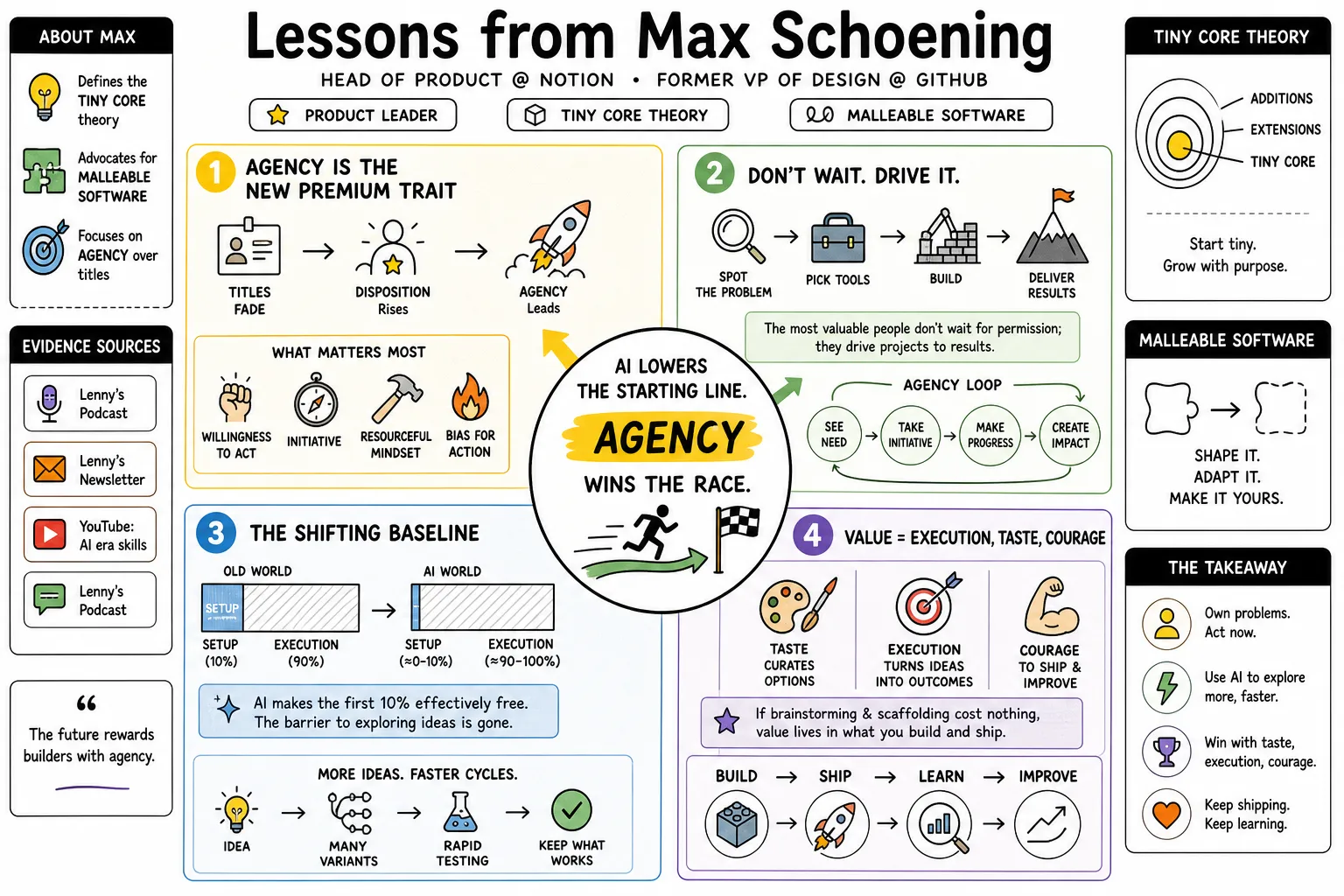
Lessons from Max Schoening
Max Schoening is the Head of Product at Notion and the former VP of Design at GitHub. He is known for defining the "tiny core" theory of product development and pushing for malleable software. These collected insights show how AI is shifting software creation away from rigid job titles and toward hands-on agency and rapid prototyping.
Part 1: Agency and the AI Era
- On the new premium trait: "In the AI era, a person's disposition—their agency and willingness to act—matters far more than their specific credentials or job titles." — Source: Lenny's Podcast
- On taking initiative: "The most valuable people don't wait for permission; they identify a problem, pick up whatever tools are necessary, and drive the project to a result." — Source: Lenny's Newsletter
- On the shifting baseline: Lenny's episode notes say Schoening argues the first 10 percent of every project is now effectively free, changing product development by making early exploration cheap. — Reference: Lenny's Podcast episode with Max Schoening
- On redefining value: "If the initial brainstorming and scaffolding cost nothing, a team's value is entirely in execution, taste, and the willingness to just build it." — Source: Lenny's Podcast
- On the end of pure specialization: "We are moving away from an industry where you can hide behind being exclusively a designer or a product manager without touching the actual materials." — Source: Substack
- On building over theorizing: "Agency means choosing to prototype a functional solution instead of writing a lengthy document arguing about why it should exist." — Source: Notion Blog
- On the velocity of AI: "The speed at which you can go from an idea to a working prototype using AI means that slow, consensus-driven processes are becoming a liability." — Source: Lenny's Podcast
- On personal scale: Apple's episode notes introduce Schoening as a Notion product leader who helps designers and PMs ship code, prototype in the terminal, and launch AI products, showing how AI expands individual operating range. — Reference: Apple Podcasts listing for Lenny's interview with Max Schoening
- On hiring for the future: "When evaluating talent today, you look for people who are naturally inclined to tinker and solve problems outside their formal job description." — Source: Lenny's Newsletter
- On facing the blank page: Lenny frames the episode around agency rather than titles, implying that AI lowers the starting friction while leaving taste and judgment as the real constraint. — Reference: Lenny's Podcast episode with Max Schoening
Part 2: The "Tiny Core" Theory
- On product foundations: "The most successful products are built around a tiny core—one small, exceptionally well-executed primitive that supports everything else." — Source: Lenny's Podcast
- On Notion's core: "Notion's success is entirely built upon the tiny core of the block, which users can endlessly recombine to fit their workflows." — Source: Lenny's Newsletter
- On GitHub's core: "At GitHub, the tiny core that drove the entire ecosystem was the pull request—a simple mechanism for proposing and reviewing change." — Source: Substack
- On finding the core: "You don't discover a product's tiny core by writing a comprehensive PRD; you find it through extreme reduction and prototyping." — Source: Lenny's Podcast
- On load-bearing primitives: "A true tiny core serves as a load-bearing primitive. If it is weak, adding more features on top will only cause the product to collapse." — Source: Lenny's Newsletter
- On simplicity vs. scale: "Great products win when markets amplify their simple, powerful foundations." — Source: YouTube Summary
- On the iPhone analogy: "The iPhone won because its tiny core—multitouch interaction—was undeniably superior to the physical keyboards that preceded it." — Source: Lenny's Podcast
- On avoiding bloat: "When teams lose sight of their tiny core, they start shipping disjointed features that dilute the fundamental value of the product." — Source: Substack
- On Dropbox's core: "Dropbox won early on because its tiny core was simply a folder that synced flawlessly and lived in the menu bar." — Source: Lenny's Newsletter
Part 3: Prototyping Over Planning
- On PRD culture: "The industry's reliance on Product Requirements Documents often prioritizes comprehensiveness over the reduction necessary to build something great." — Source: Lenny's Podcast
- On the terminal as a design tool: Apple's episode notes explicitly cover designers coding at Notion and PMs prototyping in terminals, making code a design medium rather than only an engineering handoff. — Reference: Apple Podcasts listing for Lenny's interview with Max Schoening
- On the illusion of safety: "Writing a 20-page spec feels safe, but it is an illusion. You only learn the truth about a product when you interact with a functional version of it." — Source: Substack
- On interacting with ideas: "We should interact with functional versions of ideas much earlier in the process, rather than debating static mockups." — Source: Notion Blog
- On learning by building: "You cannot spec your way to a great user experience; you have to feel it in your hands through rapid iteration." — Source: Lenny's Podcast
- On shipping to learn: "The goal of a prototype isn't to be perfect; it is to answer a specific question so you can ship production code faster." — Source: Lenny's Newsletter
- On breaking the debate loop: Lenny's episode notes highlight demos over memos and cheap exploration, supporting Schoening's preference for prototypes that teams can react to instead of abstract debate. — Reference: Lenny's Podcast episode with Max Schoening
- On the cost of delay: "The time spent formatting a beautiful slide deck about a feature could have been spent building a v1 that you can actually click through." — Source: Lenny's Podcast
- On technical fluency: "When non-engineers learn enough code to prototype, it changes the entire dynamic of how a product team collaborates." — Source: Substack
- On the real source of truth: In Notion's interview, Schoening says he builds to think and includes the data model, because clarity emerges when software's model matches the user's understanding. — Reference: Notion interview welcoming Max Schoening
Part 4: Malleable Software and Ink & Switch
- On the definition of malleable software: "Software should be bendable, allowing users to reshape their tools as easily as they rearrange furniture in a room." — Source: Ink & Switch
- On rigid applications: "Relying on locked-down applications prevents users from solving their unique, hyper-specific problems." — Source: Metamuse Podcast
- On the Potluck project: "With Potluck, we wanted to see if we could turn freeform text notes into interactive, functional tools using data extraction and computation." — Source: Geoffrey Litt's Blog
- On user empowerment: Ink & Switch defines malleable software as tools users can reshape with minimal friction, restoring agency to people who otherwise have to adapt their workflow to fixed apps. — Reference: Ink & Switch essay on malleable software
- On dynamic documents: "A document shouldn't just be dead text; it should be a living interface that reacts to the data you put into it." — Source: Ink & Switch
- On the Patchwork project: "Everyday computer users need universal version control primitives, but they shouldn't have to learn Git to get them." — Source: Ink & Switch
- On the LEGO philosophy: "I consider myself a LEGO maximalist. If you give people the right primitive building blocks, they will build functional systems you never anticipated." — Source: Notion Blog
- On the future of personal software: "The next era of personal computing will blur the line between using an application and modifying its underlying logic." — Source: Metamuse Podcast
- On breaking silos: The Ink & Switch essay argues for tools that compose into custom workflows instead of siloed monolithic apps, making data and behavior more adaptable at the point of use. — Reference: Ink & Switch essay on malleable software
Part 5: Blurring the Lines of PM, Design, and Engineering
- On collapsing roles: "AI is actively collapsing the Venn diagram of design, product management, and engineering into a single practice of building." — Source: Substack
- On shared vocabulary: "Teams perform significantly better when everyone shares a common vocabulary and set of technical materials." — Source: Lenny's Newsletter
- On the design-build hybrid: "The most effective product people today naturally straddle the line between designing an experience and writing the logic that powers it." — Source: Notion Blog
- On leaving silos behind: Notion describes Schoening as a designer-engineer-product hybrid and says AI is making those boundaries fuzzier, shifting teams toward shared materials and vocabulary. — Reference: Notion interview welcoming Max Schoening
- On touching the materials: "You cannot make great software if you are afraid to touch the materials it is made of—the code itself." — Source: Lenny's Podcast
- On engineering for designers: "Designers who use AI to write their own React components have a massive advantage because they can test interactions natively." — Source: Substack
- On design for engineers: Schoening tells Notion that the more engineering, product, and design overlap in shared materials, the better the team becomes, with AI accelerating that overlap. — Reference: Notion interview welcoming Max Schoening
- On the friction of handoffs: "Every time a design is handed off to an engineer, information is lost. The goal is to eliminate the handoff entirely." — Source: Notion Blog
- On the product triad: "The traditional triad of PM, Design, and Eng only works well when all three understand the constraints and possibilities of the medium deeply." — Source: Lenny's Newsletter
- On shaping the product: "True product ownership means being able to shape the actual software, not just the meetings about the software." — Source: Lenny's Podcast
Part 6: The Tinkerer (Tüftler) Mindset
- On the meaning of Tüftler: "I identify strongly as a Tüftler—a German word for someone who persistently tinkers with an idea until it finally clicks and works." — Source: Notion Blog
- On relentless curiosity: "Being a tinkerer means you are driven by a fundamental curiosity to tear things apart and understand exactly how they function." — Source: Liminary
- On the value of play: Notion traces Schoening's builder history through CloudApp, GitHub, Google Cloud Run, Magic, and side-project-style tinkering, treating playful building as a serious product-development habit. — Reference: Notion interview welcoming Max Schoening
- On medium-native expression: "A tinkerer prefers to express ideas in whatever medium is most native to the user experience, rather than abstracting it away in a document." — Source: Notion Blog
- On overcoming failure: "When a prototype fails, a Tüftler doesn't write a post-mortem; they just try a different angle and keep building." — Source: Lenny's Podcast
- On democratized building: "The world is built by people no smarter than you, which means you have total permission to reshape the tools and environment around you." — Source: Notion Blog
- On rejecting the status quo: "Tinkerers are naturally allergic to the phrase that justifies a process simply because it has always been done that way." — Source: Substack
- On continuous refinement: Schoening describes the German idea of a Tüftler as someone who tinkers until something works, emphasizing persistent ideation and refinement. — Reference: Notion interview welcoming Max Schoening
- On hands-on leadership: "Even as a leader, you have to stay close to the metal. If you stop tinkering, you lose your intuition for what is possible." — Source: Liminary
Part 7: Lessons from GitHub, Heroku, and CloudApp
- On GitHub's ecosystem: "Building features like Codespaces and Actions at GitHub taught me that the best platforms get out of the developer's way and automate the friction." — Source: Podimo
- On the personal README: "Inventing the profile README at GitHub was about recognizing that developers want a malleable space to express their identity." — Source: GitHub
- On Heroku's design: "At Heroku, the goal was to make deployment so invisible and elegant that the developer could focus entirely on the application code." — Source: Digitale Leute
- On the origins of CloudApp: "Building CloudApp was born from a direct, personal need to share things faster, proving that scratching your own itch is still the best way to find a product." — Source: True Ventures
- On developer experience: Lenny's episode notes say the conversation covers quality gaps in the AI software boom, making polish and reliability central to the next wave of product work. — Reference: Lenny's Podcast episode with Max Schoening
- On open source culture: "The open source model of GitHub discussions and issues proves that asynchronous, text-heavy collaboration can scale to millions of people." — Source: Podimo
- On building platforms: "When you build a platform like Heroku, your user interface is often the command line. You have to design the CLI with as much care as a graphical interface." — Source: Digitale Leute
- On founder lessons: "Being a founder forces you to abandon perfectionism in favor of survival. You ship what works, not what looks best in a portfolio." — Source: StartupHub
- On async workflows: "GitHub succeeded because it codified asynchronous work into a standard behavior for the entire software industry." — Source: Podimo
Part 8: The Future of Software Creation
- On AI as a collaborator: "AI is becoming a co-pilot that requires you to manage it with the same clarity you would use with a junior engineer." — Source: Lenny's Newsletter
- On the cost of creation: Apple's episode notes say the conversation covers why software volume has exploded while quality has not, which makes taste, quality, and judgment more scarce as creation gets cheaper. — Reference: Apple Podcasts listing for Lenny's interview with Max Schoening
- On Notion's AI strategy: "Integrating AI into Notion is about weaving intelligence directly into the block-level core of the product." — Source: Lenny's Podcast
- On the lifespan of apps: "We might be moving toward a future where apps are generated on the fly for a specific task and discarded the moment the task is done." — Source: Metamuse Podcast
- On the evolution of PMs: "The product manager of the future will look more like an editor-in-chief, directing a swarm of AI agents to execute a vision." — Source: Substack
- On lowering the floor: Apple's episode notes frame the interview around agency beating skills in the AI era, because the ability to act matters more when AI reduces the technical barrier to building. — Reference: Apple Podcasts listing for Lenny's interview with Max Schoening
- On raising the ceiling: "While AI lowers the floor, it also raises the ceiling, allowing small, high-agency teams to build systems of unprecedented complexity." — Source: Lenny's Newsletter
- On language as an interface: Ink & Switch argues that malleable systems should let users gradually become creators, and AI strengthens that path by lowering the friction between describing a need and adapting a tool. — Reference: Ink & Switch essay on malleable software
- On the joy of building: "Despite all the automation, the fundamental joy of creating something from nothing and watching someone use it will never go away." — Source: Notion Blog