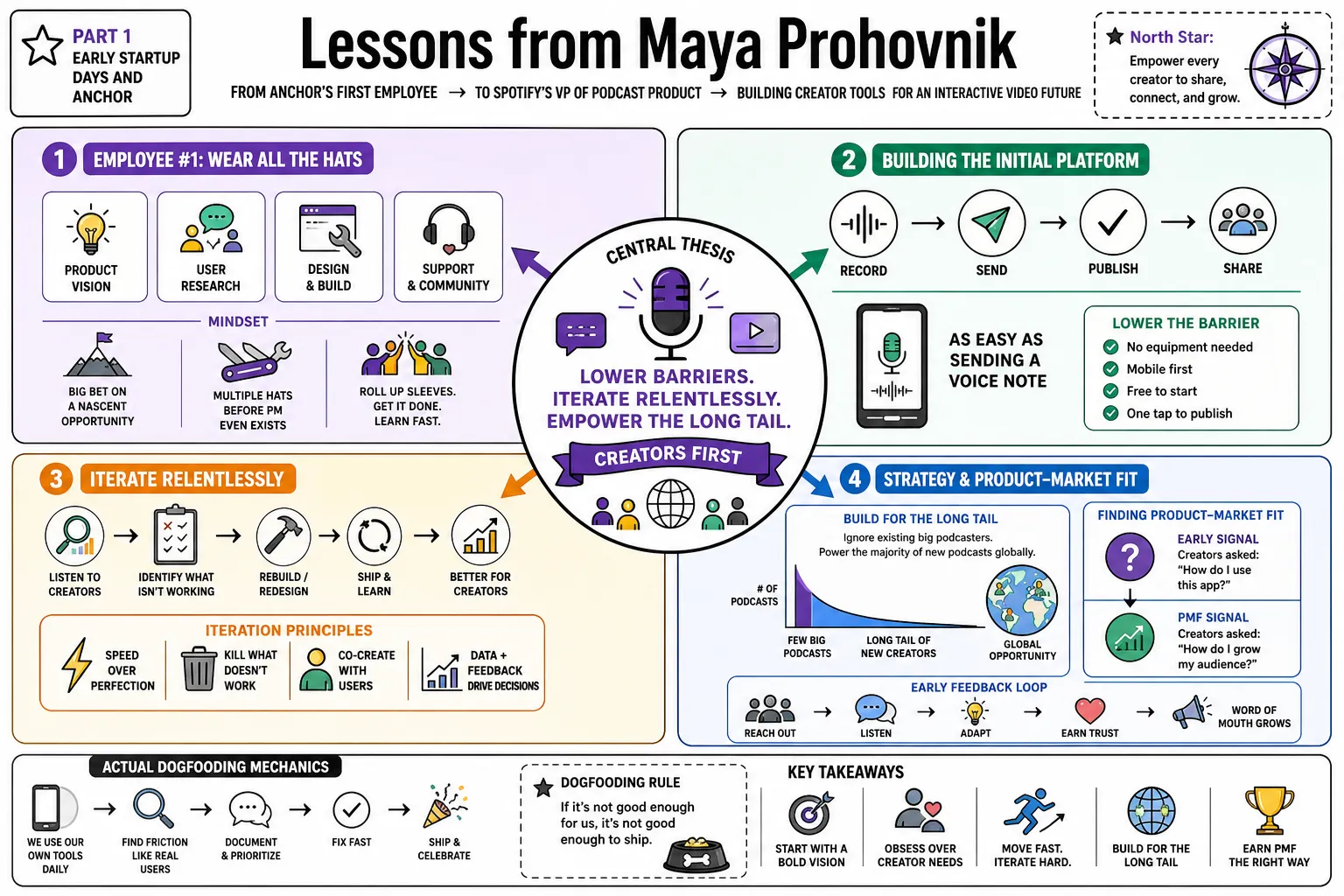
Lessons from Maya Prohovnik
Maya Prohovnik started as Anchor’s first employee and is now Spotify’s VP of Podcast Product, leading the push from audio-only feeds into interactive video. This profile breaks down how she builds creator tools and the actual mechanics of dogfooding.
Part 1: Early Startup Days and Anchor
- On being employee number one: "Taking the leap into a nascent startup requires wearing multiple hats before a formal product management function even exists." — Source: [Lenny's Newsletter]
- On initial platform building: "The early days of Anchor focused on lowering the barrier to entry for audio creation, making it as easy as sending a voice note." — Source: [The Hollywood Reporter]
- On iterative development: "Anchor's survival depended on rapid iteration and being willing to completely rebuild core features when they failed to meet creator needs." — Source: [Lenny's Newsletter]
- On building for the long tail: "The strategy was to ignore existing big podcasters and instead create the technology that would power the majority of all new podcasts globally." — Source: [Podnews]
- On finding product-market fit: "Fit was achieved when creators stopped asking how to use the app and started asking how to grow their audience." — Source: [Lenny's Newsletter]
- On early stage feedback loops: "The most valuable feedback in the beginning came from direct, informal conversations with the first 100 users." — Source: [Lenny's Podcast]
- On constrained resources: "Having limited engineering resources forced the team to prioritize only the features that directly enabled podcast publishing." — Source: [Lenny's Newsletter]
- On the mission: "The core drive was always democratization, making podcasting accessible to anyone with a smartphone." — Source: [Podcast Business Journal]
- On early user acquisition: "The best marketing was word-of-mouth generated by a product that actually worked seamlessly without a manual." — Source: [Lenny's Newsletter]
Part 2: Transitioning to Scale at Spotify
- On post-acquisition integration: "The challenge after Anchor's acquisition was maintaining startup velocity while plugging into a massive corporate infrastructure." — Source: [Lenny's Newsletter]
- On cross-functional alignment: "Scaling product requires translating goals for teams that do not natively speak product language." — Source: [Lenny's Newsletter]
- On managing larger teams: "Moving from a startup to a corporation means shifting from doing the work to designing the systems that do the work." — Source: [Lenny's Newsletter]
- On platform consolidation: "Transitioning Anchor into Spotify for Podcasters required carefully merging user experiences without alienating the core base." — Source: [Spotify Newsroom]
- On operating within an ecosystem: "At Spotify, product decisions for creators must simultaneously account for the impact on the listener app." — Source: [Podnews]
- On institutional memory: "Retaining the startup's original vision while adopting the parent company's resources is a delicate balancing act." — Source: [Built In NYC]
- On scale as a feature: "The main advantage of the Spotify acquisition was instantly giving creators access to a massive, built-in audience." — Source: [Music Business Worldwide]
- On navigating bureaucracy: "Effective product leaders in large organizations learn how to find the fast paths through necessary corporate processes." — Source: [Lenny's Newsletter]
- On maintaining agility: "Keeping a Day 1 mindset is difficult but necessary when working within a public company." — Source: [Lenny's Newsletter]
Part 3: Product Management Frameworks
- On roadmap structure: "The now/next/later framework is more effective than rigid timelines because it allows for flexibility while setting clear priorities." — Source: [Lenny's Newsletter]
- On feature prioritization: "Features should be prioritized based on how well they serve the creator's ultimate goal of reaching and engaging an audience." — Source: [Podcast Business Journal]
- On defining the problem: "A product manager's primary job is to fall in love with the user's problem instead of the team's proposed solution." — Source: [Lenny's Newsletter]
- On the role of PMs: "Product managers act as the connective tissue between engineering, design, and business strategy." — Source: [Built In NYC]
- On getting into product: "You do not need a formal technical background to be a PM; you need empathy, communication skills, and a willingness to learn." — Source: [Built In NYC]
- On ethnographic research: "Watching a user struggle with a prototype in real-time is often more informative than reading a dozen survey responses." — Source: [Lenny's Podcast]
- On customer support as a resource: "Support tickets act as an unfiltered roadmap detailing exactly what is broken in the product experience." — Source: [Lenny's Podcast]
- On killing features: "Removing a feature that distracts from the core use case is as important as shipping a new one." — Source: [Lenny's Newsletter]
- On measuring success: "Success is confirming the feature changed user behavior in the intended way, rather than just shipping the code." — Source: [Lenny's Newsletter]
- On product scope: "Scope creep is the enemy of momentum; ship the smallest viable version, learn, and iterate." — Source: [Lenny's Newsletter]
Part 4: The Practice of Dogfooding
- On the natural state: "Dogfooding should never be an occasional exercise; it must be the natural state of product development." — Source: [Liminary]
- On creator empathy: "It is difficult to build tools for creators without personally understanding their mindset." — Source: [Lenny's Podcast]
- On operationalizing the practice: "Product teams should be actively encouraged to create and maintain their own podcasts to understand the friction points." — Source: [Lenny's Podcast]
- On hidden friction: "When you use your own product daily, you discover the tiny annoyances that users feel but rarely report." — Source: [Lenny's Newsletter]
- On building intuition: "Once team members start podcasting themselves, they gain a deeper, intuitive understanding of the product that they cannot get from data alone." — Source: [Lenny's Podcast]
- On authentic usage: "Dogfooding only works if you are trying to achieve a real goal with the product, rather than clicking buttons in a test environment." — Source: [Liminary]
- On the host experience: "Experiencing the anxiety of hitting publish firsthand changes how you design the publishing interface." — Source: [Lenny's Newsletter]
- On bridging the gap: "Dogfooding closes the distance between the builder's intent and the user's reality." — Source: [Lenny's Newsletter]
- On identifying edge cases: "Regular personal use exposes the weird, unexpected ways a product can break under normal conditions." — Source: [Lenny's Podcast]
- On building conviction: "If the team loves using the product they built, it is much easier to sell that vision to the rest of the company." — Source: [Liminary]
Part 5: Data versus Intuition
- On balancing inputs: "Effective product leadership requires combining quantitative data with the qualitative empathy gained through dogfooding." — Source: [Lenny's Lightning Round]
- On redefining intuition: "Gut is actually a form of data, an accumulation of experience and context that informs decision-making." — Source: [Refound AI]
- On the limits of dashboards: "Data can tell you what users are doing, but intuition and user research are required to understand why they are doing it." — Source: [Lenny's Newsletter]
- On data as a tool: "Data should guide strategy and validate hypotheses, rather than dictate every single product decision." — Source: [Lenny's Podcast]
- On Fan Study insights: "Quantitative reports like Spotify's annual Fan Study provide the macro trends that help shape the high-level roadmap." — Source: [Podnews]
- On moving fast: "Sometimes waiting for perfect data takes too long; you have to rely on informed intuition to keep shipping." — Source: [Refound AI]
- On quantitative blind spots: "Metrics often fail to capture the emotional resonance of a feature, which is necessary for creative tools." — Source: [Lenny's Newsletter]
- On validating gut feelings: "Intuition points you in a direction, but you still need to set up the telemetry to prove you were right." — Source: [GitHub Transcripts]
- On overcoming analysis paralysis: "When the data is ambiguous, lean on the product principles and user empathy you have developed." — Source: [Lenny's Lightning Round]
Part 6: The Shift to Video Podcasting
- On changing habits: "The demand for podcast audiences for video is undeniable at this point." — Source: [Podnews]
- On revenue impact: "For almost all shows who have switched from audio to video, they are making more total revenue." — Source: [Podnews]
- On redefining the medium: "I think a podcast is whatever podcast creators and listeners say it is... to them, a podcast can be video, it can be interactive, it can exist outside of an RSS feed." — Source: [Podcast Business Journal]
- On format flexibility: "The goal is to allow creators to upload video while giving listeners the choice to watch actively or listen in the background." — Source: [Podnews]
- On the visual shift: "The transition to video reflects a broader consumer preference for multi-sensory content experiences." — Source: [Podcast Business Journal]
- On creator workflow: "Building video tools means acknowledging that video production is inherently more complex and requires a different support structure than audio." — Source: [Music Business Worldwide]
- On platform evolution: "Supporting video was a necessary step to keep Spotify competitive as a primary destination for creators." — Source: [Podnews]
- On algorithm dynamics: "Video podcasts require different discovery algorithms because visual engagement metrics differ wildly from audio completion rates." — Source: [Podcast Business Journal]
- On the future of RSS: "The traditional RSS feed is a foundational technology, but it cannot contain the interactive and visual features modern audiences expect." — Source: [Podcast Business Journal]
Part 7: Creator Monetization and Interactivity
- On closing the loop: "Podcasts have historically been a one-sided format and people have told us they want more ways to connect directly." — Source: [Music Business Worldwide]
- On listener retention: "We have found that listeners who interact with a show are four times more likely to return to that show within 30 days." — Source: [Music Business Worldwide]
- On engagement metrics: "Listeners who engage with interactive features listen to twice as many hours per month on average than those who do not." — Source: [iMusician]
- On the Spotify Partner Program: "With this program, creators can earn a revenue share on ads played on or off Spotify, or they can earn based on how much Premium subscribers stream their video content." — Source: [Berklee College of Music]
- On uninterrupted viewing: "Ensuring video content remains uninterrupted by ads for Premium viewers is key to maintaining a high-quality user experience." — Source: [Berklee College of Music]
- On the Comments feature: "Introducing comments fundamentally shifts a podcast from a broadcast medium to a community hub." — Source: [Spotify Newsroom]
- On monetization optionality: "Creators need multiple ways to make money, such as ads, subscriptions, and revenue shares, because no two audiences are identical." — Source: [Podcast Business Journal]
- On creator control: "Interactive features only work if the creator has the moderation tools necessary to maintain a healthy community." — Source: [Music Business Worldwide]
- On shifting value: "The true value of a platform is found in facilitating the transaction of attention into revenue, rather than just hosting files." — Source: [Berklee College of Music]
- On audience building: "Q&A and Polls are low-friction ways for creators to train their audience to actively participate rather than passively consume." — Source: [Spotify Newsroom]
Part 8: Leadership and Team Culture
- On the Eisenhower Matrix: "Using the urgent and important matrix helps prevent leaders from spending all their time fighting fires instead of driving strategy." — Source: [Lenny's Newsletter]
- On Radical Candor: "Direct, honest feedback is the most respectful way to manage a team and improve a product." — Source: [Lenny's Newsletter]
- On preserving startup culture: "Maintaining a fast-paced culture inside a corporation requires actively shielding the team from unnecessary administrative drag." — Source: [Lenny's Newsletter]
- On delegation: "Scaling as a leader means getting comfortable letting your team make mistakes on reversible decisions." — Source: [Lenny's Newsletter]
- On hiring for empathy: "When interviewing product managers, index heavily on their ability to understand and articulate the pain points of a specific user." — Source: [Built In NYC]
- On celebrating wins: "In a continuous deployment environment, you have to artificially create moments to pause and celebrate what the team has shipped." — Source: [Lenny's Newsletter]
- On managing up: "Effective leadership involves managing your manager's expectations by clearly communicating trade-offs and resource constraints." — Source: [Lenny's Newsletter]
- On team trust: "Trust is built when leadership actually uses the product and experiences the same bugs the engineering team is trying to fix." — Source: [Liminary]
- On continuous learning: "The podcasting landscape changes so rapidly that resting on past assumptions is the quickest way to build an obsolete product." — Source: [Maya.fish]