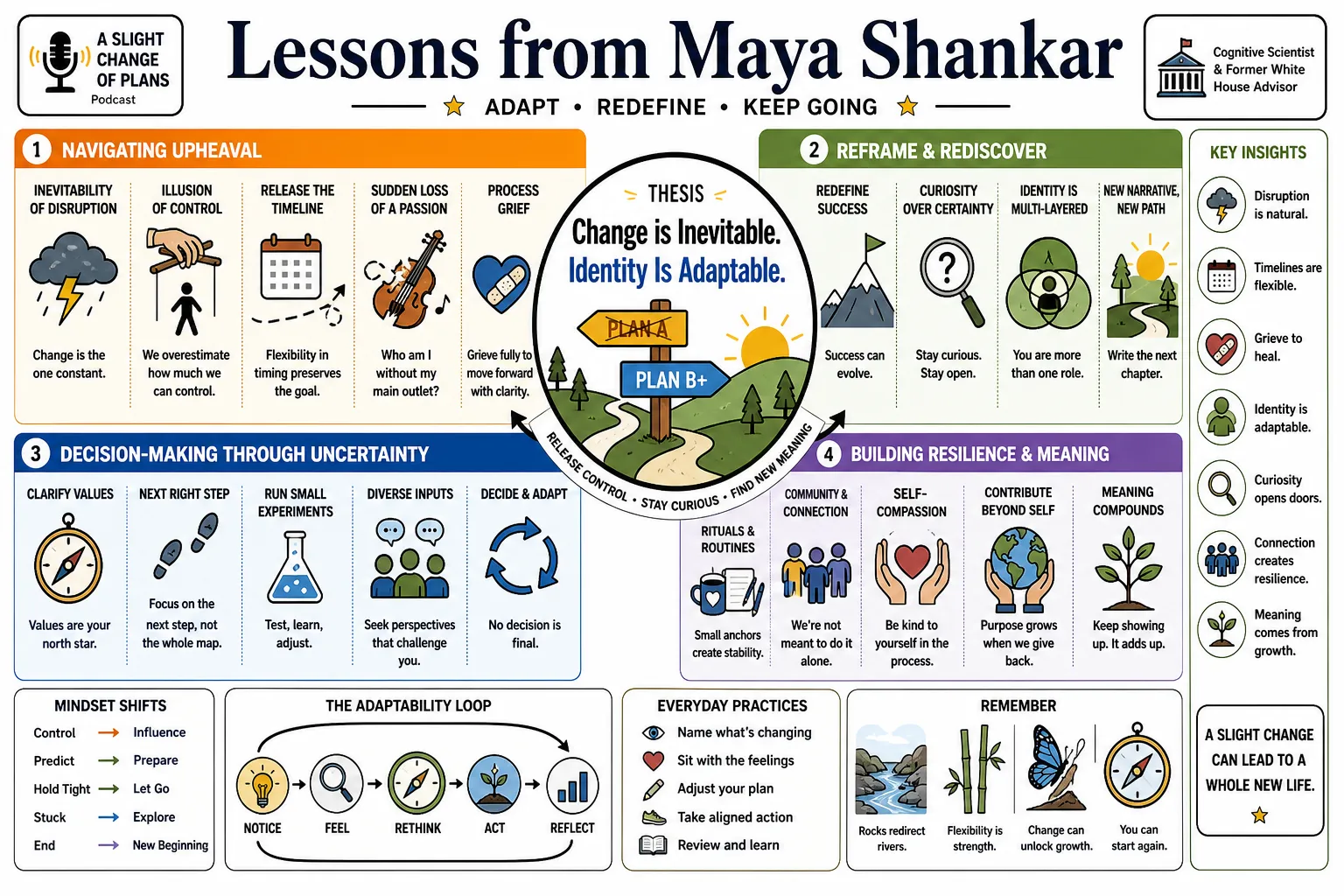
Lessons from Maya Shankar
Cognitive scientist and former White House advisor Maya Shankar studies how we adapt when our plans fall apart. Through her policy work and her podcast A Slight Change of Plans, she applies behavioral science to understand how people process disruption and redefine their purpose. This profile gathers her core insights on decision-making and maintaining identity through unexpected change.
Part 1: Navigating Upheaval
- On the inevitability of disruption: "Change is the one constant in our lives, yet we spend so much of our cognitive energy trying to avoid it rather than learning how to process it." — Source: [A Slight Change of Plans]
- On the illusion of control: "We often fall for the illusion of control, mistakenly believing we can dictate exactly how our lives unfold." — Source: [The Rich Roll Podcast]
- On releasing the timeline: "When we attach strict timelines to our goals, we set ourselves up for failure if life intervenes. Flexibility in timing preserves the goal itself." — Source: [A Slight Change of Plans]
- On sudden loss: "An abrupt end to a passion or career, like a hand injury ending a musical pursuit, forces an immediate confrontation with who you are without your primary tool of expression." — Source: [Masters of Scale]
- On processing grief: "When navigating unwanted change, there is no formal, linear process. We have to stop judging ourselves for how we manage the transition." — Source: [Guy Kawasaki's Remarkable People]
- On unexpected detours: "The path forward is rarely the one we mapped out. The detours often contain the actual substance of our adult lives." — Source: [The Mel Robbins Podcast]
- On the pain of the unfamiliar: "The discomfort we feel during a major life transition isn't always a sign that something is wrong; often, it's just the sensation of our brain processing unfamiliar variables." — Source: [A Slight Change of Plans]
- On letting go of 'the plan': "Holding on too tightly to a previous vision of your life prevents you from participating in the life you actually have." — Source: [The Rich Roll Podcast]
- On the opportunity in crisis: "The hardest moments in your life can help you reimagine who you are, forcing a creativity that comfort never requires." — Source: [The Mel Robbins Podcast]
Part 2: The Trap of Identity Foreclosure
- On identity foreclosure: "We face 'identity foreclosure' when we tie our entire sense of self to a single role, leaving us vulnerable when that role disappears." — Source: [The Mel Robbins Podcast]
- On the danger of labels: "Sometimes we don't realize how much an identity defines us until it gets threatened—until we lose it." — Source: [The Rich Roll Podcast]
- On anchoring to purpose: "Instead of anchoring your identity to a specific job or title, anchor it to the underlying purpose or traits that drew you to that work in the first place." — Source: [Guy Kawasaki's Remarkable People]
- On multidimensionality: "Cultivating a nuanced and multi-dimensional sense of self acts as a psychological insurance policy against the sudden loss of any one role." — Source: [The Mel Robbins Podcast]
- On childhood dreams: "The identities we form in childhood are powerful, but they shouldn't become prisons that keep us from evolving in adulthood." — Source: [A Slight Change of Plans]
- On shedding past selves: "It takes courage to voluntarily shed a version of yourself that people applaud, in order to pursue a version of yourself that is actually authentic." — Source: [Young and Profiting Podcast]
- On verb vs. noun identities: "Think of yourself as a collection of verbs—investigating, creating, connecting—rather than a static noun, like a 'musician' or an 'executive'." — Source: [The Decision Lab]
- On forced reinvention: "When an external event strips away your primary identity, the rebuilding process is painful, but it is also a rare chance to design yourself from scratch." — Source: [The Rich Roll Podcast]
- On professional enmeshment: "In modern culture, we often blur the line between what we do and who we are, making career transitions unnecessarily existential." — Source: [A Slight Change of Plans]
- On the fear of the void: "We cling to outdated identities because the void of 'not knowing who we are yet' is terrifying, but that void is where growth happens." — Source: [Feel Better, Live More with Dr. Rangan Chatterjee]
Part 3: Cognitive Framing and Reappraisal
- On cognitive reappraisal: "Cognitive reappraisal involves actively shifting your perspective on a stressful situation to change your emotional response and calm your nervous system." — Source: [The Mel Robbins Podcast]
- On visual self-distancing: "You can gain instant perspective by 'zooming out' and looking at your situation from a third-party viewpoint, which breaks cyclical mental spirals." — Source: [The Mel Robbins Podcast]
- On the power of the reframe: "A situation doesn't inherently dictate our emotional response; our interpretation of the situation dictates the response." — Source: [A Slight Change of Plans]
- On emotional regulation: "By changing the narrative we tell ourselves about a failure, we can literally change our physiological stress markers." — Source: [Feel Better, Live More with Dr. Rangan Chatterjee]
- On avoiding toxic positivity: "Reappraisal isn't about pretending everything is fine; it's about finding a useful, accurate frame that allows you to function despite the difficulty." — Source: [A Slight Change of Plans]
- On narrative flexibility: "The most resilient people possess narrative flexibility—the ability to rewrite the story of their life as new, unexpected chapters occur." — Source: [The Rich Roll Podcast]
- On questioning assumptions: "When stuck in a rut, ask yourself if the limiting belief you hold is a verified fact or just an unchallenged assumption." — Source: [Guy Kawasaki's Remarkable People]
- On the negativity bias: "Our brains are wired to prioritize negative information for survival, so we have to consciously practice framing things objectively to counteract that bias." — Source: [The Decision Lab]
- On small shifts in language: "Swapping 'I have to' with 'I get to' is a classic reappraisal technique that shifts a burden into an opportunity." — Source: [A Slight Change of Plans]
Part 4: The Neuroscience of Uncertainty
- On our biological aversion to the unknown: "Humans are not wired to like uncertainty; biologically, our brains often prefer a negative certainty over ambiguity." — Source: [Wave]
- On the paralysis of ambiguity: "Unexpected, unwanted changes—like a sudden layoff or health diagnosis—can be paralyzing because they plunge the brain into a state of severe unpredictability." — Source: [The Mel Robbins Podcast]
- On managing cognitive load: "Uncertainty demands a massive amount of cognitive energy, leaving us exhausted even when we haven't done anything physically taxing." — Source: [A Slight Change of Plans]
- On fear of the future: "When the future is opaque, the brain fills in the gaps with worst-case scenarios as a protective mechanism." — Source: [Feel Better, Live More with Dr. Rangan Chatterjee]
- On seeking control: "In chaotic environments, we try to micromanage small, irrelevant details to manufacture a feeling of control over our lives." — Source: [The Rich Roll Podcast]
- On embracing liminal space: "The space between what was and what will be is uncomfortable, but it is necessary for neurological adaptation." — Source: [A Slight Change of Plans]
- On building tolerance for ambiguity: "You can train your brain to handle uncertainty by intentionally exposing yourself to small, safe doses of unpredictability." — Source: [Guy Kawasaki's Remarkable People]
- On the paradox of knowing: "We crave absolute answers, but the pursuit of absolute certainty in an unpredictable world creates more anxiety than it resolves." — Source: [The Decision Lab]
- On recognizing false alarms: "Your brain's alarm system will sound during any major change, even positive ones. You have to learn to distinguish between actual danger and mere unfamiliarity." — Source: [The Mel Robbins Podcast]
- On the plasticity of the brain: "Our brains are incredibly plastic; the neurological discomfort of change is literally the feeling of new pathways being forged." — Source: [A Slight Change of Plans]
Part 5: Policymaking and Behavioral Science
- On the purpose of policy: "Good policy doesn't just look good on paper; it must account for how real, flawed humans actually make decisions in their daily lives." — Source: [White House Office of Science and Technology Policy Archives]
- On nudging: "Small, friction-reducing changes in how choices are presented can have massive impacts on public health, savings, and education outcomes." — Source: [The Decision Lab]
- On human friction: "Often, people fail to utilize government programs not because they don't want to, but because the administrative friction of applying is too high." — Source: [White House Office of Science and Technology Policy Archives]
- On behavioral insights: "Applying behavioral science to government is about recognizing that humans have limited attention and cognitive bandwidth." — Source: [The Decision Lab]
- On scaling empathy: "Systemic policy design must scale empathy, ensuring that the most vulnerable populations aren't penalized by complex bureaucratic requirements." — Source: [Young and Profiting Podcast]
- On testing assumptions: "In public policy, you cannot assume you know what will drive behavior. You have to run the experiment and let the data tell you." — Source: [Masters of Scale]
- On default options: "Making a beneficial outcome the default option, like auto-enrollment in retirement savings, is one of the most powerful tools in behavioral economics." — Source: [White House Office of Science and Technology Policy Archives]
- On government efficiency: "We can dramatically improve the efficiency of federal programs simply by simplifying language and removing unnecessary barriers to entry." — Source: [The Decision Lab]
- On evidence-based compassion: "True compassion in government means using evidence-based behavioral insights to ensure help actually reaches those who need it." — Source: [Masters of Scale]
Part 6: Empathy and Connection
- On moral elevation: "Witnessing the courage or kindness of others during adversity can quietly change what we believe is possible for ourselves, creating a ripple effect." — Source: [The Rich Roll Podcast]
- On empathy as a skill: "Empathy is not a fixed trait; it is a skill that can be cultivated, refined, and consciously applied to improve our relationships." — Source: [A Slight Change of Plans]
- On the limits of projection: "True empathy requires us to stop projecting our own reactions onto others and instead listen to how they are actually experiencing the world." — Source: [Guy Kawasaki's Remarkable People]
- On shared vulnerability: "Sharing the messy, unresolved parts of our lives fosters much deeper connection than presenting a curated story of success." — Source: [The Mel Robbins Podcast]
- On the contagion of courage: "When you act bravely in the face of uncertainty, it grants implicit permission to everyone around you to do the same." — Source: [Feel Better, Live More with Dr. Rangan Chatterjee]
- On overcoming tribalism: "Behavioral science shows that focusing on shared superordinate goals can bridge deep ideological and social divides." — Source: [The Decision Lab]
- On active listening: "Listening without the intent to immediately reply or fix the problem is one of the most difficult but vital components of human connection." — Source: [A Slight Change of Plans]
- On managing compassion fatigue: "To avoid burnout, we must balance emotional empathy—feeling what others feel—with cognitive empathy, which is understanding their perspective without absorbing the distress." — Source: [The Rich Roll Podcast]
- On humanizing data: "Data tells us what is happening at a macro level, but individual human stories provide the necessary context for why it matters." — Source: [Masters of Scale]
Part 7: Resilience and Self-Compassion
- On the utility of self-compassion: "Self-compassion isn't a luxury or a form of selfishness; research shows it is a highly effective motivational tool for navigating transitions." — Source: [A Slight Change of Plans]
- On the trap of self-blame: "Self-blame can be comforting, giving us a false sense of control over a chaotic situation, but it ultimately consumes us with shame." — Source: [Goodreads]
- On harsh inner critics: "We often speak to ourselves in moments of failure with a cruelty we would never use when addressing a friend." — Source: [The Mel Robbins Podcast]
- On the definition of resilience: "Resilience isn't about bouncing back to exactly who you were before; it's about integrating the experience and moving forward as a modified version of yourself." — Source: [Feel Better, Live More with Dr. Rangan Chatterjee]
- On productive failure: "If we strip the moral judgment away from failure, it simply becomes data that informs our next attempt." — Source: [Guy Kawasaki's Remarkable People]
- On grieving lost futures: "It is necessary to mourn the future you thought you were going to have before you can fully invest in the one unfolding in front of you." — Source: [A Slight Change of Plans]
- On setting realistic baselines: "When navigating a crisis, lowering your expectations for daily productivity is an act of psychological survival, not laziness." — Source: [The Rich Roll Podcast]
- On sustainable motivation: "Motivation driven by fear of failure is brittle; motivation driven by self-compassion and curiosity is durable." — Source: [Young and Profiting Podcast]
- On rejecting perfectionism: "Perfectionism is a defense mechanism against judgment, but it ultimately prevents us from taking the risks necessary for genuine growth." — Source: [The Mel Robbins Podcast]
- On trusting the process: "Building resilience requires trusting that you will eventually find meaning in an experience, even if it feels entirely senseless right now." — Source: [A Slight Change of Plans]
Part 8: Redefining Purpose
- On discovering the 'Why': "Identifying your core motivations acts as a stable 'North Star' when the external structures of your life collapse." — Source: [Wave]
- On qualitative metrics: "When setting goals, focus on the quality of your efforts rather than hollow, easy-to-measure metrics that lack inherent meaning." — Source: [A Slight Change of Plans]
- On pivoting: "A pivot isn't a failure to follow through; it is an intelligent adaptation to new information about yourself or the world." — Source: [Masters of Scale]
- On the pursuit of mastery: "The cognitive traits required to master the violin—discipline, deep focus, and iterative practice—are entirely transferable to science, policy, or any other domain." — Source: [Guy Kawasaki's Remarkable People]
- On intrinsic vs. extrinsic rewards: "If your primary drive is external validation, your purpose will always be at the mercy of the crowd. Intrinsic drive is the only stable foundation." — Source: [The Decision Lab]
- On finding meaning in transition: "Meaning isn't something you simply stumble upon; it is something you actively construct through how you choose to respond to change." — Source: [The Rich Roll Podcast]
- On continuous evolution: "We should expect our purpose to evolve as we gather new experiences; stubbornly clinging to a past purpose is a recipe for stagnation." — Source: [Feel Better, Live More with Dr. Rangan Chatterjee]
- On defining success: "Success should be measured not by how closely you stuck to your original plan, but by how well you navigated the deviations." — Source: [The Mel Robbins Podcast]
- On living an examined life: "Ultimately, the goal is to live a life where you are the active author of your narrative, rather than a passive recipient of circumstances." — Source: [A Slight Change of Plans]