Mayur Gupta, Kraken CMO, focuses on marketing philosophy and the principles beneath day-to-day practice. His domain invites study of how a coherent point of view shapes choices about audiences, messages, priorities, and execution.
Marketing Philosophy and Value Creation
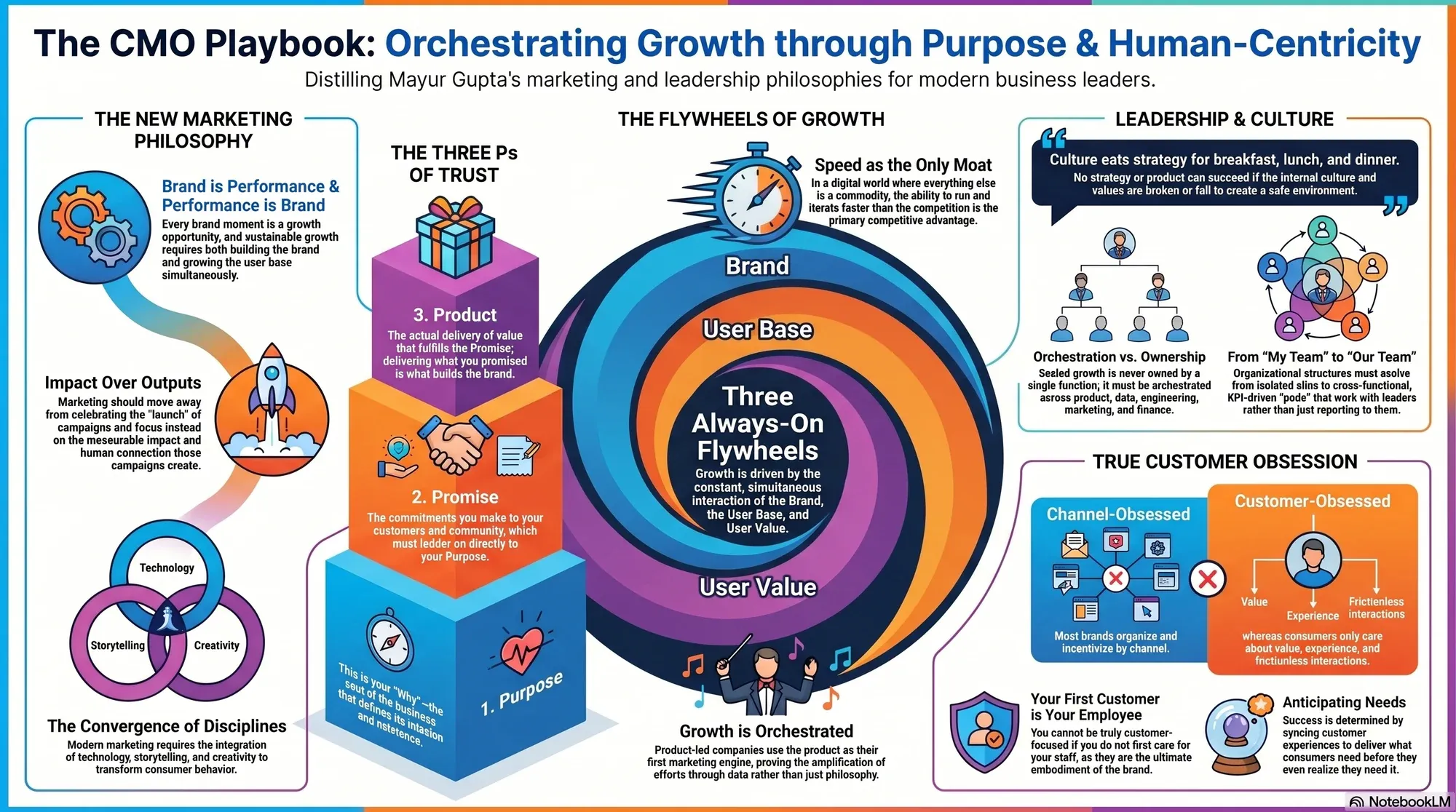
- On the New Role of Marketing: "Every moment is a brand moment and every moment is a growth & revenue opportunity. Brand is performance and performance is brand." [1]
- On Moving Beyond Campaigns: "I think that marketing for many years has been also focused too much on the concept of campaigns, which I call the outputs. More often than not, I see people and brands celebrate the launch of a campaign, but very rarely see people celebrate the impact of campaigns." [1]
- On the Core of Marketing: "If you think about the core principles of marketing, it's making sure whatever you're promising ladders up to your purpose, and then making sure you deliver what you promised. These are things that you teach your children. It's weird that in the race to make the numbers meet, we forget those basics." [2]
- On Marketing in a Digital World: "It took me many years to realize that this wasn't digital marketing. Rather, it was marketing in the digital world to a consumer that was now inherently living a digital life." [1]
- On Brand and Performance: "Sustainable growth is not a choice between growing the brand or growing the user base." [3]
- On Marketing as Humanity: "Marketing is actually pretty simple: it's just about being a good human being." [2]
- On Channel Obsession: "They say they are consumer obsessed but they are really 'channel obsessed'. They organize by channel, operate by channel, partner by channel, incentivize by channel unlike the consumer who only operates around 'value and experience'." [4]
- On Escaping the Campaign Cycle: "We used to call it a product's valley of death where all you cared about is the next feature. That brings some excitement and then it dies down. And what do you do to address it? You launch another feature. I think that marketing for many years has been also focused too much on the concept of campaigns." [1]
- On Proving Marketing’s Impact: "The 3 are NOT isolated, they amplify each other and marketing has to prove that amplification, not just through a philosophical belief but through data." [8]
- On Purpose and Profitability: "No business today can afford to make a choice between purpose and profitability, brand and performance, science and storytelling. You just cannot stand behind your purpose with a weak business model, or a business that isn't growing." [15]
- On Purpose as a Business Foundation: "It's a world of ANDs and not ORs. Interestingly, it has taken a global crisis like COVID to help us all understand that harsh reality." [15]
- On Technology and Human Behavior: Start with the human behavior preventing growth, then use technology toward changing it; technology is an enabler rather than the outcome. — Building Better CMOs, Part 1
- On Educating a Skeptical Market: Lead with the problem crypto solves, real use cases, and empathetic education rather than volatility, fear of missing out, or the technology itself. — Building Better CMOs, Part 1
- On Outcome Architecture: Define team success through macro customer and business outcomes; micro input metrics train people to optimize vanity rather than value. — Create or Destroy: Creating Value When Product Isn't Enough
- On Product-Minded Marketers: Expect marketers to think like product people by taking accountability and ownership for the end user, especially when AI is changing how products are built. — Create or Destroy: Creating Value When Product Isn't Enough
Leadership, Culture and Operating Models
- On Culture Eating Strategy: "Your culture and your values can eat your strategy for breakfast, lunch, and dinner. It doesn't matter how great you are or how brilliant the product is if your culture and values are broken." [1]
- On Psychological Safety: "If they don't end up creating a safe and trusted environment, you won't excel." [1]
- On Evolving Team Structure: "Your culture needs to evolve from 'my team' to 'our team', from 'reporting to me' to 'working with me', from isolated teams to cross-functional outcome/KPI driven pods." [4]
- On Building Internal Relationships: "There's one thing that is most undervalued but the most critical which is your ability to build relationships with your peers within the organization just as much or even more than you're trying to build as a marketeer with the external customer." [6]
- On the Difficulty of Change: "The hardest thing to change is not that strategy it is the culture and the mindset and the belief systems." [6]
- On Preserving Speed at Scale: "When you become the size of a Gannett or a Spotify, the companies that continue to grow are the ones that are conscious about not changing the core of what worked well for them – their speed and a belief in maintaining controlled chaos." [7]
- On Thriving in Ambiguity: "That's why you need a culture that thrives in chaos, where you're not afraid of chaos, you're not afraid of ambiguity, you're not afraid of change." [7]
- On Leaders as Growth Orchestrators: "You need orchestrators of growth who can ensure every team contributes to it." [8]
- On Shared Ownership: "How do you make them feel that it's not your idea It's our idea in fact they are in the bus and not outside the bus receiving." [6]
- On Cross-Functional Growth Teams: "I'm a firm believer that the customer experiences that any business needs to drive at scale... It happens at the intersection of product, data, engineering, marketing, storytelling, finance. It can no longer happen in any of those areas in isolation." [13]
- On Rebuilding Roles for AI: Reconsider roles and organizational boundaries from first principles as product, marketing, design, growth, and engineering converge in an AI-native operating model. — Create or Destroy: Creating Value When Product Isn't Enough
- On Business-Led AI Adoption: Let the business teams closest to the workflow generate and drive AI use cases, while data and engineering specialists supply shared infrastructure and customization. — Marketing Against the Grain: How a $1B Crypto Company Really Uses AI
Customer Experience, Trust and Retention
- On Being Truly Customer-Focused: "We are all obsessed by channels, and we are all obsessed by technology. But what we need is to become customer-obsessed, which means doing something in the short term that is more valuable to the customer than necessarily for the business." [9]
- On the Customer’s Reality: "From a customer standpoint, they don't care. They don't think, 'Oh, you are the head of online, so the discount code you are giving me will not work in your retail environment.'" [9]
- On Human-Centric Strategy: "At the core of any well-rounded, successful, and long-lasting organization is a human-centric strategy that is sincere and authentic." [10]
- On Employees as the First Customer: "Your goals as an organization should always be customer-focused, and that starts within your organization with your very first customer: your employee. You cannot be customer-focused if you do not first care about the people you work with, because they are the brand." [11]
- On Consumer Power: "Now, we are in a consumer-led era in which consumers have all the power." [10]
- On Delivering Value: "Consumers don't differentiate or understand brand vs. performance. They understand value and relevance." [1]
- On Experience Reflecting the Organization: "I strongly believe that the experiences you deliver to the customers are fundamentally a reflection of how you organize and how you operate." [1]
- On Frictionless Experiences: "In order for us to deliver those frictionless experiences for the consumer, which is what they are looking for, you have to break down those silos in your operating model." [1]
- On Customer-Obsessed Transformation: "It is an evolution from a legacy media business driven by traffic to now becoming a customer-obsessed organization driven by user value and not just eyeballs and impressions." [3]
- On Anticipating Customer Needs: "Marketers need to sync the customer experience to deliver what consumers need before they know they need it." [12]
- On the Three Ps of Trust: "It all boils down to three simple Ps for me that builds that trust over time which eventually leads to loyalty. It's your Purpose that defines your Why, your soul as a business. And then the Promise you make with your customers, your community which should ladder up to your Purpose. And lastly, the Product you deliver that ladders up to your Promise." [15]
- On Keeping the Brand Promise: "It's about delivering what you promised. That builds trust, and then trust builds the brand, and it builds an emotional connection." [9]
- On Earning Loyalty: "Loyalty is an outcome and not a strategy in every sphere of life. We all, as people and brands, have to earn that every day, every time with every single touch-point." [15]
- On Expectation and Retention: Reduce churn by keeping the promise and the delivered product close; retention depends on alignment between expectation and experience, not excellence in isolation. — Building Better CMOs, Part 2
- On Brand as Resilience: Build cultural and emotional connection because customers who feel more than utility are likelier to forgive inevitable product or business failures. — Building Better CMOs, Part 2
- On Activation and Retention: Identify the early action that makes users invest themselves in a product, then shape onboarding around that behavior to strengthen retention. — 1947 Rise: AI Will Replace Average Marketers
Growth, Product and Data
- On the Three Flywheels of Growth: "The way I think about it is to break this into three always-on flywheels of growth of the brand, growth of the user base, and growth of the user value, which are constantly running and helping each other." [1]
- On Growth as Orchestration: "Growth is Not Owned But Orchestrated... it is impossible. We can create that false perception but in reality scaled growth is 'orchestrated and not owned' by any single function." [8]
- On Product as a Growth Engine: "In product LED companies, product is your first marketing engine." [11]
- On Speed as an Advantage: "There are no other modes than your ability to run faster than the competition. Everything else is a commodity." [3]
- On Experimentation: "Test, learn and experiment. If it doesn't work, then experiment more and keep trying." [4]
- On Humanizing Data: "How do you apply the data so you make the experience more relevant. More humanistic?" [12]
- On Anticipating the Next Best Message: "It's all about how can you look leverage data to look ahead to really influence that very simple next best piece of messaging to her." [14]
- On Iteration Speed: "Our success will be determined by our speed of iteration, how we test to learn, how we experiment with new ideas and try to figure out what makes more sense for our customers." [15]
- On Building Through Downturns: Use market contractions to quietly strengthen infrastructure and core products while competitors pull back or chase attention. — 1947 Rise: AI Will Replace Average Marketers
AI and the Future of Marketing
- On Human-Centered Marketing: "The future of marketing is centered around the human. A strategic vision for how brands can design relevant and personalized experiences that deeply connect with their audiences." [5]
- On Converging Technology and Storytelling: "The convergence of Marketing, Technology, and Storytelling...is how brands can integrate technology and creativity to transform consumer behavior and create meaningful experiences." [5]
- On the Agent-Orchestrator Shift: Prepare for agents to execute work while people shape rules, context, and knowledge bases as orchestrators rather than merely using AI as a tool. — Create or Destroy: Creating Value When Product Isn't Enough
- On AI Effectiveness over Efficiency: Judge AI by whether it improves impact, individual customer engagement, and organizational speed by orders of magnitude, not merely whether it saves time. — Create or Destroy: Creating Value When Product Isn't Enough
- On Preserving Human Advantage: Use AI to amplify efficiency without surrendering the serendipity, creativity, and irrationality that make human judgment and culture distinctive. — 1947 Rise: AI Will Replace Average Marketers
Purpose, Brand and Personal Growth
- On the Importance of Why: "That ultimately consumers stand up for businesses that stand up for their purpose and mission. That the 'why' is still more important than the 'what.'" [2]
- On the Long-Term Brand View: "With a single minded focus on 'performance' you can grow from the 0–1 stage but to get to 1-N stage (scaled growth), you need to build a resilient, purpose driven brand as the foundation." [8]
- On Authentic Purpose: "Customers can see through that disconnect, or façade. For us at Gannett, it means continuing to stand up for unbiased journalism with deep roots in local communities, ensuring perspectives from all sides and putting those in front." [15]
- On Choosing a Meaningful Mission: "I could have gone into any other growth company with a lot of exciting things happening, but I felt that nothing can beat our purpose and mission [at Gannett]." [2]
- On the Energy of Clear Purpose: "What excites me most about Freshly is the combination of a clear purpose with the heart and values needed to become an iconic brand. They're disrupting the food and wellness industry as we know it, creating solutions and not just products." [16]
- On Daily Resilience: Build a daily philosophical practice that restores conviction after setbacks instead of expecting confidence to remain stable on its own. — 1947 Rise: AI Will Replace Average Marketers
- On Compounding Interactions: Give every interaction your best because career-changing opportunities often emerge from moments whose importance is impossible to recognize in advance. — 1947 Rise: AI Will Replace Average Marketers
Learn more:
- Moving Marketing from Outputs to Outcomes - To Be Disrupted
- Episode 03: Curating Spotify's Playlist for Success, with Mayur Gupta - YouTube
- The Right Teams & Culture for Subscription Growth with Gannett-USA Today Network CMO Mayur Gupta | by Robbie K Baxter | Medium
- 3 Marketing Strategies That Will Drive Growth From A Spotify Exec - Forbes
- Mayur Gupta, speaker and innovator | Thinking Heads®
- Legacy Brand Evolution for a New Generation with Mayur Gupta, CMO , Gannett - YouTube
- Gannett's Gupta: 'You Need a Culture That Thrives in Chaos' | Local News Initiative
- Marketing — Fluff or Growth?. I shared a keynote at mParticle's 2019… | by Mayur Gupta | Get Freshly | Medium
- Subscription Stories: Ep 37 The Right Teams & Culture with Gannett-USA Today Network CMO Mayur Gupta - YouTube
- The Human Side of Marketing and Growth with Mayur Gupta | by Tiffani Bova | Medium
- Mayur Gupta on embracing change and marketing's impact on growth with Alejandro Garcia-Amaya - YouTube
- Freshly CMO Mayur Gupta's unexpected path from technologist to marketer - MarTech
- Building a Cross-Functional Data Dream Team - with With Mayur Gupta, Chief Marketing & Strategy Officer at Gannett | USA Today Network - Data Unlocked
- Mayur Gupta - Global Vice President for Growth, Innovation & Marketing at Spotify
- Gannett's Mayur Gupta On 2021: Purposeful Profitability + Customer Obsession - Forbes
- Freshly Names Mayur Gupta as Chief Marketing Officer - PR Newswire
- Building Better CMOs with Mayur Gupta, Part 1
- Building Better CMOs with Mayur Gupta, Part 2
- Create or Destroy: Creating Value When Product Isn’t Enough
- Marketing Against the Grain: How a $1B Crypto Company Really Uses AI
- 1947 Rise: AI Will Replace Average Marketers