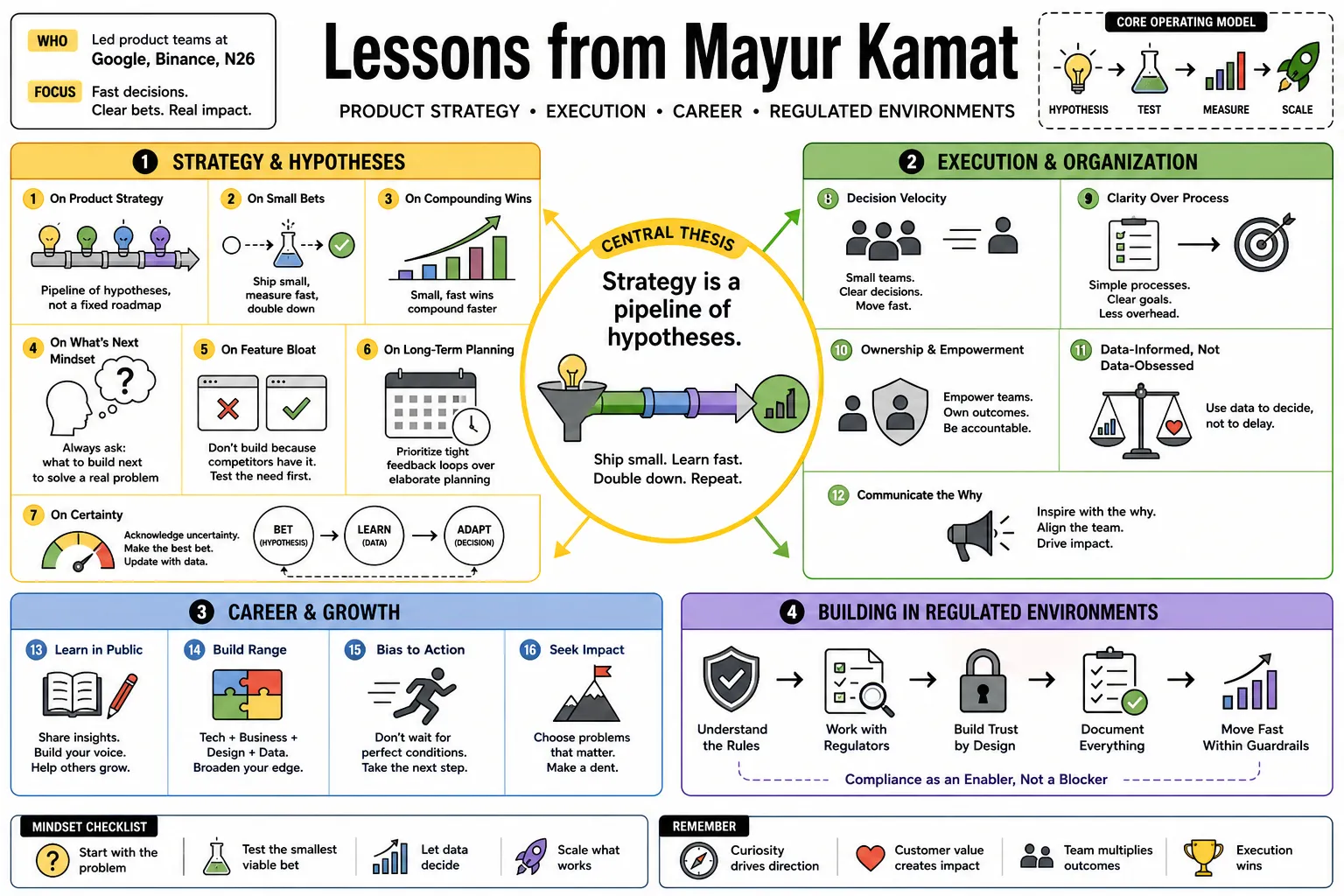
Lessons from Mayur Kamat
Mayur Kamat has led product teams at Google, Binance, and N26. He focuses on structuring organizations for quick decision-making and treating product strategy as a series of fast hypotheses. This document covers his operating principles for execution, career development, and building in regulated environments.
Part 1: Strategy and Hypotheses
- On Product Strategy: "Strategy is fundamentally a pipeline of hypotheses, rather than a fixed roadmap." — Source: Lenny's Podcast
- On Small Bets: "Ship small, measure fast, and double down on what the data proves." — Source: Lenny's Podcast
- On Compounding Wins: "Small, fast wins compound significantly faster than big, slow bets." — Source: Lenny's Podcast
- On The What's Next Mindset: "The core of product management is being driven by the question of what to build next to solve a real problem." — Source: GeekWire
- On Feature Bloat: "Avoid building features just because competitors have them; test the hypothesis that your users actually need them first." — Source: Lenny's Podcast
- On Long-Term Planning: "Prioritize tight feedback loops over elaborate, long-term planning exercises." — Source: Lenny's Podcast
- On Certainty: "Acknowledge the uncertainty in product development and use rapid iterations to buy certainty." — Source: Lenny's Podcast
- On Moving the Needle: "In fintech, growth and compliance issues are often the two areas that move the needle the fastest." — Source: Lenny's Podcast
- On Measuring Outcomes: "Data proves the hypothesis, but you have to know exactly what you are measuring before you ship." — Source: Lenny's Podcast
Part 2: Speed and Decision-Making
- On Fast vs. Perfect: "In most product scenarios, there is no right versus wrong answer, only slow versus fast." — Source: Lenny's Podcast
- On Reversible Decisions: "Fast, reversible decisions are generally superior to the pursuit of perfect ones." — Source: Lenny's Podcast
- On The 24-Hour Rule: "No decision should wait more than 24 hours to be made, even if it requires meeting late at night." — Source: Lenny's Podcast
- On Daily War Rooms: "Meeting daily as a leadership team ensures blockers are removed instantly and momentum is maintained." — Source: Lenny's Podcast
- On Hesitation: "Delaying a decision is often more costly than making the wrong decision and fixing it quickly." — Source: Lenny's Podcast
- On High-Stakes Bets: "Reserve heavy, time-consuming processes only for decisions that are truly irreversible and high-stakes." — Source: Lenny's Podcast
- On Execution Velocity: "Speed of execution is the primary competitive advantage in high-growth environments." — Source: Lenny's Podcast
- On Removing Friction: "Leadership's job is to clear the path so teams can operate at maximum velocity." — Source: Lenny's Podcast
- On Iteration Speed: "A tight feedback loop allows you to correct course before a wrong decision becomes expensive." — Source: Lenny's Podcast
Part 3: Organizational Structure
- On Flat Hierarchies: "Keeping individual contributors close to the CEO prevents information dilution and accelerates execution." — Source: Lenny's Podcast
- On Wide Span of Control: "A founder maintaining dozens of direct reports forces leaders to stay deeply involved in the details." — Source: Lenny's Podcast
- On Empowering ICs: "Individual contributors must be empowered to own their specific cell of the product completely." — Source: Lenny's Podcast
- On Leadership Involvement: "Leaders cannot afford to be disconnected from the day-to-day realities of what their teams are building." — Source: Lenny's Podcast
- On Resource Allocation: "Move your attention and physical presence to the teams handling the biggest upside or downside at any given moment." — Source: Lenny's Podcast
- On Bureaucracy: "Excessive layers of management slow down shipping and dilute ownership." — Source: Lenny's Podcast
- On Accountability: "When the structure is flat, it is immediately clear who is responsible for a product's success or failure." — Source: Lenny's Podcast
- On Team Autonomy: "Teams operating like independent cells can move faster than those relying on top-down directives." — Source: Lenny's Podcast
- On Communication Paths: "Shorten the distance between the person writing the code and the person setting the vision." — Source: Lenny's Podcast
- On Scaling Teams: "Design your organization so that adding headcount doesn't proportionally increase communication overhead." — Source: Lenny's Podcast
Part 4: Focus and Impact
- On Locating Impact: "Identify where the 10x upside or downside is and move your desk to that exact problem." — Source: Lenny's Podcast
- On Prioritization: "Not all product work is equal; focus ruthlessly on what will actually change the trajectory of the business." — Source: Lenny's Podcast
- On Avoiding Distractions: "It is easy to stay busy with low-impact tasks; true product leadership requires ignoring them." — Source: Lenny's Podcast
- On Crisis Management: "When a critical issue arises, drop everything else and embed yourself with the team solving it." — Source: Lenny's Podcast
- On Opportunity Cost: "Every hour spent on a marginal feature is an hour stolen from a product that could redefine the company." — Source: Lenny's Podcast
- On Deep Work: "Surface-level involvement in ten projects is less valuable than deep execution on the single most important one." — Source: Lenny's Podcast
- On Identifying Blockers: "The highest impact action a leader can take is often simply removing a bottleneck for their best engineers." — Source: Lenny's Podcast
- On Managing Energy: "Direct your energy toward problems where your specific context and skills can uniquely move the needle." — Source: Lenny's Podcast
- On Operational Agility: "Be willing to abandon yesterday's priority if today presents a massive new risk or opportunity." — Source: Lenny's Podcast
- On Outcome over Output: "Measure your day by the impact of the decisions you unblocked, not the number of meetings you attended." — Source: Lenny's Podcast
Part 5: Managing Career Growth
- On Superpowers: "Optimize for your superpowers. Focus on your strengths rather than obsessing over fixing your weaknesses." — Source: Lenny's Podcast
- On Self-Awareness: "Use tools like StrengthsFinder and honest reflection to identify what actually energizes you." — Source: Lenny's Podcast
- On Early Career Choices: "Do not optimize for salary early in your career if it distracts from roles that compound your learning." — Source: Lenny's Podcast
- On Compounding Environments: "Choose high-growth environments where you get daily reps; the lessons learned will outpace immediate financial gains." — Source: Lenny's Podcast
- On Network Value: "The alumni network and relationships built in hyperscale companies often become your most valuable career asset." — Source: Lenny's Podcast
- On Role Alignment: "Find roles where your natural strengths are the exact requirement for driving success in that position." — Source: Lenny's Podcast
- On Gaining Reps: "The volume of decisions you are forced to make in a fast-paced environment accelerates your judgment." — Source: Lenny's Podcast
- On Comfort Zones: "Growth happens when you intentionally place yourself in environments that test the limits of your current capabilities." — Source: Lenny's Podcast
- On Long-Term Thinking: "View your career as a compounding asset; early investments in skill acquisition yield exponential returns later." — Source: Lenny's Podcast
- On Skill Focus: "Being world-class at two things is often more effective than being marginally average at ten." — Source: Lenny's Podcast
Part 6: Navigating Compliance and Innovation
- On Regulated Spaces: "Building products in complex, regulated environments requires proving that innovation and compliance can coexist." — Source: N26 Press Release
- On Security by Design: "Integrate security and compliance into the product from day one rather than bolting them on later." — Source: GeekWire
- On Inclusive Systems: "Regulation should not be a barrier to entry; it should be the framework within which you build inclusive financial systems." — Source: Binance Blog
- On Constraints as Features: "Treat regulatory requirements as product constraints that force you to design secure, user-centric solutions." — Source: N26 Press Release
- On Trust: "In fintech, compliance is fundamentally about earning and maintaining user trust at scale." — Source: N26 Press Release
- On Navigating Red Tape: "Work closely with legal and compliance teams to find paths forward rather than treating them as roadblocks." — Source: N26 Press Release
- On Speed in Compliance: "You can still ship fast in regulated industries if your testing and validation frameworks are highly automated." — Source: Lenny's Podcast
- On Global Standards: "Building for a global market means designing a core architecture flexible enough to adapt to local regulatory variations." — Source: Binance Blog
- On Product Integrity: "Never compromise the security of the user's data or funds for the sake of a quick product launch." — Source: GeekWire
Part 7: Scaling Products
- On Hyperscale Growth: "Scaling a product to millions of users exposes edge cases that you cannot predict in early testing." — Source: Binance Blog
- On Infrastructure Limits: "Your product experience is only as good as the underlying infrastructure's ability to handle unexpected traffic spikes." — Source: Binance Blog
- On Enterprise Needs: "Building products like Android for Work taught me that enterprise scaling requires balancing administrator control with end-user simplicity." — Source: GeekWire
- On Foundational Systems: "As you scale, you have to continually rebuild foundational systems while the product is actively in use." — Source: Lenny's Podcast
- On A/B Testing at Scale: "A rigorous A/B testing culture is essential when scaling; rely on data to confirm feature viability." — Source: Lenny's Podcast
- On Global Rollouts: "Stagger feature rollouts by region to identify localization bugs before they affect your entire user base." — Source: Binance Blog
- On Technical Debt: "Acknowledge that fast scaling accrues technical debt; schedule dedicated cycles to pay it down before it halts momentum." — Source: Lenny's Podcast
- On Platform Resilience: "A scalable business requires designing systems that gracefully degrade during an outage rather than failing completely." — Source: GeekWire
- On User Feedback at Scale: "When dealing with millions of users, you must build automated mechanisms to categorize and prioritize feedback signals." — Source: Binance Blog
Part 8: Customer Empathy and Real-World Impact
- On Customer Centricity: "Technological innovation should always serve to enhance the user's relationship with their own goals, such as wealth creation." — Source: N26 Press Release
- On Solving Hard Problems: "The excitement of product management lies in navigating ambiguity to build solutions that positively impact daily lives." — Source: GeekWire
- On Financial Access: "Building inclusive financial products means designing interfaces that are accessible to users regardless of their prior knowledge." — Source: Binance Blog
- On Communication Products: "Products like Google Hangouts succeeded by reducing the friction of human connection in an increasingly digital world." — Source: GeekWire
- On Learning from Failure: "Early startup failures teach invaluable lessons about what it actually takes to build a scalable, sustainable business." — Source: GeekWire
- On User Trust: "In communication and finance, the product is useless if the user feels their security or privacy is compromised." — Source: GeekWire
- On Value Creation: "Focus on whether the product saves the user time, makes them money, or secures their assets; if it does none, reconsider the feature." — Source: N26 Press Release
- On Market Feedback: "The market is the ultimate judge of your product; if distribution fails, the elegance of the code does not matter." — Source: GeekWire
- On Impact: "The most rewarding part of building global products is knowing your work is a quiet but critical part of someone's day." — Source: N26 Press Release