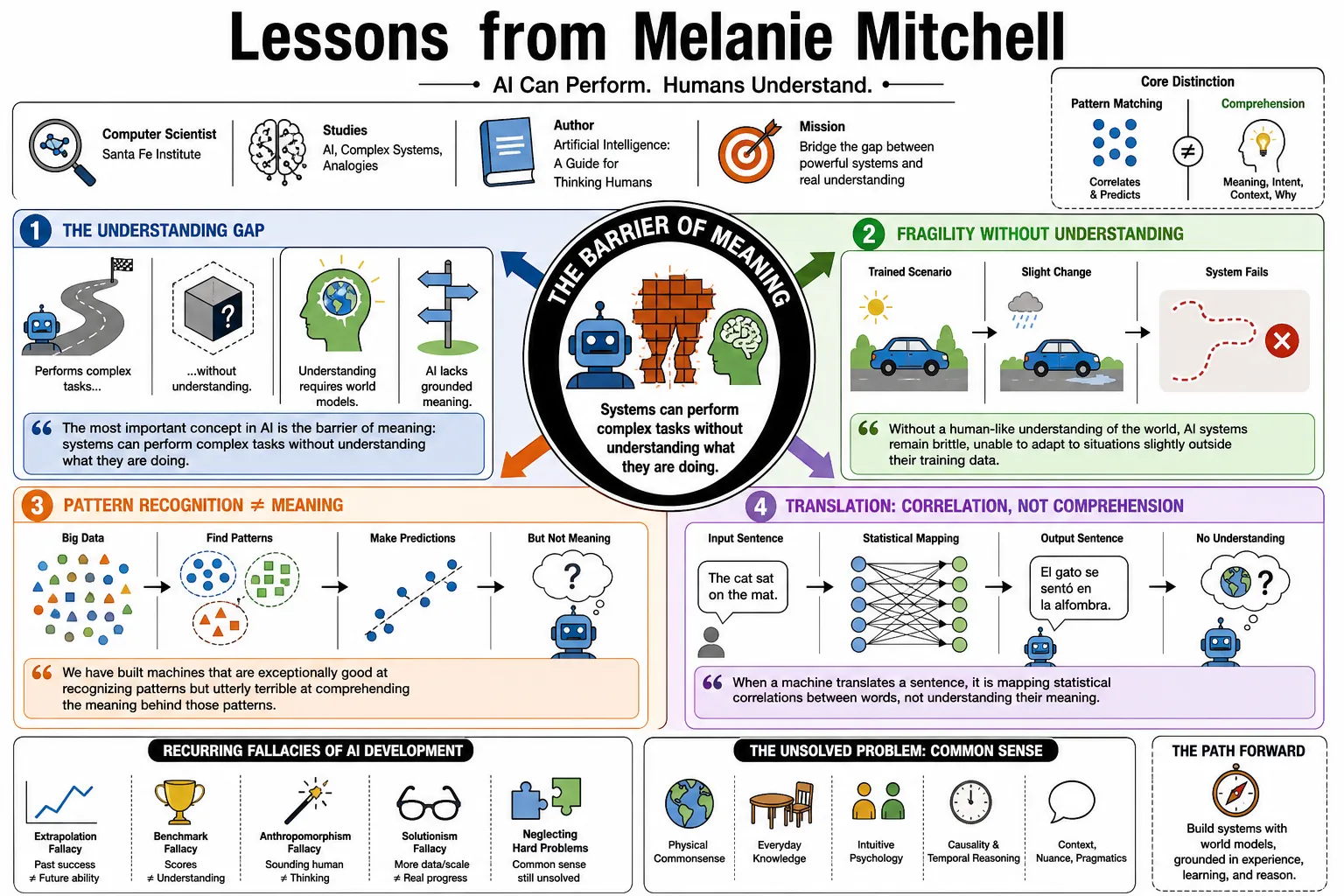
Melanie Mitchell is a computer scientist at the Santa Fe Institute who studies artificial intelligence, complex systems, and how humans form analogies. Best known for her book Artificial Intelligence: A Guide for Thinking Humans, she argues that statistical pattern matching is entirely different from actual comprehension. This collection maps out her critiques of modern machine learning, covering the recurring fallacies of AI development and the unsolved problem of common sense.
Part 1: The Barrier of Meaning
- On the "understanding" gap: "The most important concept in AI is the barrier of meaning: systems can perform complex tasks without understanding what they are doing." — Source: [Artificial Intelligence: A Guide for Thinking Humans]
- On fragility: "Without a human-like understanding of the world, AI systems remain brittle, unable to adapt to situations slightly outside their training data." — Source: [Santa Fe Institute]
- On pattern recognition vs. meaning: "We have built machines that are exceptionally good at recognizing patterns but utterly terrible at comprehending the meaning behind those patterns." — Source: [Science Magazine]
- On translation: "When a machine translates a sentence, it is mapping statistical correlations between words, not visualizing the scenario the words describe." — Source: [Quanta Magazine]
- On the illusion of depth: "Because humans use language to communicate meaning, we instinctively assume that when a machine produces language, there is meaning behind it." — Source: [Artificial Intelligence: A Guide for Thinking Humans]
- On the long tail: "Machine stupidity creates a tail risk. Machines can make many good decisions and then fail spectacularly on a tail event." — Source: [Artificial Intelligence: A Guide for Thinking Humans]
- On tail events: "The real world is almost exclusively made up of long-tail events that did not appear in the training data." — Source: [Lex Fridman Podcast]
- On extrapolation: "Current neural networks interpolate beautifully within their training distribution but fail completely when asked to extrapolate outside of it." — Source: [Why AI is Harder Than We Think]
- On robustness: "A robust AI needs to know when it doesn't know the answer, a meta-awareness that current statistical models completely lack." — Source: [Santa Fe Institute]
Part 2: The Fallacies of Artificial Intelligence
- On the continuum fallacy: "Advances on a specific AI task are often described as a first step towards general AI, assuming a continuum that does not exist." — Source: [Why AI is Harder Than We Think]
- On the tree vs. the moon: "Believing narrow AI is a step toward general AI is like claiming that the first monkey climbing a tree is making progress towards landing on the moon." — Source: [Why AI is Harder Than We Think]
- On easy vs. hard tasks: "A problem that is hard for people does not necessarily mean that it will be hard for computers." — Source: [Why AI is Harder Than We Think]
- On Moravec's Paradox: "Things like playing Go are incredibly hard for humans but computable, while walking down a busy street is effortless for us but a nightmare for robotics." — Source: [Artificial Intelligence: A Guide for Thinking Humans]
- On wishful mnemonics: "Calling a function 'understand' or 'learn' tricks researchers and the public into believing the machine is actually doing those human activities." — Source: [Why AI is Harder Than We Think]
- On suitcase words: "Intelligence, learning, and understanding are 'suitcase words' packed with many different meanings that we accidentally unpack when evaluating machines." — Source: [Artificial Intelligence: A Guide for Thinking Humans]
- On brain-in-a-vat theories: "The assumption that intelligence is all in the brain leads to the false belief that scaling up computing capacity will automatically generate general intelligence." — Source: [Why AI is Harder Than We Think]
- On the alchemy of AI: "Current AI development often looks more like alchemy than science—mixing large datasets and parameters to see what works without underlying physical theories." — Source: [Complexity: A Guided Tour]
- On the cycle of AI springs and winters: "The history of AI is a repeating cycle of overpromising, media hype, and eventual disillusionment when the systems fail to generalize." — Source: [Artificial Intelligence: A Guide for Thinking Humans]
- On overestimating progress: "We consistently overestimate how close we are to human-level AI because we consistently underestimate the complexity of human intelligence." — Source: [Santa Fe Institute]
Part 3: Embodiment and Common Sense
- On subconscious knowledge: "If commonsense knowledge is the knowledge that all humans have but is not written down anywhere, then much of it is subconscious." — Source: [Artificial Intelligence: A Guide for Thinking Humans]
- On the origins of common sense: "Encoded in the large, highly evolved sensory and motor portions of the human brain is a billion years of experience about the physical world." — Source: [Why AI is Harder Than We Think]
- On the body's role: "There are no brain parts for disembodied cognition; our physical interaction with the world is the foundation of our conceptual understanding." — Source: [Why AI is Harder Than We Think]
- On physics intuition: "A toddler knows that a glass pushed off a table will fall and break. An AI must be explicitly trained on thousands of videos to simulate this basic physics." — Source: [Lex Fridman Podcast]
- On abstract concepts: "Even our most abstract concepts, like 'justice' or 'time,' are deeply rooted in physical metaphors like weight, distance, and direction." — Source: [Artificial Intelligence: A Guide for Thinking Humans]
- On reading the world: "Humans don't just read text; we read text grounded in a lifetime of moving through a three-dimensional world." — Source: [Quanta Magazine]
- On the missing manual: "Common sense cannot be found in a Wikipedia scrape; it is the dark matter of artificial intelligence." — Source: [Artificial Intelligence: A Guide for Thinking Humans]
- On causality: "Machine learning identifies that a rooster crowing is correlated with the sunrise, but common sense knows the rooster doesn't cause the sun to rise." — Source: [Santa Fe Institute]
- On core knowledge: "Developmental psychology shows that infants are born with innate core knowledge about objects and agency, giving them a massive head start over blank-slate neural networks." — Source: [Artificial Intelligence: A Guide for Thinking Humans]
- On simulation: "When we hear a story, we don't just process the syntax; we simulate the physical and emotional states of the characters in our minds." — Source: [Sean Carroll's Mindscape]
Part 4: Complexity and Emergent Systems
- On defining complexity: "A complex system features large networks of components with no central control and simple rules that give rise to complex collective behavior." — Source: [Complexity: A Guided Tour]
- On the limits of reductionism: "Scientific reductionism has been notably mute in explaining the complex phenomena closest to our human-scale concerns, like brains and economies." — Source: [Complexity: A Guided Tour]
- On chaos: "In chaotic systems, minuscule uncertainties in initial measurements result in huge errors in long-term predictions." — Source: [Complexity: A Guided Tour]
- On computation in nature: "Computation is fundamentally what a complex system does with information in order to succeed or adapt in its environment." — Source: [Complexity: A Guided Tour]
- On exploration vs. exploitation: "Maintaining a correct balance between exploring for new information and exploiting known information is essential for all adaptive systems." — Source: [Complexity: A Guided Tour]
- On biological scaling: "Although living things occupy a three-dimensional space, their internal physiology and anatomy operate as if they were four-dimensional." — Source: [Complexity: A Guided Tour]
- On emergence: "The most fascinating aspect of nature is that the macroscopic behavior of a system is almost entirely independent of the microscopic details of its parts." — Source: [Santa Fe Institute]
- On idea models: "Idea models are 'intuition pumps': thought experiments designed to prime our intuitions about complex phenomena rather than make detailed predictions." — Source: [Complexity: A Guided Tour]
- On decentralization: "There is no CEO in an ant colony; the sophisticated foraging and building behaviors emerge entirely from local interactions." — Source: [Complexity: A Guided Tour]
Part 5: Analogies and Concept Formation
- On the core of cognition: "The ability to make analogies is not a neat parlor trick; it is the very core of human cognition." — Source: [Copycat Project)]
- On fluid concepts: "Concepts in the human mind are fluid. They stretch, merge, and adapt to new situations in ways that rigid database structures cannot." — Source: [Artificial Intelligence: A Guide for Thinking Humans]
- On the Copycat program: "Our goal with Copycat was not to solve letter-string puzzles, but to model the fundamental mechanisms of how humans perceive similarity." — Source: [Fluid Concepts and Creative Analogies]
- On slippability: "A good concept has 'slippability'—the capacity to loosen its boundaries so that a dog can be seen as a 'child' in the context of a pet owner's affection." — Source: [Santa Fe Institute]
- On mapping the unknown: "When faced with a novel situation, humans instantly map it onto known situations. This analogical mapping is what allows us to learn from sparse data." — Source: [Artificial Intelligence: A Guide for Thinking Humans]
- On abstraction: "Abstraction is the process of stripping away surface details to find the structural essence of a situation, something neural networks still struggle with." — Source: [Quanta Magazine]
- On Douglas Hofstadter's influence: "Hofstadter taught me that if you want to understand human thought, you have to understand how we recognize that 'this' is like 'that'." — Source: [Artificial Intelligence: A Guide for Thinking Humans]
- On visual analogies: "Recognizing a face in a cloud or an electrical outlet that looks shocked is a testament to the mind's relentless analogical engine." — Source: [Lex Fridman Podcast]
- On the failure of literalism: "Machines fail in edge cases precisely because they are too literal; they cannot bend their concepts to fit slight anomalies." — Source: [Why AI is Harder Than We Think]
Part 6: Machine Learning Vulnerabilities
- On brittleness: "Deep learning models are incredibly brittle. Changing a few pixels in an image can cause a network to classify a school bus as an ostrich." — Source: [Artificial Intelligence: A Guide for Thinking Humans]
- On adversarial attacks: "Adversarial examples reveal that the features a neural network uses to identify objects are radically different from the features humans use." — Source: [Artificial Intelligence: A Guide for Thinking Humans]
- On shortcuts: "Neural networks are lazy. If they can find a shortcut—like using the background of an image to classify the foreground object—they will take it." — Source: [Santa Fe Institute]
- On the Clever Hans effect: "Much of modern AI suffers from the Clever Hans effect, where the machine appears intelligent but is actually just cueing off hidden statistical correlations." — Source: [Why AI is Harder Than We Think]
- On autonomous driving: "The difficulty of self-driving cars is not in staying in the lane; it's in interpreting the intentions of pedestrians, which requires a human-like model of the world." — Source: [Artificial Intelligence: A Guide for Thinking Humans]
- On the visual world: "Computer vision systems see texture much more strongly than shape, which is the exact opposite of how human vision prioritizes objects." — Source: [Quanta Magazine]
- On trust: "The most worrisome aspect of AI systems in the short term is that we will give them too much autonomy without being fully aware of their vulnerabilities." — Source: [Artificial Intelligence: A Guide for Thinking Humans]
- On data bias: "Because models train on human internet data, they inherit our historical biases perfectly, baking human flaws into supposedly objective algorithms." — Source: [Artificial Intelligence: A Guide for Thinking Humans]
- On spurious correlations: "A model trained to recognize sheep might fail if the sheep is on a beach rather than a grassy hill, revealing it learned the background, not the animal." — Source: [Santa Fe Institute]
Part 7: Anthropomorphism and the Illusion of Intelligence
- On the Eliza effect: "We have an innate psychological vulnerability to anthropomorphize; if a machine speaks to us, we project a mind behind the words." — Source: [Artificial Intelligence: A Guide for Thinking Humans]
- On overestimating trust: "We impute human qualities to AI systems and end up overestimating the extent to which these systems can actually be fully trusted." — Source: [Artificial Intelligence: A Guide for Thinking Humans]
- On the danger of chatbots: "Fluency is not the same as truth. Modern language models are highly fluent, which makes their hallucinations much harder for humans to spot." — Source: [Lex Fridman Podcast]
- On human nature: "Our tendency to see faces in the clouds is the same cognitive habit that makes us think ChatGPT has a personality." — Source: [Sean Carroll's Mindscape]
- On evaluating AI: "When we evaluate AI, we naturally use human tests. But passing a bar exam doesn't mean the AI understands law; it means the AI is good at next-word prediction." — Source: [Santa Fe Institute]
- On the illusion of empathy: "A machine can output an apology, but without subjective experience or an understanding of social consequence, the apology is structurally empty." — Source: [Artificial Intelligence: A Guide for Thinking Humans]
- On deceptive metrics: "Our benchmarks for machine intelligence are fundamentally flawed because they measure the output, not the process by which the output is generated." — Source: [Why AI is Harder Than We Think]
- On human uniqueness: "If minds of infinite subtlety and emotional depth could be trivialized by a small chip, it would destroy my sense of what humanity is about." — Source: [Artificial Intelligence: A Guide for Thinking Humans]
- On the vocabulary of AI: "We need a new vocabulary to describe what neural networks do, because using human verbs inevitably misleads the public." — Source: [Santa Fe Institute]
Part 8: The Future of General Intelligence
- On the path forward: "To understand the nature of true progress in AI, we need to move from alchemy to developing a rigorous scientific understanding of intelligence." — Source: [Why AI is Harder Than We Think]
- On narrow vs. general AI: "A pile of narrow intelligences will never add up to a general intelligence. General intelligence is about the integration of abilities." — Source: [Artificial Intelligence: A Guide for Thinking Humans]
- On the singularity: "The idea of an impending technological singularity relies on an overly simplified, linear extrapolation of hardware capabilities." — Source: [Artificial Intelligence: A Guide for Thinking Humans]
- On biological inspiration: "If we want to build generally intelligent machines, we will likely have to build them with architectures that look much more like biological brains." — Source: [Complexity: A Guided Tour]
- On interdisciplinary research: "Solving the AI puzzle will require computer scientists to work intimately with developmental psychologists, neuroscientists, and linguists." — Source: [Santa Fe Institute]
- On the timeline: "Human-level AI is not just around the corner. It is a fundamental scientific challenge that will likely take centuries, not decades, to solve." — Source: [Artificial Intelligence: A Guide for Thinking Humans]
- On the meaning of progress: "True progress in AI will be marked not by higher scores on static benchmarks, but by systems that can adapt to new, unprogrammed environments." — Source: [Why AI is Harder Than We Think]
- On the fear of AI: "I am far more afraid of machine stupidity—machines making high-stakes decisions without understanding the context—than I am of malevolent superintelligence." — Source: [Artificial Intelligence: A Guide for Thinking Humans]
- On what machines lack: "We won't have general AI until machines possess the capacity for autonomous goal-setting and a sense of self-preservation." — Source: [Lex Fridman Podcast]
- On the ultimate goal: "The ultimate goal of AI research isn't just to build smart machines; it's to force us to figure out what human intelligence actually is." — Source: [Artificial Intelligence: A Guide for Thinking Humans]