Lessons from Melissa Dell
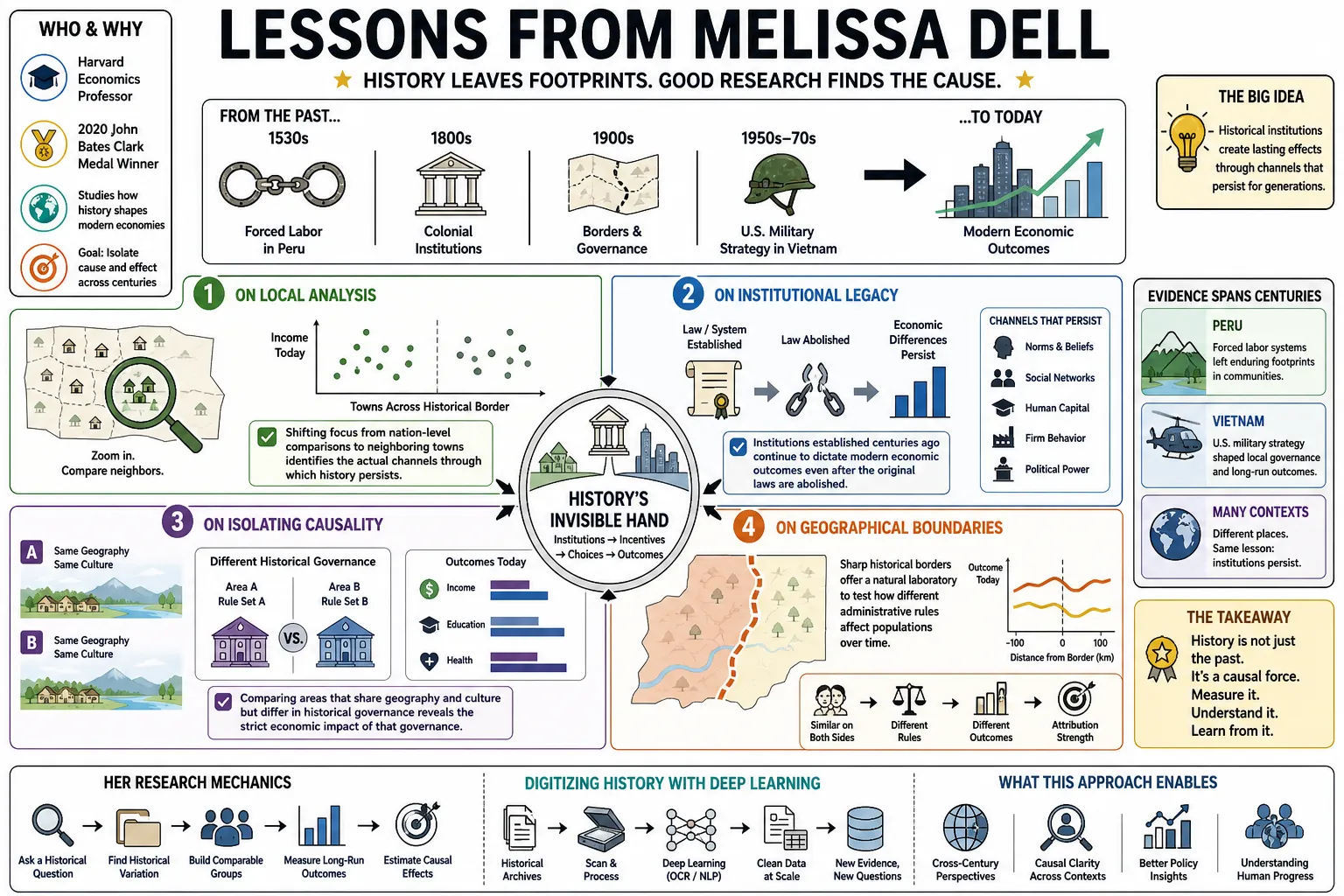
Harvard economics professor and 2020 John Bates Clark Medal winner Melissa Dell shows how historical institutions like forced labor in Peru and US military strategy in Vietnam shape modern economies. This collection looks at her methods for isolating cause and effect across centuries, alongside her recent work using deep learning to digitize historical archives.
Part 1: The Mechanics of Historical Persistence
- On local analysis: "Shifting focus from nation-level comparisons to neighboring towns identifies the actual channels through which history persists." — Source: [IMF Finance & Development]
- On institutional legacy: "Institutions established centuries ago continue to dictate modern economic outcomes even after the original laws are abolished." — Source: [The Beverage Report Podcast]
- On isolating causality: "Comparing areas that share geography and culture but differ in historical governance reveals the strict economic impact of that governance." — Source: [Harvard University News]
- On geographical boundaries: "Sharp historical borders offer a natural laboratory to test how different administrative rules affect populations over time." — Source: [Econometrica]
- On the invisible hand of history: "Historical labor systems act as an invisible hand, pushing regional development along divergent paths long after the systems end." — Source: [NBER Working Papers]
- On data granularity: "High-resolution, micro-level data allows researchers to track persistence over hundreds of years without losing the signal in national averages." — Source: [IMF Finance & Development]
- On the limits of cross-country regressions: "Broad cross-country comparisons often fail to capture the specific local mechanisms that drive inequality." — Source: [The Beverage Report Podcast]
- On historical context: "Understanding the precise rules of historical policies is necessary to map their modern economic consequences." — Source: [Harvard University News]
- On long-term divergence: "Minor differences in colonial administration can compound into massive disparities in wealth and health over two centuries." — Source: [Econometrica]
Part 2: The Long Shadow of the Mining Mita
- On the mita boundary: "Districts subjected to the colonial mining mita have household consumption levels 25 percent lower than adjacent exempt districts today." — Source: [Econometrica]
- On childhood health: "The historical burden of forced labor correlates directly with a six percentage point increase in stunted growth among modern children in those areas." — Source: [NBER Working Papers]
- On land ownership: "The mita system prevented the formation of large agricultural estates, which inadvertently restricted the political power needed to secure public goods." — Source: [Econometrica]
- On public goods: "Regions forced to send labor to the Potosí mines historically received fewer educational resources and remain less integrated into modern road networks." — Source: [Harvard University News]
- On subsistence farming: "Populations within the former mita boundaries are significantly more likely to rely on subsistence farming rather than wage labor." — Source: [Econometrica]
- On geographical controls: "Because the boundary was drawn arbitrarily across the Andes, modern differences cannot be attributed to elevation, climate, or ethnicity." — Source: [IMF Finance & Development]
- On institutional channels: "The persistence of poverty is driven by the structure of land tenure and the absence of infrastructure, rather than a direct transmission of poverty itself." — Source: [Econometrica]
- On the abolition of forced labor: "Ending a coercive labor system in 1812 did not erase its economic footprint, as the structural disadvantages had already solidified." — Source: [The Beverage Report Podcast]
- On regional inequality: "The forced labor system institutionalized inequality that regional governments have failed to correct over the subsequent centuries." — Source: [NBER Working Papers]
- On distance to mines: "The negative impacts of the mita are most pronounced in districts situated closer to the major mining centers where the labor was extracted." — Source: [Econometrica]
Part 3: Military Interventions in Vietnam
- On bombing effectiveness: "U.S. bombing campaigns in South Vietnam actively increased the military and political activities of the Viet Cong." — Source: [Quarterly Journal of Economics]
- On targeting algorithms: "Exploiting rounding thresholds in the U.S. military's targeting algorithm isolates the causal impact of air strikes from the underlying conflict dynamics." — Source: [NBER Working Papers]
- On local governance: "Heavy reliance on aerial bombardment weakened local administrative structures and reduced non-communist civic engagement." — Source: [Quarterly Journal of Economics]
- On hearts and minds: "Military strategies emphasizing overwhelming firepower led to higher insurgent activity compared to approaches focused on winning local support." — Source: [Harvard University News]
- On counterinsurgency backfires: "Applying maximum military force in civilian areas often radicalizes the population against the intervening power." — Source: [Quarterly Journal of Economics]
- On spatial discontinuities: "Comparing adjacent villages assigned to different military regions reveals how different command doctrines alter the course of a civil war." — Source: [NBER Working Papers]
- On data recovery: "Digitizing hamlet-level security evaluations from the Vietnam War era provides an unprecedented view into the micro-dynamics of counterinsurgency." — Source: [IMF Finance & Development]
- On civilian attitudes: "Bombardment consistently worsened local attitudes toward both the U.S. military and the South Vietnamese government." — Source: [Quarterly Journal of Economics]
- On military heuristics: "Arbitrary rules used by military planners to categorize security risks offer economists a perfect mechanism to test the results of those interventions." — Source: [NBER Working Papers]
- On long-term nation building: "Foreign interventions that prioritize kinetic military action over local institution building routinely fail to achieve their strategic objectives." — Source: [Quarterly Journal of Economics]
Part 4: State Action and the Mexican Drug War
- On electoral outcomes: "The election of mayors from the conservative PAN party led to immediate and significant spikes in drug-related violence." — Source: [American Economic Review]
- On cartel splintering: "When local governments cracked down on organized crime, it fractured existing cartels and sparked violent turf wars." — Source: [NBER Working Papers]
- On law enforcement strategies: "Aggressive law enforcement interventions can inadvertently increase homicide rates by disrupting stable criminal equilibriums." — Source: [American Economic Review]
- On close elections: "Using a regression discontinuity design on closely contested municipal elections isolates the effect of party policy from underlying crime trends." — Source: [NBER Working Papers]
- On violence spillovers: "Military crackdowns in one municipality cause violence to spill over into neighboring areas along the drug trafficking routes." — Source: [American Economic Review]
- On trade routes: "The geographical layout of the Mexican highway system determines exactly where displaced cartel violence will manifest." — Source: [Harvard University News]
- On state capacity: "Weak local institutions are unable to contain the violent fallout when federal or state policies attempt to dismantle organized crime." — Source: [American Economic Review]
- On economic costs: "The surge in violence following municipal crackdowns severely depresses local economic activity and female labor force participation." — Source: [NBER Working Papers]
- On policy trade-offs: "Policymakers must weigh the long-term goal of weakening cartels against the immediate cost of escalating homicides." — Source: [American Economic Review]
Part 5: Redefining the Regression Discontinuity Design
- On spatial methods: "Geographic regression discontinuity designs separate the effects of specific historical policies from gradual changes in culture or geography." — Source: [Econometrica]
- On identification strategies: "Finding an arbitrary line drawn by historical administrators is the gold standard for identifying causal effects in economic history." — Source: [The Beverage Report Podcast]
- On confounding variables: "Comparing populations strictly at the border of a policy change neutralizes the unobservable variables that plague standard observational studies." — Source: [NBER Working Papers]
- On algorithm thresholds: "Rounding errors and numerical cutoffs in government software create natural experiments that economists can exploit." — Source: [Quarterly Journal of Economics]
- On methodological rigor: "Empirical economics relies on discovering settings where treatment assignment mimics a randomized control trial." — Source: [IMF Finance & Development]
- On mapping boundaries: "Careful archival research is required to map exact historical borders before applying spatial econometrics." — Source: [Harvard University News]
- On treatment effects: "The discontinuity design measures the local average treatment effect, which may differ from the broader national average." — Source: [Econometrica]
- On policy evaluation: "Retrospective evaluation of policies using border designs provides hard evidence on what government actions actually work." — Source: [NBER Working Papers]
- On historical persistence: "Discontinuity methods prove that historical events act as active causes of modern disparities rather than mere correlated artifacts." — Source: [The Beverage Report Podcast]
Part 6: Deep Learning for Document Analysis
- On document digitization: "Standard OCR struggles with historical archives due to complex layouts, unusual fonts, and degraded paper quality." — Source: [LayoutParser Documentation]
- On EfficientOCR: "EffOCR frames character recognition as an image retrieval problem rather than a sequence-to-sequence language task." — Source: [ArXiv Research]
- On visual features: "Training contrastive vision encoders to recognize characters based strictly on appearance is highly sample-efficient." — Source: [Harvard University News]
- On LayoutParser: "LayoutParser provides a unified open-source toolkit for researchers to extract structured data from complex document images." — Source: [LayoutParser Documentation]
- On custom pipelines: "Historical economists need tools to train custom deep learning models on specific archival datasets without massive computing budgets." — Source: [ArXiv Research]
- On language models: "Decoupling character recognition from language models prevents the system from hallucinating modern text in historical documents." — Source: [Harvard University News]
- On deployability: "Creating lightweight, localized OCR models allows independent researchers to process millions of documents on standard hardware." — Source: [ArXiv Research]
- On physical archives: "Vast amounts of social science data remain trapped in hard copy; computer vision is the key to unlocking it." — Source: [LayoutParser Documentation]
- On table extraction: "Parsing historical census tables requires models that understand the spatial relationships between columns and rows independently of the underlying text." — Source: [ArXiv Research]
- On open-source tools: "Providing open-access deep learning toolkits accelerates the pace of empirical research across the humanities and social sciences." — Source: [Harvard University News]
Part 7: Building the American Stories Dataset
- On historical newspapers: "The American Stories dataset structures roughly 20 million public domain newspaper scans spanning from 1780 to 1960." — Source: [ArXiv Research]
- On layout detection: "Identifying headlines, bylines, and captions preserves the original context and hierarchy of the historical news." — Source: [LayoutParser Documentation]
- On text legibility: "Filtering out illegible scans using automated classifiers prevents downstream errors in historical text analysis." — Source: [ArXiv Research]
- On scale: "Processing a billion-scale collection of articles requires optimizing inference speeds without sacrificing transcription accuracy." — Source: [Harvard University News]
- On archival bias: "Systematically digitizing local newspapers corrects the historical bias that favors national publications and elite narratives." — Source: [ArXiv Research]
- On textual analysis: "Transforming image scans into structured databases allows economists to track the evolution of public sentiment over centuries." — Source: [The Beverage Report Podcast]
- On library collections: "Custom deep learning pipelines consistently outperform the standard, library-level OCR currently used by national archives." — Source: [LayoutParser Documentation]
- On local coverage: "Historical local news provides high-resolution data on economic shocks, labor strikes, and regional political movements." — Source: [ArXiv Research]
- On data liberation: "Converting raw images into queryable text liberates the primary sources needed to answer complex macroeconomic questions." — Source: [Harvard University News]
Part 8: The Interdisciplinary Frontier
- On merging fields: "Combining economic theory, historical archives, and computer science creates a new paradigm for quantitative social science." — Source: [IMF Finance & Development]
- On technological adoption: "Economists must adopt modern machine learning techniques to process the unstructured data of the real world." — Source: [The Beverage Report Podcast]
- On defining questions: "The ability to digitize any historical record allows researchers to ask questions that were previously considered unanswerable." — Source: [Harvard University News]
- On historical determinism: "Recognizing the persistence of historical institutions does not mean modern outcomes are deterministic or impossible to change." — Source: [IMF Finance & Development]
- On policy design: "Effective development policy requires an accurate understanding of the historical structures that maintain poverty in specific regions." — Source: [NBER Working Papers]
- On collaboration: "Building open-source software bridges the gap between computer vision engineers and economic historians." — Source: [LayoutParser Documentation]
- On original scholarship: "Researchers should apply AI tools to expand the scope of original data collection instead of solely synthesizing existing literature." — Source: [Harvard University News]
- On continuous innovation: "The frontier of economic history is defined by the tools available to extract meaning from complex, noisy sources." — Source: [The Beverage Report Podcast]
- On the ultimate goal: "The purpose of studying historical persistence is to provide the empirical foundation needed to dismantle entrenched economic inequality." — Source: [IMF Finance & Development]