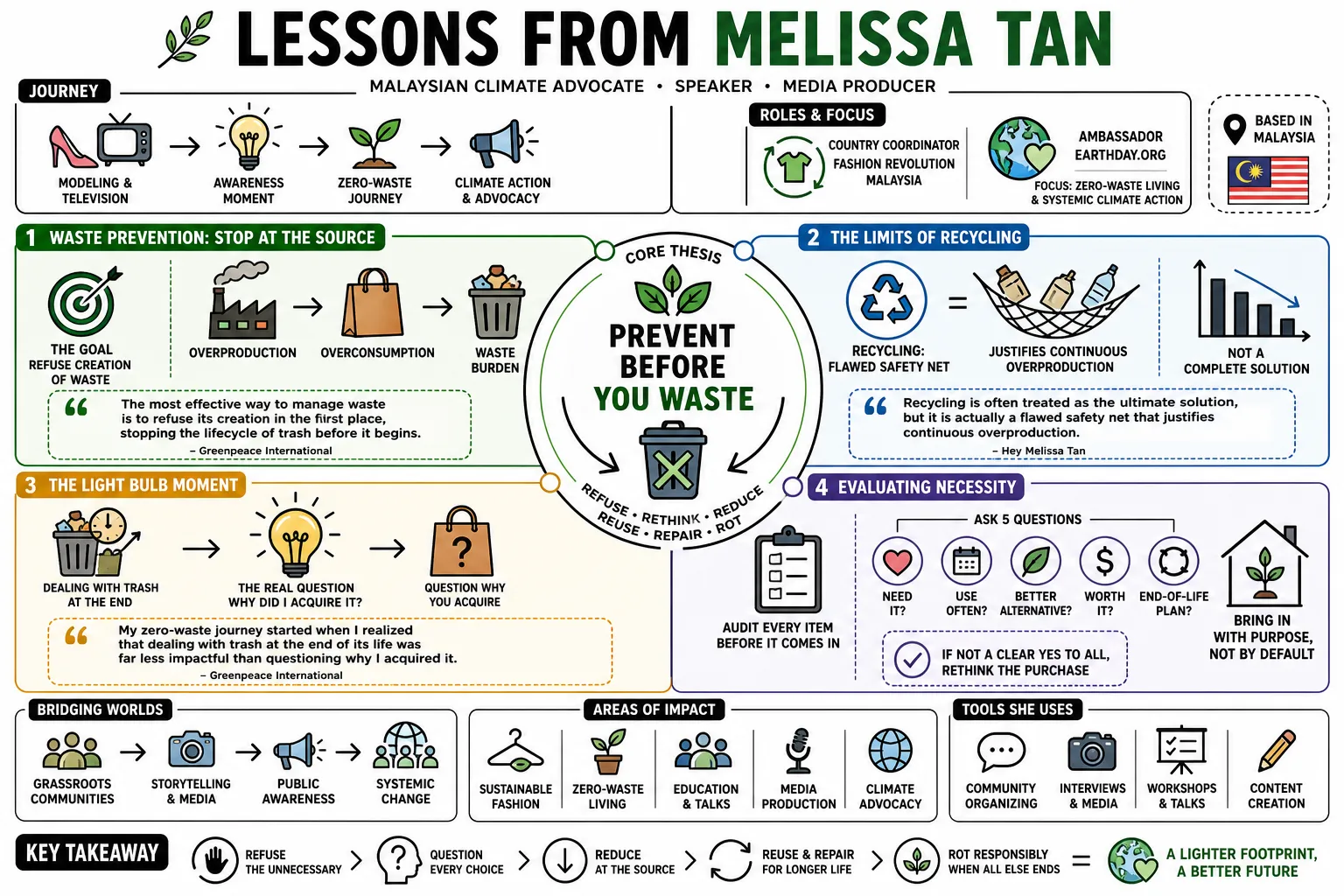
Melissa Tan is a Malaysian climate advocate, speaker, and media producer who transitioned from a career in modeling and television into environmental activism. She serves as the Country Coordinator for Fashion Revolution Malaysia and is an ambassador for EarthDay.org, focusing on zero-waste living and systemic climate action. This profile compiles her insights from community organizing, media interviews, and her work bridging grassroots sustainability efforts with public awareness.
Part 1: The Zero-Waste Philosophy
- On Waste Prevention: "The most effective way to manage waste is to refuse its creation in the first place, stopping the lifecycle of trash before it begins." — Source: Greenpeace International
- On the Limits of Recycling: "Recycling is often treated as the ultimate solution, but it is actually a flawed safety net that justifies continuous overproduction." — Source: Hey Melissa Tan
- On the Light Bulb Moment: "My zero-waste journey started when I realized that dealing with trash at the end of its life was far less impactful than questioning why I acquired it." — Source: Greenpeace International
- On Evaluating Necessity: "Every item brought into a home should be audited for its eventual end-of-life impact, prompting a shift from casual buying to deliberate stewardship." — Source: Green & Beyond Mag
- On Convenience Culture: "Populations can be spoilt by an efficient waste management system, which inadvertently discourages personal responsibility for the volume of trash generated." — Source: ResearchGate
- On Auditing Personal Trash: "Looking directly at what you throw away over a month forces a confrontation with your own consumption habits that abstract statistics cannot achieve." — Source: Hello Mentor Podcast
- On the Lifecycle of Materials: "Understanding materials means recognizing that a single-use plastic item will outlive the person who used it by centuries." — Source: Earth Day Network
- On Imperfect Zero-Waste: "The goal isn't to fit a year's worth of trash into a single glass jar; the goal is to make sustainable choices accessible and habitual for the average person." — Source: Green & Beyond Mag
- On Visual Waste: "When trash is out of sight, it is out of mind. Bringing visibility to local landfills changes how communities interact with single-use packaging." — Source: WWF Singapore
- On Shifting from Disposal to Stewardship: "We have to stop viewing ourselves as end-consumers and start viewing ourselves as temporary custodians of the materials we use." — Source: Hey Melissa Tan
Part 2: Dismantling "Sustainable" Fashion
- On the Myth of Sustainable Purchases: "No piece can solve sustainability, so buying another thing because they told you it was sustainable is never going to solve anything." — Source: Prestige Magazine
- On Clothes Swapping: "Swapping garments removes the financial transaction from fashion, forcing participants to value clothing for its utility and design rather than its retail price." — Source: Fashion Revolution Malaysia
- On the True Cost of Fast Fashion: "Cheap clothing is subsidized by the exploitation of garment workers and the degradation of local environments, meaning someone else is paying the actual price." — Source: FirstClasse
- On Thrifting as the First Resort: "Secondhand shopping should be the default mechanism for acquiring clothes, not a niche alternative for the environmentally conscious." — Source: The Conscious Market
- On Trend Cycles: "The acceleration of micro-trends is designed specifically to manufacture obsolescence, making you feel outdated so you buy more." — Source: Prestige Magazine
- On Extending Garment Lifespans: "The most sustainable garment is the one that already exists in your wardrobe, making repair and maintenance radical acts." — Source: Fashion Revolution Malaysia
- On Transparency in the Supply Chain: "Without full traceability of where materials are sourced and who stitched the fabric, environmental claims are just marketing." — Source: FirstClasse
- On Rejecting Seasonal Pressures: "Divorcing personal style from the industry's seasonal calendar is necessary to stop the cycle of constant wardrobe rotation." — Source: Hey Melissa Tan
- On Mindful Curation: "Building a wardrobe should be an exercise in curation over accumulation, focusing on pieces that serve multiple functions across different contexts." — Source: Green & Beyond Mag
- On the Term 'Sustainable Fashion': "There is no such thing as sustainable fashion in the current industry model; there is only less destructive fashion." — Source: Prestige Magazine
Part 3: Individual Action as Prototypes
- On Personal Agency: "So instead of just like sitting back and waiting for something to happen, try and do it for yourself because what you're doing is actually the pilot of what could be scaled up." — Source: The Commons Podcast
- On Overcoming Paralysis: "The scale of the climate crisis often induces paralysis, but action at the household level breaks that inertia and builds momentum." — Source: Earth Day Network
- On Modeling Behavior: "You don't need to lecture peers about sustainability; consistently modeling zero-waste habits in public is often a more effective catalyst for change." — Source: Greenpeace International
- On the Ripple Effect: "A single person demanding plastic-free alternatives at a local market can shift the vendor's practices for all future customers." — Source: WWF Singapore
- On Voting with Dollars: "Every purchase is a quiet endorsement of a company's supply chain and labor practices." — Source: FirstClasse
- On Localized Impact: "Global climate metrics are hard to grasp, but restoring a local community garden or reducing neighborhood waste provides immediate, tangible proof of concept." — Source: The Conscious Market
- On Normalizing Climate Consciousness: "The goal of individual action is to make sustainable choices appear so routine that they no longer register as alternative." — Source: Hello Mentor Podcast
- On Grassroots Prototyping: "Community initiatives serve as testing grounds for policies that city councils and governments can eventually adopt." — Source: The Commons Podcast
- On Rejecting Apathy: "Assuming your actions do not matter is a self-fulfilling prophecy that benefits the industries currently profiting from environmental degradation." — Source: Green & Beyond Mag
Part 4: Confronting Greenwashing and Systemic Flaws
- On Corporate ESG Reporting: "Many corporate sustainability reports are exercises in creative accounting, measuring metrics that look good rather than those that actually reduce harm." — Source: FirstClasse
- On Carbon Offset Limitations: "Paying for carbon credits to excuse ongoing emissions is a dangerous loophole that delays necessary systemic transitions." — Source: Greenpeace International
- On Deceptive Marketing: "If a brand spends more capital advertising their eco-friendly initiative than implementing it, the initiative is just public relations." — Source: Prestige Magazine
- On Prioritizing Planetary Health: "True sustainability requires an economic framework that places human health and ecological stability above quarterly profit margins." — Source: FirstClasse
- On Questioning 'Eco-Friendly' Labels: "Consumers must develop the media literacy to interrogate what an 'eco-friendly' tag actually guarantees about a product's lifecycle." — Source: Hey Melissa Tan
- On Systemic vs. Surface-Level Change: "Trading a plastic cup for a bioplastic cup addresses the surface issue; dismantling the single-use culture addresses the systemic issue." — Source: Earth Day Network
- On Holding Brands Accountable: "Public pressure must focus not just on demanding new green products, but on forcing companies to take responsibility for the waste they have already generated." — Source: Fashion Revolution Malaysia
- On Regulatory Necessity: "Voluntary corporate commitments are insufficient; without binding legislation, the pace of environmental reform will remain too slow." — Source: WWF Singapore
- On Influencer Marketing: "The influencer economy is inherently tied to driving consumption, creating a fundamental tension for those trying to advocate for sustainability on social media." — Source: Prestige Magazine
Part 5: Grassroots Community Organizing
- On Producing Community Events: "Events like clothes swaps and zero-waste markets are not just transactional spaces; they are physical gatherings that build solidarity among isolated advocates." — Source: The Conscious Market
- On Shared Resources: "Moving away from hyper-individualism means embracing community libraries, tool-sharing, and mutual aid to reduce overall consumption." — Source: The Commons Podcast
- On Collective Education: "Sustainability cannot be an academic concept kept behind paywalls; it must be translated into practical, accessible community workshops." — Source: Rainforest Youth Summit
- On Creating Accessible Entry Points: "Grassroots organizing works best when it offers low-barrier entry points, allowing people to engage without feeling they need to be perfect environmentalists." — Source: Green & Beyond Mag
- On Facilitating Dialogue: "Lasting change in a community happens when neighbors have the space to discuss the specific environmental challenges affecting their immediate surroundings." — Source: The Conscious Market
- On Shifting Neighborhood Norms: "When a critical mass of a community adopts a sustainable practice, the social pressure shifts, pulling reluctant individuals along." — Source: The Commons Podcast
- On Intersectional Environmentalism: "Environmental advocacy must include the voices of marginalized groups who disproportionately face the impacts of industrial pollution and climate change." — Source: Fashion Revolution Malaysia
- On Sustaining Volunteer Momentum: "Volunteer burnout is a major risk in organizing; maintaining momentum requires celebrating small wins and distributing the workload." — Source: Earth Day Network
- On the Role of Local Markets: "Curated conscious markets provide a necessary infrastructure, connecting ethical producers directly with consumers who want to change their habits." — Source: Hey Melissa Tan
Part 6: Redefining Consumer Identity
- On the 'Recycle Junkie' Origin: "Early in my journey, I was obsessed with recycling everything, before realizing that true efficiency lies in not acquiring the item at all." — Source: Green & Beyond Mag
- On Breaking Consumption Habits: "Stopping impulsive shopping requires treating consumption as an addiction that demands intentional, daily behavioral adjustments." — Source: Hello Mentor Podcast
- On the Psychology of Shopping: "Retail therapy is a temporary fix for emotional voids, but the environmental hangover of those purchases is permanent." — Source: Prestige Magazine
- On Identity Outside of Ownership: "We have been conditioned to signal our values and status through what we buy, requiring a conscious uncoupling of identity from possessions." — Source: BFM 89.9
- On Minimalism and Mental Clarity: "Reducing physical clutter invariably leads to mental clarity, making room for pursuits that don't involve material acquisition." — Source: Hey Melissa Tan
- On Resisting Targeted Advertising: "Navigating modern digital spaces requires active defense mechanisms against algorithms designed to exploit our insecurities for profit." — Source: FirstClasse
- On the Privilege of Choice: "Choosing zero-waste options is often a privilege of time and resources; the goal is to advocate for systems that make it the default for everyone." — Source: Greenpeace International
- On Unlearning Convenience: "We must unlearn the expectation that everything should be immediately available, instantly disposable, and perfectly packaged." — Source: Earth Day Network
- On Mindful Purchasing Pauses: "Instituting a mandatory waiting period between wanting an item and buying it eliminates the vast majority of unnecessary purchases." — Source: The Conscious Market
Part 7: Effective Climate Storytelling
- On Leveraging Media Platforms: "Television and digital media must be co-opted to mainstream environmental issues, moving them from niche documentaries to daily entertainment." — Source: BFM 89.9
- On the Impact of Visual Evidence: "Data rarely changes minds, but showing the visceral reality of plastic choking a local waterway forces immediate emotional engagement." — Source: WWF Singapore
- On the Antarctic Expedition: "Witnessing the rapid degradation of pristine environments like Antarctica crystallizes the urgency of the crisis in a way that reading about it cannot." — Source: Green & Beyond Mag
- On Making Science Accessible: "The role of a climate communicator is to act as a translator, turning dense IPCC reports into actionable, relatable community directives." — Source: Earth Day Network
- On Avoiding Doom-Scrolling Narratives: "Constant fatalism induces apathy; climate storytelling must balance the severity of the threat with tangible pathways for meaningful intervention." — Source: The Commons Podcast
- On Authentic Advocacy: "Audiences can spot performative activism instantly; effective storytelling requires the advocate to live the principles they are preaching." — Source: Prestige Magazine
- On Bridging the Gap: "There is a massive disconnect between scientific consensus and public behavior; closing that gap requires narratives rooted in local, daily realities." — Source: Hello Mentor Podcast
- On Storytelling as a Catalyst: "A well-told story about a community overcoming an environmental challenge is a blueprint that other communities can copy." — Source: Rainforest Youth Summit
- On Maintaining Audience Engagement: "You cannot shame people into caring about the planet; you have to invite them into a narrative where their participation matters." — Source: FirstClasse
Part 8: Resilience and Long-Term Activism
- On Navigating Climate Anxiety: "Eco-anxiety is a rational response to ecological destruction, but it must be channeled into collective action rather than isolated despair." — Source: Greenpeace International
- On Career Transitions: "Pivoting from traditional modeling to climate advocacy was a necessary alignment of my professional output with my internal ethics." — Source: Hello Mentor Podcast
- On Endurance in Advocacy: "Environmentalism is not a short-term campaign; it requires the pacing and stamina of a lifelong marathon." — Source: Earth Day Network
- On Finding Hope in Action: "Hope is not a prerequisite for action; rather, sustained action generates the hope necessary to continue the work." — Source: The Commons Podcast
- On Setting Boundaries: "Activists must protect their own mental health; burning out in the pursuit of planetary health is entirely counterproductive." — Source: Green & Beyond Mag
- On Celebrating Small Victories: "Acknowledging minor policy shifts or local community wins is vital fuel for sustaining long-term systemic campaigns." — Source: Fashion Revolution Malaysia
- On the Evolution of Personal Advocacy: "Your approach to activism should mature over time, shifting from rigid personal purity to a focus on flexible, systemic coalition building." — Source: Hey Melissa Tan
- On Intergenerational Responsibility: "We are operating with the knowledge that our current choices permanently dictate the living conditions of future generations." — Source: Rainforest Youth Summit
- On Learning from Setbacks: "A failed sustainability initiative is not a reason to quit; it is data on what specific barriers need to be dismantled next." — Source: FirstClasse
- On the Lifelong Commitment to the Planet: "There is no finish line where the planet is definitively 'saved'; there is only the ongoing, daily practice of doing less harm and more good." — Source: WWF Singapore