Mellody Hobson is the Co-CEO and President of Ariel Investments and the former chair of the Starbucks board. She is known for her advocacy of long-term "active patience" in investing and for challenging corporate America to be "color brave" rather than color blind. This profile explores her frameworks for financial independence, board leadership, and navigating both markets and life with unflinching resilience.
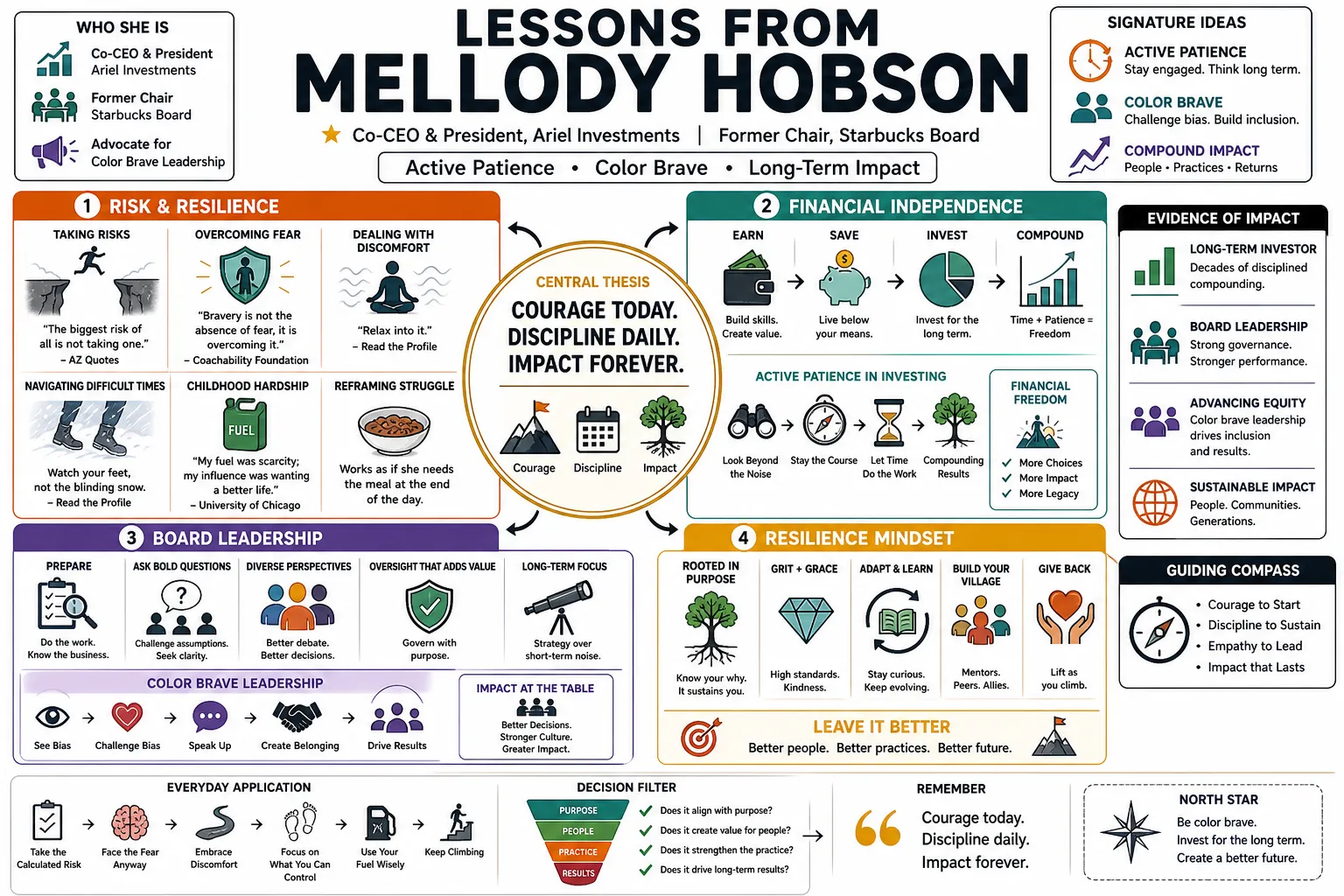
Part 1: Risk and Resilience
- On Taking Risks: "The biggest risk of all is not taking one." — Source: AZ Quotes
- On Overcoming Fear: "Bravery is not the absence of fear, it is overcoming it." — Source: Coachability Foundation
- On Dealing with Discomfort: "If we can learn to deal with our discomfort and just relax into it, we'll have a better life." — Source: Read the Profile
- On Navigating Difficult Times: In a storm, you must watch your feet rather than looking up at the blinding snow, or else you will fall. — Source: Read the Profile
- On Childhood Hardship: "My fuel was scarcity; my influence was wanting a better life." — Source: University of Chicago
- On Reframing Struggle: She still works as if she needs the meal at the end of the day, using early financial anxiety as an ongoing source of drive. — Source: Read the Profile
- On Handling Criticism: Hobson treats hard feedback as useful only after separating signal from delivery: look for the grain of truth, learn from repeated criticism, and avoid helping critics by turning their judgment into destructive self-talk. — Reference: TED transcript on Hobson taking tough feedback and finding signal in criticism
- On Acknowledging Fear: Taking the leap often comes down to asking yourself the simple question of what the absolute worst-case scenario could actually be. — Source: Her Network
- On Tenacity: Maintaining a hard-core mentality is a prerequisite for enduring the inevitable plot twists of a long career. — Source: Entrepreneur
- On Enduring the Market: Volatility is not merely a condition to survive, but a structural reality to exploit. — Source: Masters of Scale
Part 2: Diversity and Inclusion
- On Being Color Brave: "Instead of being color blind, we need to be color brave." — Source: TED
- On Honest Conversations: It is time for leaders to become completely comfortable having uncomfortable conversations about race in the workplace. — Source: AZ Quotes
- On Expanding Your Circle: "Invite people into your life who don't look or act like you. You might find they challenge your assumptions and make you grow." — Source: Read the Profile
- On Talent Distribution: Genius and talent do not discriminate by race or gender, even if they are not equally represented in corporate environments. — Source: Harvard Business School
- On Corporate Survival: Failing to build a genuinely diverse board is essentially committing corporate suicide in the modern business era. — Source: CBS News
- On Competitive Advantage: Embracing diversity is not just a moral obligation; it is a measurable competitive advantage in the marketplace. — Source: AZ Quotes
- On Avoiding Echo Chambers: Hobson argues that leaders should be color brave rather than color blind, because openly discussing race and widening who is represented in decision-making makes organizations smarter and less blind to reality. — Reference: TED talk on being color brave rather than color blind
- On Title vs. Insight: Just because someone holds a massive title and makes a lot of money does not inherently mean their ideas are better than yours. — Source: MasterClass
- On Actionable Diversity: Companies need far less talk and significantly more elbow grease when it comes to fixing the racial makeup of their leadership. — Source: CBS News
- On Representation: When you are the only person of color in the room, it is your responsibility to speak up so that your unique perspective is on the record. — Source: TED
Part 3: Financial Literacy and Independence
- On Personal Responsibility: "As women, we are raised to have rescue fantasies. I'm here to tell you... no one is coming." — Source: Wilfred Bain
- On Demystifying Money: Exposing children to the everyday costs of goods is the first step in breaking cycles of financial illiteracy. — Source: Morningstar
- On Starting Small: The most crucial financial decision is simply to start saving, because even small amounts compound meaningfully over time. — Source: Her Network
- On Compound Interest: Understanding how compound interest works is the single most important concept for anyone hoping to build generational wealth. — Source: NGPF
- On Financial Dieting: Saving money must be treated with the same consistency as a diet, where retirement funds are considered untouchable. — Source: Her Network
- On Survival: True financial literacy is not just a tool for wealth generation; it is fundamentally a life-saving skill. — Source: AZ Quotes
- On Practical Education: Having a child pay the check at a restaurant is a highly effective way to teach them the real value of a dollar. — Source: Morningstar
- On Teaching Parents: If you can successfully teach a child about money, you automatically teach their parents in the process. — Source: Princeton University
- On Honest Anchoring: Parents must anchor financial conversations in reality rather than shielding their children from the costs of living. — Source: Charles Schwab
- On Taking Ownership: Waiting to be rescued financially is a trap; you must be the active architect of your own economic stability. — Source: Wilfred Bain
Part 4: Investment Philosophy
- On Patience: "Patience wins." — Source: Read the Profile
- On Time Arbitrage: The core of a successful long-term strategy is playing time arbitrage against a market that is obsessed with the short term. — Source: Read the Profile
- On Steady Growth: The tortoise always wins; slow and steady growth is vastly superior to chasing quick, unpredictable gains. — Source: The Motley Fool
- On Active Patience: True patience is not static; it requires active, bottom-up fundamental research while you wait for the right opportunity. — Source: Ariel Investments
- On Finding Value: The best investments are often found in companies that are temporarily misunderstood, ignored, or underfollowed by the broader market. — Source: Ariel Investments
- On Independent Thinking: Conviction must be built on independent research rather than mindlessly following benchmark indexes. — Source: Ariel Investments
- On Margin of Safety: Waiting for the perfect pitch means doing all the background work and striking only when the price offers a massive margin of safety. — Source: Ariel Investments
- On Market Reactions: A disciplined investor must ignore the noise of temporary market volatility and focus entirely on the underlying business fundamentals. — Source: Ariel Investments
- On Economic Moats: Identifying durable franchises with significant barriers to entry is the bedrock of a long-term portfolio. — Source: Ariel Investments
Part 5: Leadership and Decision-Making
- On Excellence: "Excellence is an input; success is an outcome." — Source: University of Chicago
- On Subject Matter Expertise: In the Aspire episode description, Hobson and Emma Grede frame subject matter expertise as a foundation of real leadership, especially for thriving in male-dominated spaces and negotiating for yourself. — Reference: Apple Podcasts episode notes for Aspire with Mellody Hobson
- On Giving Feedback: Honest feedback is a gift, and it is entirely unhelpful to just tell employees they are doing great when they have room to grow. — Source: Podcast Transcript AI
- On Receiving Feedback: When criticized, the most productive response is to internally ask why the person is saying it and accept the insight without defensiveness. — Source: McKinsey
- On Board Stewardship: When sitting in a boardroom, a leader must actively imagine an employee and a shareholder sitting right at the table with them. — Source: Starbucks
- On Strategic Thinking: Strategic decision-making is not a skill reserved for executives; it is a framework that can be applied to any daily challenge. — Source: MasterClass
- On Listening: To avoid sucking the air out of a room, make it a deliberate habit to ask questions about other people immediately upon entering. — Source: McKinsey
- On Long-Term Commitment: Building a career through decades of persistence at one firm often yields deeper mastery than constantly chasing the next trend. — Source: Podcast Transcript AI
- On Corporate Transformation: When Starbucks named Hobson non-executive chair, she credited the company with elevating and transforming its business over nearly two decades by adapting to market environments and evolving consumer trends. — Reference: Business Wire release on Hobson becoming Starbucks non-executive chair
Part 6: Personal Growth and Perspective
- On Happiness: "I'm a 'happy warrior' because I actually am happy." — Source: Read the Profile
- On Finding Belonging: Even when you are the first in your family to attend an elite institution, you must carry the conviction that you perfectly belong there. — Source: Princeton University
- On Perspective: Maintaining a wide perspective during difficult plot twists is exactly what prevents you from breaking under pressure. — Source: Omny.fm
- On Daily Practice: Excellence is not a destination you arrive at, but a continuous, daily practice that you apply to every small task. — Source: University of Chicago
- On Forgiving the Past: Acknowledging the devastation of childhood instability does not mean holding resentment; you can recognize your parents lacked the tools without blaming their intent. — Source: Princeton University
- On Self-Talk: Hobson says Lewis Hamilton repeatedly reminded her to speak kindly to herself in her head, because ambitious people can beat themselves up even before the outside world starts criticizing them. — Reference: UChicago Graham School podcast with Mellody Hobson
- On Enduring Hardship: When frustrated by isolation or setbacks, anchoring yourself in historical perspective can immediately restore your gratitude. — Source: Fantha Tracks
- On Personal Bravery: Being brave in your personal life requires the exact same courage it takes to be bold in your professional life. — Source: Entrepreneur
- On Embracing Discomfort: If you consistently lean into the things that make you uncomfortable, your baseline for what you can handle will drastically expand. — Source: Read the Profile
Part 7: Relationships and Marriage
- On Mutual Respect: A successful marriage is built on profound mutual respect and the simple joy of having found each other. — Source: Thrive Global
- On Removing Competition: The secret to a high-functioning partnership between two driven people is entirely eliminating any sense of competition between them. — Source: Thrive Global
- On Celebrating Success: When your partner is an iconic figure, the healthiest response is to simply accept it, be proud of it, and celebrate it fully. — Source: Thrive Global
- On Letting Go: "Jedi don't hold on." When someone leaves your life or company, you must let them go rather than clinging to what is lost. — Source: Fandom
- On Awe: A strong relationship requires that both people remain in complete awe of each other in a deeply healthy way. — Source: Thrive Global
- On Opening Up: Allowing yourself to be brave in love inherently means opening yourself up to the very real possibility of heartbreak. — Source: Entrepreneur
- On Emotional Independence: You must enter a relationship as a fully formed architect of your own life rather than looking for a rescuer. — Source: Wilfred Bain
- On Shared Wisdom: Marrying someone with a completely different life experience allows you to anchor your daily frustrations in their broader historical wisdom. — Source: Jedi News
- On Partnership Dynamics: A thriving relationship functions best when both individuals are equally committed to making the other person feel valued and heard. — Source: Thrive Global
Part 8: Philanthropy and Education
- On Giving Back: "My pledge is to the process; as long as I have the resources at my disposal, I will seek to raise the bar for future generations." — Source: The Giving Pledge
- On Artisan Learning: Education should function as an artisan apprenticeship built on deep questioning, not an assembly line designed just to produce diplomas. — Source: The Giving Pledge
- On Systemic Change: True philanthropy requires dedicating the majority of your wealth to aggressively closing the opportunity gaps in education. — Source: The Giving Pledge
- On Financial Inclusion: Hobson calls financial illiteracy dangerous for society and argues that children need better opportunities to understand the stock market and investing early, not only after wealth has already accumulated elsewhere. — Reference: CNBC article on Hobson calling financial illiteracy dangerous
- On Active Engagement: Teaching students through real-world scenarios, like managing actual investment portfolios, leaves a far deeper impact than theoretical lectures. — Source: Princeton University
- On Legacy: Establishing physical spaces and endowments for marginalized students ensures that they know they belong at elite institutions for centuries to come. — Source: Princeton University
- On After-School Programs: Investing heavily in extracurricular arts and culture is vital for keeping high school students engaged and ambitious about their futures. — Source: Bookey
- On Expanding Access: Philanthropy should focus on providing practical tools to families who have been historically excluded from wealth-building conversations. — Source: Princeton University
- On Generational Impact: Empowering a single student with financial literacy acts as a catalyst that eventually transforms the economic trajectory of their entire family. — Source: Princeton University