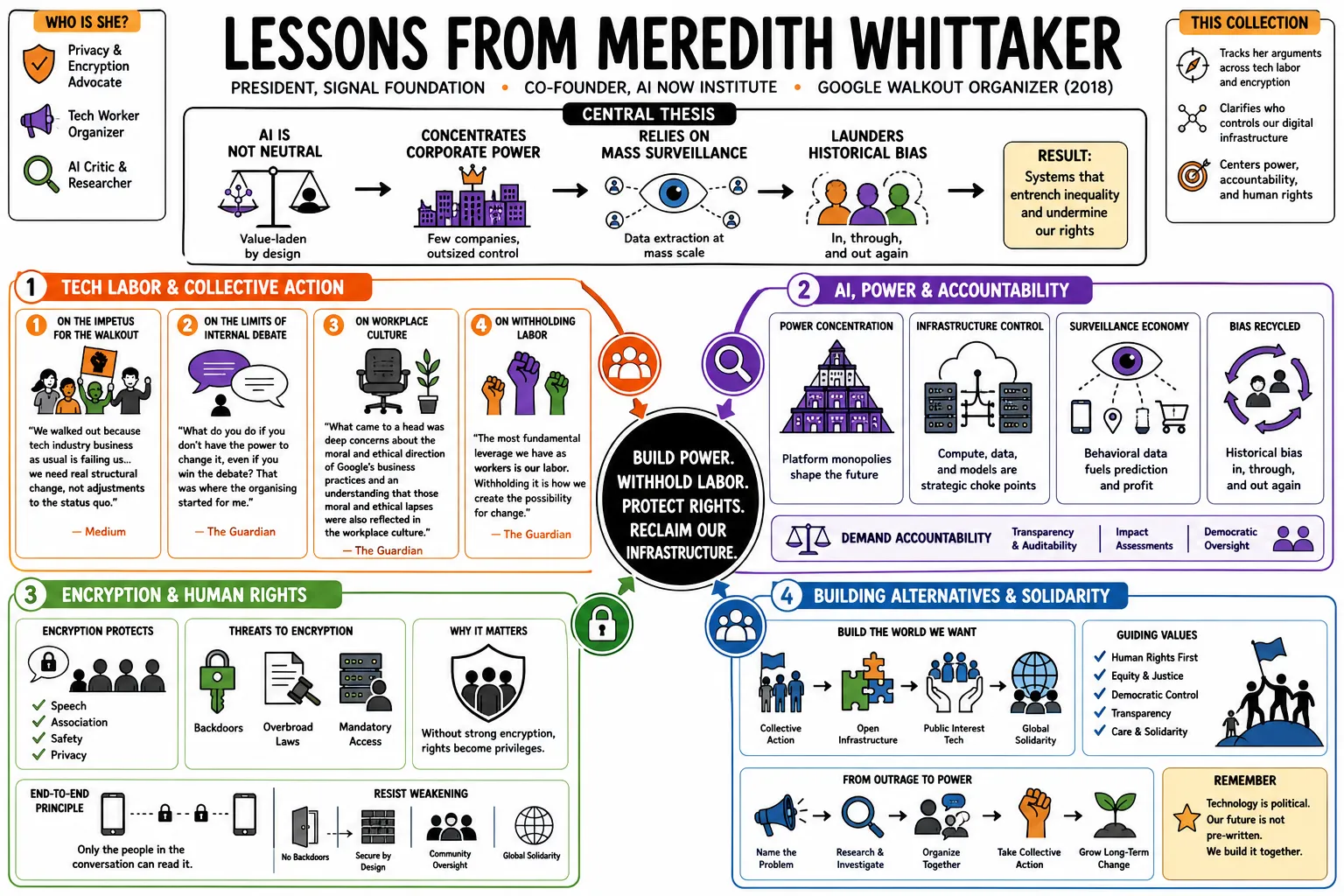
Meredith Whittaker is the President of the Signal Foundation, co-founder of the AI Now Institute, and a central organizer of the 2018 Google Walkout. Her work rejects the idea that artificial intelligence is neutral, showing how these systems instead concentrate corporate power, rely on mass surveillance, and launder historical bias. This collection tracks her arguments across tech labor and encryption to clarify who actually controls our digital infrastructure.
Part 1: Tech Labor and Collective Action
- On the impetus for the walkout: "We walked out because tech industry business as usual is failing us... we need real structural change, not adjustments to the status quo." — Source: Medium
- On the limits of internal debate: "What do you do if you don't have the power to change it, even if you win the debate? That was where the organising started for me." — Source: The Guardian
- On workplace culture: "What came to a head was deep concerns about the moral and ethical direction of Google's business practices and an understanding that those moral and ethical lapses were also reflected in the workplace culture." — Source: The Guardian
- On withholding labor: "There's a lot of power in being able to withhold your labor collectively, and joining together as the people that ultimately make these companies function or not, and say, 'We're not going to do this.'" — Source: Fast Company
- On the necessity of worker-led intervention: "My sense is that intervention is going to need to be led by organized tech workers and social movements who are kind of demanding this, because it would signal a radical shift of how the tech industry operates." — Source: Business Insider
- On unionization: "This is why the union effort is so positive, why workers taking control over the work and actually building the power to direct those decisions instead of executives is so important." — Source: Gizmodo
- On the employer as family myth: "Mass layoffs simply prove the point that your employer is not your family." — Source: Fast Company
- On corporate retaliation: "Retaliation isn't always obvious... people who stand up and report discrimination, abuse, and unethical conduct are punished, sidelined, and pushed out." — Source: Mashable
- On systemic unaccountability: "Google paying $90M to Andy Rubin is one example among thousands, which speak to a company where abuse of power, systemic racism, and unaccountable decision-making are the norm." — Source: Medium
- On the structural stakes of AI development: "Addressing these problems, and making sure AI is just, accountable, and safe, will require serious structural change to how technology is developed and how tech corporations are run." — Source: Medium
Part 2: The Myth of Neutral AI and Historical Bias
- On the reality of training data: "It is determining our access to resources, our access to opportunity, our place in the world. And, of course, it's determining this based on past data... So it is, and I believe inextricably will be, replicating patterns of historical inequality and marginalization." — Source: Fast Company
- On naturalizing inequality: "It's naturalizing often racist and misogynist determinations about people's place in the world behind the veil of computational sophistication." — Source: The Guardian
- On the impossibility of a pristine algorithm: "There isn't a way to get out of that and then be like, 'This is a pristine, unbiased algorithm', because data is authored by people. It's always going to be a recycling of the past and then spitting that out." — Source: The Guardian
- On the illusion of objectivity: "There is no Cartesian window of neutrality that you can put an algorithm behind and be like, 'This is outside our present and history.'" — Source: The Guardian
- On truth versus plausibility: "This is not a system that has any understanding of veracity or truth, right? Like facts are bolted on post hoc as sort of an afterthought... This is an aggregate of some of the worst and maybe best parts of text on the internet spit back out as plausible-sounding content." — Source: Fast Company
- On human accountability: "Technology is built by humans and controlled by humans, and we cannot talk about technology as an independent agent acting outside of human decisions and accountability." — Source: The Innovator
- On disability and normative assumptions: "How can we draw from disability activism and scholarship to ensure that we protect people who fall outside of the 'norms' reflected and constructed by AI systems?" — Source: AI Now Institute
- On power asymmetries in algorithms: "Beyond biased data, additional risks are presented by the significant power asymmetries between those with the resources to design and deploy AI systems, and those who are classified, ranked, and assessed by these systems." — Source: AI Now Institute
- On algorithmic subjects: "We are not the users of AI; we are the subjects of AI." — Source: YouTube
Part 3: Big Tech Monopoly and Concentration of Power
- On deployment against the vulnerable: "AI is a tool that will largely be used by those who already have power, like our bosses, the police, and the border patrol, on those who have less power." — Source: YouTube
- On derivative technologies: "AI as we understand it today is fundamentally a technology that is derivative of centralized corporate power and control." — Source: YouTube
- On the concentration of resources: "It is built on the concentrated resources that accrue to a handful of large tech corporations... largely based in the US and China via the surveillance advertising business model." — Source: YouTube
- On the true nature of AI infrastructure: "Infrastructure isn't just chips. Infrastructure is data infrastructure, is labor infrastructure, is the sort of sedimentary layers of standards and practices that attend to all of that." — Source: Springerin
- On global AI supremacy: "We see a bipolar universe when it comes to AI where you have the giants in the US and then some in China duking it out for AI supremacy." — Source: YouTube
- On artificial power: The authority AI grants tech companies allows them to influence governance, knowledge, and daily life far beyond their actual market value. — Source: Noema Magazine
- On who really controls the pause button: "These are the people who could actually pause AI if they wanted to, because they control the compute and data infrastructure required for modern AI." — Source: The Guardian
- On unprecedented consolidation: We are currently witnessing the greatest concentration of computational and economic power in history, commanded by a handful of companies that answer to almost no one. — Source: Noema Magazine
- On the dependency of modern AI: You simply cannot build or deploy artificial intelligence at scale without relying on the vast, proprietary infrastructure owned by a few mega-corporations. — Source: Fast Company
Part 4: Surveillance Capitalism and Extraction
- On the origins of modern AI: "AI is a derivative of surveillance capitalism. It is a technology that requires massive amounts of data and massive amounts of centralized compute... it is a technology of extraction." — Source: The Verge
- On the business model foundation: "The AI we have today is ultimately built on the back of that kind of platform... surveillance advertising business model." — Source: TechMeme
- On AI as an extractive force: "AI is a technology of extraction. It requires vast amounts of data, vast amounts of compute, and vast amounts of human labor." — Source: YouTube
- On surveillance as a systemic illness: "Surveillance was a 'disease' from the very beginning of the internet, and encryption is deeply threatening to the type of power that constitutes itself via these information asymmetries." — Source: The Guardian
- On information asymmetry: "We're not going to convince those in power that they should give up their pursuit of information asymmetry as a tool of power, which is effectively what surveillance generates for those who surveil over those who are surveilled." — Source: CyberScoop
- On the true purpose of massive datasets: The relentless accumulation of human data serves as the central, driving economic engine of the modern internet. — Source: ON with Kara Swisher
- On the illusion of free services: The cost of free consumer technology is the total subjugation of our digital lives into exploitable data streams. — Source: The Verge
- On the normalization of tracking: We have allowed corporations to normalize a level of intimate surveillance that would be considered abhorrent if conducted by a physical person in our living rooms. — Source: ON with Kara Swisher
- On the branding of AI: Often, what is sold to the public as artificial intelligence is merely a sophisticated rebrand of traditional surveillance architecture. — Source: POLITICO
Part 5: The Hype and Distraction of Existential Risk
- On the misdirection of AI doomsday: "AI's biggest risk isn't 'consciousness', it's the corporations that control them." — Source: Fast Company
- On the marketing of ghost stories: "These ghost stories about existential risk are effectively advertisements for a technology that only a handful of companies have." — Source: Springerin
- On the convenience of sci-fi fears: "Geoff Hinton’s warnings are much more convenient, because they project everything into the far future so they leave the status quo untouched." — Source: The Guardian
- On the arrogance of the existential threat narrative: "What I hear in that is: 'Those current harms aren't existential to me. I have millions of dollars... but what could affect my existence is if a sci-fi fantasy came to life and men like me would not be the most powerful entities in the world.'" — Source: The Guardian
- On bypassing present harms: Obsessing over rogue, sentient AI allows powerful executives to evade accountability for the real-world discrimination, labor exploitation, and privacy violations happening right now. — Source: Reddit
- On the illusion of a runaway train: Framing AI as an unstoppable force of nature obscures the fact that it is a human-made product, developed by specific people making deliberate choices. — Source: Reddit
- On moving fast and breaking things: "How do we make sure that you move as slowly as you have to to get it right? Because the consequences for the rest of us aren't worth the payout for a few." — Source: Fast Company
- On treating AI as magic: By mystifying artificial intelligence as an alien entity, we excuse the very human executives who deploy it from legal and moral responsibility. — Source: The Verge
- On the true existential threat: The most immediate danger is not an all-knowing machine taking over, but highly flawed systems being trusted to make life-or-death decisions in housing, criminal justice, and healthcare. — Source: AI Now Institute
Part 6: Privacy, Encryption, and Defending Signal
- On privacy as a human right: "Privacy is a fundamental human right, not a luxury or a concern only for those with 'something to hide.'" — Source: Cybernews
- On the threat of encryption: "Encryption is deeply threatening to power." — Source: The Guardian
- On zero-compromise security: "Signal either works for everyone or it works for no one... We will hold the line." — Source: The Guardian
- On rebuilding the stack: "Signal's rebuilding the stack to show you we can do it differently... we collect as close to no data as possible." — Source: Cybernews
- On the true definition of security: "When people put privacy and security in opposition, I think they really need to check their definitions of security." — Source: World Economic Forum
- On private life as a baseline: "I think of privacy from the framework of fundamental human rights, the rights of private communication, to live a private life, to think and do and communicate with who you want." — Source: World Economic Forum
- On resisting mass data collection: "Signal is there to preserve that norm of private, intimate communications against a trend that really has crept up in the last 20, 30 years without, I believe, clear social consent." — Source: Masters of Scale
- On who needs privacy: "Every military in the world uses Signal, every politician I'm aware of uses Signal. Every CEO I know uses Signal because anyone who has anything truly confidential to communicate recognises that storing that on a Meta database... is not good practice." — Source: The Guardian
- On systemic privacy protections: "We have developed novel cryptographic techniques to protect metadata so we don't know who you are, we don't know who you're talking to... and we don't collect the kind of analytics and telemetry data that most other apps do." — Source: Tech Policy Press
- On the core premise of Signal: "What I stand for and what Signal does is preserve the ability and the human right to communicate privately." — Source: World Economic Forum
Part 7: Regulation, Audits, and Government Complicity
- On performative ethics: "What the government should do is invest in 'regulatory guardrails that meaningfully check and shape the way these technologies are used,' ... as distinct from 'a statement of ethics that is a nice sentiment but ultimately there's no real accountability attached.'" — Source: Business Insider
- On the irony of defense ethics: "An AI ethics document from the Department of the Defense, overseeing the world's most lethal military as they call themselves? There's some irony already baked in there." — Source: Business Insider
- On government hypocrisy: "It’s deeply ironic that the same government that is pushing to lead on meaningful AI regulation... is also falling for baseless AI hype when it comes to children." — Source: EDRi
- On the danger of audit washing: "There’s a real danger there also of audit washing. So you have say, PricewaterhouseCoopers come in with a checklist... ultimately that’s an exercise in weak compliance, not an exercise in the kind of accountability that leads to more democratic decision making." — Source: Miah Hammond-Errey Podcast
- On weak standards: "Using narrow or weak standards as deployment criteria risks allowing companies to assert that their technology is safe and fair without accounting for how it will be used... they could function to mask harm instead of preventing it." — Source: House Committee Testimony
- On refusing complicity: "I did not stand by and let my integrity get eaten away by making excuses for being complicit." — Source: The Guardian
- On magical thinking in surveillance: "The claims being made around client-side scanning... is magical thinking. It is cynically weaponising a meaningless semantic distinction between mass surveillance that happens before encryption takes effect and breaking encryption." — Source: The Guardian
- On the regulator's duty: "AI is not conscious, it’s not superhuman, and AI-based scanning cannot both maintain privacy and security and surveil all private communications. It is the regulator’s job to understand this." — Source: EDRi
- On the reality of law enforcement data: "Law enforcement and others have never had access to more data than exists right now... the issue really is how do you make use of that." — Source: YouTube
Part 8: The Political Economy of Tech
- On reading the industry: "Dissecting the particularities of what it means to be able to do research on AI and related technologies... is a project that I think can help develop a clearer political-economic read of tech and the tech industry overall, and reveal the capital interests that are propelling research." — Source: Logic Magazine
- On understanding hype: "The production of hype is a question of political economy. For every piece of hype that Silicon Valley produces, there is a well-formulated critique of it out there... Once we think about AI as a weapon of class war, and about the chasm as simply the class divide, things become clear." — Source: Jacobin
- On the profit motive: "Ultimately, shareholder value and the profit motive are driving these companies' existence. That is reflected in the technology they build, which is built to benefit a vanishingly small number of usually white men." — Source: Logic Magazine
- On corporate governance: "We should not have corporations driven by shareholder value making determinations that, you know, profoundly affect the well-being of millions if not billions of people." — Source: City Arts & Lectures
- On the non-profit model: "If we were governed by that type of fiduciary duty to the shareholders... we're basically rowing up against this business model." — Source: Remarkable People
- On venture capital's needs: "The venture capital business model needs to be understood as requiring hype. Venture capital looks at valuations and growth, not necessarily at profit or revenue... you simply have to have a narrative that is compelling enough to float those valuations." — Source: Politico
- On ethical resistance: "Initially, big companies accommodated the ethical implications of AI research, but when it challenged their culture and their business model, they started pushing us out." — Source: Logic Magazine
- On agentic AI's threat: "Agentic AI... is ultimately threatening to break the blood-brain barrier between the application layer and the OS layer by conjoining all of these separate services, muddying their data, and doing things like undermining the privacy of your Signal messages." — Source: Business Insider
- On the magic genie trap: "An AI agent is marketed like a 'magic genie bot' that can think multiple steps ahead... It would need to be able to drive that across our entire system with something that looks like root permission." — Source: SXSW
- On the new attack vector: "The way an agent works is that it completes complex tasks on your behalf, and it does that by accessing many sources of data... that access is an attack vector and that really nullifies our reason for being at Signal." — Source: Slush Conference