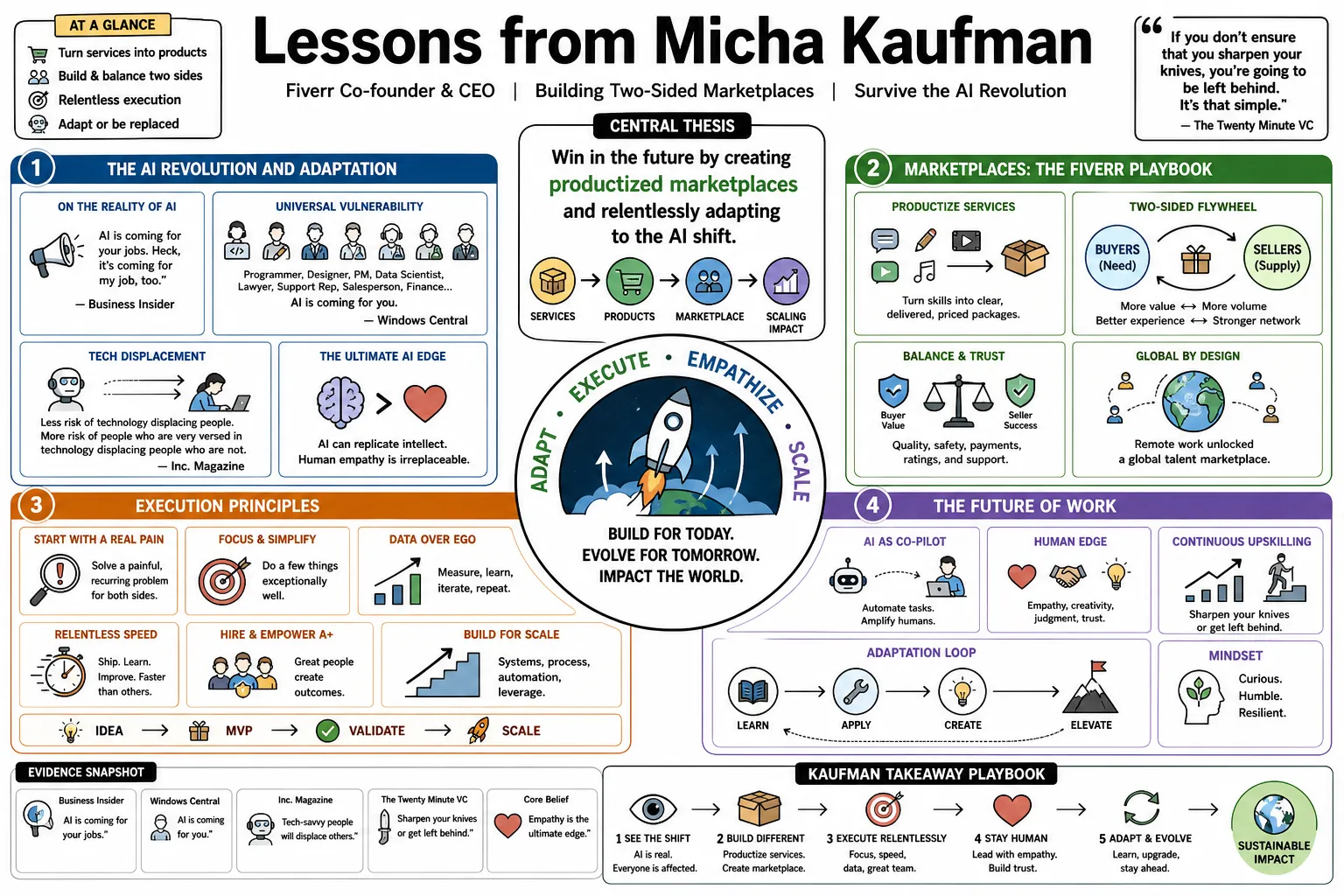
Lessons from Micha Kaufman
Fiverr co-founder and CEO Micha Kaufman changed the freelance economy by turning digital services into e-commerce products. He is known for his blunt advice on building two-sided marketplaces and urgent warnings about AI. This profile organizes his thoughts on startup execution, the future of work, and scaling a global platform.
Part 1: The AI Revolution and Adaptation
- On the reality of AI: "So here is the unpleasant truth: AI is coming for your jobs. Heck, it's coming for my job, too. This is a wake-up call." — Source: Business Insider
- On universal vulnerability: "It does not matter if you are a programmer, designer, product manager, data scientist, lawyer, customer support rep, salesperson, or a finance person — AI is coming for you." — Source: Windows Central
- On continuous upskilling: "If you don't ensure that you sharpen your knives, you're going to be left behind. It's that simple." — Source: The Twenty Minute VC
- On technological displacement: "There's less of a risk of technology displacing people. But I think there's more risk of people who are very versed in technology displacing people who are not." — Source: Inc. Magazine
- On the ultimate AI ultimatum: "If you're not adapting to AI, F* you. You're done!" — Source: The Twenty Minute VC
- On mastering your craft: "Unless you become an exceptional talent — a master — you will face the need for a career change in a matter of months." — Source: Economic Times
- On confronting reality: "I honestly don't think that a promising professional future awaits you if you disregard reality." — Source: Economic Times
- On the shifting nature of difficulty: "You must understand, that what was once considered 'easy tasks' will no longer exist; what was considered 'hard tasks' will be the new easy, and what was considered 'impossible tasks' will be the new hard." — Source: Substack
- On required velocity: "The speed at which technology is changing, and the possibilities it brings, are incredible, and they demand new thinking and higher velocity to stay at the top of our game." — Source: Windows Central
- On AI skills in hiring: AI literacy and the ability to leverage emerging tools have become absolute non-negotiables for evaluating new talent. — Source: Inc. Magazine
Part 2: Human Creativity and AI Collaboration
- On the uniqueness of humanity: "AI is a unique and powerful tool, but it's the human element that imbues work with originality." — Source: USA Today
- On creation versus generation: "AI, by itself, doesn't create—it generates. There's a difference." — Source: USA Today
- On the proper hierarchy: "AI should serve people, not the other way around. When we let humans lead and machines assist, the results are extraordinary." — Source: USA Today
- On platform evolution: Integrating AI into a marketplace is about fundamentally reimagining how algorithms and human ingenuity can seamlessly work together. — Source: NCFA Canada
- On the human essence: No matter how advanced generative models become, they lack the lived experience and emotional context that true creativity demands. — Source: Success Story Podcast
- On the danger of over-reliance: Relying completely on AI to do the work turns professionals into mere editors rather than visionary creators. — Source: The Twenty Minute VC
- On augmenting capability: The most successful professionals view AI not as a competitor, but as a force multiplier for their existing expertise. — Source: CNBC
- On the new baseline: AI raises the floor of what is acceptable, meaning humans must push the ceiling of what is exceptional. — Source: Success Story Podcast
- On the balance of automation: Routine workflows should be automated, preserving human cognitive energy for strategic and deeply creative endeavors. — Source: The Startup Playbook Podcast
- On the future of artistry: Technology will democratize the technical skills required for art, making the artist's underlying vision and taste the true differentiator. — Source: NYSE TV
Part 3: The Mechanics of Marketplaces
- On defining the platform: Fiverr is better understood as an e-commerce marketplace—comparable to Amazon or Etsy—rather than a traditional gig economy app. — Source: Staffing Industry Analysts
- On friction elimination: The core goal of a digital marketplace is to make purchasing complex digital services as simple as buying a physical product online. — Source: Noah Kagan
- On strategic transformation: Sustainable marketplace growth requires moving from a transactional model to a platform capable of handling multi-phase, mission-critical projects. — Source: The Startup Playbook Podcast
- On standardization: By productizing services, you remove the back-and-forth negotiation that traditionally slows down freelance work. — Source: Substack
- On market liquidity: The first mandate of any marketplace founder is ensuring liquidity—matching supply with demand quickly enough that neither side abandons the platform. — Source: Forbes
- On pricing dynamics: Setting an artificial constraint, like a uniform low price point, can initially serve as a powerful forcing function for user adoption. — Source: Substack
- On the trust deficit: A successful marketplace must architect trust through transparency, reviews, and standardized deliverables, bridging the gap between strangers. — Source: Entrepreneur
- On product-led growth: The product itself must be the primary driver of acquisition, inherently encouraging users to share their experience. — Source: The Startup Playbook Podcast
- On evolving beyond the gimmick: Initial viral hooks are necessary for traction, but long-term retention relies on delivering compounding value and moving upmarket. — Source: Success Story Podcast
Part 4: The Freelance Economy and Future of Work
- On individual branding: "The platforms then become the home of an individual's personal brand and professional identity — a place to feature the most experienced, professional, and creative talent." — Source: INSETA
- On freelance agility: Freelancers are inherently better equipped than traditional corporate employees to adapt to technological shifts, because they constantly manage their own professional evolution. — Source: The Twenty Minute VC
- On the shift in enterprise: The modern enterprise is being reshaped by the integration of on-demand talent, moving away from rigid full-time structures. — Source: Success Story Podcast
- On decentralization: Work is no longer a place you go, but a thing you do, distributed across a global network of specialized talent. — Source: CNBC
- On the illusion of job security: Traditional employment offers a false sense of security; true security comes from an individual's market relevance and adaptability. — Source: The Twenty Minute VC
- On the micro-entrepreneur: Every freelancer is essentially a micro-entrepreneur, responsible for their own marketing, operations, and product development. — Source: Entrepreneur
- On the death of the resume: In the digital talent marketplace, portfolios and verified past performance completely eclipse traditional resumes. — Source: The Startup Playbook Podcast
- On global equalization: Digital marketplaces level the playing field, allowing talent in emerging markets to compete directly with professionals in established tech hubs. — Source: Forbes
- On the evolution of loyalty: Professional loyalty is shifting from companies to one's own craft and personal network. — Source: Success Story Podcast
Part 5: Startup Fundamentals and Innovation
- On the billion-dollar framework: Successful billion-dollar ideas usually come from identifying massive, existing markets plagued by inefficiencies and applying software to solve them. — Source: Forbes Australia
- On defining luck: Luck is simply the intersection where preparation meets opportunity; entrepreneurs must be ready to seize the right moment when it arrives. — Source: Forbes Australia
- On solving your own problems: The best startups often begin by solving a friction point the founder has experienced firsthand in their professional life. — Source: The Startup Playbook Podcast
- On irrational optimism: Entrepreneurs must be irrational optimists who maintain conviction in their vision even when initial investors and peers are highly skeptical. — Source: Medium
- On early feedback: Like many ideas ahead of their time, pitching Fiverr resulted in rejection from early investors, which only strengthened conviction in the core premise. — Source: Substack
- On simplicity as a feature: Complexity is the enemy of adoption; a startup's primary job is to abstract away the complexity of a process for the end user. — Source: Noah Kagan
- On the danger of pivoting too soon: Founders often abandon their core premise too early in the face of friction, mistaking a distribution problem for a product failure. — Source: Success Story Podcast
- On observing behavior: True innovation comes from watching how people currently hack solutions together and building a dedicated product to formalize that behavior. — Source: The Startup Playbook Podcast
- On timing the market: Being too early is indistinguishable from being wrong; success requires not just the right idea, but the right technological readiness in the market. — Source: Forbes
Part 6: Strategy, Scaling, and Momentum
- On the reality of building: "Building something gives you nothing. It's all about the deployment. It's all about taking it to the market. It's getting noticed. It's validating. And then it's scaling." — Source: Success Story Podcast
- On self-disruption: Long-term relevance requires the willingness to cannibalize your own successful products before a competitor does. — Source: Success Story Podcast
- On viral hooks: Early momentum often requires leaning into a specific acquisition strategy, like a fixed price point, to generate volume before expanding. — Source: Substack
- On metrics over assumptions: Early-stage growth requires a relentless focus on user metrics and behavioral data rather than relying on theoretical business models. — Source: The Startup Playbook Podcast
- On the necessity of focus: Scaling successfully means learning to say no to adjacent opportunities that dilute the core value proposition. — Source: Forbes
- On the transition of leadership: As a company scales, a founder must transition from being the primary problem-solver to the architect of a system that solves problems. — Source: Success Story Podcast
- On managing hypergrowth: The organizational structure that got a startup to its first million will inevitably break as it scales to ten million; reinvention is constant. — Source: The Startup Playbook Podcast
- On leveraging constraints: Limited capital in the early days forces creative problem-solving and prevents startups from masking fundamental flaws with marketing spend. — Source: Forbes Australia
- On building network effects: True scale is achieved only when each new user adds incremental value to the experience of all existing users on the platform. — Source: Substack
Part 7: Leadership, Culture, and Responsibility
- On operational efficiency: "It does not make sense to hire more people before we learn how to do more with what we have." — Source: Inc. Magazine
- On individual responsibility: "Why do you think it's my responsibility to make you better as professionals?" — Source: Reddit
- On radical candor: Caring for a team involves telling them the hard, unvarnished truths about the market, rather than shielding them from reality. — Source: The Twenty Minute VC
- On scaling DNA: The hardest part of growth is ensuring the founder's initial cultural DNA translates across hundreds of employees in distributed offices. — Source: Substack
- On defining culture: Culture is not office perks; it is the shared understanding of how decisions are made when the CEO is not in the room. — Source: The Startup Playbook Podcast
- On the role of a mentor: A mentor should act as a soundboard rather than a source of simple answers, steering entrepreneurs toward their own solutions. — Source: Forbes
- On storytelling in leadership: Effective leaders use storytelling to provide context for overcoming hurdles and to align the organization around a unified vision. — Source: Forbes
- On accountability: In a fast-moving environment, teams must operate with high autonomy, which is only possible when coupled with high accountability. — Source: Success Story Podcast
- On navigating crises: A leader's true mettle is tested not during periods of easy growth, but in how they communicate and pivot during macroeconomic downturns. — Source: The Twenty Minute VC
Part 8: The Entrepreneurial Mindset and Resilience
- On the necessity of rejection: Early rejection is often a positive signal; if everyone immediately agrees with an idea, it likely isn't disruptive enough. — Source: Substack
- On continuous learning: The most critical skill for a founder is the ability to unlearn outdated assumptions and quickly assimilate new paradigms. — Source: The Twenty Minute VC
- On dealing with uncertainty: Entrepreneurship is the art of making high-stakes decisions with incomplete information and being comfortable with the resultant anxiety. — Source: Success Story Podcast
- On the marathon mentality: Building a generational company requires pacing, emotional regulation, and an incredibly high tolerance for pain. — Source: The Startup Playbook Podcast
- On intellectual honesty: Founders must ruthlessly evaluate their own product's flaws; believing your own marketing hype is the first step toward failure. — Source: Forbes
- On the value of execution: Ideas are a commodity; the true differentiator is the relentless, day-to-day execution of the underlying vision. — Source: Forbes Australia
- On embracing constraints: The best creative solutions are often born out of severe limitations, forcing entrepreneurs to think outside conventional frameworks. — Source: Noah Kagan
- On the founder's ego: A successful founder must have enough ego to believe they can change the world, but enough humility to listen to their customers. — Source: The Startup Playbook Podcast
- On defining success: True success is not just financial exit; it is the realization that your platform has fundamentally altered how millions of people earn a living. — Source: CNBC
- On the future: The most successful individuals and companies will be those that view technological disruption not as a threat to be managed, but as an advantage to be seized. — Source: The Twenty Minute VC