Lessons from Michael Chime
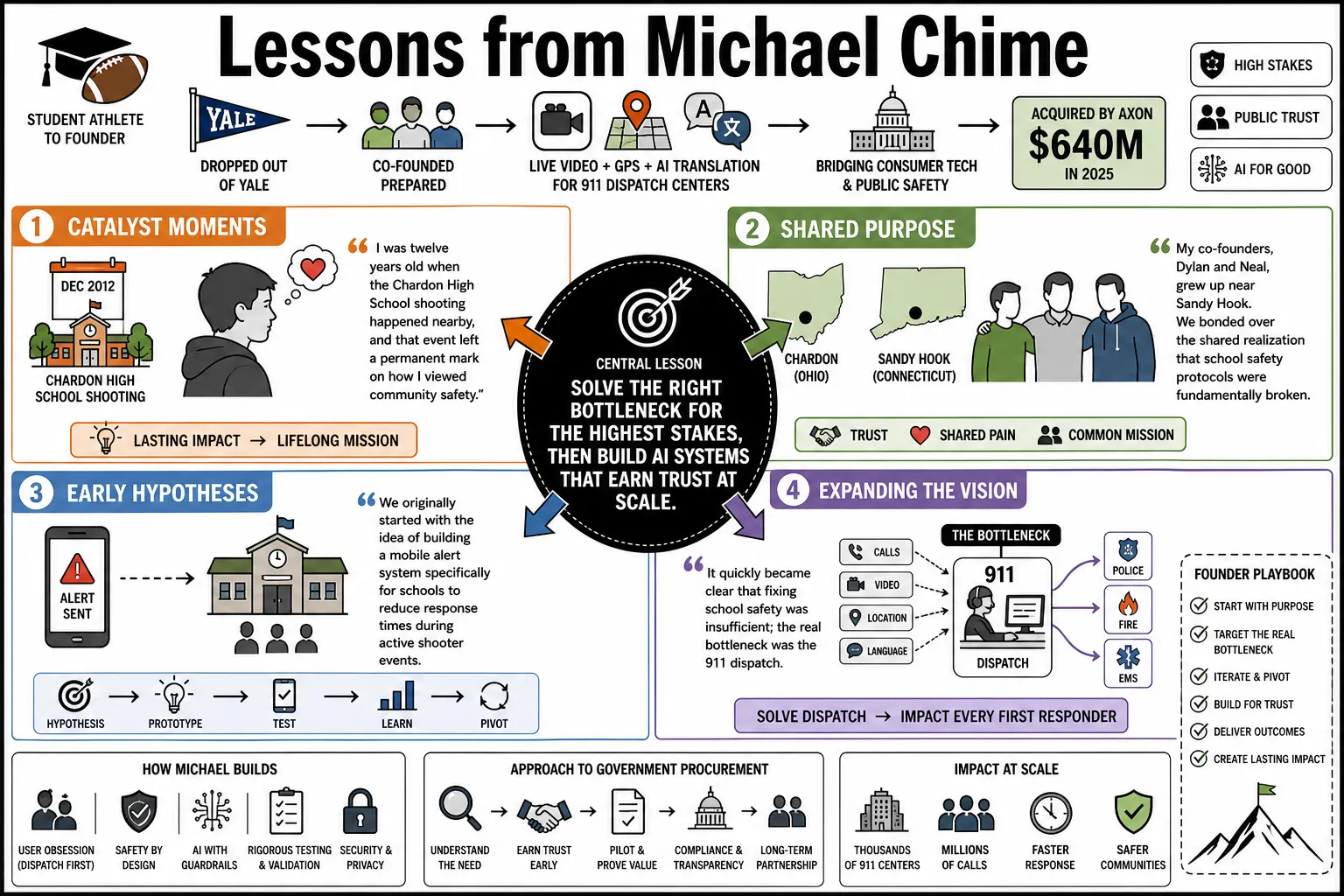
Michael Chime dropped out of Yale to co-found Prepared, a startup that brought live video, GPS, and AI translation to 911 dispatch centers. By targeting the gap between modern consumer tech and aging public safety infrastructure, he built a company that Axon acquired for $640 million in 2025. This profile follows his path from student athlete to founder, detailing his approach to government procurement and how he builds AI for high-stakes environments.
Part 1: The Origins of the Mission
- On Catalyst Moments: "I was twelve years old when the Chardon High School shooting happened nearby, and that event left a permanent mark on how I viewed community safety." — Source: [Pulse 2.0]
- On Shared Purpose: "My co-founders, Dylan and Neal, grew up near Sandy Hook. We bonded over the shared realization that school safety protocols were fundamentally broken." — Source: [TechCrunch Found]
- On Early Hypotheses: "We originally started with the idea of building a mobile alert system specifically for schools to reduce response times during active shooter events." — Source: [Forbes]
- On Expanding the Vision: "It quickly became clear that fixing school safety was insufficient; the real bottleneck was the 911 dispatch infrastructure itself, which handled every type of emergency." — Source: [First Round Review]
- On Personal Motivation: "You don't dedicate your life to public safety software unless you have a deeply personal reason to want the system to work faster and better." — Source: [Finding Gravitas]
- On Recognizing Inefficiency: "Watching how information was relayed during emergencies, we saw a game of telephone where critical seconds were lost translating what was happening." — Source: [a16z Podcast]
- On the First Product Iteration: "Our first app was basic, but it proved that sending data directly from the scene of an emergency to the people managing the response could save lives." — Source: [Pulse 2.0]
- On Shifting Focus: "Moving from a school-centric app to a national 911 platform meant realizing that every community faced the exact same communication limitations we saw in our hometowns." — Source: [TechCrunch Found]
- On Sustaining the Drive: "When you build tools for dispatchers, you hear the 911 calls. You hear the panic. That grounds the entire company in the reality of why we exist." — Source: [First Time Founders]
Part 2: The Gap in Emergency Tech
- On Consumer vs. Public Tech: "Why was I, an everyday citizen, better equipped from a data perspective to communicate to my friend in any odd moment than I would be to 911?" — Source: [Business Insider]
- On Voice-Only Limitations: "The entire 911 infrastructure was built around voice calls, completely ignoring that people now communicate primarily through text, video, and images." — Source: [Axon]
- On Information Asymmetry: "Callers on the scene have high-definition cameras in their pockets, while dispatchers were staring at screens that looked like they were from the 1990s." — Source: [Pulse 2.0]
- On Blind Dispatching: "First responders were essentially walking into chaotic, life-or-death situations blind, relying entirely on whatever a panicked caller could verbalize." — Source: [a16z Podcast]
- On the GPS Problem: "It was shocking to learn that ordering a rideshare gave the driver a more accurate location of the user than a dispatcher could get from a frantic 911 call." — Source: [First Round Review]
- On Legacy Software: "911 centers were trapped in legacy contracts with software providers who had no incentive to modernize their user interfaces or integrate new data types." — Source: [Forbes]
- On Dispatcher Overload: "Beyond a lack of data, dispatchers were already overworked, meaning any new technology had to seamlessly fit into their existing workflow without adding friction." — Source: [First Time Founders]
- On the Cost of Inaction: "When emergency tech stagnates, the cost isn't lost revenue or lower engagement metrics. The cost is measured in response times and lost lives." — Source: [Finding Gravitas]
- On Band-Aid Solutions: "For years, the industry approached modernization by putting minor patches on legacy, on-premise systems instead of rebuilding for a cloud-native world." — Source: [Axon]
- On Technical Debt in Government: "Public safety infrastructure had accumulated massive technical debt simply because it is incredibly hard to change systems that must be online 24/7 with zero downtime." — Source: [TechCrunch Found]
Part 3: Building Prepared
- On the Core Mission: "We started Prepared to ensure every emergency call gets the best possible response." — Source: [Axon]
- On Earning Trust: "You cannot walk into a 911 center as a 20-something founder and tell them how to do their jobs. You have to sit, listen, and build precisely what they ask for." — Source: [First Round Review]
- On Product Iteration: "We spent hundreds of hours sitting behind dispatchers, watching where they clicked, how they typed, and where they got frustrated, just to understand their physical workflow." — Source: [a16z Podcast]
- On Feature Prioritization: "If a feature didn't immediately make a dispatcher's job easier or faster during an active call, we cut it from the roadmap." — Source: [Pulse 2.0]
- On Managing Live Video: "Introducing live video to 911 meant we had to build safeguards. Dispatchers needed the ability to blur or drop feeds instantly to protect their own mental health." — Source: [TechCrunch Found]
- On Cloud Architecture: "Moving 911 software to the cloud was a massive technical hurdle, but it was the only way to enable real-time data sharing across different jurisdictions." — Source: [First Time Founders]
- On Overcoming Skepticism: "Early on, the default answer from agencies was 'no.' We had to give the software away for free in pilot programs just to prove that our cloud infrastructure wouldn't crash." — Source: [Finding Gravitas]
- On Scaling the Platform: "We realized that to scale, the software couldn't require a six-month installation process. It had to be deployable via a web browser almost instantly." — Source: [Forbes]
- On the Axon Acquisition: "Together, with Axon, we can bring our platform to more communities, build new tools faster, and better support every phase of emergency response from first call to final resolution." — Source: [Axon]
Part 4: AI in High-Stakes Environments
- On Augmentation over Replacement: "AI should be used to augment human capabilities rather than replace them, particularly in high-stakes environments like emergency dispatch." — Source: [a16z Podcast]
- On Real-Time Translation: "When a non-English speaker calls 911, waiting three minutes for a human translator can be fatal. AI audio translation bridges that gap instantly." — Source: [Pulse 2.0]
- On Cognitive Load: "Dispatchers process immense amounts of trauma and data simultaneously. AI's role is to reduce their cognitive load by automating the mundane parts of the call." — Source: [First Time Founders]
- On AI Hallucinations: "In public safety, you cannot afford AI hallucinations. Every summarization or transcription model we use has to be heavily constrained and verifiable by the operator." — Source: [TechCrunch Found]
- On Automated Summarization: "If an AI can summarize a five-minute panicked phone call into a clean, three-sentence brief for the police officers en route, you fundamentally change the speed of the response." — Source: [Axon]
- On Non-Emergency Calls: "A massive percentage of 911 volume is non-emergency. Using AI to triage and route those calls keeps the lines open for actual life-threatening events." — Source: [Business Insider]
- On Keyword Extraction: "We trained models specifically to listen for keywords like 'gun' or 'unconscious,' flagging these instantly on the dispatcher's screen even if the audio is chaotic." — Source: [First Round Review]
- On the Ethics of AI: "When deploying machine learning in policing and emergency response, transparency with the public and the agencies about exactly what the model does and doesn't do is non-negotiable." — Source: [Finding Gravitas]
- On Continuous Training: "The acoustic environment of a 911 call is terrible, filled with wind, screaming, and sirens. Standard speech-to-text models fail, so we had to refine our systems on actual edge-case audio." — Source: [a16z Podcast]
- On AI as a Co-Pilot: "We don't build AI that makes dispatch decisions. We build AI that acts as a co-pilot, surfacing the right data so the human expert can make the best possible decision." — Source: [Forbes]
Part 5: Leadership and Team Building
- On Hiring for Mission: "If an engineer simply wants to build consumer apps and get rich quick, they won't survive here. We hire people who want their code to directly save lives." — Source: [First Time Founders]
- On Founder Maturation: "Going from a dorm room to managing a company handling critical national infrastructure forces you to mature incredibly fast. You have to leave your ego at the door." — Source: [Finding Gravitas]
- On Authentic Culture: "Culture isn't ping pong tables. In our space, culture is how the team supports each other after listening to traumatic 911 audio during product testing." — Source: [First Round Review]
- On Fostering Resilience: "Building software for government agencies means facing relentless bureaucracy. You have to build a team that views a slow sales cycle as a structural puzzle, rather than a personal defeat." — Source: [TechCrunch Found]
- On Transparent Communication: "When our software has a bug, it impacts emergency response. We operate with radical transparency internally about our failures." — Source: [Pulse 2.0]
- On Leading as a Gen Z CEO: "Age is a liability in enterprise sales until you prove that you understand their granular problems better than the legacy vendors who have been around for thirty years." — Source: [Finding Gravitas]
- On Delegating: "The hardest transition as a founder was stepping back from the codebase and trusting the engineering leaders we brought in to scale the architecture." — Source: [First Time Founders]
- On Managing Burnout: "Because our mission is so intense, burnout is a real risk. We had to enforce boundaries to ensure people actually logged off and detached from the weight of the work." — Source: [Forbes]
- On Celebrating Wins: "We measure success in actual 'saves'—instances where our software directly contributed to a successful rescue, rather than only looking at ARR. We share those stories with the entire company." — Source: [Axon]
Part 6: Navigating Government Procurement
- On the Bureaucracy Barrier: "Selling to municipal governments is a gauntlet of RFPs, budget cycles, and legal reviews. You have to survive the process before you can ever prove the product." — Source: [a16z Podcast]
- On the Land and Expand Strategy: "We started by offering our core video product to dispatch centers for free. Once they saw the value, they became our champions when it came time to pay for the full AI suite." — Source: [First Round Review]
- On Building Champions: "Your best salesperson isn't someone on your payroll; it's a veteran 911 director telling a neighboring county that your software changed their center." — Source: [TechCrunch Found]
- On Compliance and Security: "In public safety, security isn't a feature, it's the prerequisite. We had to achieve CJIS compliance before most agencies would even take our phone calls." — Source: [Pulse 2.0]
- On Local Government Budgets: "911 centers are notoriously underfunded. We had to price the software in a way that made it a no-brainer for a city council to approve." — Source: [First Time Founders]
- On Procurement Timelines: "You have to capitalize the company to survive 18-month sales cycles. If you run out of money while waiting for a city to sign a contract, your product doesn't matter." — Source: [Forbes]
- On Overcoming Incumbents: "Legacy vendors defend their turf aggressively. We avoided trying to rip and replace their core systems immediately, instead integrating alongside them to prove our value first." — Source: [Axon]
- On Empathy for Buyers: "Government buyers aren't being difficult on purpose; they are heavily scrutinized for how they spend taxpayer dollars and cannot afford to buy snake oil." — Source: [Finding Gravitas]
- On Data Silos: "One of the biggest challenges in public safety is that neighboring counties use different software that doesn't communicate. We pitched interoperability as a core feature." — Source: [a16z Podcast]
- On the Importance of Pilots: "A 60-day pilot in a live dispatch center does more to close a deal than a hundred PowerPoint slides ever could." — Source: [First Round Review]
Part 7: From Student to Founder
- On Leaving Yale: "Having the awkward conversation with my mother about dropping out of Yale to build a startup was one of the hardest things I did, but the conviction in the mission made it necessary." — Source: [Finding Gravitas]
- On the Thiel Fellowship: "The Thiel Fellowship provided capital and, more importantly, gave us permission to ignore the traditional path and focus entirely on a massive, systemic problem." — Source: [Forbes]
- On Student Athletics: "Playing defensive line at Yale taught me discipline and how to perform under physical and mental exhaustion, which translated perfectly into the early days of startup life." — Source: [TechCrunch Found]
- On Naivete as an Asset: "If we had known how hard it was to sell cloud software to 911 centers, we might not have started. Our naivete allowed us to challenge assumptions that industry veterans accepted as facts." — Source: [First Time Founders]
- On Rapid Maturation: "You grow up fast when your code dictates whether an ambulance gets to the right address. The transition from college student to accountable founder happened overnight." — Source: [Pulse 2.0]
- On Balancing Priorities: "During my junior year, I realized I couldn't be a great football player, a great student, and a great CEO. I had to pick the one that could impact the most lives." — Source: [First Round Review]
- On Building the First Iteration: "We built the first version of the app in our dorm rooms, fueled by a shared obsession with solving a problem that most of our peers weren't even thinking about." — Source: [a16z Podcast]
- On Seeking Mentorship: "Because we were young, we relentlessly sought out mentors in the public safety space. We knew we had the technical skills, but we needed their domain expertise." — Source: [Finding Gravitas]
- On Managing Doubt: "There were months early on where we couldn't get a single dispatch center to adopt the software. We survived on the absolute certainty that the current system was unacceptable." — Source: [Forbes]
Part 8: The Future of Public Safety
- On the Unified Ecosystem: "The ultimate goal is a seamless flow of data where video from a caller's phone automatically routes to the dispatcher, and then directly to the dashboard of the responding police cruiser." — Source: [Axon]
- On Proactive Dispatch: "Right now, 911 is entirely reactive. With the right data and AI, we can move towards a system that anticipates resource needs based on real-time community data." — Source: [a16z Podcast]
- On Telecommunicator Well-being: "A major focus in public safety software isn't simply better data for responders; it's building interfaces that actively protect the mental health of the dispatchers." — Source: [First Round Review]
- On the Role of Drones: "Integrating caller location data with automated drone deployment means we can get a camera on a scene minutes before a human officer arrives." — Source: [Axon]
- On Ubiquitous Connectivity: "As satellite connectivity to mobile phones becomes standard, the expectation is that a citizen can stream data to 911 from the middle of the wilderness." — Source: [Pulse 2.0]
- On Data Standardization: "For emergency response to truly modernize nationally, we need open data standards so that different software vendors can plug into the same emergency ecosystem without friction." — Source: [TechCrunch Found]
- On Public Expectations: "Citizens expect 911 to function like consumer technology. The technology sector has a moral obligation to help government agencies meet that consumer standard." — Source: [Business Insider]
- On the End of the Radio Era: "While radio will always be a fallback, the primary mode of emergency coordination is shifting permanently to encrypted, high-bandwidth digital data streams." — Source: [First Time Founders]
- On the Long-Term Vision: "We want to reach a point where technology has eliminated every unnecessary delay in the emergency response chain, ensuring that help always arrives the moment it is needed." — Source: [Axon]