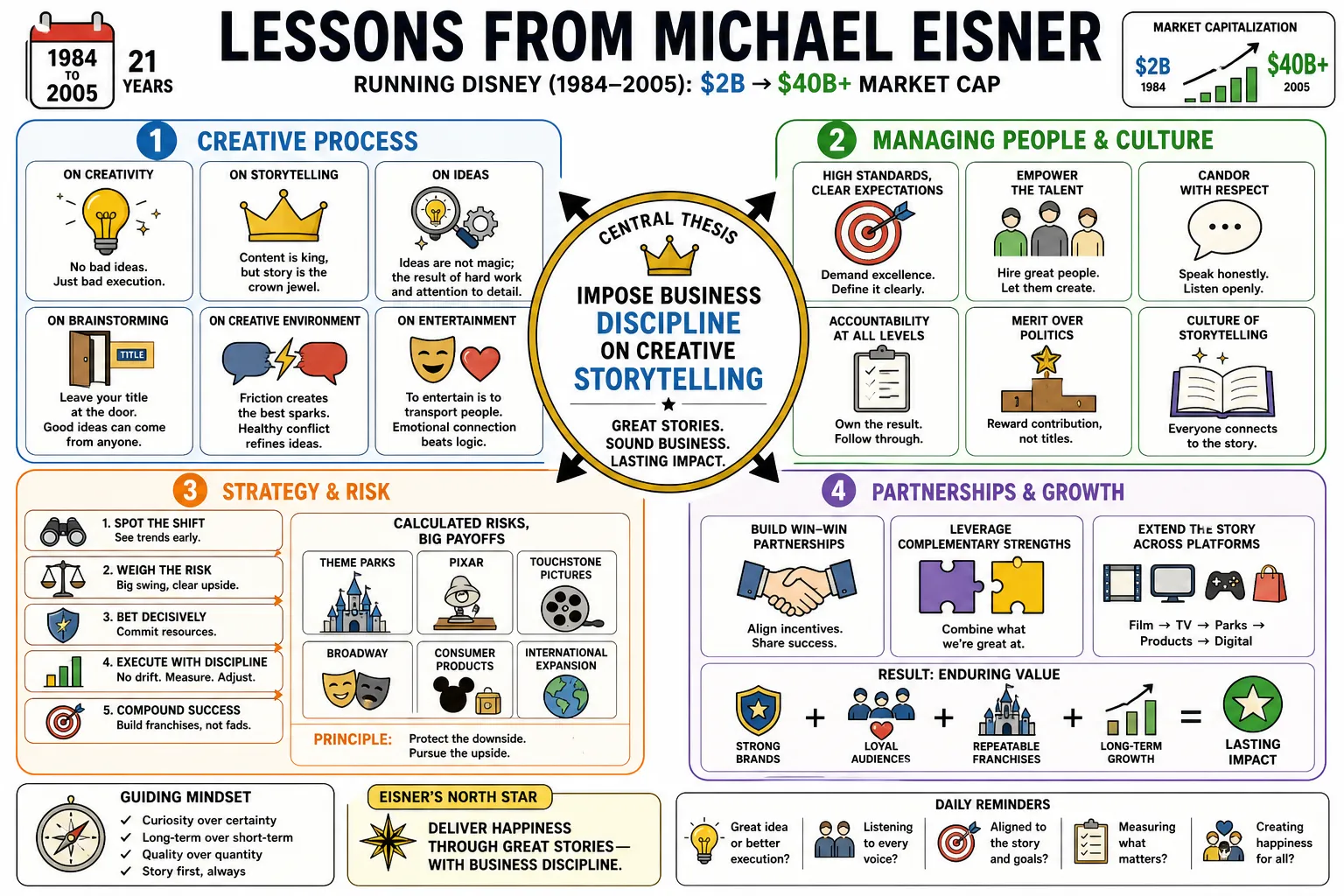
Lessons from Michael Eisner
Michael Eisner led The Walt Disney Company from 1984 to 2005. In his letter about stepping down, he pointed to the company’s work across film, television, consumer products and theme parks. — Disney — Robert Iger Named Chief Executive Officer.
Part 1: Creative Process
- Invest in the ability to tell a story: Eisner argues that owning a television station or a satellite gives you a way to reach people. Keeping that advantage depends on finding people who can tell a story worth tuning in for. — Television Academy — Michael Eisner Oral History.
- Expect to work through many ideas: Eisner describes creative management as repeatedly developing, discarding and reconsidering ideas with incomplete information. The work calls for judgment as well as financial discipline. — Disney — Eisner’s September 2004 Board Letter.
- Give unusual pitches a hearing: Eisner says Disney’s pitch meetings welcomed outlandish ideas for films and television. The team could hear an idea and reject it on the spot. — Williams Parker — Interview with Michael D. Eisner.
- Work with someone who can challenge your thinking: Eisner describes his partnership with Frank Wells as a source of both support and creative disagreement. Each could push the other to reconsider an idea. — Williams Parker — Interview with Michael D. Eisner.
- Leave room to challenge a research finding: Eisner recalls that network research nearly kept Happy Days from being made because it suggested a show set in the 1950s would not work. — Television Academy — Michael Eisner Oral History.
- Give creative teams a budget they can work within: Eisner recalls keeping film budgets under control at Paramount and Disney. He argues that spending more can become a substitute for solving a creative problem. — Williams Parker — Interview with Michael D. Eisner.
- Allow room for experiments to fail: Eisner says he tried to make it clear that a failed idea would not end someone’s career. He treated repeated mistakes differently from an experiment that did not work out. — Williams Parker — Interview with Michael D. Eisner.
- Notice what a live audience is responding to: Eisner recalls that the audience response to Fonzie led Happy Days to move from a single-camera format to a multi-camera show. — Television Academy — Michael Eisner Oral History.
Part 2: Leadership
- Show what matters by attending to the details: Eisner defends hands-on leadership through Walt Disney’s example, from working out cartoon gags to picking up litter at Disneyland. — Williams Parker — Interview with Michael D. Eisner.
- Put the next set of priorities in writing: In a letter welcoming Michael Ovitz as Disney’s president, Eisner described the direction he wanted the company to take, what he expected of the leadership team, and the issues he wanted Ovitz to address. — Penn Carey Law Archives — Eisner’s 1995 Letter to Michael Ovitz.
- Share the thinking and keep responsibility clear: Eisner says he worked with Frank Wells to solve problems at Disney and held ultimate responsibility for decisions as CEO. — Williams Parker — Interview with Michael D. Eisner.
- Think about who you need beside you when you take on a new role: In his oral history, Eisner discusses the team he assembled at Disney and singles out Jeffrey Katzenberg and Frank Wells. — Television Academy — Michael Eisner Oral History.
- Give someone room to check your judgment: Eisner argues that a trusted partner can question a decision and help a leader see a downside they might otherwise overlook. — The Diane Rehm Show — Michael Eisner on Working Together.
- Make it easier for people to get an idea across: Eisner recalls the frustration of trying to convey a disagreement to a boss and wishing he had been able to articulate it better. — Forbes — First Job: Michael Eisner.
- Show enthusiasm for an idea you want people to pursue: Eisner describes his leadership style as that of a cheerleader. He recalls reacting enthusiastically when someone brought him an idea he wanted to see made. — Williams Parker — Interview with Michael D. Eisner.
- Make decisions and follow through on them: Eisner’s memo to Ovitz asks him to make decisions, carry them through and avoid getting bogged down in analysis. — Penn Carey Law Archives — Eisner’s 1995 Letter to Michael Ovitz.
Part 3: Corporate Culture
- Give executives a reason to cooperate across divisions: Eisner says he and Wells tied part of top executives’ compensation to Disney’s overall performance to encourage cooperation. — Michael Eisner and Tony Schwartz — Work in Progress.
- Carry a standard of care across different jobs: Eisner credits his former headmaster with teaching him to do the best work he could at whatever task he took on. — Library of Congress — Michael Eisner Interviewed for Posterity.
- Give a project a chance to surprise you: Eisner says the eventual popularity of Grease surprised him. He also recalls that people expected Roots to fail. He uses both examples to explain how hard it is to predict a hit. — Williams Parker — Interview with Michael D. Eisner.
- Learn how new technology changes the work: Eisner urged Disney to follow new technologies that could change how it creates, distributes and protects its content. — Disney — Eisner’s September 2004 Board Letter.
- Share the wins as well as the setbacks: When Eisner describes working with Frank Wells, he recalls going through difficult stretches together and celebrating when things went well. — The Diane Rehm Show — Michael Eisner on Working Together.
- Look outside the usual places for creative ideas: Eisner recalled hearing a Mahler concert and wondering what Disney could make in that spirit. The idea led to Disney’s Millennium Symphonies. — Library of Congress — Michael Eisner Interviewed for Posterity.
- Keep formats that work while trying new ones: Eisner argues for continuing to make movies, stage shows and theme parks while also experimenting with newer ways to reach audiences. — Williams Parker — Interview with Michael D. Eisner.
Part 4: Risk Taking
- Test whether the costly part of a pitch is feasible: Eisner recalls that the opening of Raiders of the Lost Ark sounded expensive enough to deter other studios. He says Spielberg made the film with that sequence and delivered it within budget. — In Depth with Graham Bensinger — Eisner on Raiders of the Lost Ark.
- Consider the risk of standing still: Eisner discusses the pressure on media companies to adapt as streaming, artificial intelligence and consolidation change the business. — In Depth with Graham Bensinger — Michael Eisner.
- Separate new investment from day-to-day operating costs: Disney CFO Tom Staggs told shareholders in 2003 that the company was trimming day-to-day expenses in its parks while working to maintain the guest experience. He distinguished that response from the substantial investment Disney had recently completed. — Disney — 2003 Annual Meeting Remarks.
- Pay attention to your own reaction to an idea: Eisner says his physical reaction to a creative idea can inform his judgment. In the Library of Congress interview, he contrasts that response with relying on market research. — Library of Congress — Michael Eisner Interviewed for Posterity.
- Expect new distribution channels to coexist with old ones: Eisner recalls predictions that television would kill radio and video would kill television. He saw streaming as a way to expand access to programming while older media continued to exist. — Williams Parker — Interview with Michael D. Eisner.
- Recognize when a partnership is failing: Looking back on his partnership with Michael Ovitz, Eisner says it became clear fairly early that the arrangement was a mistake. He describes moving on as part of finding partnerships that work. — Vanity Fair — Michael Eisner on Disney, Ovitz, and the Future of Media.
Part 5: Brand Building
- Build the brand through many individual decisions: Eisner recalls that he and Frank Wells came to see strengthening the Disney brand as work that accumulated across many decisions over time. — Michael Eisner and Tony Schwartz — Work in Progress.
- Protect the brand in the decisions customers can see: Eisner asked Ovitz to keep an eye on how Disney’s brands were used, including by licensees overseas, and to examine the quality of the products sold under those names. — Penn Carey Law Archives — Eisner’s 1995 Letter to Michael Ovitz.
- Keep a recognizable standard when entering a new market: Eisner says he wanted the Paris park to offer the quality guests expected from Disney’s US parks. He also pointed to the company’s work with French films and filmmakers when discussing its place in France. — CNN American Morning — Michael Eisner on Disneyland Paris.
- Consider production and distribution together: Eisner regarded the Capital Cities/ABC acquisition as important to Disney’s growth at a time when media production and distribution were consolidating. — Disney — Eisner’s September 2004 Board Letter.
- Use new formats to deepen the audience’s connection: Eisner describes digital animation as a way for audiences to experience familiar Disney characters differently. He frames the technology as a means to strengthen the connection with the audience. — Disney — 2003 Annual Meeting Remarks.
- Look for growth that uses a strength you already have: Eisner asked Ovitz to look beyond hotels attached to parks. He suggested considering destinations that people would visit on their own and asking how Disney could bring entertainment to the hotel experience. — Penn Carey Law Archives — Eisner’s 1995 Letter to Michael Ovitz.
- Treat architecture as part of the experience: Eisner traces his interest in architecture to a trip to Rome as a teenager. He discusses how that interest later shaped the attention Disney gave to design. — In Depth with Graham Bensinger — Michael Eisner.
Part 6: Partnerships
- Make it clear you are on the same side: Eisner points to Joe Torre and Don Zimmer as an example of trust. In his account, Torre could take advice from Zimmer knowing that Zimmer did not want his job. — The Diane Rehm Show — Michael Eisner on Working Together.
- Settle the leadership roles early: Eisner recalls that Disney wanted to hire him and Frank Wells together. Wells agreed to be president and chief operating officer while Eisner took the chief executive role. — The Diane Rehm Show — Michael Eisner on Working Together.
- Leave room for a partner who wants less of the spotlight: Eisner says Wells was comfortable with a less public role and remained an enthusiastic participant in the work. He sees public visibility as a poor measure of a partner’s contribution. — The Diane Rehm Show — Michael Eisner on Working Together.
- Agree on what you want to build together: Eisner recalls sharing a direction for Disney with Frank Wells. He credits the partnership with helping them assemble a team from Disney, Warner Bros. and Paramount. — Michael Eisner and Aaron Cohen — Working Together.
- Pair different skills without making them rigid roles: Eisner contrasts his public-facing creative role with Wells’s legal background. He also recalls that Wells often championed ideas for new parks and movies. — The Diane Rehm Show — Michael Eisner on Working Together.
Part 7: Career Growth
- Take a first job that gets you into the industry: Eisner started in broadcasting as an NBC page during college. He later worked as a logging clerk and placed commercials in Saturday morning shows before moving into programming. — Television Academy — Michael Eisner Oral History.
- Look for responsibility in an unfashionable part of the business: Eisner calls taking a job in daytime programming at ABC his big break. At the time he saw it as work that other people were reluctant to take on. — Forbes — First Job: Michael Eisner.
- Learn about the world before specializing: Eisner advocates a broad education for aspiring filmmakers. He compares learning to operate a camera to learning to drive: the technical skill matters, and so does knowing where you want to go. — Michael Eisner — Address to the Tri-State Camping Conference.
- Learn from a boss who can improve your idea: Eisner singles out Barry Diller as his best individual boss. He valued having someone who could recognize a promising idea and either back it or offer a way to improve it. — Forbes — First Job: Michael Eisner.
- Let a setback redirect your work: Eisner recounts writing plays in college, trying to write in Paris and eventually walking away from that path after early rejections. — In Depth with Graham Bensinger — Michael Eisner.
- Know what makes the work rewarding: Eisner names intellectual and emotional stimulation among the things he values about work. He also says he urged Disney employees to make time for their families. — Forbes — First Job: Michael Eisner.
Part 8: Work Ethic
- Keep operating priorities visible during a distraction: In his 2004 letter to Disney’s board, Eisner identifies creating new work, running the company efficiently and preparing for the future as priorities he wanted executives to maintain during a difficult period. — Disney — Eisner’s September 2004 Board Letter.
- Learn how to follow as well as lead: Eisner recalls learning at Keewaydin how to lead other campers and how to follow when someone else was in charge. — Michael Eisner — Address to the Tri-State Camping Conference.
- Learn how a team handles an unexpected setback: Eisner remembers weathering rainstorms and rough water as a camp counselor. He recalls those incidents as part of learning how to work as a team. — Forbes — First Job: Michael Eisner.
- Give people real responsibilities to learn from: Eisner contrasts the tasks adults handle for children at home with the responsibilities campers take on themselves. He sees cooking and setting up camp as part of learning to be independent. — Michael Eisner — Address to the Tri-State Camping Conference.