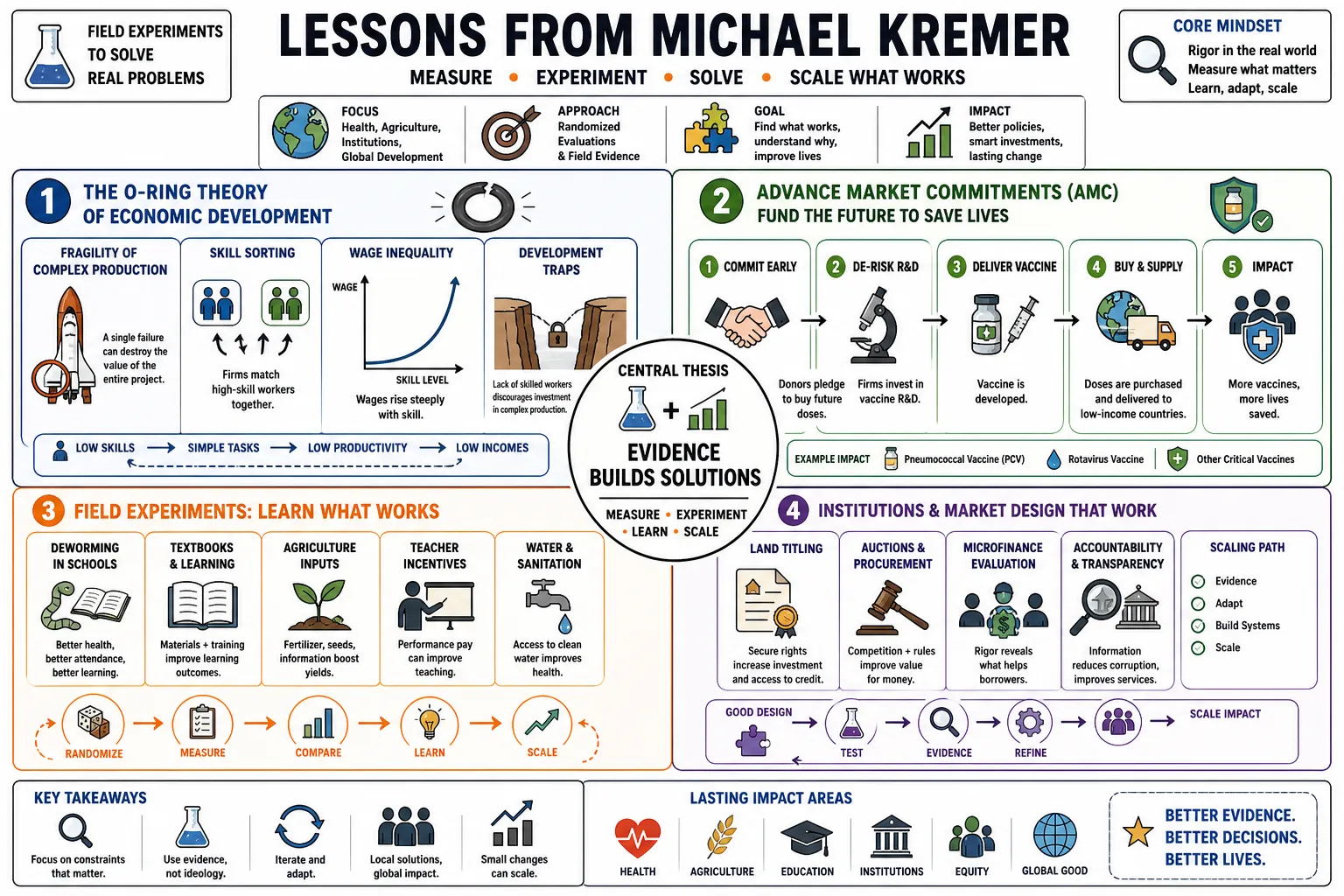
Lessons from Michael Kremer
Economist Michael Kremer shifted the study of poverty toward measuring what actually works. He designed Advance Market Commitments to fund vaccines and developed the O-Ring theory to explain how small errors bottleneck entire economies. This profile covers his use of field experiments to solve practical problems in health, agriculture, and institutional design.
Part 1: The O-Ring Theory of Economic Development
- On the fragility of complex production: "Modern production processes consist of a sequence of tasks where a single failure can destroy the value of the entire project, much like the O-ring on the Space Shuttle Challenger." — Source: [Quarterly Journal of Economics]
- On skill sorting: "Because production relies on the proficiency of all tasks, firms have an incentive to match high-skill workers together." — Source: [Quarterly Journal of Economics]
- On wage inequality: "Wages rise steeply with skill levels because highly proficient workers are exponentially more productive when matched with equally proficient peers." — Source: [Quarterly Journal of Economics]
- On development traps: "Countries can get stuck in low-skill equilibria; if a nation lacks a critical mass of skilled workers, firms will avoid investing in complex, high-value production." — Source: [Quarterly Journal of Economics]
- On the multiplier effect of skill: "A high-skill economy benefits from a multiplier effect, where the collective proficiency of the workforce drives output vastly higher than the sum of individual contributions." — Source: [Quarterly Journal of Economics]
- On bottlenecks in manufacturing: "A highly skilled worker paired with an unskilled worker who makes frequent mistakes will find their productivity bottlenecked by their partner’s errors." — Source: [American Economic Association]
- On international trade: "Opening up to international markets allows developing countries to import better technology and integrate into global supply chains, effectively bypassing local skill bottlenecks." — Source: [Quarterly Journal of Economics]
- On capital accumulation: "Capital will not flow to countries with low-skill labor forces because the complementarity between tasks makes physical capital investments less profitable there." — Source: [Quarterly Journal of Economics]
- On product quality: "Rich countries specialize in producing more complex goods rather than simply producing larger quantities of the same goods as poor countries." — Source: [Quarterly Journal of Economics]
Part 2: Experimental Economics and Field Work
- On the experimental approach: "The experimental approach is characterized by dividing broad issues into smaller, more manageable questions that can be rigorously tested." — Source: [NobelPrize.org]
- On testing economic theory: "Field experiments allow economists to move beyond observational data to directly test mechanisms and isolate causal relationships in real-world settings." — Source: [NobelPrize.org]
- On local coordination: "The idea of local authorities being an obstacle is a misconception; coordinating with local stakeholders provides valuable, practical perspectives." — Source: [Conversations with Tyler]
- On evidence-based policy: "When governments and non-profits base their decisions on randomized controlled trials, they can direct scarce resources toward the most cost-effective interventions." — Source: [Poverty Action Lab]
- On iterating interventions: "Like A/B testing in the tech industry, development interventions must be continually tested and refined to discover what actually works on the ground." — Source: [NobelPrize.org]
- On unanticipated results: "Experiments often yield surprising results that contradict both common sense and established economic theory, highlighting the need for empirical validation." — Source: [Poverty Action Lab]
- On scaling success: "Identifying a successful intervention in one context is only the first step; the next challenge is understanding whether and how it scales to different populations." — Source: [American Economic Review]
- On the role of NGOs: "Non-governmental organizations are often more willing than governments to serve as testing grounds for unproven but potentially high-impact social programs." — Source: [Poverty Action Lab]
- On the evolution of economics: "The shift toward field experiments has transformed development economics from a theoretical discipline into an applied, policy-oriented science." — Source: [NobelPrize.org]
Part 3: Health, Deworming, and Externalities
- On school absenteeism: "A school-based mass deworming treatment in Kenya led to a 25 percent reduction in school absenteeism among children." — Source: [Econometrica]
- On treatment externalities: "Treating children for worms benefits even the untreated children in the same community by reducing the overall prevalence and transmission of the parasite." — Source: [Econometrica]
- On long-term economic gains: "Children who received additional years of deworming treatment experienced a 13 percent increase in hourly earnings as adults." — Source: [Poverty Action Lab]
- On cost-effective public health: "Delivering deworming medication through existing school infrastructure makes it one of the most cost-effective ways to increase school participation." — Source: [Evidence Action]
- On user fees in health: "Introducing even small copayments for preventative health products like deworming pills or mosquito nets drastically reduces their adoption among the poor." — Source: [Quarterly Journal of Economics]
- On consumption improvements: "Long-term follow-ups of deworming recipients showed a 14 percent increase in consumption expenditures two decades after the initial treatment." — Source: [PNAS]
- On scaling deworming: "The evidence from Kenya directly inspired the Deworm the World Initiative, which now reaches hundreds of millions of children globally." — Source: [Evidence Action]
- On evaluating public goods: "Standard economic evaluations often underestimate the value of health interventions because they fail to account for positive epidemiological externalities." — Source: [Econometrica]
- On health as human capital: "Improving child health is a fundamental investment in a country's future human capital and economic capacity." — Source: [American Economic Association]
Part 4: Advance Market Commitments and Vaccine Development
- On the hold-up problem: "Pharmaceutical companies historically lacked incentives to invest in vaccines for neglected diseases because they feared developing countries could not afford them once created." — Source: [Center for Global Development]
- On market creation: "An Advance Market Commitment functions as a pull mechanism, guaranteeing a minimum price for a vaccine that meets specific efficacy standards." — Source: [Center for Global Development]
- On sinking R&D costs: "By creating a predictable future market, donors can encourage private firms to sink the massive upfront costs required for vaccine research and manufacturing." — Source: [Center for Global Development]
- On the pneumococcal pilot: "The $1.5 billion pilot AMC for the pneumococcal vaccine successfully accelerated its development, ultimately saving an estimated 700,000 lives." — Source: [Gavi, the Vaccine Alliance]
- On at-risk investments: "Making at-risk investments in vaccine manufacturing capacity prior to clinical approval can save billions of dollars and significantly accelerate distribution during a crisis." — Source: [IMF Podcasts]
- On optimal AMC design: "The structure of an AMC should vary depending on the product’s stage of development, balancing the need to incentivize innovation with the goal of securing low long-term prices." — Source: [American Economic Review]
- On late-stage vs. early-stage innovation: "Pull mechanisms are particularly effective for late-stage development where the desired product can be clearly specified in advance." — Source: [Quarterly Journal of Economics]
- On adapting AMCs for COVID-19: "The core principles of advance market commitments were instrumental in funding and expediting the rapid production of COVID-19 vaccines." — Source: [National Bureau of Economic Research]
- On global public goods: "Mechanisms that stimulate private investment in global public goods can deliver returns on investment that vastly exceed standard aid programs." — Source: [Center for Global Development]
Part 5: Education and Human Capital
- On input-based education policy: "Simply providing more textbooks or reducing class sizes in developing countries often fails to improve test scores if the underlying pedagogical approach remains unchanged." — Source: [American Economic Journal]
- On tracking and peer effects: "Grouping students by initial achievement levels can benefit both high- and low-achieving students by allowing teachers to target their instruction more effectively." — Source: [American Economic Review]
- On teacher incentives: "Tying teacher pay to student test scores can increase attendance and test-taking, but it also risks encouraging teachers to teach narrowly to the test." — Source: [Poverty Action Lab]
- On remedial education: "Targeted remedial education programs, even when delivered by young, informally trained tutors, can substantially improve basic literacy and numeracy skills." — Source: [Quarterly Journal of Economics]
- On health as an educational input: "Often, the cheapest way to improve educational outcomes is not through traditional educational inputs, but by treating highly prevalent diseases that keep kids out of school." — Source: [Econometrica]
- On information asymmetries in schooling: "Providing parents with accurate information about the economic returns to education can significantly increase school enrollment and attendance." — Source: [Poverty Action Lab]
- On contract teachers: "Hiring local contract teachers, who face contract renewal based on performance, can sometimes deliver better student outcomes than relying solely on tenured civil-service teachers." — Source: [Poverty Action Lab]
- On the illusion of free education: "Even when schooling is technically free, the hidden costs of uniforms, supplies, and lost child labor can be prohibitive for the poorest families." — Source: [American Economic Review]
- On scalable education models: "Standardized, highly structured pedagogical programs have shown the ability to deliver consistent learning gains across varying contexts when implemented at scale." — Source: [Development Innovation Lab]
Part 6: Agricultural Technology and Smallholder Farmers
- On agricultural advice: "Delivering customized, science-based agricultural advice directly to smallholder farmers via mobile phones is a low-cost way to significantly boost crop yields." — Source: [Precision Development]
- On digital extension services: "Digital extension can bypass the logistical bottlenecks of traditional in-person agricultural training, reaching millions of farmers at a fraction of the cost." — Source: [Development Innovation Lab]
- On underutilization of fertilizer: "Despite high potential returns, many smallholder farmers fail to use fertilizer due to behavioral barriers and a lack of reliable information." — Source: [American Economic Review]
- On human-centered weather forecasting: "Translating complex meteorological data into actionable, localized advice helps farmers make better decisions about when to plant and apply inputs." — Source: [Development Innovation Lab]
- On technology adoption barriers: "The gap between the social need for resilient crops and the commercial incentives for R&D leaves poor farmers vulnerable to climate and pest shocks." — Source: [Poverty Action Lab]
- On input subsidies: "Time-limited subsidies offered just after harvest, when farmers have cash on hand, can significantly increase the adoption of agricultural inputs." — Source: [American Economic Review]
- On risk and experimentation: "Farmers in developing nations operate at the margin of subsistence, making them rationally hesitant to risk their crop on unproven agricultural technologies." — Source: [Poverty Action Lab]
- On mobile money and agriculture: "The integration of mobile money platforms reduces transaction costs, enabling farmers to save for inputs and better manage seasonal cash flow." — Source: [Precision Development]
- On soil testing: "Providing farm-specific soil testing results can help farmers optimize their fertilizer use, shifting from generic recommendations to targeted nutrient management." — Source: [Precision Development]
- On agricultural pull mechanisms: "The AMC model used for vaccines can be adapted to agriculture, guaranteeing markets for innovations like drought-resistant seeds tailored to low-income regions." — Source: [Development Innovation Lab]
Part 7: Behavioral Economics in Development
- On present bias: "Present-biased preferences, or procrastination, explain why individuals often fail to make small, immediate investments that yield large future returns." — Source: [American Economic Review]
- On commitment devices: "Offering farmers the option to purchase fertilizer vouchers immediately after harvest acts as a commitment device, overcoming the temptation to spend the cash elsewhere." — Source: [American Economic Review]
- On nudges in public health: "Small behavioral nudges, such as text message reminders, can significantly improve adherence to medical regimens and water treatment protocols." — Source: [Poverty Action Lab]
- On the psychology of pricing: "The demand for preventive health products in developing countries is highly elastic around zero; charging even a nominal fee signals a transaction rather than an entitlement, drastically reducing uptake." — Source: [Quarterly Journal of Economics]
- On bounded rationality: "Development programs must be designed with the understanding that people have limited cognitive bandwidth and cannot always process complex information perfectly." — Source: [Conversations with Tyler]
- On default options: "Setting the default option to enrollment in savings or health programs dramatically increases participation, leveraging inertia for positive outcomes." — Source: [Poverty Action Lab]
- On peer effects and behavior: "An individual's likelihood of adopting a new technology or behavior is strongly influenced by the adoption decisions of their immediate social network." — Source: [American Economic Review]
- On the cost of complexity: "Simplifying the application process for social programs is often more effective at increasing uptake than increasing the financial value of the benefit itself." — Source: [Poverty Action Lab]
- On self-control in saving: "Without formal banking, people in developing economies often rely on informal rotating savings and credit associations to enforce self-control in saving." — Source: [Quarterly Journal of Economics]
- On rational procrastination: "When the cost of making a decision is immediate but the benefits are delayed and uncertain, procrastination is a predictable behavioral response." — Source: [American Economic Review]
Part 8: Innovation Policy and Meta-Institutions
- On meta-innovations: "Meta-innovations are new social institutions or mechanisms explicitly designed to accelerate the pace of scientific and technological progress." — Source: [NobelPrize.org]
- On shaping innovation: "We must actively shape the direction of innovation to ensure it addresses human needs, such as expanding access to clean water, rather than solely serving affluent markets." — Source: [Effective Altruism]
- On the cost-effectiveness of innovation: "Investing in innovation is highly cost-effective because the upfront costs of development are relatively low compared to the massive impacts achieved at scale." — Source: [Development Innovation Lab]
- On economists as founders: "Academic economists have a unique opportunity to act as founders, designing and launching institutions that directly apply economic theory to social problems." — Source: [Conversations with Tyler]
- On open science: "Promoting open science and data sharing is a critical meta-innovation that reduces duplication of effort and accelerates the accumulation of knowledge." — Source: [NobelPrize.org]
- On public funding for R&D: "Because innovation is a global public good, governments and philanthropic organizations must step in to fund research that the private sector will ignore." — Source: [IMF Podcasts]
- On institutional capacity: "A core challenge in development is building local institutional capacity that can sustain and adapt innovations after the initial funding ends." — Source: [Development Innovation Lab]
- On matching funds: "Government matching funds for philanthropic investments in R&D can align incentives and draw more resources toward neglected global challenges." — Source: [Center for Global Development]
- On innovation prizes: "Prizes and milestone payments offer an alternative to traditional grant funding, paying only for successful outcomes and transferring the risk of failure to the innovators." — Source: [American Economic Review]
- On the future of development: "The future of poverty alleviation lies in our ability to design markets and institutions that systematically generate and scale solutions for the world's most vulnerable people." — Source: [NobelPrize.org]