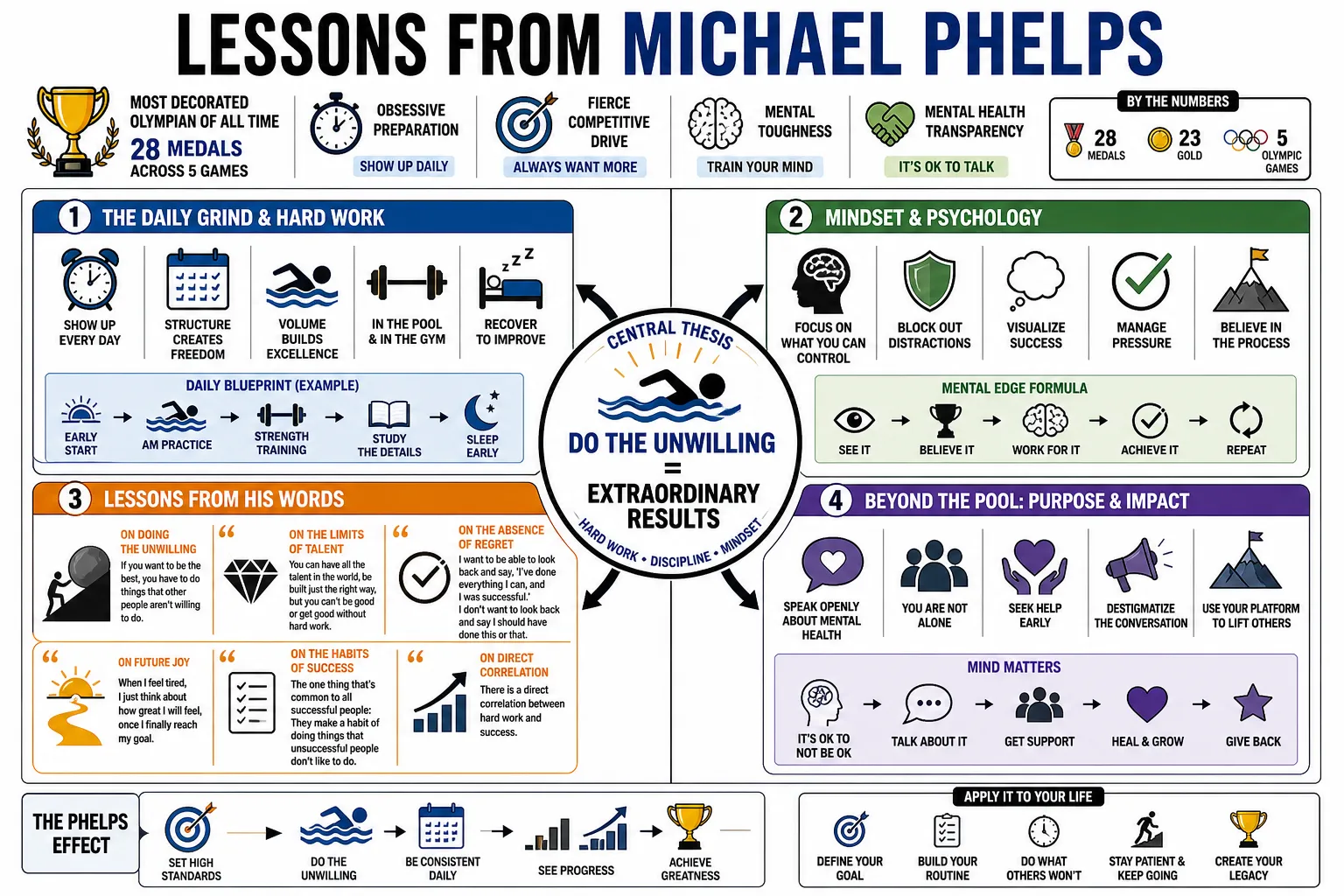
Lessons from Michael Phelps
Michael Phelps competed at five Olympic Games, from Sydney 2000 to Rio 2016. He won a record 28 medals across four of those Games. His accounts of training, competition and life after swimming show how he prepared to race and how his priorities changed after retirement. — U.S. Olympic & Paralympic Hall of Fame.
Part 1: The Daily Grind & Hard Work
- Make recovery part of the work: To sustain his training, Phelps counted recovery sessions, nutrition and sleep as part of his preparation. — My Way Through.
- Develop technique beyond natural strengths: Phelps brought a long reach and strong legs to swimming. Bowman still rebuilt parts of his strokes so he could use those advantages more effectively. — Figuring Out with Raj Shamani.
- Judge the career against your own aims: Before London, Phelps said what mattered at retirement was whether he had done what he set out to do. The medal total was secondary to that judgment. — The Guardian Interview.
- Keep your reasons in sight: On difficult mornings, Phelps looked at the goal sheets he kept nearby to remind himself what the day’s work was for. — Figuring Out with Raj Shamani.
- Work consistently when motivation varies: Bowman teaches that consistent practice depends on showing up even on days when motivation is low. — Bob Bowman on Winning.
- Use repetition to build an advantage: Phelps recalls a period when he trained on Sundays and holidays. He saw those extra sessions as an advantage over swimmers who took Sundays off. — My Way Through.
Part 2: Visualization & Preparation
- Rehearse what might go wrong: Phelps imagined what he would do if his goggles broke or his suit tore, alongside picturing the race he hoped to swim. — WHOOP Podcast.
- Play the race through in your mind: Ahead of competition, Phelps used quiet moments to picture how he wanted the race to unfold. — WHOOP Podcast.
- Build a repeatable warm-up: Phelps describes arriving early, stretching, getting in the water to warm up, and listening to music as he prepared to race. — Figuring Out with Raj Shamani.
- Take the preparation opportunity: Phelps treated preparation as a chance to improve that a competitor might take if he let it pass. — Figuring Out with Raj Shamani.
- Practice a stroke count you can rely on: Phelps practiced counting strokes so he knew how many he usually took per length. He relied on that habit when he could barely see in the Beijing 200-meter butterfly. — U.S. Olympic Trials Transcript.
Part 3: Goal Setting & Ambition
- Set milestones on the way to a championship: Phelps set season targets that would give him a chance to reach the times he wanted to swim at a world championship or Olympics. — Figuring Out with Raj Shamani.
- Give an ambitious goal a training plan: Bowman helped Phelps picture results other people doubted and work out what he would have to improve in each stroke to pursue them. — My Way Through.
- Write down target times: Bowman had Phelps put his goals in writing, including the times he wanted to hit in each event. — My Way Through.
Part 4: Facing Failure & Adversity
- Test where the next hundredth might come from: Phelps and Bowman used trial and error to look for gains in the turn, kick, streamline, or angle of the dive. — Figuring Out with Raj Shamani.
- Commit in the moment and review afterward: In a close finish, Phelps says he had to commit to his decision about when to reach for the wall. Afterward, he wanted to review the race to see whether the choice held up. — U.S. Olympic Trials Transcript.
- Track the goals a medal can hide: Even after winning eight golds in Beijing, Phelps noted that he had missed two of the times he had set for himself. — My Way Through.
- Give a setback a next step: After placing fifth at his first Olympics, Phelps went back to training. Bowman gave him a new target to work toward: a world record. — Figuring Out with Raj Shamani.
- Focus on what your race review reveals: Asked about the Olympic medal record, Phelps turned to his own goals and the improvements he could make after watching his races. — U.S. Olympic Trials Transcript.
Part 5: Bob Bowman & Coaching
- Make room for disagreement with a coach: Phelps recalls often disagreeing with Bowman while valuing the confidence his coach had in him from the beginning. — My Way Through.
- Recognize the mentor beyond the sport: Phelps describes Bowman as a father figure who spent much of his competitive life traveling and training with him. — Figuring Out with Raj Shamani.
- Build skills that hold up under pressure: Bowman says Phelps learned skills he could rely on under pressure. His advice was to practice without expecting every condition to be ideal. — Bob Bowman’s ASU Talk.
- Practice responding to equipment trouble: Phelps recalls Bowman deliberately damaging his goggles in training to see how he would respond when something went wrong. — My Way Through.
- Notice the limits you put into words: Phelps says that during training he and Bowman took the word “can’t” out of their vocabulary. — My Way Through.
- Build a shared vision with your coach: Phelps says trusting Bowman came first. From early in their relationship, the two shared the goal of getting Phelps to multiple Olympics. — My Way Through.
- Make the technical standard specific: Phelps recalls Bowman insisting that he maintain a six-beat kick in freestyle practice. The standard gave him a precise habit to work on. — Figuring Out with Raj Shamani.
Part 6: The Mindset of a Champion
- Recognize the drive to avoid losing: Phelps says avoiding defeat mattered deeply to him and was a central part of his competitive drive. — My Way Through.
- Count on the other legs of the relay: Phelps singled out the Beijing 4×100-meter freestyle relay as a race he remembers vividly. The result depended on Jason Lezak catching Alain Bernard on the final leg. — NBC Sports Interview.
- Notice when passion becomes obsession: Phelps describes a point when his passion for swimming became an obsession with finding out how far he could go in the sport. — Figuring Out with Raj Shamani.
- Prepare for life after the goal: Phelps describes feeling lost after the Olympics and having to find sources of fulfillment beyond competition. — Becoming Michael Phelps.
- Make athlete support feel safe to use: In 2022, Phelps urged Olympic sports leadership to act on a gap he saw between the mental-health support on offer and athletes’ willingness to use it. — Sports Illustrated Interview.
Part 7: Mental Health & Vulnerability
- Challenge the expectation of invulnerability: Phelps says the pressure to appear strong and a fear of rejection kept him from speaking openly about his struggles for years. — CBS News Interview.
- Ask for help when you need it: Phelps recounts a period of severe depression and says opening up and asking for help were important steps for him. — CBS News Interview.
- Give mental health daily attention: Phelps says he learned to attend to his mental health daily. He notes that difficulties can surface even during important moments. — Sports Illustrated Interview.
- Build an identity beyond the pool: Phelps says that for a long time he saw himself mainly as a swimmer. Treatment helped him examine parts of himself he had set aside. — Sports Illustrated Interview.
- Keep learning how to communicate: Phelps describes understanding himself and learning how to communicate as ongoing work. — Sports Illustrated Interview.
- Share your experience when it can help: Phelps says helping even one person by speaking about his struggles would mean more to him than winning a gold medal. — CBS News Interview.
- Record what difficult days feel like: Phelps says he journals on difficult days so he can look back at what he was thinking and going through. — Sports Illustrated Interview.
Part 8: Fatherhood & Legacy
- Make feelings easier to talk about: Phelps wants his children to grow up able to talk about their feelings and what is bothering them. — GOLF Interview.
- Put water safety ahead of competition: Phelps wanted his son to be safe in the water. He and Nicole would support his interests whether or not he chose competitive swimming. — ABC News Interview.
- Pay attention to the ordinary moments: Phelps talks about taking fatherhood a moment at a time and enjoying the details of his son’s early life. — ABC News Interview.
- Accept that parents are still learning: Nicole Phelps describes stepping back when she cannot fix a difficult family situation and accepting that she and Michael are still figuring things out. — Nicole Phelps Interview.
- Give children a way to pause: Phelps describes taking a deep breath and roaring as a family routine. The pause gives his children a moment to say what upset them. — GOLF Interview.