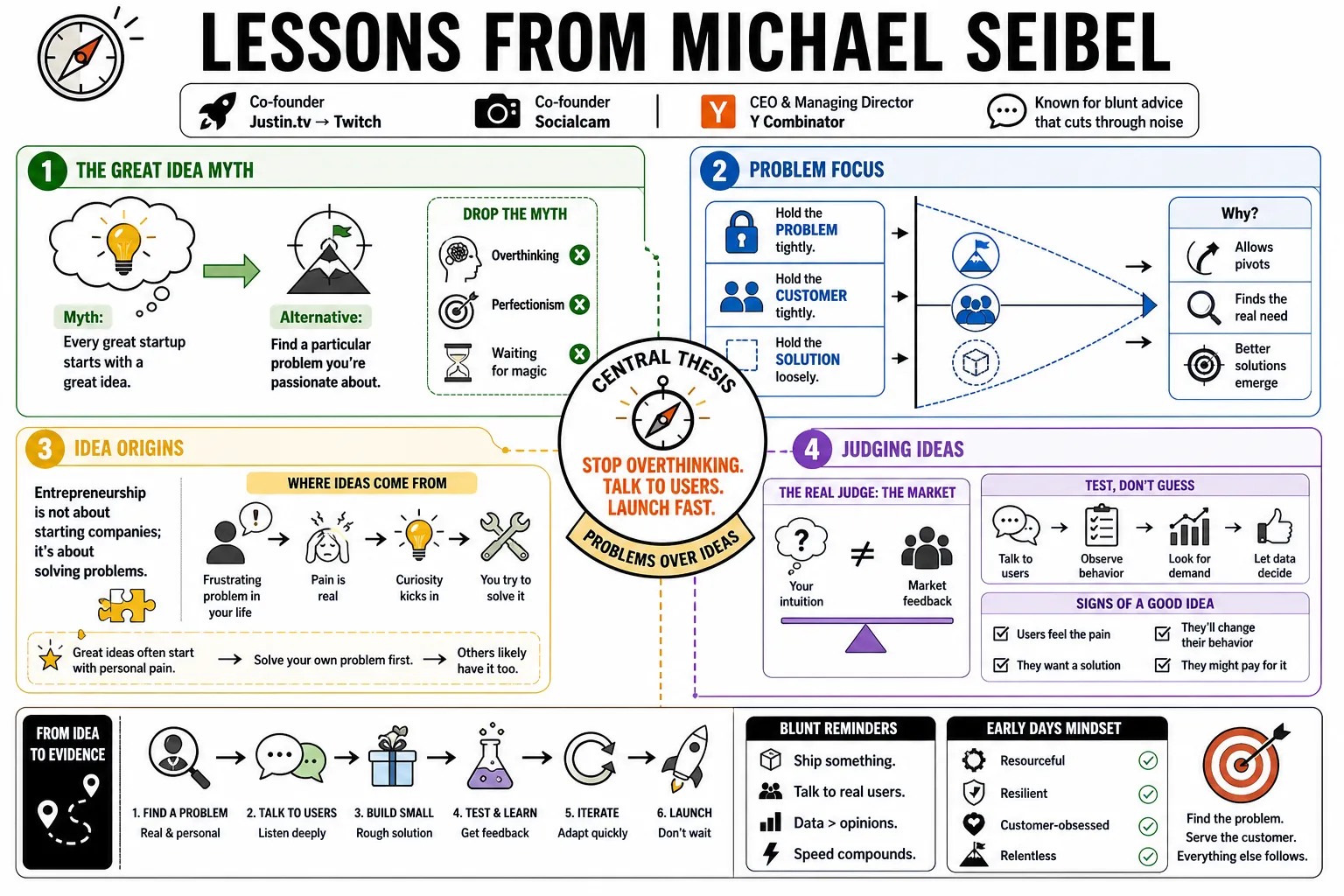
Lessons from Michael Seibel
Michael Seibel co-founded Justin.tv (which became Twitch) and Socialcam before serving as CEO and Managing Director of Y Combinator. He is known for blunt advice that pushes founders to stop overthinking, launch quickly, and actually talk to users. This profile collects his frameworks for getting through the unglamorous early days of building a company. — YC — Michael Seibel.
Part 1: Generating and Evaluating Startup Ideas
- On the Great Idea Myth: "At some point during their formative years they learned that every great startup started with a great idea and if the idea isn't amazing... the startup will fail. I'd like to offer an alternative... Find a particular problem that you're passionate about." — YC — One Order of Operations for Starting a Startup.
- On Problem Focus: "Hold the problem you're solving tightly. Hold the customer tightly. Hold the solution you're building loosely." — YC Startup School — How to Plan an MVP.
- On Personal Experience: Great startup ideas frequently emerge when founders attempt to solve a frustrating problem they experience in their own daily lives. — YC — How to Get and Test Ideas.
- On Judging Ideas: The market, not your own intuition, determines whether an idea is actually valuable. The problem itself is the true opportunity. — YC — How to Get and Test Ideas.
- On Initial Concepts: The version of the idea you start with is rarely the version that becomes a massive business. Accept that your initial assumption will evolve. — YC — How to Get and Test Ideas.
- On Simplicity: The best businesses can be explained in one or two sentences to absolutely anyone without stumbling or requiring industry jargon. — Michael Seibel — How to Pitch Your Company.
Part 2: Finding and Managing Co-founders
- On Technical Foundations: Early startup teams should be small (ideally two to four people) with at least half of the founding team being deeply technical. — YC — One Order of Operations for Starting a Startup.
- On Equity Splits: "One of the reasons why we tell people to be generous with their equity is it helps them remove... co-founders who are not essential, who really shouldn't be on the team." — Michael Seibel — How to Split Equity Among Founders.
- On Speed of Execution: "When great founders say they'll do something, two weeks later, it's done, and they've learned from it. They do this consistently." — YC — What Makes Great Founders Stand Out.
- On Formidability: "Working with someone who consistently gets things done is intimidating in a good way... Their ability to execute creates formidability." — YC — What Makes Great Founders Stand Out.
Part 3: Building the Minimum Viable Product (MVP)
- On Launching: "If you walk away with one thing from this presentation, it's launch something bad quickly." — YC Startup School — How to Plan an MVP.
- On Perfectionism: Perfecting a product before getting customer feedback is functionally impossible. The launch is just the beginning of the learning process. — YC Startup School — How to Plan an MVP.
- On Time to Market: The absolute best practice is to get a functional, albeit flawed, version of your product into users' hands within the first two months. — YC Startup School — How to Plan an MVP.
- On Solving the Core Issue: "If your screwdriver doesn't help the mechanic solve the problem, keep the mechanic, keep the problem. Fix the screwdriver!" — YC Startup School — How to Plan an MVP.
- On Continuous Improvement: "Continue improving on your solution until it actually solves the problem." — YC Startup School — How to Plan an MVP.
- On Technical Independence: Relying on external development shops to build your initial MVP is a major risk. Founders need to control their own iteration cycles directly. — YC — Should I Use a Dev Shop?.
- On Scope Reduction: If your MVP will take six months to build, you are building too much. Cut the scope until you can launch in weeks. — YC Startup School — How to Plan an MVP.
- On the First Version: Your first version is going to be embarrassing. If it isn't, you waited far too long to put it out into the world. — YC Startup School — How to Plan an MVP.
Part 4: Talking to Users and Customer Discovery
- On Customer Understanding: You literally cannot build something people want if you refuse to spend time understanding who they are and what they need. — YC — Secrets You Can Learn From Your Customers.
- On Asking Questions: Stop pitching your solution in user interviews. Ask about their workflow, their pain points, and how they currently solve the problem. — YC — Secrets You Can Learn From Your Customers.
- On Identifying Pain: Look for the "hair on fire" problem. If a user is actively losing money or time and desperately trying to fix it, that is your target. — Michael Seibel — The Real Product Market Fit.
- On Real Feedback: "A lot of these teams, the really core thing going on is ego protection and nothing else... when you really talk to someone and you get down to the core, it’s being okay with getting rejection." — YC — Successful Founders Are OK With Rejection.
- On Customer Support: Founders must do customer support in the early days. It is the fastest, highest-fidelity channel for product feedback. — YC — Secrets You Can Learn From Your Customers.
- On Listening to Complaints: Pay the most attention to the users who are complaining. They care enough to tell you what is broken rather than just churning silently. — YC — Secrets You Can Learn From Your Customers.
- On User Demographics: Don't build for an abstract persona. Find a real human being, learn their name, and solve their specific daily struggle. — YC — Secrets You Can Learn From Your Customers.
- On Being Wrong: Assume your initial assumptions about the user are wrong. Use conversations to correct your mental model as fast as possible. — YC — Secrets You Can Learn From Your Customers.
Part 5: Achieving and Identifying Product-Market Fit
- On Defining Fit: "You have reached product/market fit when you are overwhelmed with usage—usually to the point where you can't even make major changes to your product because you are swamped just keeping it up and running." — Michael Seibel — The Real Product Market Fit.
- On Premature Scaling: "If you have not yet made something your customers want—in other words, have found product-market fit—it makes little sense to grow." — Michael Seibel — The Real Product Market Fit.
- On False Signals: Media coverage, investor interest, and winning pitch competitions are not product-market fit. Only frantic, organic user demand is. — Michael Seibel — The Real Product Market Fit.
- On the Tipping Point: "What I look for is a frantic founding team trying to deal with ever-growing numbers of happy, loyal, and ideally paying customers." — Michael Seibel — The Real Product Market Fit.
- On Retention as Proof: If you have high top-line growth but terrible retention, you have a leaky bucket, not product-market fit. — Michael Seibel — The Real Product Market Fit.
- On Pricing: Charging money early is an excellent way to validate product-market fit. Free usage often masks a lack of real value. — Michael Seibel — The Real Product Market Fit.
- On Iteration Speed: The companies that find fit fastest are usually the ones that run the highest number of product iterations per month. — YC Startup School — How to Plan an MVP.
- On Recognizing Failure: If you have to forcefully push your product on every single user without any organic referrals, you have not found the fit yet. — Michael Seibel — The Real Product Market Fit.
- On Market Size: A small but obsessed market is infinitely better than a massive market that feels indifferent about your product. — Michael Seibel — The Real Product Market Fit.
Part 6: Growth, Retention, and Doing Things That Don't Scale
- On Early Hustle: "Get your first customer by any means necessary, even by manual work that couldn't be managed for more than ten, much less 100 or 1000 customers." — YC — What Does It Mean to Do Things That Don't Scale?.
- On Lean Operations: Until you have undeniable product-market fit, "stay lean, keep burn low, and resemble a Navy SEAL team instead of an Army battalion." — Michael Seibel — The Real Product Market Fit.
- On Unscalable Sales: Doing things that don't scale, like personally installing software on a client's computer, builds trust and creates massive early learnings. — YC — What Does It Mean to Do Things That Don't Scale?.
- On the Funnel: Growth without retention is entirely useless. Fix your retention metrics before you spend a single dollar on paid acquisition. — Michael Seibel — The Real Product Market Fit.
- On Measuring Success: Measure your growth rate weekly. A steady 5-7% weekly growth compounding over time is what turns startups into unicorns. — Michael Seibel — The Real Product Market Fit.
- On Distractions: "A team, a product, and an office are all just a means to an end." Don't mistake building the infrastructure of a company for actual growth. — YC Podcast — Michael Seibel on Starting a Startup.
- On Momentum: Startups live and die by momentum. If you lose momentum, the team loses morale, and it becomes incredibly difficult to recover. — YC — What Makes Great Founders Stand Out.
- On Building What People Want: "Build something people want" is the ultimate growth hack. Everything else is secondary. — YC Startup School — How to Plan an MVP.
Part 7: Pitching, Fundraising, and Investors
- On Pitch Clarity: You need to be able to describe your company so simply that a stranger in a coffee shop can immediately understand what you do and who you serve. — Michael Seibel — How to Pitch Your Company.
- On Practicing the Pitch: "One piece of advice that Justin Kan gives that I really like is, aggressively practice pitching, friends, colleagues, existing investors, before you go out. There's something that you can learn from every run of it." — Michael Seibel — How to Pitch Your Company.
- On Reading Rejection: "Believe the 'No', but don't believe the 'Why'... for the majority of investors, it doesn't benefit them to give the reasons, and they're a little bit afraid that if they give real feedback, the founder's going to think they're an asshole." — YC — Investors Said No, Now What?.
- On Pitching Power: You gain negotiating power in fundraising not by having a slick deck, but by building a great product that users already love. — Michael Seibel — Why Does Your Company Deserve More Money?.
- On Asking for Advice: "Think about what you want and ask for it... Just send an email that can be read in 30 seconds or less and ask for the advice you want." — Michael Seibel — How to Ask for Advice.
- On Simple Pitch Structure: The ideal pitch is two clear sentences explaining the business, followed by one concrete example of a customer using it successfully. — Michael Seibel — How to Pitch Your Company.
- On Focus in Meetings: Prioritize being understood completely over sounding highly sophisticated but confusing the investor. Clarity always wins. — Michael Seibel — How to Pitch Your Company.
Part 8: The Reality of Being a Founder and Leadership Mindset
- On the Real Steve Jobs: Be brave enough to solve real problems through constant iteration and customer feedback, rather than pretending to be an untouchable, visionary genius. — YC Startup School — How to Plan an MVP.
- On The Struggle: The intense difficulty and near-constant feeling of failure in a startup is not a bug in the system. It is the standard founder experience. — Michael Seibel — Why Should I Start a Startup?.
- On Ego and Bravery: Building a startup requires stripping away your ego. You have to be willing to look foolish and ask basic questions to uncover real truths. — YC — Successful Founders Are OK With Rejection.
- On Resilience: Being a founder is fundamentally about your capacity to endure rejection and keep moving forward without losing enthusiasm. — YC — Successful Founders Are OK With Rejection.