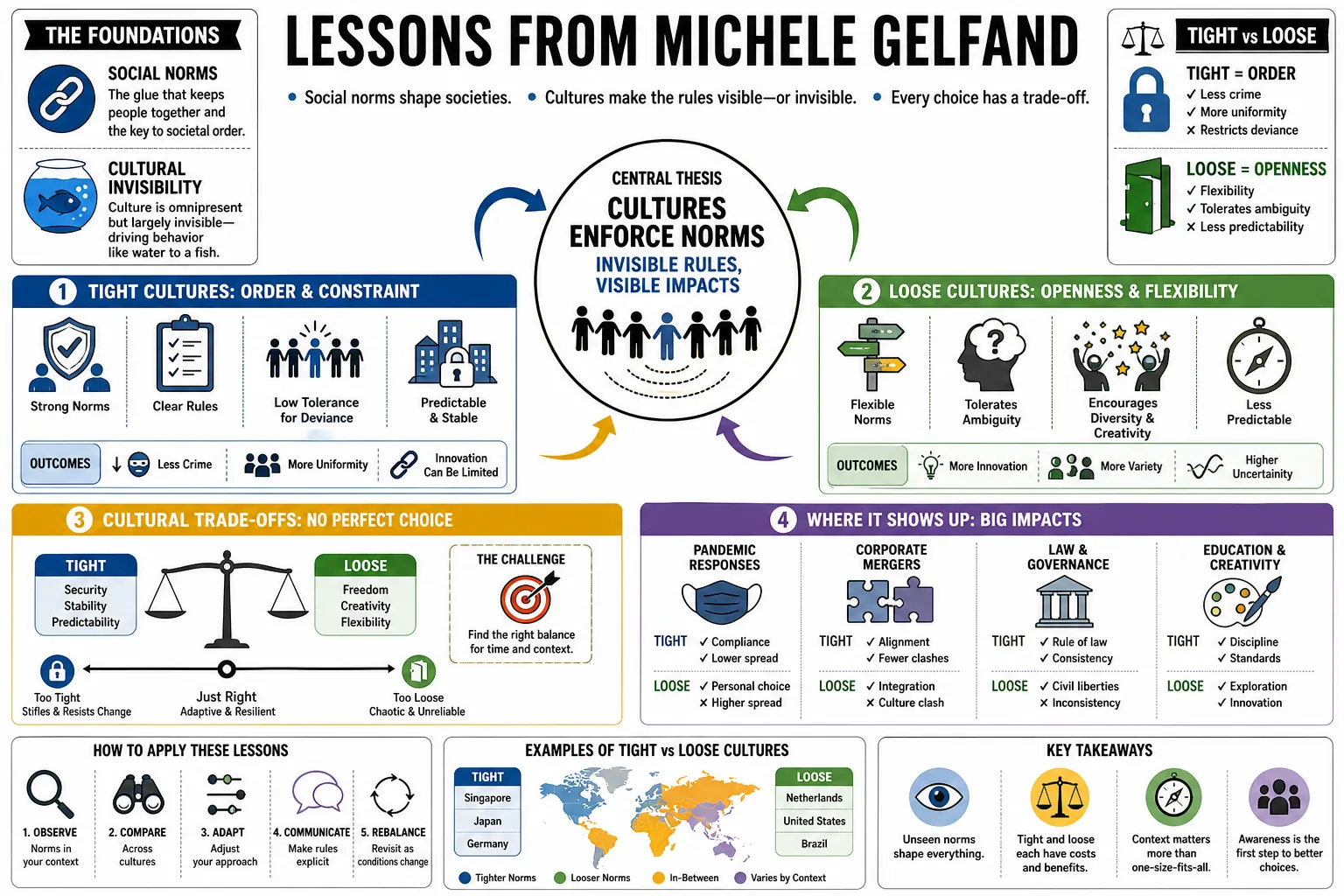
Lessons from Michele Gelfand
Cultural psychologist Michele Gelfand developed the framework of "tight" and "loose" cultures to explain how groups enforce social norms. Her research details why some societies demand strict obedience to rules while others tolerate deviance, exposing the unwritten expectations that shape everything from international pandemic responses to failed corporate mergers.
Part 1: The Foundations of Tight and Loose Cultures
- On Social Norms: "Social norms are the glue that keep people together and the key that unlocks societal order; without them, behavior would be unpredictably chaotic." — Source: [Behavioral Scientist]
- On Cultural Invisibility: "Culture is omnipresent but largely invisible, much like water is to a fish—we rarely recognize this force is driving our behavior until we step outside of it." — Source: [Stanford GSB]
- On Tight Cultures: "Tight societies opt for order, resulting in less crime and more uniformity, but they also severely restrict deviance from established rules." — Source: [Chicago Booth Review]
- On Loose Cultures: "Loose societies aim for openness, valuing flexibility and tolerating ambiguity, which fosters creativity but can lack predictability." — Source: [EconTalk]
- On Cultural Trade-offs: "Neither cultural extreme is inherently superior; tightness secures coordination at the cost of rigidity, while looseness secures innovation at the cost of disorder." — Source: [Behavioral Scientist]
- On Ubiquity: "The tight-loose dynamic is a fractal pattern that dictates behavior not just in nations, but within individual states, corporations, and even marriages." — Source: [Rule Makers, Rule Breakers]
- On Cultural Intelligence: "Developing cultural intelligence requires understanding that behaviors are rational adaptations to a group's history, rather than judging them through our own lens." — Source: [Sidewalk Talk]
- On Deviance: "In tight environments, stepping out of line invites swift punishment, whereas loose environments may ignore or even celebrate the exact same behavior." — Source: [Stanford GSB]
- On Synchrony: "Nations with tight norms exhibit higher behavioral synchrony, meaning citizens naturally coordinate their actions in public spaces more effectively." — Source: [Chicago Booth Review]
- On the Purpose of Rules: "Rules are a technology for human cooperation, acting as a dial that groups turn up or down based on what they need to survive." — Source: [Hidden Brain]
Part 2: The Role of Threat in Shaping Norms
- On Ecological Threat: "The primary driver pushing a culture toward tightness is a history of chronic ecological and historical threat, such as natural disasters or famine." — Source: [PNAS]
- On Territorial Conflict: "Societies that have faced frequent invasions or border conflicts develop strict internal rules to ensure group survival against outside forces." — Source: [Rule Makers, Rule Breakers]
- On Perceived Danger: "Threats do not even need to be real to alter behavior; as long as a population perceives a threat, that perception causes the group to tighten." — Source: [EconTalk]
- On the Luxury of Safety: "Cultures that enjoy geographic isolation and abundant resources face fewer collective threats, affording them the luxury of looseness." — Source: [Behavioral Scientist]
- On Fluctuating Norms: "As threats crop up, groups instinctively tighten their rules; as those threats subside, they gradually loosen again." — Source: [Stanford GSB]
- On Manufactured Fear: "Leaders and politicians can manipulate a population's sense of security, artificially inflating the perception of threat to enforce strict conformity." — Source: [Stanford GSB]
- On Laboratory Behavior: "When research participants are exposed to threatening news, they immediately express a stronger desire for order, rules, and autocratic leadership." — Source: [Behavioral Scientist]
- On Punishment: "The presence of threat induces a psychological shift where people demand harsher, more immediate punishments for anyone breaking social rules." — Source: [PNAS]
- On Evolutionary Adaptation: "Strict adherence to norms is not an arbitrary cultural quirk, but a highly rational survival mechanism developed over generations of facing danger." — Source: [Hidden Brain]
Part 3: The Fifty States and Regional Differences
- On State-Level Variation: "The United States is not culturally monolithic; it is a collection of states that fall on drastically different points of the tight-loose spectrum." — Source: [PNAS]
- On Tight States: "States in the South and Midwest tend to be tighter, placing a high premium on tradition, etiquette, and social order." — Source: [Chicago Booth Review]
- On Loose States: "Coastal and frontier states exhibit much weaker social norms, allowing for greater behavioral flexibility and tolerance for the unconventional." — Source: [Stanford GSB]
- On the Costs of Looseness: "Highly loose states often struggle with coordination, facing higher rates of homelessness, drug use, and overall social disorganization." — Source: [PNAS]
- On the Benefits of Looseness: "States with weaker norms generate more patents, attract more artists, and provide a better environment for minority-owned businesses." — Source: [Rule Makers, Rule Breakers]
- On the Costs of Tightness: "While tight states benefit from stability, they also report higher incarceration rates, more discrimination, and lower overall happiness scores." — Source: [Chicago Booth Review]
- On Ecological Drivers in the US: "American states that historically endured higher rates of disease, severe weather, and environmental hardship predictably developed tighter cultures." — Source: [PNAS]
- On Personality Traits: "Residents of tight states score higher in conscientiousness and self-regulation, whereas residents of loose states score higher in openness to new experiences." — Source: [Behavioral Scientist]
- On Mobility: "People naturally migrate toward states that match their personal preference for rules, continuously reinforcing regional cultural divides." — Source: [Stanford GSB]
Part 4: Class, Status, and Social Environments
- On Working-Class Environments: "Working-class individuals face higher daily instability and economic threat, leading their communities to adopt tighter social norms." — Source: [Stanford GSB]
- On Affluence: "Upper-class environments offer financial buffers against mistakes, reducing immediate threats and allowing for looser, more permissive behaviors." — Source: [Harvard Business Review]
- On the Function of Rules for the Poor: "In unforgiving economic environments, rules are not restrictions but vital safeguards that prevent catastrophic missteps." — Source: [Behavioral Scientist]
- On the Nuisance of Rules: "Wealthier individuals, protected by resources, are more likely to view institutional rules as optional constraints rather than necessary safety measures." — Source: [Rule Makers, Rule Breakers]
- On Childhood Socialization: "Working-class children learn early to enforce rules strictly, showing less tolerance for rule-breaking peers than affluent children do." — Source: [Chicago Booth Review]
- On Institutional Mismatches: "Working-class students often experience severe friction when entering elite, loose universities where the unwritten rules clash with their tight upbringing." — Source: [Stanford GSB]
- On Empathy Across Classes: "Recognizing that class-based behaviors are logical responses to different levels of environmental threat helps reduce judgment across income brackets." — Source: [Sidewalk Talk]
- On Parenting Styles: "Low-income parents emphasize obedience and discipline not out of harshness, but to protect their children from a dangerous environment." — Source: [Behavioral Scientist]
- On Workplace Expectations: "Affluent employees expect a degree of autonomy and flexibility that working-class employees often interpret as confusing or chaotic." — Source: [Harvard Business Review]
Part 5: Navigating the COVID-19 Pandemic
- On Pandemic Outcomes: "Nations with loose cultures suffered nearly five times the cases and eight times the deaths compared to tight nations during the first year of COVID-19." — Source: [The Lancet]
- On Coordination Speed: "Tight cultures were able to rapidly coordinate public health measures like masking because their citizens were already socialized to prioritize collective rules." — Source: [Stanford GSB]
- On Evolutionary Mismatch: "Loose cultures faced an evolutionary mismatch; their default preference for individual liberty actively undermined the collective discipline needed to fight a virus." — Source: [Behavioral Scientist]
- On the Threat Signal: "Because they had not faced chronic historical threats, loose societies struggled to perceive an invisible virus as an immediate, severe danger." — Source: [The Lancet]
- On Leadership Messaging: "In loose cultures, inconsistent messaging from politicians exacerbated the public's inability to organize and tighten their behavior during the crisis." — Source: [Stanford GSB]
- On the Threat Reflex: "Tight societies possess a cultural reflex to lock down and defer to authority the moment danger appears, a reflex missing in places like the US or Italy." — Source: [Chicago Booth Review]
- On Individualism: "The pandemic required a level of synchronized collective action that felt deeply unnatural in highly individualistic, loose nations." — Source: [Behavioral Scientist]
- On Temporary Tightening: "To survive existential crises, loose societies must learn how to temporarily tighten their norms without permanently sacrificing their core freedoms." — Source: [Rule Makers, Rule Breakers]
- On Reverting to Looseness: "Once a crisis has passed, a healthy society must possess the flexibility to release strict controls and loosen up again." — Source: [Stanford GSB]
Part 6: Corporate Culture, Mergers, and Acquisitions
- On Cultural Due Diligence: "Companies evaluating mergers must conduct cultural due diligence to assess norm strength, rather than relying strictly on financial alignment." — Source: [Harvard Business Review]
- On Merger Failures: "Substantial gaps in tightness between merging companies consistently lead to poor integration and failed deals." — Source: [Strategy+Business]
- On Integration Time: "When a tight company acquires a loose one, the cultural friction causes the integration process to take significantly longer." — Source: [Harvard Business Review]
- On Financial Returns: "Acquiring firms that ignore severe cultural mismatches typically experience marked drops in stock price and overall valuation post-merger." — Source: [Stanford GSB]
- On Operational Friction: "A company built on rigid compliance will inevitably clash with an acquisition target whose culture is built on spontaneous, unstructured innovation." — Source: [Strategy+Business]
- On Organizational Subcultures: "Even within a single corporation, departments differ; accounting requires a tight culture for accuracy, while marketing requires a loose culture for creativity." — Source: [Rule Makers, Rule Breakers]
- On Industry Demands: "Manufacturing and aviation must maintain tight cultures to ensure physical safety, whereas tech firms rely on looseness to drive disruption." — Source: [Behavioral Scientist]
- On Employee Retention: "Forcing employees accustomed to a loose, flexible environment into a tight corporate hierarchy is a guaranteed way to drive away top talent." — Source: [Harvard Business Review]
- On Managing Mergers: "Leaders of newly merged entities must explicitly negotiate which operations will be kept tight and where looseness will be permitted." — Source: [Strategy+Business]
- On Accountability vs. Innovation: "Mergers fail when leaders cannot reconcile one side's demand for accountability with the other side's demand for creative freedom." — Source: [Stanford GSB]
Part 7: Negotiation and Conflict Resolution
- On Negotiation Styles: "Negotiators from tight cultures place a high value on predictability, adherence to established protocols, and strict punctuality." — Source: [Harvard Business Review]
- On Ambiguity in Bargaining: "Those from loose cultures are far more comfortable with unstructured bargaining processes and frequently shifting terms." — Source: [Stanford GSB]
- On Conflict Cultures: "Organizations naturally develop specific, normative ways of managing disagreements, determining whether conflict is openly debated or quietly suppressed." — Source: [NIH]
- On Contextual Shifts: "Introducing a high-threat context at the bargaining table can cause an otherwise loose negotiator to suddenly become rigid and tight." — Source: [Behavioral Scientist]
- On Predictability: "Understanding where a counterpart falls on the tight-loose spectrum is the most reliable way to predict their reactions to unexpected proposals." — Source: [EconTalk]
- On Communication Strategy: "Building trust in cross-cultural negotiations requires tailoring your approach to match the specific norm-strength of the people across the table." — Source: [Harvard Business Review]
- On Forgiveness and Revenge: "Tight cultures often require formal, structured apologies to resolve disputes, whereas loose cultures might forgive through informal, interpersonal gestures." — Source: [Stanford GSB]
- On Moving Beyond Stereotypes: "Evaluating tightness offers a much more accurate and actionable metric for negotiation behavior than relying on broad national stereotypes." — Source: [Rule Makers, Rule Breakers]
- On Cross-Cultural Misunderstandings: "Adopting a highly informal, loose posture in a tight negotiation environment is frequently interpreted not as friendliness, but as disrespect." — Source: [Harvard Business Review]
Part 8: Cultural Ambidexterity and The Future
- On Ambidexterity: "The most resilient organizations achieve tight-loose ambidexterity, perfectly balancing the need for strict accountability with the space for empowerment." — Source: [Berkeley Haas]
- On Goldilocks Cultures: "Societies thrive most when they avoid extremes, finding a middle ground that prevents both oppressive tightness and chaotic looseness." — Source: [Stanford GSB]
- On Leadership: "Effective leaders know exactly when to tighten the reins to manage a crisis, and when to loosen them to allow for innovation." — Source: [Chicago Booth Review]
- On Calibrating Norms: "Groups must continuously audit their own rules, evaluating whether specific norms are still protecting them or if they have become obsolete constraints." — Source: [Behavioral Scientist]
- On Internet Culture: "Online spaces often begin with extreme looseness, but eventually require gradual tightening to manage toxic behavior and maintain a usable community." — Source: [Rule Makers, Rule Breakers]
- On Global Challenges: "Climate change represents an unprecedented, chronic global threat that will likely force cultures worldwide to tighten their environmental norms." — Source: [Stanford GSB]
- On the Danger of Extremes: "Pushing a culture too far into tightness breeds authoritarianism, while pushing it too far into looseness results in anomie and institutional collapse." — Source: [EconTalk]
- On Empathy Building: "Viewing the world through the tight-loose framework allows us to see the rational logic behind behaviors we might otherwise find frustrating or alien." — Source: [Sidewalk Talk]
- On Designing Institutions: "Schools, hospitals, and governments must purposefully design their normative architecture to match the specific outcomes they want to achieve." — Source: [Behavioral Scientist]
- On the Invisible Force: "Once we recognize culture as the hidden software governing human interaction, we gain the power to consciously rewrite it for a better future." — Source: [Stanford GSB]