Michio Kaku, a theoretical physicist, futurist, and renowned science communicator, has dedicated his career to exploring the frontiers of science and predicting the trajectory of human civilization. His work makes complex topics like string theory and quantum physics accessible while painting a vivid picture of humanity's future.
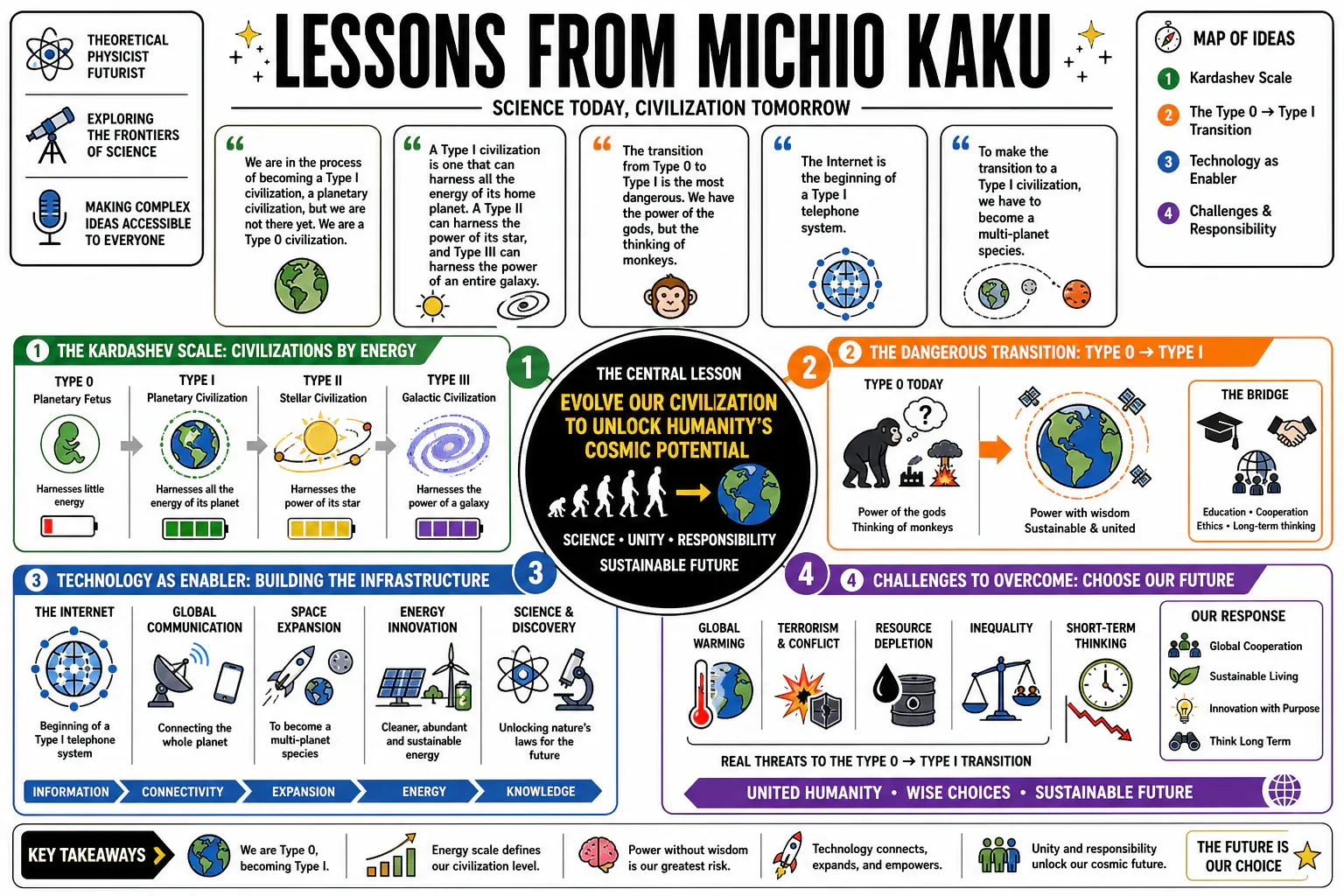
Part 1: The Future of Civilization and the Kardashev Scale
A central theme in Kaku's work is the classification of civilizations based on their energy consumption, a concept known as the Kardashev scale.
Quotes:
- "We are in the process of becoming a Type I civilization, a planetary civilization, but we are not there yet. We are a Type 0 civilization."
- "A Type I civilization is one that can harness all the energy of its home planet. A Type II can harness the power of its star, and a Type III can harness the power of an entire galaxy."
- "The transition from Type 0 to Type I is the most dangerous. We have the power of the gods, but the thinking of monkeys."
- "The Internet is the beginning of a Type I telephone system."
- "To make the transition to a Type I civilization, we have to become a multi-planet species."
- "Global warming, terrorism, resource depletion—these are the growing pains of a Type 0 civilization struggling to be born into a Type I."
- "To see the future of a Type I civilization, you simply have to look at science fiction."
Learnings:
- The Kardashev Scale as a Roadmap: Kaku uses this scale to frame humanity's progress. It provides a long-term vision and a way to measure our technological and societal evolution based on our mastery of energy.
- The Perilous Transition to Type I: Kaku warns that the transition from a fragmented, Type 0 civilization to a unified planetary one is fraught with danger. Our technological power (nuclear weapons, genetic engineering) is outstripping our social and political maturity, creating a risk of self-destruction.
- Hallmarks of a Type I Civilization: A true Type I civilization would have a planetary government, a planetary language, a planetary economy, and control over global phenomena like weather and earthquakes.
- The Internet as a Catalyst: He views the internet as the first piece of Type I infrastructure, creating a global communication network that is essential for building a planetary culture.
- The Necessity of Becoming a Multi-Planet Species: To ensure long-term survival and manage planetary resources, Kaku argues that we must expand beyond Earth.
Part 2: Physics of the Future and Technological Predictions
Kaku excels at forecasting the technological advancements that will shape our world in the coming decades and century.
Quotes:
- "By 2100, our destiny is to become like the gods we once worshipped and feared."
- "In the future, your wall will be your computer screen, your doctor, and your tutor. The internet will be in your contact lens."
- "The two great technologies of the 21st century will be biotechnology and artificial intelligence."
- "The future of medicine is the spare parts store for the human body."
- "We will have brain-computer interfaces, so that you can mentally control the objects around you. It will be a new form of magic."
- "In the future, cancer will be treated like the common cold. We'll have nanoparticles that hunt down and kill cancer cells one by one."
- "The future of transportation is the 'personal bubble' of force fields."
- "By 2050, we will have a 'brain net,' an internet of the mind, where you can convey emotions and memories."
Learnings:
- The Future is Knowable: Kaku's predictions are not wild guesses. They are based on prototypes that already exist in laboratories today. He systematically interviews scientists at the cutting edge to understand what is scientifically plausible.
- Dematerialization and Ubiquitous Computing: The computer chip will continue its exponential trend of becoming smaller and cheaper, eventually "disappearing" into the fabric of our lives—in our walls, clothes, and even our bodies.
- The Rise of Personalized and Regenerative Medicine: Medicine will shift from a one-size-fits-all approach to one that is highly personalized, based on our individual genomes. We will move beyond treating symptoms to regenerating damaged tissues and organs.
- The Brain as the Next Frontier: The next great technological platform will be the brain. Brain-computer interfaces will revolutionize communication, entertainment, and how we interact with the world.
- AI as a Tool, Not a Tyrant: Kaku is an AI optimist. He believes AI will be a powerful tool that augments human intelligence, automating mundane tasks and serving as expert assistants, rather than becoming our overlords.
Part 3: The Cosmos, String Theory, and the "God Equation"
As a theoretical physicist, Kaku's ultimate quest is for a "theory of everything" that can explain all the forces of the universe.
Quotes:
- "The universe is a symphony of vibrating strings."
- "String theory is the only game in town. It's the only theory that has the potential to unite all the forces of nature."
- "We are stardust. The atoms in our bodies were forged in the heart of a star."
- "The 'God Equation' would be the ultimate prize of science. It would be an equation perhaps no more than one inch long that would allow us to 'read the mind of God.'"
- "Our universe is not the only one. There may be a multiverse of universes, each with different laws of physics."
- "The Big Bang was not the beginning. There was a world before the Big Bang."
- "If the universe is a book, then the laws of physics are the grammar of that book."
Learnings:
- The Universe is More Than We See: Kaku pushes us to imagine a universe far grander and stranger than our everyday experience, with extra dimensions, vibrating strings of energy, and potentially parallel universes.
- The Quest for a "Theory of Everything": The holy grail of modern physics is to unify Einstein's theory of gravity with quantum theory. Kaku champions string theory as the leading candidate for this ultimate theory.
- Our Cosmic Origins: He frequently reminds us of our deep connection to the cosmos, emphasizing that the very elements that make up our bodies were created in the nuclear furnaces of stars billions of years ago.
- Science and the "Mind of God": Kaku often uses the metaphor of "reading the mind of God" not in a religious sense, but to describe the profound elegance and simplicity that physicists hope to find in the ultimate laws of nature.
- The Multiverse Concept: String theory naturally leads to the idea of a multiverse, a vast collection of universes where our own Big Bang was just one of many.
Part 4: The Future of Humanity and Space Exploration
Kaku is a staunch advocate for space exploration as an insurance policy for the long-term survival of the human species.
Quotes:
- "The dinosaurs did not have a space program, and that is why they are not here today."
- "Sooner or later, we will have to leave the nest. The Earth is our cradle, but you cannot stay in the cradle forever."
- "We are the explorers. It is in our DNA to explore the unknown."
- "The future of humanity is to become a multi-planet species."
- "Mars is the ultimate prize in the solar system."
- "A 'backup plan' for humanity is not a luxury; it is a necessity."
- "The space program is the greatest adventure of all time."
Learnings:
- The Asteroid Insurance Policy: Kaku's most compelling argument for space travel is the existential threat posed by asteroid impacts, super-volcanoes, or other planetary catastrophes. Becoming a multi-planet species is our ultimate life insurance.
- Economic and Technological Drivers: The cost of space access is plummeting due to reusable rockets and new technologies. This will open up space for tourism, mining, and scientific discovery on an unprecedented scale.
- Terraforming Mars: He believes that in the long run, we will have the technology to "terraform" Mars—to engineer its atmosphere and climate to make it more Earth-like.
- Stepping Stones to the Stars: The Moon and Mars are not the final destination but crucial stepping stones that will allow us to develop the technologies needed to eventually explore other star systems.
- Inherent Drive to Explore: Beyond practical reasons, Kaku believes that exploration is a fundamental part of the human spirit that drives us to push boundaries and venture into the unknown.
- Inspiration for the Next Generation: He sees the space program as a powerful engine of scientific and educational inspiration, encouraging young people to pursue careers in science and technology.
Sources and Links:
The ideas above are primarily sourced from Dr. Kaku's major books and extensive media appearances.
- Books:
- "The Future of Humanity: Terraforming Mars, Interstellar Travel, Immortality, and Our Destiny Beyond Earth": A deep dive into our future in space.
- "Physics of the Future: How Science Will Shape Human Destiny and Our Daily Lives by the Year 2100": Details his predictions for technology this century.
- "The God Equation: The Quest for a Theory of Everything": Explains the search for the ultimate physical law.
- "Physics of the Impossible: A Scientific Exploration into the World of Phasers, Force Fields, Teleportation, and Time Travel": Examines sci-fi concepts through the lens of physics.
- Official Website and Social Media: A good source for his latest articles and media appearances.
- YouTube Interviews and Lectures: Numerous interviews, full lectures, and documentary clips featuring Michio Kaku are available on YouTube, providing accessible summaries of his core ideas. Searching for his name will yield a vast library of content.