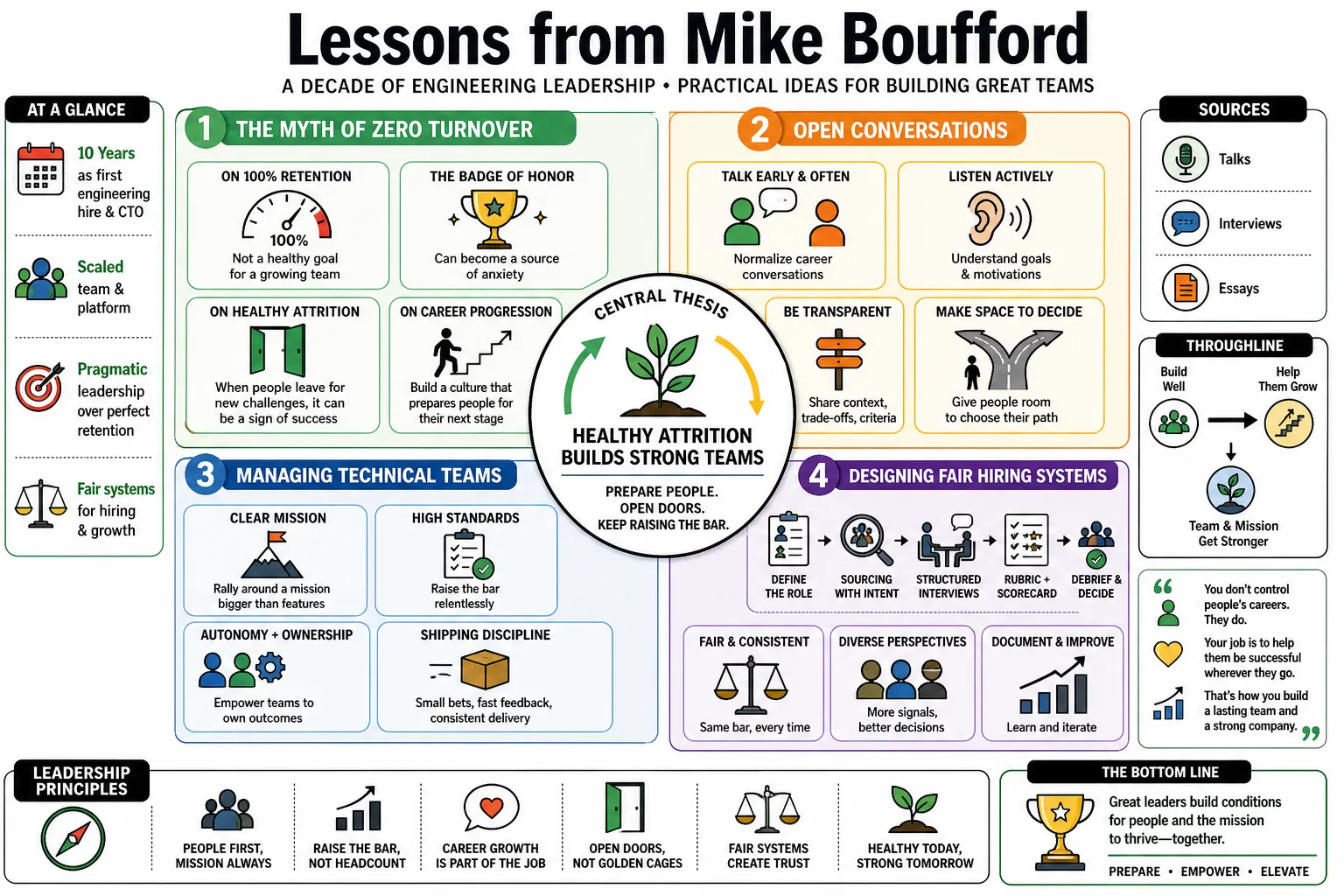
Lessons from Mike Boufford
As the first engineering hire and eventual CTO at Greenhouse, Mike Boufford spent a decade scaling the company's team and platform. He is known for a pragmatic take on engineering leadership, arguing against zero employee turnover and championing structured hiring. This profile collects his advice on managing technical teams and designing fair hiring systems, drawn from his talks, interviews, and essays.
Part 1: The Myth of Zero Turnover
- On 100% Retention: "Aiming for zero turnover is not necessarily a healthy goal for a growing engineering team." — Source: First Round Review
- On the Badge of Honor: "What starts as a badge of honor for retaining everyone can eventually become a source of anxiety as you feel you're just jinxing your success." — Source: First Round Review
- On Healthy Attrition: "When employees leave to pursue new challenges or career growth, it can be a sign of success rather than a failure of leadership." — Source: First Round Review
- On Career Progression: "Leaders should build a culture that prepares employees for their next stage, even if that eventually means leaving the company." — Source: First Round Review
- On Open Conversations: "Encourage open conversations about long-term career goals with your team, even if those goals point toward the exit door." — Source: First Round Review
- On Building Networks: "If former employees go on to become the next generation of tech leaders, it ultimately strengthens the professional network and reputation of the team." — Source: Medium
- On Unhealthy Retention: "Holding onto people simply to maintain a zero-turnover metric can stifle their personal growth and the organization's dynamism." — Source: First Round Review
- On Evolving Motivation: "Understand that personal motivations evolve over time, and what keeps an engineer engaged in year one may not be what they need in year five." — Source: First Round Review
- On Measuring Success: "Evaluate your success as a manager based on the caliber of opportunities your people secure when they leave, rather than solely on who stays." — Source: First Round Review
- On Moving On: "The natural lifespan of a role is often tied to the company's growth stage; outgrowing a role is a feature, not a bug." — Source: First Round Review
Part 2: Fairness and Structured Hiring
- On Defining Fairness: "Leaders must move beyond a superficial understanding of fairness to build a shared vocabulary and conceptual framework around it." — Source: CTO Craft Con
- On Sourcing Inequality: "Access to job opportunities is often unequal from the start; building diverse teams requires intentional sourcing strategies." — Source: CTO Craft Con
- On Structured Interviews: "While structured hiring processes require a significant investment of time and energy, they are essential for producing fairer outcomes." — Source: CTO Craft Con
- On Reducing Bias: "A structured approach respects both the candidate's life and the company's needs by reducing the risks associated with bias-driven hires." — Source: CTO Craft Con
- On Salary Negotiations: "Relying on a candidate's level of assertiveness during salary negotiations inadvertently creates disparate impacts and perpetuates inequality." — Source: CTO Craft Con
- On Consistent Compensation: "Establish consistent pay policies upfront rather than determining compensation based on how hard a candidate pushes back." — Source: CTO Craft Con
- On Broadening the Funnel: "You must ensure a broad, diverse group of people is aware of and actively encouraged to apply for your open roles." — Source: CTO Craft Con
- On Recruiter Collaboration: "Helping non-technical recruiters understand programming terminology bridges the gap in engaging top technical talent." — Source: Greenhouse Webinar
- On Hiring Systems: "Building a hiring platform requires treating the hiring process as a measurable, scalable system rather than a series of ad-hoc conversations." — Source: CockroachDB Podcast
- On Interview Calibration: "Every interviewer must operate from the same rubric to ensure that a 'yes' means the exact same thing across the organization." — Source: CTO Craft Con
Part 3: Scaling Engineering Teams
- On the First Hire: "As the first engineering hire, your primary job is to build the foundation that allows the fiftieth hire to be successful." — Source: Code Story
- On Hyper-Growth: "Scaling from seed to enterprise requires constantly rebuilding your internal processes before they break under the weight of new headcount." — Source: Code Story
- On Architectural Failures: "You will inevitably face architectural failures as you scale; the goal is to design systems that fail gracefully and recover quickly." — Source: CockroachDB Podcast
- On Engineering Pipelines: "Treat your engineering onboarding and growth pipelines with the same rigor you apply to your continuous integration systems." — Source: Code Story
- On Letting Go of Code: "The hardest transition for an early technical leader is stepping away from the codebase to focus entirely on the organization." — Source: First Round Review
- On Process Debt: "Just as you accumulate technical debt, rapidly growing teams accumulate process debt that must be periodically refactored." — Source: Heavybit Platform Builders
- On Preserving Agility: "As you add layers of management, you must actively fight the natural tendency toward organizational sluggishness." — Source: Code Story
- On Scaling Communication: "What works for a team of five sitting in one room will completely break down for a distributed team of fifty." — Source: Code Story
- On Tooling Choices: "Select infrastructure and tools that solve today's bottlenecks but have a clear path to supporting tomorrow's scale." — Source: CockroachDB Podcast
- On Continuous Evolution: "The organizational structure you have today is temporary; prepare your team for the reality of constant reorganization." — Source: Code Story
Part 4: Leadership and Management Best Practices
- On Earning Respect: "Leaders should focus on earning the respect of their teams through consistent support, rather than chasing headlines or vanity metrics." — Source: Heavybit Platform Builders
- On Founder Relationships: "Maintaining an honest and productive relationship with the company's co-founders is required for long-term executive success." — Source: First Round Review
- On Candid Feedback: "Candid war stories are far more valuable for developing managers than sanitized corporate training modules." — Source: Heavybit Platform Builders
- On Delegation: "You must be willing to hand off responsibilities you previously owned to others in order to focus on entirely new challenges." — Source: First Round Review
- On Psychological Safety: "Create an environment where engineers feel safe to surface architectural concerns without fear of being labeled blockers." — Source: Heavybit Platform Builders
- On Managing Managers: "Managing individual contributors is entirely different from managing managers; the latter requires coaching through indirect influence." — Source: Heavybit Platform Builders
- On Decision Making: "Push decision-making power as far down the organizational chart as possible to keep the engineering team moving fast." — Source: Heavybit Platform Builders
- On Setting Context: "A leader's primary job is to provide the business context that allows engineers to make the right choices, rather than dictating technical solutions." — Source: Heavybit Platform Builders
- On Resilience: "True leadership is demonstrated in the immediate aftermath of a severe system outage, rather than during a successful product launch." — Source: Heavybit Platform Builders
Part 5: Career Growth and Role Evolution
- On the 18-Month Cycle: "Anticipate that your role in a high-growth startup will fundamentally change every eighteen to twenty-four months." — Source: First Round Review
- On Staying Relevant: "To stay with a company long-term, you must proactively scale your own skill set at the same pace the company is scaling." — Source: First Round Review
- On Giving Away Your Legos: "Scaling your career means constantly relinquishing control over projects you built from scratch." — Source: First Round Review
- On Avoiding Plateau: "Early employees often hit a ceiling because they try to apply early-stage tactics to late-stage problems." — Source: First Round Review
- On Managing Up: "As you grow, your ability to manage up and align with the board becomes just as important as managing your engineering team." — Source: First Round Review
- On Ten-Year Horizons: "Thinking in decades rather than quarters changes how you approach mentorship, architecture, and personal development." — Source: First Round Review
- On Recognizing Limits: "Sometimes the best career move is recognizing when you are no longer the right person for the scale the company has reached." — Source: First Round Review
- On Seeking Discomfort: "If you feel completely comfortable in your executive role, you are likely not growing fast enough for the business." — Source: First Round Review
- On Mentorship: "Find mentors who are operating at the scale your company will reach in two years, not the scale you are at today." — Source: First Round Review
Part 6: Broadening Business Acumen
- On Cross-Functional Knowledge: "To succeed at the executive level, you must deeply understand areas outside your core technical function." — Source: First Round Review
- On Reading Broadly: "Read books on the domains of your fellow executives to better grasp how the entire business functions." — Source: First Round Review
- On Speaking the Language: "A CTO must be able to translate complex technical debt into business risk that the CFO and CEO can understand." — Source: First Round Review
- On Product-Market Fit: On Stride's Scaling Tech podcast, Boufford discusses how Greenhouse thought about expanding customer segmentation after product-market fit, including defining the ideal customer profile and deciding which customer demands to serve. — Reference: Stride Scaling Tech episode on Greenhouse customer segmentation after product-market fit
- On Business Metrics: "Stop talking exclusively about uptime and latency, and start talking about how engineering velocity impacts customer acquisition costs." — Source: First Round Review
- On Sales Empathy: In First Round's interview, Boufford says joining the executive team pushed him to learn the language of other functions, including reading sales and marketing books and taking a finance course to understand how the business fit together. — Reference: First Round interview on Boufford learning sales, marketing, finance, and the language of the broader business
- On Budgeting: "Mastering the financial mechanics of an engineering department is a prerequisite for a seat at the executive table." — Source: First Round Review
- On Strategy Alignment: "Ensure that your engineering roadmap is a direct reflection of the company's broader strategic priorities, rather than a list of technical desires." — Source: First Round Review
- On the Big Picture: "The most effective technical leaders view the codebase merely as a tool to solve business problems." — Source: First Round Review
Part 7: Adapting to Generative AI
- On LLM Adoption: "Getting up to speed with generative AI requires an approach focused on practical application rather than waiting for perfect theoretical expertise." — Source: Geeks Who Lead
- On Non-Expert Leverage: "You don't need a PhD in machine learning to use AI effectively; you need a willingness to experiment and iterate." — Source: Geeks Who Lead
- On AI in Hiring: "When applying AI to hiring, the objective must be to augment human decision-making and reduce bias, rather than completely automating the recruiter away." — Source: AI DIET World
- On Ethical AI: "The integration of AI into HR technology requires strict oversight to ensure algorithms do not inherit and scale historical prejudices." — Source: AI DIET World
- On the AI Learning Curve: "Leaders must carve out dedicated time to play with new AI tools personally to understand their real-world capabilities and limitations." — Source: Geeks Who Lead
- On Developer Productivity: "Generative AI is shifting the baseline of developer productivity; teams that fail to adopt these tools will quickly fall behind." — Source: Geeks Who Lead
- On System Architecture: "The rise of LLMs requires us to rethink our architectures, moving from deterministic systems to ones that can handle probabilistic outputs gracefully." — Source: Geeks Who Lead
- On AI Hype: "Filter out the noise of AI hype by focusing strictly on tools that solve immediate, quantifiable pain points in your development workflow." — Source: Geeks Who Lead
- On Future-Proofing: "Prepare your engineering organization for AI by fostering a culture of continuous learning and adaptability." — Source: Geeks Who Lead
Part 8: Culture and the Unexpected Moments
- On Shaping Culture: "Company culture is defined by the unexpected moments and how leadership responds to them, rather than by mission statements." — Source: Heavybit Platform Builders
- On Leading by Example: "Your team will mirror your reactions during a crisis; maintaining calm under pressure sets the behavioral standard." — Source: Heavybit Platform Builders
- On Celebrating Failure: "Creating a culture of innovation requires publicly celebrating well-intentioned failures as learning opportunities." — Source: Medium
- On Organic Growth: "You cannot force a culture; you can only plant the seeds by hiring people who align with your core values and giving them space." — Source: Heavybit Platform Builders
- On the Silent Signals: "The subtle decisions you make about who gets promoted and who gets let go send louder cultural signals than any all-hands meeting." — Source: Heavybit Platform Builders
- On Remote Dynamics: "Translating office culture to a remote environment requires deliberate, manufactured touchpoints that mimic organic hallway conversations." — Source: Medium
- On Onboarding: "A new hire's first week sets the cultural trajectory for their entire tenure; invest heavily in the onboarding experience." — Source: Medium
- On Toxicity: "Tolerating a brilliant but toxic engineer silently destroys the culture you have spent years trying to build." — Source: Heavybit Platform Builders
- On Lasting Impact: "The ultimate measure of your company's culture is how alumni treat each other long after they have left the organization." — Source: Heavybit Platform Builders