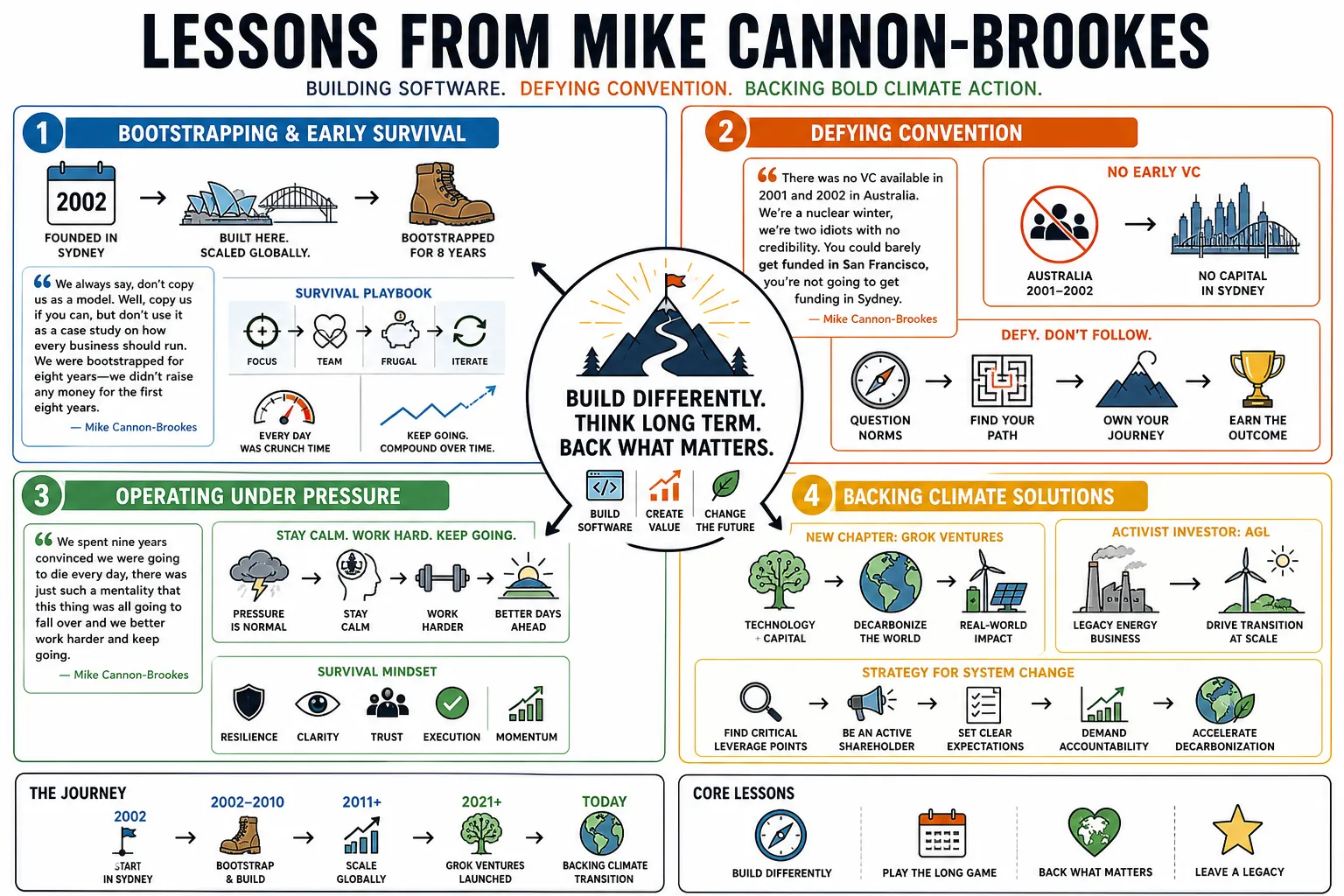
Lessons from Mike Cannon-Brookes
Mike Cannon-Brookes co-founded Atlassian in 2002, building a major enterprise software business from Sydney without early venture capital. Today, he directs Grok Ventures to force decarbonization in legacy energy markets, notably through his activist investment in AGL. This collection covers his playbook for building software and navigating self-doubt, alongside his strategy for funding climate action.
Part 1: Bootstrapping and Early Survival
- On defying convention: "We always say, don’t copy us as a model. Well, copy us if you can, but don’t use it as a case study on how every business should run. We were bootstrapped for eight years—we didn’t raise any money for the first eight years." — Source: [ITnews]
- On external funding constraints: "There was no VC available in 2001 and 2002 in Australia. We’re a nuclear winter, we’re two idiots with no credibility. You could barely get funded in San Francisco, you’re not going to get funding in Sydney." — Source: [Stratechery]
- On operating under pressure: "We spent nine years convinced we were going to die every day, there was just such a mentality that this thing was all going to fall over and we better work harder and keep going." — Source: [Stratechery]
- On setting simple milestones: "The goal was straightforward. Sell one Jira license a week. That’s all we needed to survive." — Source: [GetLatka]
- On lacking traditional credentials: "We didn't even try to get venture capital. It wasn't available in Australia at the time, and we didn't have a pitch deck or the resume to back it up." — Source: [GetLatka]
- On building without a safety net: "Without outside investors to satisfy in the early days, the focus remained entirely on customer needs and building an indispensable product." — Source: [Business of Software]
- On the debt that started it all: "The company launched using roughly $10,000 in credit card debt. This forced extreme financial discipline from day one." — Source: [Forbes]
- On delaying outside investment: "Taking our first external funding from Accel Partners in 2010 provided liquidity for early employees and accelerated international expansion." — Source: [Business of Software]
- On maintaining hunger: "A bootstrapped mentality keeps the team focused on fundamental business metrics rather than vanity milestones, even after going public." — Source: [Stratechery]
Part 2: Product Strategy and Development
- On pricing models: "Providing transparent, standardized pricing without enterprise haggling forces a software company to compete purely on the quality and utility of its product." — Source: [Atlassian]
- On land-and-expand growth: "The most effective way to grow software revenue is to build tools so intuitive that individuals adopt them voluntarily, pulling the rest of the organization along." — Source: [Stratechery]
- On R&D investment: "Software companies must prioritize engineering over traditional sales teams if they want to build products that essentially sell themselves." — Source: [Observer Effect]
- On continuous iteration: "Shipping early and frequently allows developers to learn from real user friction rather than relying on theoretical boardroom assumptions." — Source: [Atlassian]
- On listening to the user: "Direct feedback from the people clicking the buttons is vastly more valuable than top-down feature requests from executives who never use the software." — Source: [How I Built This]
- On competing in a crowded market: "You don't need to be the only tool in the category. You simply need to get out of the user's way and let them do their job." — Source: 20VC
- On scaling infrastructure: "Architecture decisions made in a company's first three years will dictate its ability to scale in year ten, requiring a balance between speed and technical debt." — Source: [Be Better Off]
- On ecosystem building: "Allowing third-party developers to build integrations and plugins turns a standalone application into an indispensable platform." — Source: [Atlassian]
- On frictionless adoption: "If a user has to talk to a salesperson or sign a complex contract just to try your software, you've already lost the modern developer." — Source: [Stratechery]
Part 3: Company Culture and Core Values
- On radical transparency: "Building an 'Open company, no bullshit' culture requires leaders to share difficult truths rather than burying them." — Source: [Atlassian]
- On sustainable work: "The value to 'Build with heart and balance' ensures that employees maintain passion for their work without burning out." — Source: [Built In]
- On customer priority: "'Don’t #@!% the customer' is the ultimate tie-breaker in any internal debate, placing user needs above short-term corporate goals." — Source: [Atlassian]
- On collaboration: "'Play, as a team' emphasizes that collective success and cross-functional support matter more than individual brilliance." — Source: [Medium]
- On continuous improvement: "The mandate to 'Be the change you seek' empowers every employee, from interns to executives, to fix broken processes rather than complain about them." — Source: [Atlassian]
- On constructive friction: "Progress often depends on constructive unreasonableness, meaning people who refuse to adapt to a broken system and instead force the system to adapt to better standards." — Source: [Atlassian]
- On authentic workplaces: "The initial goal in founding the company was simply to create a place where people could be who they authentically are without rigid corporate conformity." — Source: [Atlassian]
- On enforcing values: "Core values must be hard-wired into the organization's DNA, guiding hiring, firing, and everyday ethical behavior." — Source: [Atlassian Investor Relations]
- On organizational trust: "Trust is built when leadership admits mistakes openly and explains the rationale behind difficult decisions." — Source: [a-ha!]
- On cultural evolution: "As a company scales from two founders to thousands of employees, its values shouldn't change, but how they are applied and communicated must evolve." — Source: [Observer Effect]
Part 4: Imposter Syndrome and Personal Growth
- On persistent self-doubt: "It is entirely normal to frequently feel like you do not know what you are doing and are well, well out of your depth." — Source: [Dynamic Business]
- On facing the unknown: "You will often find yourself in situations where you lack the qualifications, but the key is realizing there is no eject button and you must figure it out." — Source: [Atlassian]
- On harnessing inadequacy: "Instead of trying to eliminate imposter syndrome, use feelings of inadequacy as a powerful motivator to enter deep-learning mode." — Source: [Elite Agent]
- On the value of questioning: "Successful people often question their own knowledge, which leads them to seek out better advice and rigorously test their assumptions." — Source: [Atlassian]
- On masking inexperience: "It is common to sit in boardrooms surrounded by professionals and secretly write down acronyms to look up on Wikipedia later." — Source: [Dynamic Business]
- On accepting discomfort: "Growth only happens when you are willing to look foolish in the short term to gain competence in the long term." — Source: TEDxSydney
- On sharing vulnerability: "Speaking openly about your own insecurities gives others the permission to admit what they don't know, accelerating team learning." — Source: TEDxSydney
- On the myth of the expert: "Most people who appear perfectly confident are just better at hiding their internal panic; nobody has all the answers upfront." — Source: [Substack]
- On iterative confidence: "Confidence isn't a prerequisite for action; it is a byproduct of surviving situations where you initially felt entirely unqualified." — Source: TEDxSydney
- On staying grounded: "Reminding yourself that you are still figuring things out prevents the arrogance that often precedes a major professional failure." — Source: [BigSpeak]
Part 5: Artificial Intelligence and the Future of Work
- On human relevance in the AI era: "I don't worry about being replaced by AI. I worry about being replaced by someone who's really good at using AI." — Source: 20VC Shorts
- On market turbulence: "The market is like a moody teenager: just yesterday it was buying everything with 'AI' attached to it, and today it's punishing companies for the slightest deviation from forecasts." — Source: [Hamidun]
- On building an AI-native team: "Integrating artificial intelligence requires fundamentally rethinking workflows rather than bolting new features onto old processes." — Source: [The AI Daily Brief]
- On developer productivity: "AI tools will dramatically shift how developers spend their time, moving them away from boilerplate code toward higher-level system design." — Source: Weights & Biases
- On SaaS evolution: "The next wave of software will actively execute tasks through autonomous AI agents integrated directly into team environments." — Source: a16z Podcast
- On tech valuations: "Current market valuations often reflect short-term hype cycles rather than the long-term compounding value of integrating AI thoughtfully into essential enterprise tools." — Source: 20VC
- On distributed work: "The future of work relies on asynchronous communication and tools that allow global teams to maintain alignment without being in the same room." — Source: [Stratechery]
- On creativity vs. data: "While data can optimize a process, human creativity remains the critical element for defining what problems are actually worth solving." — Source: 20VC
- On AI acting as a teammate: "The goal is to evolve software from a passive repository of information into an active participant that anticipates team needs and removes friction." — Source: [Stratechery]
Part 6: The Urgency of Climate Action
- On domestic capabilities: "We can do it all inside our country, it's entirely within our control." — Source: [100 Climate Conversations]
- On taking responsibility: "We’re not going to solve climate change, we’re not going to change our economy, we’re not going to harness the opportunities of decarbonisation by making it someone else’s problem." — Source: [100 Climate Conversations]
- On the cost of inaction: "There's a cost of inaction as much as there's a cost of action here." — Source: [The Guardian]
- On the need for policy: "Having no policy framework is like having no compass in the desert - you've got Buckley's chance of finding your way." — Source: [SBS News]
- On stepping up: "Australian businesses have reached a tipping point and sitting on the fence is no longer good enough." — Source: [Ragtrader]
- On the economic transition: "Decarbonization presents a massive economic opportunity for nations with the right natural resources to export renewable energy globally." — Source: [The Guardian]
- On business leadership: "As business leaders, we have an awesome responsibility. Faced with government inaction on some of our biggest problems, it's the business community that can step up and drive meaningful change." — Source: [Ragtrader]
- On making a tangible impact: "I'm still pretty damn focused on making an impact at a large scale, removing huge volumes of emissions through active investments and philanthropy … and have the proud scars to prove it." — Source: [The Guardian]
- On regulatory stability: "Clear government targets create the stability necessary to lower the cost of capital and unleash private sector innovation in green tech." — Source: [TIME]
- On corporate operations: "Software companies must lead by example by committing to renewable energy and providing blueprints for others to reduce their carbon footprints." — Source: [Reddit]
Part 7: Investing for Impact and Grok Ventures
- On the AGL demerger: "The demerger makes no sense, or cents... We believe it destroys value for everyone – shareholders, employees, Australia and the planet." — Source: [SolarQuotes]
- On unified energy grids: "We believe that keeping AGL together is the best way to put the company back at the forefront of energy generation in Australia. A combined AGL can deliver more affordable, reliable renewable energy." — Source: [SolarQuotes]
- On walking away strategically: "The Brookfield-Grok consortium looking to take private & transform AGL is putting our pens down, with great sadness." — Source: [Forbes]
- On successful interventions: "A great day in the future of Australia's decarbonisation." — Source: [Net Zero Investor]
- On unconventional investing: "Grok has never been a typical investor. We do things that require courage, deep belief, and often gut-wrenching commitment to the outcomes we believe the world needs." — Source: [Grok Ventures]
- On the climate capital stack: "Effective climate investment requires deploying capital across multiple stages, ranging from early-stage venture funding for unproven tech to massive infrastructure financing." — Source: [RenewEconomy]
- On lighthouse investments: "Taking a massive, activist stake in a legacy fossil fuel company can serve as a catalyst, proving that shareholder pressure can accelerate the green transition." — Source: [Grok Ventures]
- On blending profit and purpose: "Business success isn't just about profit; it's about positively impacting the world." — Source: [Everyday Entrepreneur]
- On systemic influence: "Private capital has a duty to step in and force heavy emitters to transition when regulatory frameworks move too slowly." — Source: [UNSW]
Part 8: Australian Innovation and Technology Leadership
- On defying geographic limits: "Being based in Sydney rather than Silicon Valley forces a company to build a global mindset and a digital-first go-to-market strategy from day one." — Source: [Stratechery]
- On local talent: "Australia possesses world-class engineering talent, but it historically lacked the capital and risk appetite needed to scale global software giants." — Source: 20VC
- On the renewable superpower vision: "Australia has the land, sun, and wind to power itself sustainably and export green energy to the rest of the world." — Source: [The Fifth Estate]
- On resource utilization: "We are responsible for using our resources and influence to create a better world." — Source: [Everyday Entrepreneur]
- On corporate responsibility: "Modern employees demand that their employers take a stand on societal issues, making corporate activism a core component of talent retention." — Source: [Ragtrader]
- On building ecosystem infrastructure: "Initiatives like Sun Cable demonstrate that ambitious, continent-spanning infrastructure projects are required to transition entire electrical grids." — Source: [100 Climate Conversations]
- On explaining policy to business: "Business leaders can accelerate change by clearly articulating to their peers what sensible climate policy means for reducing risk and operational costs." — Source: [TIME]
- On technology's role in climate: "Software and data optimization will be equally critical as solar panels and batteries in managing the complexities of a modern, decentralized energy grid." — Source: [Energy Insights]
- On legacy: "Ultimately, the measure of a successful technology leader includes the tangible, positive impact they engineered for the broader world." — Source: [The Guardian]