Mike James Ross is a leadership adviser at Egon Zehnder and a former chief human resources officer at La Maison Simons. Earlier he worked on organizational transformation at McKinsey. He co-authored Intention: The Surprising Psychology of High Performers. — Egon Zehnder’s Mike James Ross biography.
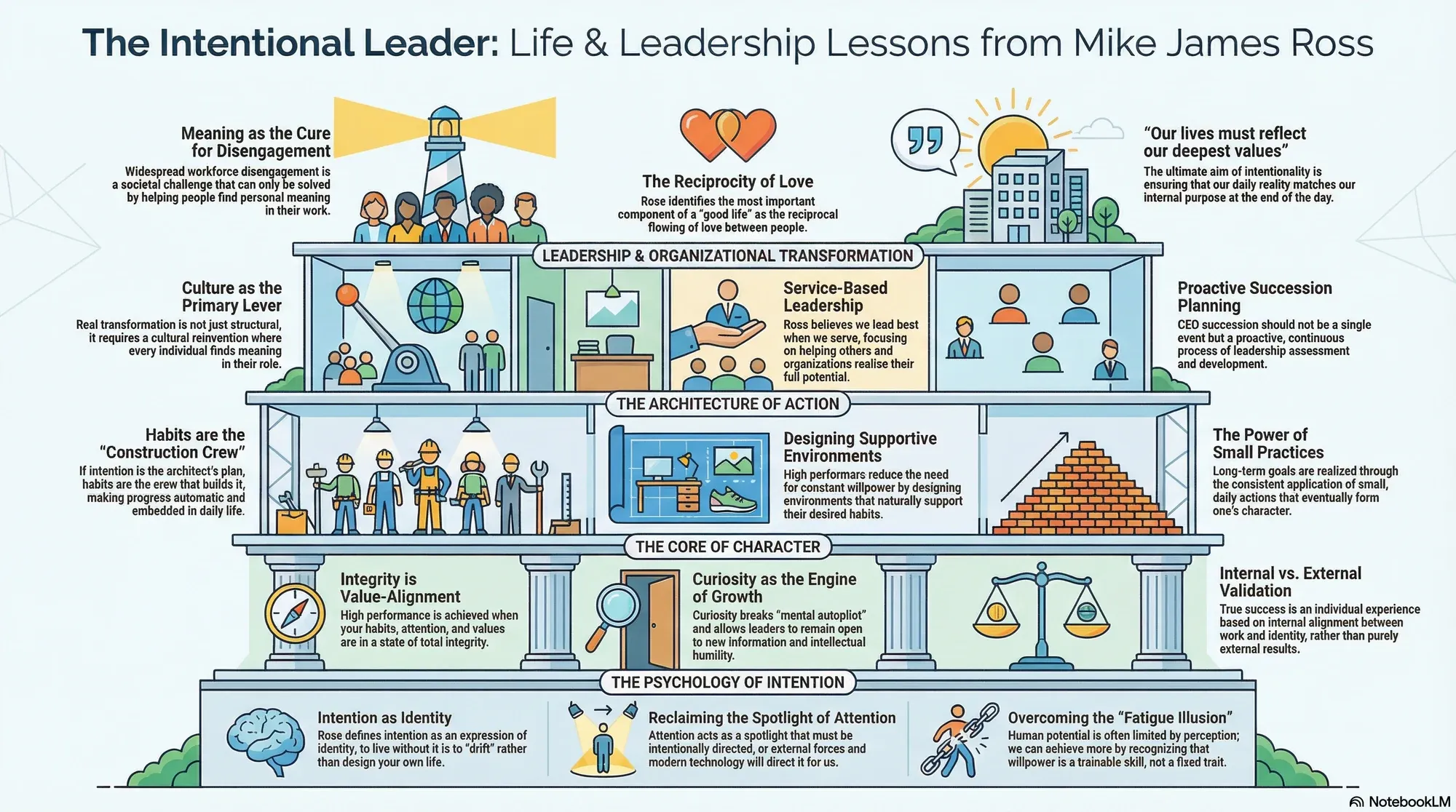
Part 1: The Psychology of Intention
- Use intention to express what matters to you: Ross and his co-authors connect intention with identity. They present deliberate choices as a way to act on what matters to a person and feel more engaged in everyday life. — Intention, introduction.
- Make choices you would otherwise leave to habit: Ross describes an intentional life as one in which people make active choices about how they live. He connects leaving those choices to default routines with feeling disengaged or dissatisfied. — LeaderLab interview on intention.
- Practice the skills behind intention: In Intention, Ross and his co-authors present willpower, curiosity, integrity, attention and habits as skills people can practice to make more deliberate choices. — Intention book excerpts.
- Choose where to put your attention: Ross describes attention as a choice about where to focus time and energy when several things are competing for them. — LeaderLab interview on intention.
- Notice what limits your choices: The authors identify social media, social expectations and reduced autonomy at work as pressures that can narrow the choices people feel able to make. — Intention, A Languishing World.
- Take responsibility for choices you can make: Ross describes willingness to make decisions and accept responsibility as a trait he values in senior leaders. He recalls hearing that distinction from the search firm that recruited him as a CHRO. — HR Leaders interview with Mike James Ross.
- Notice the limits you assume about effort: Ross and his co-authors suggest that beliefs about willpower can shape how readily people give up on a difficult task. They use this to invite readers to question some of the limits they take for granted. — Intention book excerpts.
Part 2: The Core of Character
- Clarify your values before making choices: Ross describes integrity as acting in line with your values. Naming those values gives you something concrete to check against when making a decision. — LeaderLab interview on intention.
- Consider more than one explanation: Ross and his co-authors describe curiosity as the ability to entertain competing viewpoints. Considering what another explanation accounts for can help someone develop a better approach. — Intention book excerpts.
- Stay open to changing your answer: Ross says curiosity means remaining open to new information even when you think you already know the answer. What you learn can give you reason to revise it. — LeaderLab interview on intention.
- Judge performance in light of the challenge: Ross argues that high performance depends on the difficulty of the task for the person doing it. He gives examples that range from elite sport to ordinary tasks that can take real effort for someone facing a barrier. — HR Leaders interview with Mike James Ross.
Part 3: The Architecture of Action
- Use habits to make important actions easier: Ross suggests deciding how you want to live and putting repeatable practices in place to make the necessary actions easier to carry out. — LeaderLab interview on intention.
- Let small actions add up: The authors compare repeated actions to compounding interest. A change can be small on any given day and still have a substantial effect when repeated. — Intention, Taking Control of Unconscious Actions.
- Practice adapting before a major disruption: Ross and Greig Schneider recommend small changes in how teams work together. Shorter assignments and changes to meeting routines give teams opportunities to adjust their approach before larger changes demand it. — Resilience Won’t Save Your Organization. Adaptability Will.
- Look at the environment around a habit: Ross and his co-authors describe how people sometimes stay up to reclaim personal time after a day full of obligations. They use the example to show how circumstances can help explain a habit that people already know how to change in principle. — Intention, A Languishing World.
Part 4: Leadership and Organizational Transformation
- Lead by serving others: Ross describes service as the starting point of his approach to leadership. In his coaching, that means helping individuals and teams develop what they are capable of doing. — Egon Zehnder’s Mike James Ross biography.
- Connect organizational change with individual engagement: Ross says his work on culture change as a consultant and CHRO informed Intention. It made him consider both how organizations change and what individuals can do about their own engagement. — HR Leaders interview with Mike James Ross.
- Consider leadership and structure together during transitions: Ross’s advisory work with boards and executives brings together leadership assessment, succession planning and organizational design. These are distinct parts of the changes he helps clients navigate. — Egon Zehnder’s Mike James Ross biography.
- Treat culture and structure as parts of the same change: At La Maison Simons, Ross led a multiyear transformation as CHRO. Egon Zehnder describes the work as involving structural, cultural and leadership changes. — Egon Zehnder’s Mike James Ross biography.
- Define the skills the organization needs first: Ross advises employers to identify the work and skills they need before deciding who counts as a high performer. Someone can excel in one role and be poorly matched to another. — HR Leaders interview with Mike James Ross.
- Plan for the destination to change: Ross and Schneider argue that a change program built around a fixed end state is poorly suited to conditions that keep shifting. They advise teams to adapt their next steps as circumstances change. — Resilience Won’t Save Your Organization. Adaptability Will.
- Look for a better fit when someone is struggling: Ross suggests HR teams build ways to identify people whose skills are poorly matched to their assignments. That gives the organization a chance to help them find work that fits. — HR Leaders interview with Mike James Ross.
- Look for people who have changed their minds: When interviewing for adaptability, Ross and Schneider suggest asking about new skills a candidate has learned and views they have recently reconsidered. Those examples reveal how the candidate responds to change. — Resilience Won’t Save Your Organization. Adaptability Will.
Part 5: Meaning, Purpose, and Life Transitions
- Distinguish the sources of meaning at work: In his Leading Culture interview, Ross distinguishes the meaning of work from meaning in the work itself and meaning people find at work. He raises the question of what employers owe employees who want to develop their skills. — Leading Culture interview excerpt with Mike James Ross.
- Make room for love and connection: In his What is a Good Life? interview, Ross discusses the importance of love and connection in a fulfilling life and considers meaning from a collective perspective. — What is a Good Life? interview with Mike James Ross.
- Consider whether AI can help match people to work: Ross sees a possible benefit of AI in HR. It could help employers match people’s skills to tasks and start a conversation about a better assignment when a role is a poor fit. — HR Leaders interview with Mike James Ross.
- Study what makes work meaningful: After serving as CHRO at Simons, Ross pursued doctoral research at Concordia on meaningful work. His work examines the philosophy and psychology behind the meaning people find in their jobs. — Concordia’s Meaning at Work in the Age of AI event.
- See parenting as a place to practice intention: In Intention, the authors describe Ross’s goal as raising children who can act with intention themselves. He treats that as a personally important measure of performance. — Intention, About Us.
- Give people room to find their own path: Ross began at Concordia as an independent student after an unsuccessful first attempt at university. When he helped establish a bursary for students following that route, he emphasized the value of giving them practical support and room to take risks. — Concordia’s Inflection Point Bursary interview.
- Connect ideas and people as work changes: Ross and Greig Schneider argue that as AI changes the value of technical expertise, leaders should invest in connecting people and ideas and in challenging assumptions that hold teams back. — Resilience Won’t Save Your Organization. Adaptability Will.