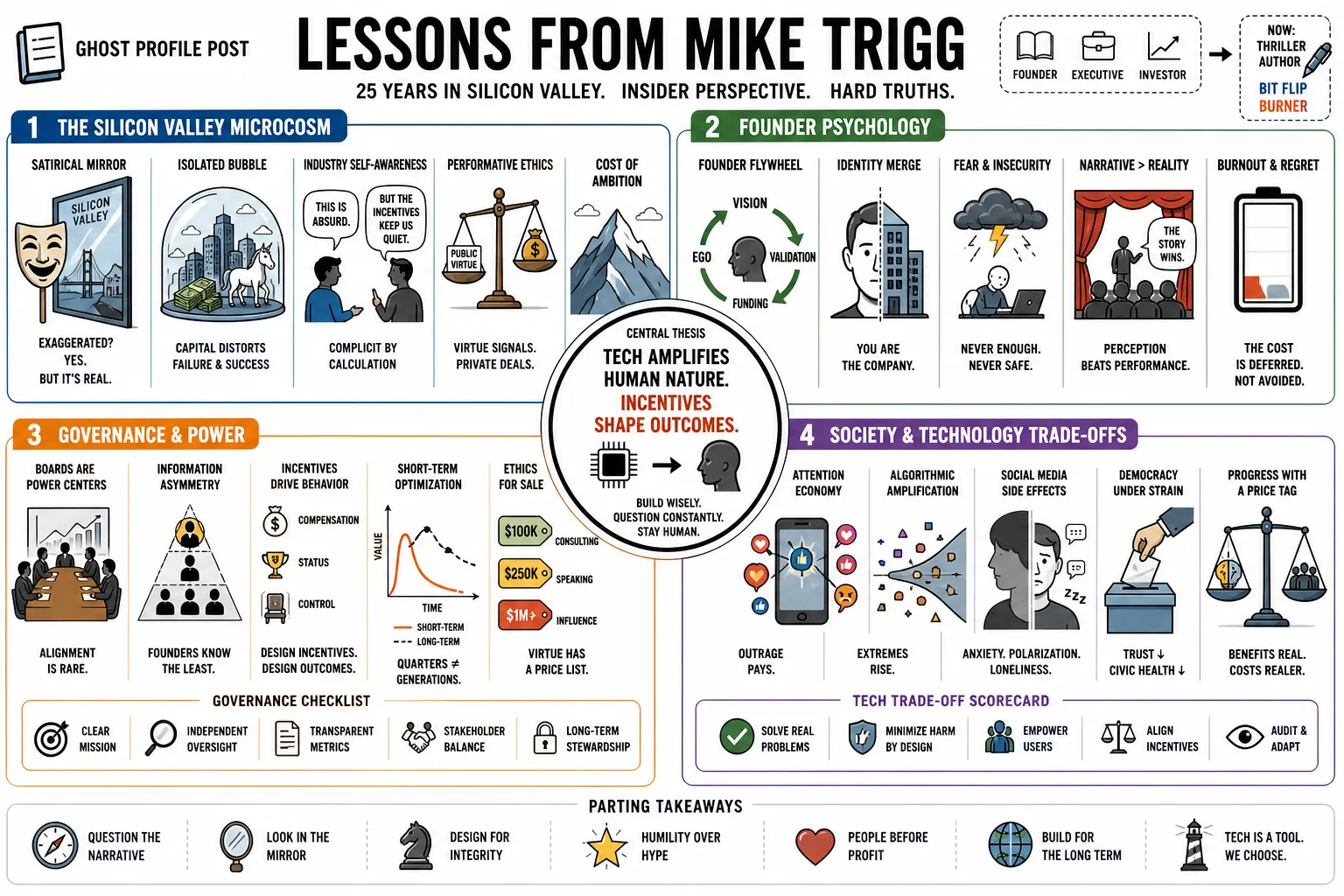
Lessons from Mike Trigg
Mike Trigg spent 25 years as a Silicon Valley founder, executive, and investor before leaving to write thrillers like Bit Flip and Burner. Drawing on that insider background, he examines the reality of corporate governance and founder psychology, as well as the consequences of social media. The observations below outline his firsthand take on building companies and the societal trade-offs of modern technology.
Part 1: The Silicon Valley Microcosm
- On Regional Satire: "Silicon Valley is often treated as an exaggerated caricature, but its internal dynamics serve as a strict microcosm for broader American struggles with wealth and inequality." — Source: [MikeTrigg.com]
- On the Tech Ecosystem: "We operate in an isolated bubble where massive capital availability distorts the basic definition of failure and success." — Source: [Establishing Your Empire]
- On Industry Self-Awareness: "People inside the valley often realize how absurd the culture is, yet they remain complicit because the financial incentives to stay quiet are too high." — Source: [Manhattan Book Review]
- On Performative Ethics: "Greed and envy and pride and all the other deadly sins are the core flywheel of who we are." — Source: [Bit Flip]
- On the Cost of Ambition: "The relentless pursuit of scale often forces early idealists to abandon their original moral framework." — Source: [Medium]
- On Capital and Risk: "The region attracts self-selecting risk-takers, but the safety net of venture capital often insulates them from the real-world consequences of their risks." — Source: [ScaleHQ Podcast]
- On the Insider's View: "It is entirely possible to love the energy of the Bay Area and still want to tear down the systemic flaws that make it exclusionary." — Source: [MikeTrigg.com]
- On Tech's Reputation: "We shifted from being perceived as the underdog innovators building the future to the corporate behemoths controlling it." — Source: [Armed with A Book]
- On Wealth Inequality: "The juxtaposition of extreme startup wealth against the localized housing and homelessness crises makes the tech sector an easy, and deserved, target for societal critique." — Source: [MikeTrigg.com]
- On Daily Pretension: "The power dynamics of startup culture are most visible in everyday interactions—like how an investor treats a waiter over an avocado." — Source: [Bit Flip]
Part 2: The Illusion of Tech Meritocracy
- On Workplace Demands: "…some days it seems like the only thing we're 'crushing' is ourselves." — Source: [Bit Flip]
- On the Tech Archetype: "The stereotype exists because it is continually rewarded by the funding mechanisms that prioritize aggressive confidence over competent humility." — Source: [Manhattan Book Review]
- On Merit and Luck: "Founders routinely confuse the fortunate timing of market trends with their own personal genius." — Source: [Establishing Your Empire]
- On Entitlement: "There is an expectation in tech that you deserve to be wealthy by 30 simply because you work at a software company." — Source: [ScaleHQ Podcast]
- On Diversity Gaps: "Despite the rhetoric about building an open future, the actual cap tables and boardrooms remain heavily insulated and exclusive." — Source: [Medium]
- On the Grind: "The win-at-all-costs ethos forces employees into a constant state of anxiety, disguised as passion for the product." — Source: [MikeTrigg.com]
- On Management: "We grow up not understanding the distinction between management and leadership." — Source: [Establishing Your Empire]
- On Founder Worshipping: "The media cycle elevates CEOs to visionaries before their companies have even achieved sustainable profitability." — Source: [Armed with A Book]
- On Employee Leverage: "For all the talk of talent being a company's greatest asset, the legal structure of equity often leaves early employees highly vulnerable." — Source: [Bit Flip]
Part 3: Corporate Greed and Power Dynamics
- On Venture Capital Influence: "Investors aren't just betting on companies; they actively engineer the aggressive timelines that lead to corporate malfeasance." — Source: [Capital Allocators Podcast]
- On the Growth Mandate: "When the board demands exponential growth in a linear market, executives are forced into a corner where corner-cutting becomes standard practice." — Source: [Bit Flip]
- On Fraudulent Schemes: "The line between faking it until you make it and actual wire fraud is much thinner than founders want to admit." — Source: [Foreword Reviews]
- On Executive Complicity: "Mid-level executives often spot the ethical breaches early but stay silent to protect their unvested stock options." — Source: [Bit Flip]
- On Transparency: "Companies preach radical transparency to their employees while keeping the actual financial health of the business entirely opaque." — Source: [Medium]
- On Acquisition Politics: "The sale of a company is rarely about the best product synergy; it is almost always about the liquidity needs of the dominant investors." — Source: [ScaleHQ Podcast]
- On Board Room Battles: "Founders often lose control of their companies not because of bad product decisions, but because they fail to manage the diverging interests of their board members." — Source: [MikeTrigg.com]
- On Corporate Apologies: "The standard tech apology for a data breach is a calculated legal maneuver designed to mitigate liability, not take actual responsibility." — Source: [Manhattan Book Review]
- On Wealth Accumulation: "The structure of modern tech exits ensures that the vast majority of capital flows to a handful of people who were already wealthy." — Source: [Capital Allocators Podcast]
- On Moral Flexibility: "As the valuation goes up, the company's collective moral compass often points in whatever direction sustains the valuation." — Source: [Bit Flip]
Part 4: Digital Anonymity and Social Media
- On Online Identity: "Anonymity on the internet was initially designed to protect dissidents, but it has been co-opted to shield abusers from accountability." — Source: [Burner]
- On Political Disinformation: "The algorithms aren't broken; they are functioning exactly as designed by optimizing for outrage over factual consensus." — Source: [MikeTrigg.com]
- On the Attention Economy: "We traded our privacy for convenience, only to realize the product being sold was our underlying behavior." — Source: [Burner]
- On Social Movements: "Digital-first political movements can scale rapidly, but their lack of offline infrastructure makes them incredibly fragile." — Source: [Armed with A Book]
- On Platform Responsibility: "Social media companies cannot claim to be neutral public squares while simultaneously tweaking the algorithm to boost specific engagement metrics." — Source: [ScaleHQ Podcast]
- On Radicalization: "The distance between a fringe internet forum and real-world violence is compressed by the constant reinforcement of echo chambers." — Source: [Burner]
- On the Desire for Connection: "People join anonymous online mobs not just for ideology, but for a twisted sense of community they lack in the physical world." — Source: [Medium]
- On Tech Addiction: "The platforms employ the exact same psychological hooks as slot machines, applied to human relationships." — Source: [Manhattan Book Review]
- On Regulatory Failure: "Legislation is perpetually five years behind the technology, leaving society to bear the immediate cost of unconstrained experiments." — Source: [MikeTrigg.com]
Part 5: Navigating Career Transitions
- On Identity and Work: "When you tie your entire self-worth to your title at a tech company, leaving the industry forces a severe personal crisis." — Source: [Establishing Your Empire]
- On the Pivot to Writing: "Moving from a 25-year career in business to writing fiction requires tearing down the analytical frameworks that made you successful in the first place." — Source: [Medium]
- On Learning Curves: "You have to be willing to return to the bottom of the learning curve and accept that your past credentials do not guarantee future competence." — Source: [ScaleHQ Podcast]
- On Creative Outlets: "The corporate environment drains creative energy, making it essential to deliberately carve out time for non-transactional pursuits." — Source: [Manhattan Book Review]
- On Redefining Success: "Success in your second act is rarely measured in financial exits; it is measured in autonomy and the quality of the work." — Source: [MikeTrigg.com]
- On Leaving the Bubble: "Stepping away from Silicon Valley provides the necessary distance to see the industry's flaws without the defensive bias of an active participant." — Source: [Armed with A Book]
- On Transferable Skills: "The resilience required to endure a failing startup is the exact same resilience required to face endless publishing rejections." — Source: [Establishing Your Empire]
- On Age in Tech: "The industry's obsession with youth forces older workers to either transition to pure management or exit the ecosystem entirely." — Source: [MikeTrigg.com]
- On Embracing Risk: "Quitting a stable executive job to write a novel is objectively irrational, which is exactly why you have to do it." — Source: [Medium]
Part 6: Writing the Tech Thriller
- On Fiction vs. Reality: "While there are many non-fiction books about Silicon Valley, I wanted to provide a more nuanced, fictionalized look at the industry's culture to expose the emotional truth." — Source: [MikeTrigg.com]
- On Creating Protagonists: "The most compelling characters in tech thrillers are the ones who are deeply flawed and complicit in the system they are trying to navigate." — Source: [Bit Flip]
- On Pacing: "A startup's trajectory mirrors the classic thriller arc: high stakes, constant paranoia, and an inevitable crash." — Source: [Manhattan Book Review]
- On Research: "The best research for a corporate thriller is lived experience; you can't fake the specific language of a tense board meeting." — Source: [Foreword Reviews]
- On Satire: "You don't need to exaggerate much to satirize tech culture; you just have to document the actual conversations happening in the cafes on University Avenue." — Source: [Armed with A Book]
- On AI and Authorship: "AI can generate text, but it lacks the lived human perspective required to inject genuine irony or dread into a narrative." — Source: [ScaleHQ Podcast]
- On the Business of Books: "Authors are essentially founders of their own small business, managing product development, marketing, and distribution." — Source: [Establishing Your Empire]
- On Thematic Focus: "I write about the dark side of technology not because I hate the industry, but because the stakes for society are too high to ignore the downsides." — Source: [MikeTrigg.com]
- On Reader Expectations: "Readers of tech thrillers want the insider details—the exact way equity is structured or how a server farm operates—to feel grounded in reality." — Source: [Medium]
- On Drafting: "Writing a novel requires the same blind faith as starting a company: you have to believe the final product will work long before you have proof." — Source: [Manhattan Book Review]
Part 7: Investment Strategy and Moats
- On Assessing Moats: "A competitive advantage isn't a static asset; the trajectory of the moat—whether it is widening or narrowing—is far more important than its current size." — Source: [Capital Allocators Podcast]
- On Corporate Culture: "Culture is the most durable competitive advantage a company can build, yet it is the hardest metric for traditional analysts to quantify." — Source: [Capital Allocators Podcast]
- On Angel Investing: "Early-stage investing is less about evaluating the product and entirely about evaluating the founder's capacity to handle inevitable failure." — Source: [ScaleHQ Podcast]
- On Market Timing: "Being early to a market is functionally indistinguishable from being wrong." — Source: [MikeTrigg.com]
- On Capital Efficiency: "Too much early capital masks structural flaws in the business model, leading to spectacular failures at scale." — Source: [Establishing Your Empire]
- On the Role of the Board: "A good board member asks the questions the CEO is actively trying to avoid answering." — Source: [MikeTrigg.com]
- On Due Diligence: "Financial audits only tell you what happened; cultural audits tell you what will happen next." — Source: [Capital Allocators Podcast]
- On Portfolio Construction: "Venture returns rely on power laws, which forces investors to push all their companies toward high-risk, binary outcomes." — Source: [ScaleHQ Podcast]
- On Long-Term Thinking: "The public markets optimize for the next quarter, while genuine innovation requires a timeline of decades." — Source: [Capital Allocators Podcast]
Part 8: The Reality of Entrepreneurship
- On the Employee Experience: "Even in highly successful tech companies, most employees eventually realize they are just easily replaceable parts in a massive machine." — Source: [MikeTrigg.com]
- On Product-Market Fit: "You cannot force the market to want your software, no matter how elegant the code is." — Source: [ScaleHQ Podcast]
- On the Burden of Leadership: "Founders absorb all the anxiety of the organization, shielding the team while dealing with the reality of payroll." — Source: [Establishing Your Empire]
- On Scaling Culture: "The company culture that works for ten people breaks at fifty, and breaks again at two hundred." — Source: [Medium]
- On Pivoting: "A successful pivot requires admitting you were completely wrong about your original thesis, which bruises the founder's ego." — Source: [MikeTrigg.com]
- On Isolation: "The role of the CEO is inherently lonely because you cannot share the worst news with your employees or your investors." — Source: [Manhattan Book Review]
- On Customer Feedback: "Customers will routinely lie to you about liking a product if they don't have to pay for it yet." — Source: [ScaleHQ Podcast]
- On Burnout: "We treat physical exhaustion as a badge of honor in startups, completely ignoring the degradation in decision-making that follows." — Source: [Armed with A Book]
- On Legacy: "At the end of a long career, the lines of code are obsolete; the only thing that remains is how you treated the people you worked with." — Source: [MikeTrigg.com]