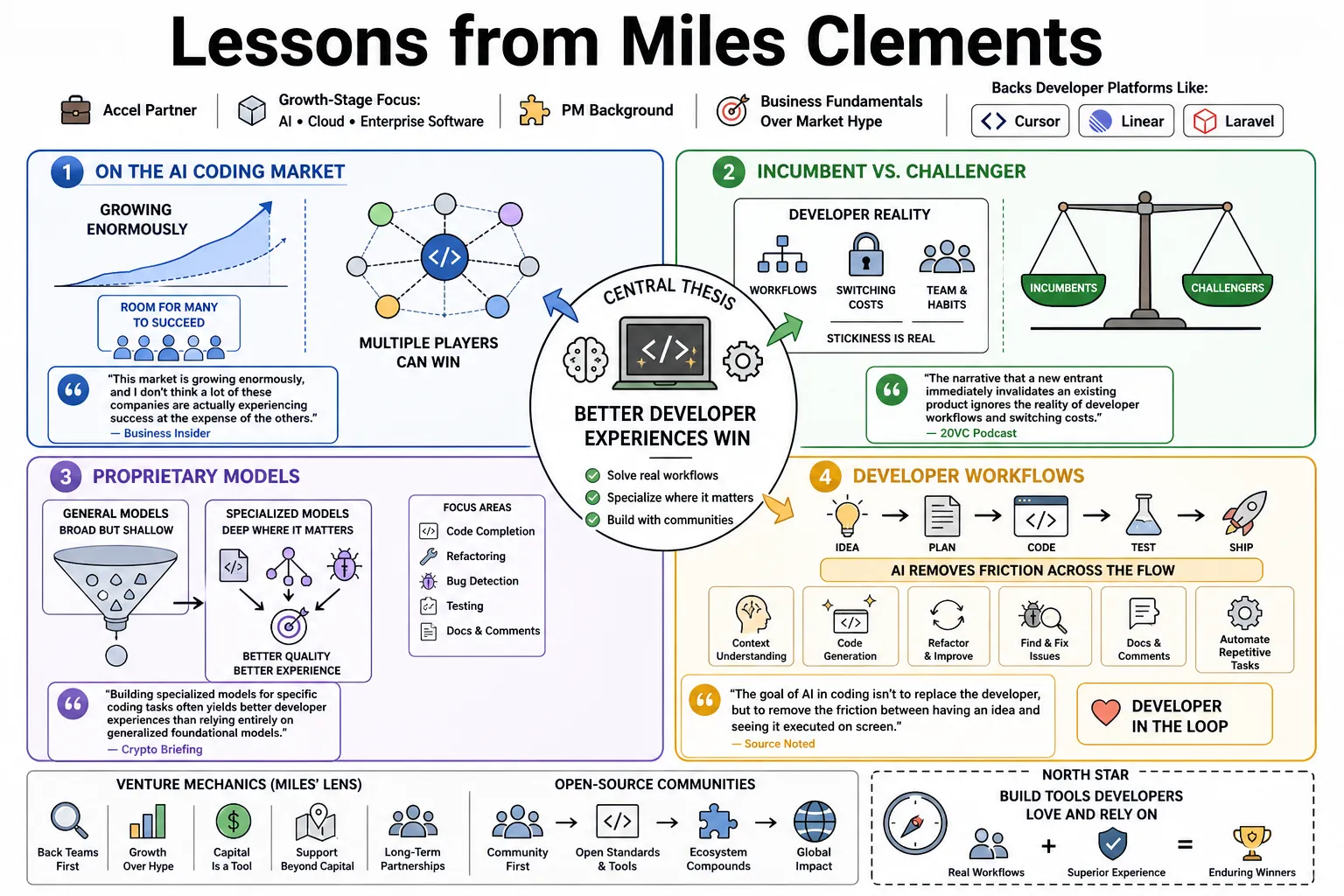
Lessons from Miles Clements
Accel Partner Miles Clements invests in growth-stage AI, cloud, and enterprise software. Drawing on his product management background, he prioritizes business fundamentals over market hype when backing developer platforms like Cursor, Linear, and Laravel. This profile collects his practical advice on venture mechanics, open-source communities, and AI-assisted coding.
Part 1: The AI Developer Experience
- On the AI Coding Market: "This market is growing enormously, and I don't think a lot of these companies are actually experiencing success at the expense of the others." — Source: Business Insider
- On Incumbent vs. Challenger: "The narrative that a new entrant immediately invalidates an existing product ignores the reality of developer workflows and switching costs." — Source: 20VC Podcast
- On Proprietary Models: "Building specialized models for specific coding tasks often yields better developer experiences than relying entirely on generalized foundational models." — Source: Crypto Briefing
- On Developer Workflows: "The goal of AI in coding isn't to replace the developer, but to remove the friction between having an idea and seeing it executed on screen." — Source: Accel Spotlight
- On Demos vs. Reality: "You can build a polished AI demo in 48 hours. That provides zero signal on whether the product is actually viable in a production environment." — Source: Substack
- On Evaluating AI Startups: "We look for teams that are deeply embedded in the developer community and understand the edge cases, rather than just wrapping a prompt around an API." — Source: 20VC Podcast
- On the Future of Software Engineering: Clements's Cursor investment memo frames software engineering as moving toward human-agent collaboration, where tools shrink the gap between intent and action instead of merely helping developers type syntax faster. — Reference: Accel investment memo on Cursor and human-agent software work
- On AI Defensibility: "In the current era, competitive advantage is increasingly shifting toward distribution, vertical expertise, and network effects rather than just model performance." — Source: Accel Insights
- On Tooling Fragmentation: "Developers are willing to try new tools, but they ultimately consolidate around platforms that offer a seamless, reliable experience." — Source: Business Insider
- On the Claude Code Narrative: "The idea that a single new model release completely changes the competitive landscape often overstates the immediate impact on enterprise adoption." — Source: Crypto Briefing
Part 2: Growth Investing and Market Cycles
- On Growth Fundamentals: "Growth investing isn't just about finding fast-growing companies; it's about finding companies whose growth is sustainable and backed by unit economics." — Source: 20VC Podcast
- On Missed Opportunities: The 20VC episode foregrounds missing Rippling and losing ServiceTitan as investment lessons, so the safer lesson is about using missed deals to improve judgment rather than treating every miss as bad luck. — Reference: 20VC episode agenda on missing Rippling and losing ServiceTitan
- On the IPO Market: "The window for multi-billion dollar IPOs isn't dead, but the bar for predictability and margin profile is significantly higher than it was a few years ago." — Source: 20VC Podcast
- On Private Equity Buyers: "Firms like Thoma Bravo and Vista have fundamentally changed the exit landscape for software companies, providing a very real alternative to public markets." — Source: TLDL
- On Valuation Discipline: "You can't let a euphoric market dictate your entry price if you want to generate consistent returns in the growth stage." — Source: Accel Insights
- On Capital Efficiency: Clements's Linear memo praises a company that grew quickly while operating profitably and preserving prior fundraises, treating outside capital as optional acceleration rather than proof of momentum. — Reference: Accel memo on Linear's profitable growth and funding choice
- On Market Corrections: "Corrections are healthy because they force everyone—investors and founders—to refocus on fundamental business metrics rather than vanity milestones." — Source: 20VC Podcast
- On Sector Rotation: "While AI is commanding the most attention, the underlying transition to the cloud in legacy industries is still a massive ongoing opportunity." — Source: Business Insider
- On the Growth Stage Machine: The 20VC conversation explicitly centers Accel's growth fund, ownership strategy, win rate, and large-fund outcome math, which supports a lesson about growth investing as a repeatable operating system. — Reference: 20VC episode agenda on Accel's growth investing machine
- On Late-Stage Diligence: "At the growth stage, you aren't just betting on the founder's vision; you are interrogating the sales efficiency, the cohort retention, and the gross margins." — Source: Accel Spotlight
Part 3: First-Principle Company Building
- On First-Principle Thinking: "The best founders operate on first-principle thinking—guided by disciplined root-cause reasoning rather than just following industry trends." — Source: Accel Insights
- On Customer-Centricity: "Product development should always be customer-focused rather than technology-first, even in deeply technical domains." — Source: Forbes
- On Avoiding Consensus: "If you build your company based on what everyone else on Twitter is doing, you're going to end up with a highly commoditized product." — Source: Spotify Podcasts
- On Defining the Problem: "A surprising number of startups fail because they build an elegant solution to a problem that doesn't actually matter to the buyer." — Source: 20VC Podcast
- On Organizational Design: In the Linear memo, Clements links every new hire and strategic decision to first-principles reasoning, making organization design part of product quality rather than a separate administrative layer. — Reference: Accel memo on Linear's hiring and strategic discipline
- On Focus: "The hardest part of building a successful company isn't deciding what to build, but having the discipline to decide what to ignore." — Source: Accel Spotlight
- On Learning Velocity: His Laravel memo shows the value of staying close to a builder community: repeated meetups, persistent founder contact, and firsthand product observation helped Accel understand the company's ambition before investing. — Reference: Accel memo on learning from Laravel's community and founder process
- On Long-Term Thinking: "First principles require a willingness to look foolish in the short term to be proven right in the long term." — Source: Substack
- On Linear's Approach: "Linear succeeded because they prioritized craft, performance, and user experience over rapid, undisciplined feature expansion." — Source: Accel Insights
- On Complexity: "As companies scale, complexity is the enemy of execution. The best leaders constantly prune organizational overhead." — Source: Spotify Podcasts
Part 4: Product Strategy and Distribution
- On Product Management: "Good product management isn't just about managing a backlog; it's about deeply understanding the market context and the user's daily reality." — Source: Medium
- On the Distribution Advantage: "An inferior product with incredible distribution will often beat a superior product with no go-to-market strategy." — Source: Substack
- On Go-To-Market Fit: "Product-market fit gets all the attention, but go-to-market fit—knowing exactly how to sell the product repeatedly—is what scales a business." — Source: 20VC Podcast
- On Product-Led Growth: Clements points to Linear's speed, craft, deep customer empathy, and rapid agent adoption as evidence that product quality can become distribution, retention, and expansion machinery. — Reference: Accel memo on Linear product craft and adoption
- On Feature Parity: "Chasing feature parity with an incumbent is usually a trap. You have to change the rules of the game to win." — Source: Accel Insights
- On User Experience: "In enterprise software, user experience is no longer a nice-to-have; it is a core defensible moat." — Source: Forbes
- On Building for Developers: "Developers have an incredibly low tolerance for marketing fluff. You win them over through utility and performance." — Source: Crypto Briefing
- On Pricing Strategy: "Pricing is one of the most underutilized levers in software. How you package and price dictates who buys and how they use it." — Source: Spotify Podcasts
- On Enterprise Sales: "Transitioning from bottom-up adoption to top-down enterprise sales requires a fundamental shift in company DNA." — Source: Medium
Part 5: The Open Source Commercial Model
- On Open Source Communities: "The strength of an open-source project is directly proportional to the vibrancy and engagement of its community." — Source: Accel Insights
- On the Laravel Investment: "Laravel has demonstrated how a passionate community can drive organic adoption at a scale that traditional marketing could never achieve." — Source: Appoly
- On Commercialization: The Laravel memo frames commercialization as adding hosting, scaling, and platform services around an open-source ecosystem so the product can create more value without abandoning the community that made it work. — Reference: Accel memo on Laravel Cloud and the open-source ecosystem
- On Open Source Economics: "When executed correctly, open source provides a massive top-of-funnel advantage that drastically reduces customer acquisition costs." — Source: 20VC Podcast
- On Developer Evangelism: "The best evangelists for an open-source project aren't employees; they are the developers who have built their own livelihoods on top of the framework." — Source: Medium
- On Project Governance: "Balancing the needs of enterprise customers with the direction of the open-source project requires a delicate touch and transparent communication." — Source: Accel Spotlight
- On Enterprise Support: "Large enterprises will adopt open source, but they need a commercial entity to provide the security, compliance, and support they require." — Source: Forbes
- On Ecosystem Growth: "A successful open-source company eventually transitions from building a tool to nurturing an entire ecosystem of partners and integrations." — Source: Spotify Podcasts
- On the PHP Ecosystem: "The narrative that certain programming languages are dead is often completely detached from the reality of what powers the internet." — Source: Accel Insights
Part 6: Venture Capital Mechanics
- On Board Roles: The 20VC agenda moves from ownership and win rate to public positions, chips off the table, and founder-led companies, supporting a board lesson about matching advice to each company's stage and strategic options. — Reference: 20VC episode agenda on ownership, public positions, and founder-led companies
- On Partnership Dynamics: "Venture is a team sport. The best decisions come from vigorous internal debate, not solitary conviction." — Source: 20VC Podcast
- On Deal Sourcing: "The best growth investments rarely come from cold inbound; they are the result of years of relationship building and market mapping." — Source: TLDL
- On Reference Checking: "The most valuable insights in diligence don't come from the management presentation, but from talking to customers who churned." — Source: Substack
- On Fund Sizes: "Fund size dictates strategy. You have to align your investment thesis with the math required to return the fund." — Source: 20VC Podcast
- On Portfolio Construction: "You can't be afraid of concentration in your winners. Growth investing requires leaning heavily into the companies that are compounding." — Source: Accel Insights
- On Founder Relationships: "Trust is built in the difficult board meetings, not the celebratory dinners." — Source: Medium
- On Competitive Deals: Clements's public episode framing emphasizes Accel's win rate and the changing approach to ownership, which makes deal-winning less about generic brand and more about earning the right fit for a specific founder and round. — Reference: 20VC episode agenda on win rate and ownership strategy
- On the Role of VC: "Our job isn't to run the company; our job is to help the founder see around corners they haven't encountered yet." — Source: Spotify Podcasts
Part 7: Assessing Founders and Teams
- On Founder-Led Companies: "We consistently see that founder-led companies at the growth stage are able to maintain their product velocity better than those that bring in outside CEOs too early." — Source: 20VC Podcast
- On Executive Hiring: The Linear memo treats hiring as a strategic decision guided by disciplined root-cause reasoning, reinforcing that growth-stage leadership depends on adding people who strengthen the company's operating principles. — Reference: Accel memo on Linear's hiring discipline
- On Self-Awareness: "The most impressive founders know exactly what they are bad at and hire people who are world-class in those specific areas." — Source: Accel Spotlight
- On Resilience: "Every high-growth company goes through existential crises. You have to underwrite the founder's emotional resilience as much as the business model." — Source: Forbes
- On Storytelling: "The ability to communicate a compelling vision is a hard skill. It's how you recruit engineers, win customers, and raise capital." — Source: Medium
- On Product Instincts: "Great founders maintain a deep, almost instinctual connection to the product, even when the company has a thousand employees." — Source: Spotify Podcasts
- On Managing Dilution: "Founders who understand capital structure and manage dilution carefully tend to be the most disciplined operators." — Source: TLDL
- On Culture: "Culture isn't what's written on the wall; it's the behavior that gets rewarded and tolerated when things get difficult." — Source: Substack
- On Adaptability: Clements's own profile spans product management, late-stage investing, and AI, cloud, SaaS, and enterprise companies, so the durable lesson is that stage and market context should change how a company builds. — Reference: Accel profile on Clements's background and sectors
Part 8: Market Discipline and Profitability
- On Profitability vs. Growth: "Being profitable doesn't mean you have to be anti-investors. It means you control your own destiny." — Source: Accel Insights
- On Burn Rates: "High burn rates mask operational inefficiencies. When money is free, it's easy to confuse spending with strategy." — Source: 20VC Podcast
- On the Rule of 40: "Metrics like the Rule of 40 are useful heuristics, but they have to be contextualized by the size of the addressable market and the competitive dynamics." — Source: Business Insider
- On Unit Economics: Linear's profitable growth and best-in-class efficiency metrics make the supported point that scale should improve the business model, not hide weak economics under a larger revenue number. — Reference: Accel memo on Linear's efficiency metrics and profitable growth
- On Market Size: "A great team in a small market will eventually hit a ceiling. We look for markets that are large enough to absorb mistakes." — Source: Forbes
- On Pricing Power: "The truest test of product value is pricing power. If you can't raise prices, you might not be as essential as you think." — Source: Substack
- On Sustainable Growth: "Sustainable growth comes from high net revenue retention, not just brute-forcing new logo acquisition." — Source: Medium
- On Economic Moats: "Software is inherently deflationary, so building a lasting business requires establishing a moat that protects your margins over time." — Source: Spotify Podcasts
- On Capital Allocation: The 20VC agenda covers whether sub-$10B outcomes matter to a large fund, when to take chips off the table, and whether firms should manage public positions, all of which frame late-stage investing as capital allocation under constraints. — Reference: 20VC episode agenda on outcome math, liquidity, and public positions