Lessons from Miles Grimshaw
Miles Grimshaw is a Partner at Thrive Capital and former General Partner at Benchmark who backed early rounds in Superhuman, Airtable, and Segment. He approaches startup growth as biology rather than a rigid physics equation. This profile collects his insights on founder selection, multi-product expansion, and capital dynamics in the AI era.
Part 1: The Biology of Investing
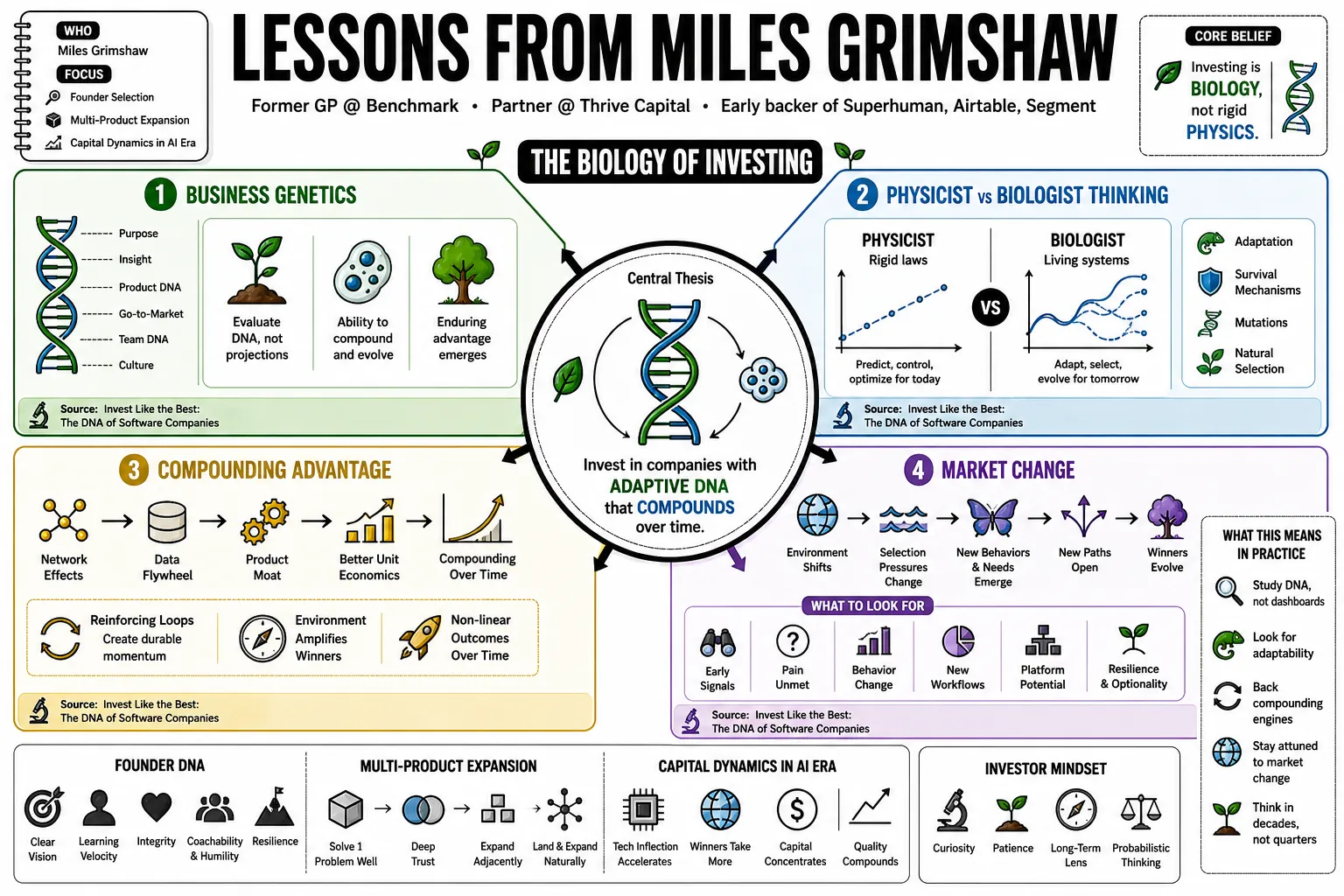
- On Business Genetics: "You have to evaluate the DNA of early-stage companies—their ability to compound and evolve—rather than treating their trajectory as a static physics equation." — Source: Invest Like the Best: The DNA of Software Companies
- On Physicist vs. Biologist Thinking: "If you view markets like a physicist, you look for rigid predictive laws. If you view them like a biologist, you look for adaptation, survival mechanisms, and mutations." — Source: Invest Like the Best: The DNA of Software Companies
- On Compounding Advantage: "The best software businesses don't just grow linearly; their internal genetics allow them to compound their advantages as they interact with their environment over time." — Source: Invest Like the Best: The DNA of Software Companies
- On Market Change: "We are highly change-aware. The best opportunities emerge where abrupt technical or industrial shifts force companies to adapt rapidly or die." — Source: 20VC with Harry Stebbings
- On Survival Traits: "Evaluating a startup is often about figuring out if they have the specific survival traits needed to outlast the inevitable periods of market re-evaluation." — Source: Invest Like the Best: The DNA of Software Companies
- On Organic Growth: "You can't force a product into a market that rejects it. Like a biological organism, it needs an environment where it can organically extract nutrients—in this case, user engagement." — Source: The Founders Podcast
- On the Second Act: "A company's genetics dictate whether it has the capacity for a differentiated second act once the initial product growth naturally slows down." — Source: Invest Like the Best: The DNA of Software Companies
- On Adaptive Moats: "Static moats are a myth in software. A true moat is biological; it adapts and hardens in response to the specific threats the company faces as it scales." — Source: 20VC with Harry Stebbings
- On Founder Resilience: "You are underwriting the founder's capacity to evolve their own thinking just as much as you are underwriting the initial product idea." — Source: Invest Like the Best: The DNA of Software Companies
Part 2: Assessing Founders and Early Signals
- On Early Data: "Relying purely on early data can be a trap. Sometimes the metrics look terrible because the market hasn't realized they need the product yet, or the product hasn't fully matured." — Source: 20VC with Harry Stebbings
- On Generational Vision: "We look for founders who aren't just building a product, but a generational company. They are thinking about decade-long horizons." — Source: Thrive Capital Announcements
- On Founder Selection: "Picking the right founder often comes down to identifying an obsession with a specific problem that borders on the irrational." — Source: 20VC with Harry Stebbings
- On Sourcing: "The best sourcing doesn't happen at networking events. It happens by following the trail of smart engineers and seeing what obscure tools they are using on weekends." — Source: 20VC with Harry Stebbings
- On Contrarianism: "Being contrarian for the sake of it is useless. You have to be right about a non-consensus view, which usually requires specialized, unshared knowledge." — Source: Invest Like the Best: The DNA of Software Companies
- On the Idea Maze: "Good founders have already navigated the idea maze before you meet them. They can tell you exactly why the obvious solutions will fail." — Source: 20VC with Harry Stebbings
- On Speed of Execution: "Velocity is the ultimate leading indicator. How much has the product improved between the first time we met and the second time?" — Source: Startup Grind
- On Customer Empathy: "Founders who struggle are often those who build for an imagined customer. The best founders have a direct, high-bandwidth connection to actual user pain." — Source: Startup Grind
- On Initial Traction: "Initial traction is less about the absolute number of users and more about the depth of engagement from a small, rabid fan base." — Source: 20VC with Harry Stebbings
Part 3: The AI Era and Capital Intensity
- On the Deep Learning Decade: "We are transitioning from the software era to the deep learning decade, where the fundamental constraints of building applications have completely shifted." — Source: The Gradient Podcast
- On Hardware Constraints: "The shortage of hardware for LLMs isn't just a supply chain issue; it's a defining feature that dictates which AI startups can achieve scale." — Source: The Gradient Podcast
- On AI Vendor Adoption: "When Cursor, OpenAI, and Anthropic independently adopt the same security tool unprompted, you pay attention. That kind of convergence is a massive signal." — Source: Thrive Capital Announcements
- On Capital Requirements: Grimshaw says AI makes engineering easier, but distribution and customer migration remain some of the most capital-intensive parts of building software companies; he also argues that venture remains well suited to ambitious, capital-heavy projects such as OpenAI, SpaceX, Monzo, Oscar, and Nudge. — Reference: LaBossiere Podcast Miles Grimshaw episode on startup capital intensity and VC as a capital instrument
- On the Era of Doing: Grimshaw frames AI as a shift from digitizing information to products that do more of the work for users, using examples such as ChatGPT searching, Cursor coding, and autonomous driving. — Reference: LaBossiere Podcast Miles Grimshaw episode on moving from digitizing to doing
- On Value Capture in AI: "The open question in generative AI is whether the value will accrue to the foundational models, the infrastructure providers, or the end-user applications." — Source: The Gradient Podcast
- On Trillion-Dollar Outcomes: In the LaBossiere conversation, Grimshaw links trillion-dollar outcomes to powerful market tailwinds and sustained founder inventiveness, noting that the question has moved from who becomes the first trillion-dollar company to who might become the first ten-trillion-dollar company. — Reference: LaBossiere Podcast Miles Grimshaw episode on trillion-dollar outcomes
- On AI Native Products: "An AI-native product isn't just a traditional app with a chat interface slapped on. It requires a complete rethink of the user experience from the ground up." — Source: The Gradient Podcast
- On Model Commoditization: Grimshaw argues that simply being an API call to an underlying model is not enough; the stronger AI application companies shape intelligence into differentiated product experiences, own workflow depth, and build full-stack product advantages. — Reference: LaBossiere Podcast Miles Grimshaw episode on AI application moats and full-stack teams
- On Developer Velocity: "Tools like Cursor aren't just incremental improvements; they change the baseline velocity at which software can be written, altering the entire ecosystem." — Source: Thrive Capital Announcements
Part 4: The Co-Pilot Strategy and Incumbents
- On the Co-Pilot Concept: "The 'Co-Pilot' model is often an incumbent strategy. Existing market leaders have a structural distribution advantage in deploying these tools to their existing user base." — Source: 20VC with Harry Stebbings
- On Distribution vs. Innovation: "In the AI race, you have to ask if the startup will get distribution before the incumbent gets innovation. With co-pilots, incumbents often move faster." — Source: 20VC with Harry Stebbings
- On Feature vs. Product: "Many AI tools currently masquerading as standalone products are actually just features that will eventually be absorbed by larger platforms." — Source: 20VC with Harry Stebbings
- On Incumbent Data Advantages: "Incumbents have years of historical user data. A co-pilot trained on a company's specific proprietary data will always outperform a generic AI tool." — Source: The Gradient Podcast
- On Workflow Lock-in: "Users don't want to switch to a new app just for an AI feature. They want AI integrated into the workflows they already use every day." — Source: Invest Like the Best: The DNA of Software Companies
- On Pricing AI: "Incumbents can bundle AI co-pilots into existing enterprise contracts, making it incredibly difficult for startups to compete on price or procurement." — Source: 20VC with Harry Stebbings
- On Startup Opportunities: "To beat an incumbent co-pilot, a startup has to build something that requires a completely different fundamental architecture that the incumbent cannot adopt without cannibalizing its core business." — Source: 20VC with Harry Stebbings
- On UI Paradigms: "The chat interface is likely a transitional UI. The most effective co-pilots will eventually become invisible, anticipating user needs without prompting." — Source: The Gradient Podcast
- On Enterprise Trust: Grimshaw says co-pilot-style products are naturally strong for incumbents because they already own the data, distribution, user experience, and seat-based business model; startups need to seek a different shape of product, such as moving from co-pilot to command center. — Reference: LaBossiere Podcast Miles Grimshaw episode on co-pilots, incumbents, and command centers
Part 5: Multi-Product Strategy and Scaling B2B
- On the Platform Transition: "Moving from a single-product tool to a multi-product platform is the most dangerous and necessary transition a B2B company will make." — Source: Invest Like the Best: Building Lattice
- On Product Sequencing: "You can't build the second product until the first product has achieved overwhelming dominance in its specific niche." — Source: Startup Grind
- On Customer Permission: "You only earn the right to sell a second product if the customer implicitly trusts the value you delivered with the first one." — Source: Invest Like the Best: Building Lattice
- On Organizational Design: "Scaling multi-product requires a shift in company genetics. The org structure that built the initial wedge will break when trying to manage a suite." — Source: Invest Like the Best: Building Lattice
- On Cross-Selling: "The unit economics of a multi-product company only work if the cost of acquiring a customer for the second product is a fraction of the cost of the first." — Source: Startup Grind
- On Platform Gravity: "A true platform exerts gravitational pull. Third parties start building on top of it because the underlying data model is too valuable to ignore." — Source: Invest Like the Best: Building Lattice
- On R&D Allocation: "Deciding how to allocate engineering resources between maintaining the core engine and betting on the next product is the CEO's most difficult balancing act." — Source: Invest Like the Best: Building Lattice
- On Market Expansion: "Sometimes the second product doesn't just expand the revenue per user; it unlocks entirely new buyer personas within the same organization." — Source: Startup Grind
- On Pricing Power: "Multi-product suites gain pricing power not just from feature volume, but from the eliminated friction of managing multiple different software vendors." — Source: Invest Like the Best: Building Lattice
- On AI as a Facilitator: "AI is acting as an accelerant for multi-product expansion, allowing companies to build adjacent features in a fraction of the historical time." — Source: Startup Grind
Part 6: Infrastructure vs. Application Software
- On Infrastructure Resilience: "Infrastructure and developer tools are generally beneficiaries, not victims, of major technological shifts. They provide the picks and shovels." — Source: The Gradient Podcast
- On Application Vulnerability: "Pure application software is highly susceptible to disruption by AI, as the barriers to recreating complex workflows continue to drop." — Source: The Gradient Podcast
- On API Businesses: "The best API companies turn complex, fragmented real-world processes into a single line of clean code." — Source: Invest Like the Best: The DNA of Software Companies
- On Developer Adoption: "You don't sell developer tools top-down. You build something so elegant that individual engineers sneak it into the codebase from the bottom up." — Source: The Gradient Podcast
- On LangChain and Abstractions: "Tools like LangChain succeed because they provide the necessary abstractions for developers to build complex LLM applications without managing the underlying chaos." — Source: The Gradient Podcast
- On Infrastructure Lock-in: "Once an API becomes a structural load-bearing wall in a company's product, the churn rate effectively drops to zero." — Source: Invest Like the Best: The DNA of Software Companies
- On Open Source: "Open source isn't a business model; it's a top-of-funnel distribution strategy that requires a separate, deliberate monetization engine." — Source: The Gradient Podcast
- On Compounding Data: "Infrastructure companies that passively collect and organize metadata across their user base often discover unexpected, highly lucrative secondary product lines." — Source: Invest Like the Best: The DNA of Software Companies
- On the Tooling Cycle: "Every new computing paradigm creates a messy period of fragmented tooling, followed by a consolidation phase where one or two platforms become the default standard." — Source: The Gradient Podcast
Part 7: Lessons from Misses and Mistakes
- On Missing Figma: "Passing on Figma early on was a lesson in underestimating how collaborative, browser-based software could completely consume a traditionally desktop-bound workflow." — Source: 20VC with Harry Stebbings
- On Missing Plaid: "Missing Plaid taught me the danger of evaluating an infrastructure company purely on its initial, narrow use case rather than the broader economic activity it could eventually intermediate." — Source: 20VC with Harry Stebbings
- On Re-evaluating Theses: "The hardest part of investing is aggressively updating your priors when new evidence contradicts your initial thesis on a company." — Source: 20VC with Harry Stebbings
- On False Negatives: "In venture, your false negatives—the great companies you said no to—are vastly more expensive than your false positives." — Source: Invest Like the Best: The DNA of Software Companies
- On Price Sensitivity: "Being overly disciplined on valuation in the early stages can cause you to miss the defining outliers of a generation." — Source: 20VC with Harry Stebbings
- On Market Sizing: "Early market sizing exercises are almost always wrong. Great founders don't just capture existing markets; they expand them or create entirely new ones." — Source: Invest Like the Best: The DNA of Software Companies
- On Timing: "You can have the right thesis about a technology, but if you are five years too early, you are still effectively wrong." — Source: 20VC with Harry Stebbings
- On Consensus Blindspots: "When an entire partnership unanimously agrees an investment is a good idea, it's often a sign that the opportunity is already too obvious and the alpha is gone." — Source: 20VC with Harry Stebbings
- On Learning from Failure: "You have to conduct rigorous post-mortems not just on the companies that failed, but on the massive successes you failed to understand." — Source: Invest Like the Best: The DNA of Software Companies
Part 8: The Venture Capital Craft
- On Long-Term Commitment: "We make few investments per year, but our intensity and drive to show up for founders forges a bond that transcends good times and bad." — Source: Thrive Capital Announcements
- On Servicing Founders: "Venture capital isn't just about writing a check. It's a service business where your core product is high-leverage strategic guidance during moments of crisis." — Source: 20VC with Harry Stebbings
- On the 5 Pillars: "Venture is built on five pillars: sourcing, selecting, winning, servicing, and exiting. You have to be world-class at all of them to generate consistent returns." — Source: 20VC with Harry Stebbings
- On Board Dynamics: "A good board member doesn't try to run the company. They act as a forcing function for clarity, ensuring the founder is confronting the most difficult questions." — Source: Startup Grind
- On Partnership Structure: "The best venture firms operate as a true partnership of equals, where conviction is tested through rigorous, unvarnished debate." — Source: The Gradient Podcast
- On Career Transitions: "Moving between firms like Thrive and Benchmark provides a rare perspective on how different, highly successful architectures of venture capital operate at scale." — Source: 20VC with Harry Stebbings
- On Reputation: "Your reputation in venture is your only real asset. It is built slowly over decades of interactions with founders and lost quickly through a single breach of trust." — Source: Invest Like the Best: Building Lattice
- On Pattern Recognition: "Experience gives you pattern recognition, but the danger is applying old patterns to new paradigms where the fundamental rules have changed." — Source: 20VC with Harry Stebbings
- On Independent Thinking: "You have to insulate yourself from the noise of the ecosystem. If you consume the same inputs as everyone else, you will generate the same consensus outputs." — Source: Invest Like the Best: The DNA of Software Companies
- On the Privilege of the Job: Grimshaw describes investing through curiosity about market change as both joyful and a privilege: the job lets him study new species of companies, ask what is well adapted to the changing world, and look for category-defining businesses. — Reference: LaBossiere Podcast Miles Grimshaw episode on curiosity, market change, and the privilege of investing