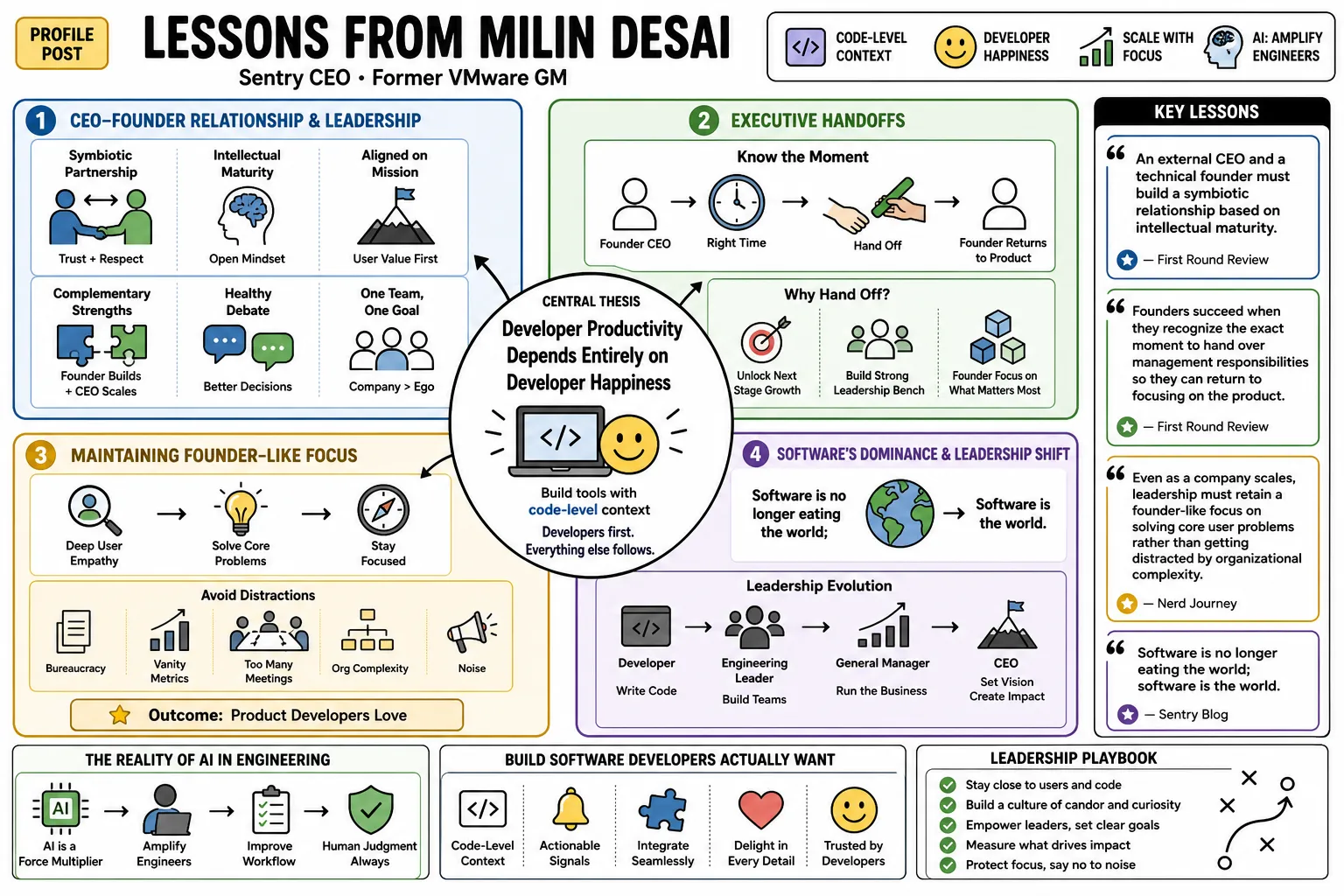
Lessons from Milin Desai
Sentry CEO and former VMware general manager Milin Desai argues that developer productivity depends entirely on developer happiness. He believes engineering tools must provide code-level context instead of just operational alerts. This profile covers his views on scaling infrastructure, the reality of AI in engineering, and building software that developers actually want to use.
Part 1: The CEO-Founder Relationship and Leadership
- On the Founder-CEO Dynamic: Desai’s Sentry lesson is that an external CEO works when the founder intentionally chooses the handoff, keeps contributing first-principles product judgment, and both sides communicate without ego. — Reference: First Round transcript on Desai and David Cramer’s CEO-founder relationship
- On Executive Handoffs: Sentry’s handoff worked because the founder recognized which CEO responsibilities he did not want to own and deliberately created room for Desai to lead the next chapter. — Reference: First Round transcript on Cramer’s CEO handoff
- On Maintaining Founder-Like Focus: "Even as a company scales, leadership must retain a founder-like focus on solving core user problems rather than getting distracted by organizational complexity." — Source: Nerd Journey
- On Software's Dominance: "Software is no longer eating the world; software is the world." — Source: Sentry Blog
- On Transitioning Roles: "Moving from a developer role to the business side requires learning to translate technical value into business outcomes." — Source: Shift Mag
- On Authentic Leadership: "Leadership in developer tools demands authenticity; developers can immediately spot when a leader doesn't understand their daily reality." — Source: Frontlines
- On Building Relevance: "Leaders must continuously build, own, and maintain their relevance as technology shifts beneath them." — Source: Nerd Journey
- On Communication Scale: "As an executive, communication must scale contextually, ensuring that every team understands not just the 'what' but the 'why' of a decision." — Source: Nerd Journey
- On Trusting Engineering: Desai treats the founder-builder voice as a scaling asset: leadership should preserve the engineering point of view while adding the structures needed for growth. — Reference: First Round transcript on preserving founder-builder intensity
- On the Value of B2D: Desai’s B2D lesson is that developers resist conventional selling, so the company has to earn attention through technical value, credibility, and the right product experience. — Reference: First Round transcript on Sentry’s B2D model
Part 2: Developer Productivity and Happiness
- On the Core Equation: "Developer productivity is deeply linked to developer happiness; they are intrinsically tied and supported by data." — Source: Forbes
- On Efficiency Gains: "A developer who is 10% happier than another requires 10% less time to accomplish the exact same work." — Source: Forbes
- On True Motivation: "Developers are happiest when they are empowered to innovate, create new features, and ship code to users." — Source: Forbes
- On Developer Pride: "Engineers derive significant pride from writing quality code, fixing bugs, and meaningfully improving application performance." — Source: Forbes
- On Workflow Barriers: "Productivity and happiness are severely hampered by excessive internal messaging, cumbersome processes, and disruptive tools." — Source: Forbes
- On the Cost of Distraction: "Companies must minimize distractions and context-switching to allow developers to focus on the deep work they were hired to do." — Source: Forbes
- On Developer Experience: "Optimizing the developer experience isn't just a perk; it's a foundational requirement for building a successful software business." — Source: Forbes
- On Internal Tooling: "If your internal tools require more maintenance than they provide in value, they are actively damaging your team's productivity." — Source: Forbes
- On Meaningful Metrics: "Measuring lines of code or commit frequency is a flawed way to evaluate a developer's true contribution to the product." — Source: Runtime
- On Removing Friction: "The goal of good developer tooling is to remove the friction between having an idea and seeing that idea running in production." — Source: Sentry Blog
Part 3: The 10x Software Team
- On Measuring Outcomes: "You should be measuring productivity at a team level to achieve the outcomes that you want to achieve. Because otherwise you end up with busy work without impact." — Source: Runtime
- On the 10x Myth: "We need to shift our focus from the myth of the '10x developer' to the reality and necessity of the '10x software team'." — Source: Sentry Blog
- On Shared Context: "Shared context is the key enabler for a 10x team, allowing members to collaborate effectively and handle tasks across the stack." — Source: Sentry Blog
- On Team Synergies: "When a team operates with seamless shared context, the output is significantly greater than the sum of its individual developers." — Source: Sentry Blog
- On AI’s Role in Teams: Desai’s AI-for-teams view is that production context can become a shared reasoning layer, helping teams coordinate fixes instead of treating AI as an isolated coding assistant. — Reference: SiliconANGLE/theCUBE on shared context and 10x software teams
- On Cross-Stack Visibility: Sentry’s AI argument depends on full production context: stack traces, breadcrumbs, environment data, and infrastructure signals have to come together before AI can reason usefully. — Reference: SiliconANGLE/theCUBE on production context for developer AI
- On Eliminating Silos: Desai’s scaling playbook pushes against functional silos: product, engineering, marketing, and go-to-market need to shape launches together from beta through general availability. — Reference: First Round transcript on cross-functional product launches
- On Collective Accountability: "When you measure success at the team level, you foster an environment of collective accountability rather than individual blame." — Source: Runtime
- On Impact Over Output: "Focusing on the team's ability to deliver customer value prevents the organization from optimizing for mere output." — Source: Runtime
Part 4: Scaling Business and Constrained Resources
- On the VMware Experience: "Scaling VMware's cloud networking business from zero to a billion-dollar run rate required intense focus on solving genuine infrastructure pain points." — Source: VMware
- On Constrained Planning: "The art of constrained resource planning forces a team to prioritize the features that truly move the needle for the business." — Source: Nerd Journey
- On Pricing Strategy: Desai’s pricing lesson is that strong product ROI creates room for creative packaging and commercialization, but pricing only works when it matches the value customers already feel. — Reference: First Round transcript on VMware pricing and packaging lessons
- On Organizational Adaptability: Desai had to adapt the VMware enterprise-scaling playbook for Sentry’s developer-led motion, keeping useful operating discipline without crushing the product-led engine. — Reference: First Round transcript on adapting the VMware playbook at Sentry
- On the Open-Source Balance: Desai frames open source as both community and business discipline: Sentry maximized adoption first, then built a sustainable model around affordable hosted value. — Reference: ShiftMag interview on Sentry’s open-source business model
- On Go-to-Market Evolution: "A go-to-market strategy that works for early adopters will inevitably break; it must be continuously rebuilt as you target the enterprise." — Source: Frontlines
- On Micro-segmentation: "Driving the adoption of network virtualization meant convincing the market that software could handle what hardware traditionally dominated." — Source: SiliconANGLE
- On Multi-Cloud Realities: "Scaling multi-cloud offerings requires understanding that customers want agility and integration, not just another place to host VMs." — Source: CRN
- On Enterprise Value: Desai’s enterprise lesson is to serve scale without becoming bespoke; Sentry’s “Fortune 500,000” mindset is to satisfy larger customers while still building for the broad developer base. — Reference: First Round transcript on building for the Fortune 500,000
Part 5: Code-Level Observability and Context
- On the Observability Market: Desai’s observability point is developer-centered: the market has to move from passive monitoring toward code-level context that helps engineers understand and fix failures. — Reference: SiliconANGLE/theCUBE on developer-focused observability
- On Code-Level Observability: "Code observability is the missing piece; it's about having direct visibility into how specific code changes impact the customer experience." — Source: Forbes
- On Deep Context: "Developers need deep context—stack traces, logs, and commit history—to understand not just that code is broken, but exactly why it is broken." — Source: Nerd Journey
- On Fixing vs. Finding: Desai’s Sentry thesis is that observability should close the loop: find the root cause, suggest or generate the fix, and eventually prevent risky code before it ships. — Reference: SiliconANGLE/theCUBE on Seer and proactive bug prevention
- On Proactive Prevention: "The evolution of monitoring is moving from passive detection of errors to the proactive, automated prevention of bad code reaching production." — Source: SiliconANGLE
- On the Developer's Dashboard: "A developer's dashboard shouldn't look like an infrastructure monitoring screen; it needs to speak the language of commits, releases, and code lines." — Source: Shift Mag
- On Tracing Reality: "Distributed tracing only matters to a developer if it can point them to the exact file and function that caused the bottleneck." — Source: TechStrong
- On Reducing MTTR: "Mean Time To Resolution is directly proportional to the amount of accurate context you can provide the developer at the moment the alert fires." — Source: Sentry Blog
- On Application State: "Understanding the state of the application at the exact moment of failure is the difference between a quick fix and a three-day debugging session." — Source: Sentry Blog
Part 6: The AI-Native Mindset
- On AI Agents: Desai’s agentic-AI view is practical rather than abstract: agents become valuable when connected to production context and embedded directly in the developer workflow. — Reference: SiliconANGLE/theCUBE on agentic AI in developer workflows
- On Becoming AI-Native: "Adopting an AI-native mindset requires executives and teams to rethink processes from the ground up, rather than just bolting AI onto existing workflows." — Source: Nerd Journey
- On Automated Reasoning: "The future of error tracking is using production data and LLMs to automatically reason through errors and suggest the correct root-cause fixes." — Source: SiliconANGLE
- On Context and LLMs: Desai’s core AI lesson is that model quality is not enough; the difference comes from feeding LLMs the production context that explains what actually broke. — Reference: SiliconANGLE/theCUBE on production context and root-cause accuracy
- On the Future of Debugging: Desai’s future of debugging is a shorter loop: production context identifies the root cause, AI proposes the fix, and developers review the change instead of hunting blindly. — Reference: SiliconANGLE/theCUBE on AI-assisted debugging loops
- On Opting In to AI: "Companies must actively 'opt in' to the AI transition; waiting on the sidelines ensures you will be outpaced by those who embrace the new paradigm." — Source: Nerd Journey
- On Trusting AI: Trust in AI developer tools comes from traceable context: the system has to show the production data, traces, and workflow signals behind its recommendation. — Reference: SiliconANGLE/theCUBE on Sentry’s reasoning layer and context
- On AI’s True Value: Desai’s higher-value AI outcome is not faster boilerplate; it is giving engineers back time for architecture and design by compressing root-cause and remediation work. — Reference: SiliconANGLE/theCUBE on AI freeing developers for architecture and design
- On Proactive AI: "We are moving toward systems where AI can evaluate a pull request and predict its performance impact in production before it ever ships." — Source: SiliconANGLE
- On the AI Learning Curve: "Every software leader today has a mandate to flatten the AI learning curve for their engineering teams." — Source: Nerd Journey
Part 7: Bottom-Up Growth and Developer Tools
- On Community-Led Growth: "A bottoms-up, community-led model only works if the product delivers immediate, undeniable value to the individual developer." — Source: Frontlines
- On Developer Advocacy: "Technical marketing and developer advocacy are about authentically communicating technical value to a highly skeptical audience." — Source: Nerd Journey
- On Solving Real Problems: Desai’s developer-tool rule is blunt: if the product does not solve a meaningful engineering pain, developers will not use it, talk about it, or pay for it. — Reference: ShiftMag interview on useful developer products
- On Product-Led Trust: Sentry’s trust loop is product-led: deliver value, listen to developer feedback, acknowledge the gaps, and let adoption compound through usefulness. — Reference: ShiftMag interview on community feedback and adoption
- On the Developer Persona: "Understanding the developer persona means recognizing that their primary goal is to stay in the flow state, not to learn a new tool." — Source: Frontlines
- On Frictionless Adoption: Desai’s adoption lesson is to make the paid product easier than self-hosting: affordable, accessible, and valuable enough that developers choose it willingly. — Reference: ShiftMag interview on affordability and developer adoption
- On Building for the User: Desai’s Sentry playbook starts with the person writing and fixing code; executive buyers matter, but the product has to respect the developer’s daily reality first. — Reference: First Round transcript on building for developers
- On the Power of Open Source: Desai credits open source with Sentry’s reach and credibility: the community made the product visible, useful, and trusted before it became a large commercial company. — Reference: ShiftMag interview on open-source community support
- On Scaling DevTools: Desai’s DevTools scaling challenge is to keep individual developers engaged while building the packaging, enterprise readiness, and operating model needed for much larger customers. — Reference: First Round transcript on Sentry’s DevTools scaling
Part 8: Career Development and Relevance
- On Expanding Curiosity: "Career longevity in technology requires a deliberate effort to constantly expand your curiosity beyond your current domain." — Source: Nerd Journey
- On the Value of Context: "Understanding the broader business context of your work elevates you from a task executor to a strategic contributor." — Source: Nerd Journey
- On Career Transitions: "Moving from engineering to product to general management requires a willingness to unlearn old habits and embrace new metrics of success." — Source: Shift Mag
- On Owning Your Path: "You must take active ownership of your career relevance; the technology industry will not wait for you to catch up." — Source: Nerd Journey
- On Mentorship: Desai’s career lessons came from watching operators scale hard technical businesses, especially VMware leaders who modeled pricing, packaging, enterprise motion, and constrained execution. — Reference: First Round transcript on leaders who influenced Desai
- On Cross-Functional Empathy: "A strong product manager must develop deep empathy not just for the customer, but for the engineering and sales teams executing the vision." — Source: Shift Mag
- On the Scope of Responsibility: "As you move up in an organization, your scope of responsibility shifts from delivering code to delivering clarity." — Source: Nerd Journey
- On Handling Upside: "Leaders must learn how to manage the 'upside'—how to capitalize on unexpected success and scale it without breaking the culture." — Source: Nerd Journey
- On Continuous Learning: "The moment you believe you have mastered your domain is the exact moment you begin to lose your relevance." — Source: Nerd Journey