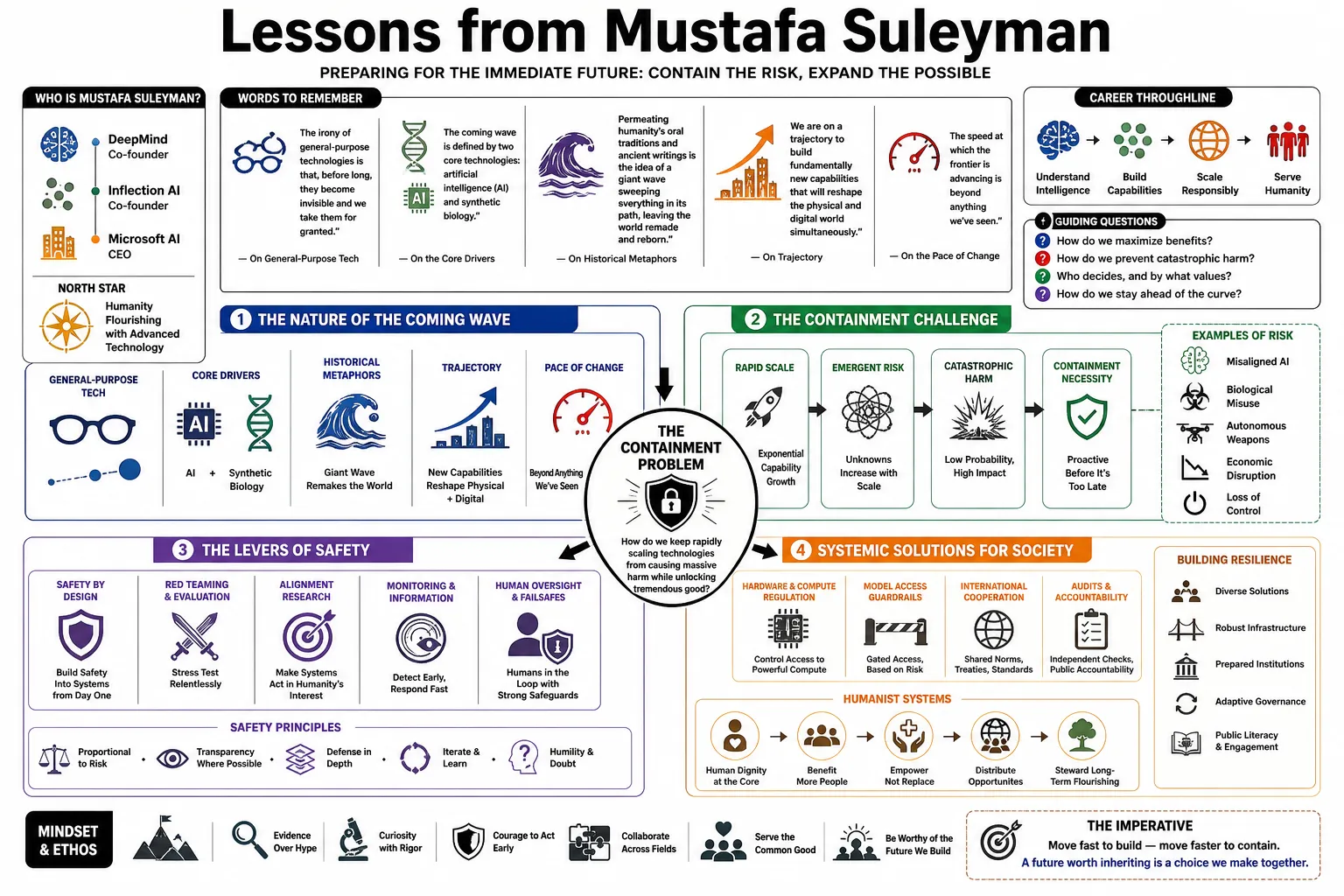
Lessons from Mustafa Suleyman
Mustafa Suleyman co-founded DeepMind and Inflection AI before becoming CEO of Microsoft AI. He frequently highlights the "containment problem," which asks how to keep rapidly scaling technologies like AI and synthetic biology from causing massive harm. This profile gathers his arguments on safety constraints, hardware regulation, and humanist systems, detailing how an executive at the center of the industry prepares for the immediate future.
Part 1: The Nature of the Coming Wave
- On General-Purpose Tech: "The irony of general-purpose technologies is that, before long, they become invisible and we take them for granted." — Source: [The Coming Wave]
- On the Core Drivers: "The coming wave is defined by two core technologies: artificial intelligence (AI) and synthetic biology." — Source: [Goodreads]
- On Historical Metaphors: "Permeating humanity's oral traditions and ancient writings is the idea of a giant wave sweeping everything in its path, leaving the world remade and reborn." — Source: [Frank Diana's Blog]
- On Trajectory: "We are on a trajectory to build fundamentally new capabilities that will reshape the physical and digital world simultaneously." — Source: [The Coming Wave]
- On the Pace of Change: "The speed at which these new systems scale is unlike anything we have seen in previous technological revolutions." — Source: [Exponential View]
- On Asymmetric Power: "Over the next 10 years, AI will be the greatest force amplifier in history, enabling a redistribution of power on a historical scale." — Source: [Medium]
- On Compression of Knowledge: "A single image-generation model running on a laptop can compress the open web into a tool of extraordinary creativity." — Source: [Substack]
- On Synthetic Biology Risk: "A single pathogenic experiment could spark a pandemic, a tiny molecular event with global ramifications." — Source: [The Coming Wave]
- On Planetary Drivers: "Human beings may no longer be the primary planetary drivers; we will interact more with AIs than other people." — Source: [The Coming Wave]
- On Inevitability: "The wave cannot be wished away; it is driven by immense commercial incentives and geopolitical competition." — Source: [The Diary of a CEO]
Part 2: The Containment Dilemma
- On the Great Dilemma: "We must navigate a path between the poles of catastrophe and dystopia. This is the essential dilemma of our age." — Source: [Toby Sinclair]
- On the Definition of Containment: "Adapted technologies are contained technologies. The most urgent task is not to ride or vainly stop the wave but to sculpt it." — Source: [Goodreads]
- On Total Control: "Absolute control over AI is a myth; we need a layered web of containment mechanisms." — Source: [Making Sense Podcast]
- On Halting Progress: "If AI systems ever threaten humanity in an uncontrollable way, development must be halted entirely." — Source: [Open The Magazine]
- On Technical Checks: "Containment requires provable safety mechanisms embedded at the base layer of the code itself." — Source: [Business Insider]
- On Fragility: "The modern world is incredibly fragile, and uncontained general-purpose technologies expose that fragility." — Source: [The Coming Wave]
- On Regulatory Moats: "We need regulatory structures that match the exponential nature of the threat." — Source: [Foreign Affairs]
- On Global Coordination: "A containment strategy fails if it is only implemented in one jurisdiction; it requires unprecedented international cooperation." — Source: [Financial Times]
- On the Price of Failure: "Failing to contain these technologies means sleepwalking into a future where human agency is permanently subordinated." — Source: [The Coming Wave]
Part 3: Humanist Superintelligence
- On System Design: "AI should be built to empower people, not to be a person." — Source: [Mustafa Suleyman's Website]
- On the Psychosis Risk: "There is a severe danger that users will view AI as conscious, leading to misguided advocacy for AI rights." — Source: [Windows Central]
- On Emotional Intelligence: "Building systems with high EQ is just as important as optimizing for IQ or raw computational power." — Source: [Inflection AI Blog]
- On AI Companionship: "We are entering an era where AI can provide meaningful, empathetic companionship, but the boundaries must remain clear." — Source: [Exponential View]
- On Subservience: "Superintelligence must remain structurally subservient to human flourishing." — Source: [Financial Times]
- On Anthropomorphism: "Designing AI to mimic human flaws is a mistake; we need tools that are reliable, predictable, and distinctly non-human." — Source: [Decoder Podcast]
- On Alignment: "Alignment is a continuous process of democratic negotiation rather than a math problem to be solved once." — Source: [The Coming Wave]
- On Personal Boundaries: "Your personal AI should advocate for you, keep your secrets, and never cross the line into manipulation." — Source: [Inflection AI Blog]
- On Values at the Core: "A humanist superintelligence bakes ethical constraints directly into its reward functions." — Source: [Mustafa Suleyman's Website]
Part 4: Hardware and Choke Points
- On Supply Chains: "The hardware supply chain for advanced AI is the most effective point for regulatory intervention." — Source: [El Pais]
- On Compute Limits: "Tracking the sales and deployment of high-end GPUs gives governments a map of where capabilities are growing." — Source: [Medium]
- On the Data Center Scale: "The sheer physical footprint of frontier AI training runs makes them impossible to hide from regulators." — Source: [Making Sense Podcast]
- On Licensing: "High-risk capabilities, like recursive self-improvement, should require strict licenses similar to nuclear materials." — Source: [Business Insider]
- On Hardware Audits: "Regulators must have the authority to audit software alongside the physical server clusters where models are trained." — Source: [Medium]
- On National Security: "Access to advanced compute is now a primary vector of national security." — Source: [Foreign Affairs]
- On Export Controls: "Controlling the flow of chip manufacturing equipment is a crude but necessary mechanism for buying time." — Source: [Financial Times]
- On Resource Intensive Scaling: "The energy and capital required to train the next generation of models create natural barriers to entry." — Source: [Decoder Podcast]
- On Democratization Risks: "As compute becomes cheaper, the barrier to creating dangerous biological or digital pathogens drops dangerously low." — Source: [The Coming Wave]
Part 5: Corporate Structure and Deployment
- On Large Incumbents: "Deploying AI safely at scale requires the infrastructure and reach that only a few major technology companies possess." — Source: [Microsoft AI Announcement]
- On the Jagged Edge: "We must balance the exponential growth of capabilities with the reality of 'jagged edges' and unpredictable model behaviors." — Source: [Business Chief]
- On Startup Speed: "Integrating fast-paced, startup-like innovation within a large corporate structure is the defining management challenge in AI." — Source: [Substack]
- On Team Building: "Pioneering teams are built on a shared understanding of both the immense potential and the profound risks of what they are building." — Source: [Microsoft AI Announcement]
- On Consumer Products: "The transition from research labs to daily consumer products demands a massive shift in how we evaluate system safety." — Source: [Decoder Podcast]
- On Open Source: "Open sourcing powerful, general-purpose frontier models poses an unacceptable risk to global security." — Source: [The Diary of a CEO]
- On Market Incentives: "Commercial incentives naturally push companies to release capabilities faster than is safe; regulation must act as the counterweight." — Source: [Financial Times]
- On Corporate Responsibility: "Technology companies can no longer claim neutrality. The products we build actively shape the fabric of society." — Source: [DeepMind Ethics Society]
- On Moving to Microsoft: "Scaling humanist AI requires unprecedented compute and a commitment to embedding safety into the core of everyday tools." — Source: [Microsoft AI Announcement]
- On Cross-Disciplinary Hiring: "You cannot build safe AI with engineers alone; it requires ethicists, policy experts, and sociologists in the room." — Source: [Inflection AI Blog]
Part 6: Geopolitics and Global Order
- On the Nation-State: "The coming wave of technology fundamentally challenges the authority and capability of the traditional nation-state." — Source: [The Coming Wave]
- On the New Arms Race: "We are in the midst of an intelligence arms race that will define the geopolitical hierarchy for the next century." — Source: [Foreign Affairs]
- On Treaties: "We need an international treaty for AI that mirrors the non-proliferation agreements used for nuclear weapons." — Source: [Time Magazine]
- On Asymmetric Warfare: "AI tools drastically lower the cost of executing sophisticated cyberattacks and disinformation campaigns." — Source: [Making Sense Podcast]
- On Global South Inclusion: "If the benefits of the coming wave are restricted to a few wealthy nations, the resulting inequality will destabilize the globe." — Source: [The Diary of a CEO]
- On Non-State Actors: "Small, motivated groups will soon have access to destructive capabilities previously reserved for superpowers." — Source: [The Coming Wave]
- On Democratic Resilience: "Elections face a stress test from generative AI that our current information ecosystems are unprepared to handle." — Source: [Financial Times]
- On Regulatory Arbitrage: "Without global coordination, companies will simply move to jurisdictions with the weakest AI safety laws." — Source: [Medium]
- On Trust: "The fundamental casualty of uncontained AI may be human trust in institutions, media, and each other." — Source: [The Coming Wave]
Part 7: The Evolution of Work and Society
- On Job Displacement: "AI goes beyond replacing rote tasks; it automates complex, cognitive labor at a scale society is unprepared for." — Source: [Young and Profiting Podcast]
- On Reskilling: "The current era is less about replacing human labor and more about testing human adaptability and the urgent need for reskilling." — Source: [India Times]
- On Economic Restructuring: "We will eventually need to decouple human dignity and survival from the traditional wage-labor model." — Source: [The Diary of a CEO]
- On Education: "Education systems must pivot from teaching information retrieval to teaching critical thinking and ethical judgment." — Source: [What Now? with Trevor Noah]
- On Creativity: "AI will commoditize average content creation, but it will place a massive premium on true human originality and curation." — Source: [Big Technology Podcast]
- On Health and Longevity: "The integration of AI and synthetic biology will lead to unprecedented breakthroughs in personalized medicine." — Source: [Mayim Bialik's Breakdown]
- On Social Friction: "The immediate risk of AI is not human extinction, but a massive increase in social friction and institutional paralysis." — Source: [The Coming Wave]
- On the Meaning of Work: "When machines can do most things better than we can, humanity will have to redefine what gives life purpose." — Source: [Exponential View]
- On Abundance: "If navigated correctly, this technology could usher in an era of radical abundance, solving scarcity in energy and materials." — Source: [The Coming Wave]
Part 8: Pragmatism and Paths Forward
- On Optimism vs Pessimism: "I am neither a doomer nor a blind techno-optimist; I am a pragmatist looking at the structural realities of this wave." — Source: [The Diary of a CEO]
- On Transparency: "Transparency from AI labs cannot be optional; the public has a right to know what is being built." — Source: [Medium]
- On Speaking Up: "Engineers inside frontier labs have a moral obligation to act as whistleblowers if safety protocols are ignored." — Source: [Financial Times]
- On Iterative Deployment: "Releasing models in small, controlled stages is the only way to discover and patch their jagged edges safely." — Source: [Decoder Podcast]
- On the Turing Test: "We need a new Turing Test that evaluates an AI's practical capabilities in the real world rather than merely its conversational fluency." — Source: [MIT Technology Review]
- On Human Oversight: "There must always be a 'human in the loop' for decisions that affect liberty, health, or safety." — Source: [Mustafa Suleyman's Website]
- On Algorithmic Audits: "Independent, third-party audits of frontier models must become standard practice before public release." — Source: [Medium]
- On Fail-Safes: "Every advanced AI system must possess a verifiable, un-hackable off switch." — Source: [The Coming Wave]
- On Public Engagement: "The debate over AI's future cannot be confined to Silicon Valley; it requires active participation from all sectors of society." — Source: [Time Magazine]
- On the Ultimate Goal: "The purpose of building superintelligence is to solve the hardest challenges facing humanity, rather than strictly enriching corporations." — Source: [Microsoft AI Announcement]