Lessons from Nabeel Qureshi
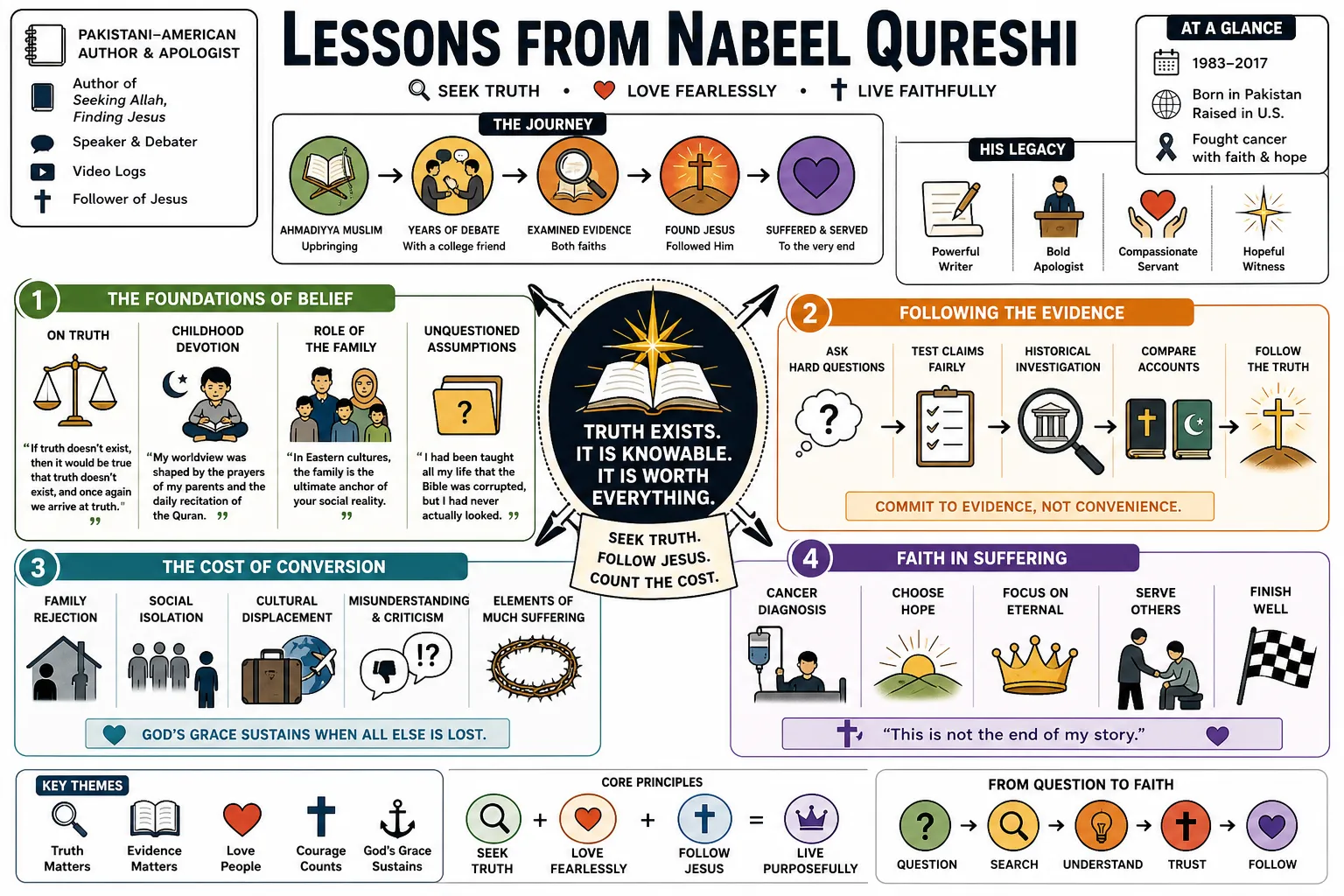
Nabeel Qureshi was a Pakistani-American author and Christian apologist best known for his memoir Seeking Allah, Finding Jesus. The book details his conversion from Ahmadiyya Islam following a years-long debate with a college friend over the historical claims of both faiths. This profile uses his books, speeches, and video logs to cover his arguments on religious evidence, the cultural costs of conversion, and his approach to faith while facing terminal cancer.
Part 1: The Foundations of Belief
- On Truth: "If truth doesn't exist, then it would be true that truth doesn't exist, and once again we arrive at truth. There is no alternative; truth must exist." — Source: [Seeking Allah, Finding Jesus]
- On Childhood Devotion: "As a child, my worldview was shaped by the prayers of my parents and the daily recitation of the Quran, giving me an unshakable confidence in my identity." — Source: [Seeking Allah, Finding Jesus]
- On the Role of the Family: "In Eastern cultures, the family is the ultimate anchor of your social reality; to reject the religion of your family is to reject the family itself." — Source: [No God But One: Allah or Jesus?]
- On Unquestioned Assumptions: "I had been taught all my life that the Bible was corrupted, but I had never actually looked at the historical evidence for how the text was preserved." — Source: [Dallas Theological Seminary Address]
- On Islamic Honor: "Honor and shame are the primary lenses through which Eastern cultures view morality, making intellectual debate a deeply personal affair." — Source: [Answering Jihad]
- On Religious Defense Mechanisms: "When confronted with arguments against our faith, our initial reaction is rarely objective analysis; it is usually defensive rationalization." — Source: [Biola University Lecture]
- On Ahmadiyya Islam: "Growing up in a persecuted minority sect of Islam taught me what it meant to be hated for my beliefs, which ironically prepared me for my later conversion." — Source: [Unbelievable? Podcast]
- On Sincerity: "Sincerity is not a test for truth; you can be completely sincere, yet sincerely wrong." — Source: [Seeking Allah, Finding Jesus]
- On the Concept of Allah: "The Islamic concept of God emphasizes his absolute transcendence and unknowability, making the Christian concept of a personal, relational Father deeply foreign." — Source: [No God But One: Allah or Jesus?]
- On Reading the Quran: "Reciting the Quran in Arabic was an act of worship, but it wasn't until I began reading it in English to defend my faith that I confronted its more difficult passages." — Source: [Houston Baptist University Interview]
Part 2: The Role of Friendship in Evangelism
- On Relational Evangelism: "Effective evangelism requires relationships. There is a simple reason I never listened to street preachers: they didn't seem to care about me." — Source: [Medium Article]
- On Patience in Dialogue: "My friend David Wood didn't try to win a debate on the first day; he spent years eating meals with me and answering my arguments with patience." — Source: [Seeking Allah, Finding Jesus]
- On Hospitality: "If you want to reach a Muslim with the gospel, invite them to your dinner table. Hospitality lowers walls that arguments cannot." — Source: [RZIM Summer Institute]
- On Authentic Love: "People know when they are an evangelistic project rather than a friend. If you don't actually love the person, don't try to share your faith with them." — Source: [Focus on the Family Broadcast]
- On Listening: "The most effective way to start a conversation about faith is simply to ask a question and genuinely listen to the answer without interrupting." — Source: [100 Huntley Street]
- On Trust: "I only engaged with David's arguments because I trusted his character. Without trust, evidence is just noise." — Source: [Seeking Allah, Finding Jesus]
- On Cultural Barriers: "Many Christians are afraid of Muslims, which prevents the very friendships necessary for the gospel to be shared." — Source: [Answering Jihad]
- On Asking Questions: "David would ask me questions about Islam that I didn't have the answers to, forcing me to go back and research my own faith." — Source: [Seeking Allah, Finding Jesus]
- On Long-Term Investment: "Conversion is rarely a single event. It is a long journey of dismantling a worldview, and it requires friends who are willing to walk that long road." — Source: [Moody Radio Interview]
Part 3: Confronting Evidence and Doubt
- On Historical Inquiry: "I set out to disprove Christianity by showing that Jesus didn't die on the cross, only to find that the crucifixion is one of the best-attested facts of ancient history." — Source: [No God But One: Allah or Jesus?]
- On Double Standards: "I realized I was using a highly critical standard for the Bible and giving the Quran a free pass. When I applied the same historical scrutiny to both, the results terrified me." — Source: [Seeking Allah, Finding Jesus]
- On the Resurrection: "If Jesus rose from the dead, then his claim to be God is vindicated. If he didn't, Christianity is a fraud. It all rests on this single historical event." — Source: [Unbelievable? Podcast]
- On Muhammad's Life: "I found one violent story after another about Muhammad. I consciously tried to dismiss each one, just like the Muslims online." — Source: [SuperSummary Analysis]
- On Internal Pleading: "Allah, please have mercy on me. I don't mean to doubt you." — Source: [Seeking Allah, Finding Jesus]
- On the Textual Transmission of the Quran: "The traditional narrative that the Quran has been perfectly preserved down to the letter is a myth not supported by the earliest Islamic manuscripts." — Source: [No God But One: Allah or Jesus?]
- On Jesus's Claims: "Jesus didn't just claim to be a prophet; he claimed the divine name, forgave sins, and accepted worship. You cannot just call him a good teacher." — Source: [RZIM Address]
- On Ignoring Truth: "Alright. Now if it were the case that Christianity were true, would you want to know it?" — Source: [Seeking Allah, Finding Jesus]
- On the Trinity: "I used to think the Trinity meant three Gods. Understanding it as one Being and three Persons was the intellectual breakthrough I needed to see its coherence." — Source: [Seeking Allah, Finding Jesus]
- On the Reliability of the New Testament: "The sheer volume of early Greek manuscripts for the New Testament is staggering compared to any other ancient text, giving us high confidence in what the authors originally wrote." — Source: [Biola University Lecture]
Part 4: Islam and Christianity Contrasted
- On Grace vs. Works: "In Islam, you are constantly trying to tip the scales of your good deeds to outweigh the bad. In Christianity, the scale is broken, and Jesus offers his own righteousness." — Source: [Seeking Allah, Finding Jesus]
- On God's Love: "The Quran says Allah does not love the unbeliever. The Bible says God loved us while we were yet sinners. That difference changes everything." — Source: [No God But One: Allah or Jesus?]
- On the Nature of Sin: "Islam views sin primarily as a mistake or weakness that needs guidance. Christianity views sin as a fundamental rebellion that requires a savior." — Source: [Crossway Interview]
- On Peace: "The Islamic concept of peace is rooted in submission to the law of Allah. The Christian concept of peace is rooted in reconciliation with God through Christ." — Source: [Answering Jihad]
- On Fatherhood: "Calling God 'Father' in Islam is considered blasphemous because it implies physical reproduction. In Christianity, it reveals the eternal relational nature of God." — Source: [RZIM Address]
- On the Cross: "Islam teaches that Jesus was rescued from the cross because God wouldn't let his prophet suffer such a shameful death. Christianity teaches that God embraced that shame out of love." — Source: [No God But One: Allah or Jesus?]
- On Human Rights: "When the foundation of law is viewed purely as divine dictate without a basis in the inherent image of God in humanity, human rights become fragile." — Source: [The Gospel Coalition]
- On Certainty: "Muslims often lack assurance of salvation, hoping for Allah's mercy on judgment day. Christians have assurance because salvation is based on what Christ has done, not what we do." — Source: [Focus on the Family]
- On Knowing God: "Islam offers a religion of laws to obey; Christianity offers a relationship with the Lawgiver." — Source: [Seeking Allah, Finding Jesus]
Part 5: The Cost of Conversion
- On the Cost of Following Jesus: "All suffering is worth it to follow Jesus. He is that amazing." — Source: [Goodreads Quote Repository]
- On the Immediate Aftermath: "My first year as a Christian was unimaginably difficult and without a doubt the most painful period of my life." — Source: [PAOC Testimony]
- On Breaking His Parents' Hearts: "The most agonizing moment of my life was telling my parents I had become a Christian. I felt like I was plunging a dagger into their chests." — Source: [Seeking Allah, Finding Jesus]
- On Losing Community: "To convert from Islam is to commit cultural suicide. You lose your friends, your family, your community, and everything you once knew." — Source: [Dallas Theological Seminary Chapel]
- On Mourning: "I mourned the loss of my Islamic identity and the traditions of my childhood. Even when you find the truth, leaving the past behind involves deep grief." — Source: [Seeking Allah, Finding Jesus]
- On Divine Comfort: "When I lay on the floor crying after my conversion, asking God why it had to be this way, I felt a profound sense of His presence, telling me He was enough." — Source: [Unbelievable? Podcast]
- On the Necessity of the Church: "New converts from Islam don't just need theology; they need a new family to replace the one they lost. The church must step up to be that family." — Source: [Biola University Apologetics Conference]
- On Counting the Cost: "Jesus never promised that following Him would be easy. In fact, He guaranteed it would cost us everything, but He promised He would be with us." — Source: [No God But One: Allah or Jesus?]
- On Emotional Barriers: "For a Muslim to consider Christianity, they have to overcome an emotional barrier that is far larger than any intellectual barrier." — Source: [RZIM Lecture]
- On Ultimate Loyalty: "We are called to love our families, but our highest loyalty must be to Christ. If we elevate our family above Him, it becomes an idol." — Source: [Moody Radio Broadcast]
Part 6: Engaging Culture and Radicalism
- On Understanding Jihad: "If we do not understand the historical and theological roots of Jihad in early Islam, we will fail to understand the motivations of modern radical groups." — Source: [Answering Jihad]
- On Peaceful Muslims: "The vast majority of Muslims are peaceful, loving people. But this is often because they do not emulate the literal historical example of Muhammad." — Source: [Answering Jihad]
- On Radicalization: "Radicalization often happens not because a Muslim abandons their faith, but because they decide to pursue the original teachings of Islam more seriously." — Source: [The Gospel Coalition Article]
- On Loving Enemies: "The Christian response to terrorism cannot be hatred or fear; it must be the radical, self-sacrificial love that Jesus demonstrated on the cross." — Source: [RZIM Summer Institute]
- On Religious Liberty: "Defending the rights of Muslims to practice their religion in the West is essential for Christians if we want our own religious liberties to be protected." — Source: [Answering Jihad]
- On Political Rhetoric: "Demonizing Muslims does not make America safer; it only alienates the very people who desperately need to hear the message of the gospel." — Source: [Focus on the Family Interview]
- On Scriptural Context: "We must read the Quran in its historical context, understanding the concept of abrogation where later, more militant verses often cancel out earlier, peaceful ones." — Source: [No God But One: Allah or Jesus?]
- On True Reform: "Reforming Islam is incredibly difficult because it requires Muslims to reject the clear, historical actions of their prophet as a standard for morality." — Source: [Crossway Q&A]
- On the Ultimate Solution: "Military intervention and political policies cannot ultimately solve the problem of radicalization; only a transformation of the heart through Christ can." — Source: [Houston Baptist University Address]
Part 7: Trusting God in Suffering
- On Receiving a Diagnosis: "When I was diagnosed with stage IV stomach cancer, my first reaction was not fear, but a deep desire to trust God with whatever time I had left." — Source: [Nabeel Qureshi YouTube Vlog]
- On Divine Healing: "I believe God can heal me miraculously. But even if He doesn't, my faith in Him remains unchanged because it is based on the resurrection of Jesus, not my own circumstances." — Source: [Nabeel Qureshi YouTube Vlog]
- On the Purpose of Pain: "Suffering forces us to realize that this world is not our home, stripping away our illusions of control and driving us closer to the heart of God." — Source: [RZIM Ministry Update]
- On Gratitude: "Even in the midst of chemotherapy, I can look at my wife and daughter and thank God for the incredible blessings He has given me." — Source: [Nabeel Qureshi YouTube Vlog]
- On the Problem of Evil: "The existence of suffering doesn't disprove God; rather, it highlights our need for a Savior who enters into our suffering and redeems it." — Source: [No God But One: Allah or Jesus?]
- On Relying on Grace: "When you are too weak to pray or read the Bible, you realize that your standing with God is entirely dependent on His grace holding onto you, not your strength holding onto Him." — Source: [Nabeel Qureshi YouTube Vlog]
- On Facing Death: "Death for the Christian is not the end; it is simply a transition into the presence of the One who loves us most." — Source: [RZIM Ministry Update]
- On Personal Legacy: "I don't want my legacy to be about my intellect or my arguments; I want it to be about the love and grace of Jesus Christ." — Source: [Nabeel Qureshi YouTube Vlog]
- On Praying Through Tears: "Sometimes the most faithful prayer you can offer is simply crying out to God when you have no words left." — Source: [Nabeel Qureshi YouTube Vlog]
Part 8: Time, Eternity, and Legacy
- On Urgency: "When you realize your time is limited, the trivial things fade away, and you become singularly focused on what will last for eternity." — Source: [Nabeel Qureshi YouTube Vlog]
- On Regret: "My only regret is that I did not know Jesus sooner, so that I could have spent more of my life serving Him." — Source: [100 Huntley Street Interview]
- On Truth and Love: "We must speak the truth, but if we do not speak it in love, we have gained nothing. Truth without love is harsh; love without truth is empty." — Source: [Final YouTube Message]
- On the Kingdom of God: "We spend so much time building our own little kingdoms on earth, forgetting that we are citizens of a Kingdom that will never end." — Source: [Biola University Chapel]
- On the Gospel Message: "The gospel is not a message of self-improvement; it is a message of resurrection for the spiritually dead." — Source: [Dallas Theological Seminary]
- On Spiritual Warfare: "The battle for souls is not won through clever argumentation alone; it is won on our knees in prayer." — Source: [Seeking Allah, Finding Jesus]
- On Passing the Baton: "I am just one voice, but I pray that God will raise up thousands of others to carry the message of Christ to the Muslim world." — Source: [RZIM Final Address]
- On Encountering Christ: "When you truly encounter the living Jesus, your life can never be the same. He demands everything, but He gives you Himself." — Source: [No God But One: Allah or Jesus?]
- On Ultimate Hope: "My hope rests not in my healing, nor in my doctors, but in the nail-scarred hands of Jesus." — Source: [Nabeel Qureshi YouTube Vlog]