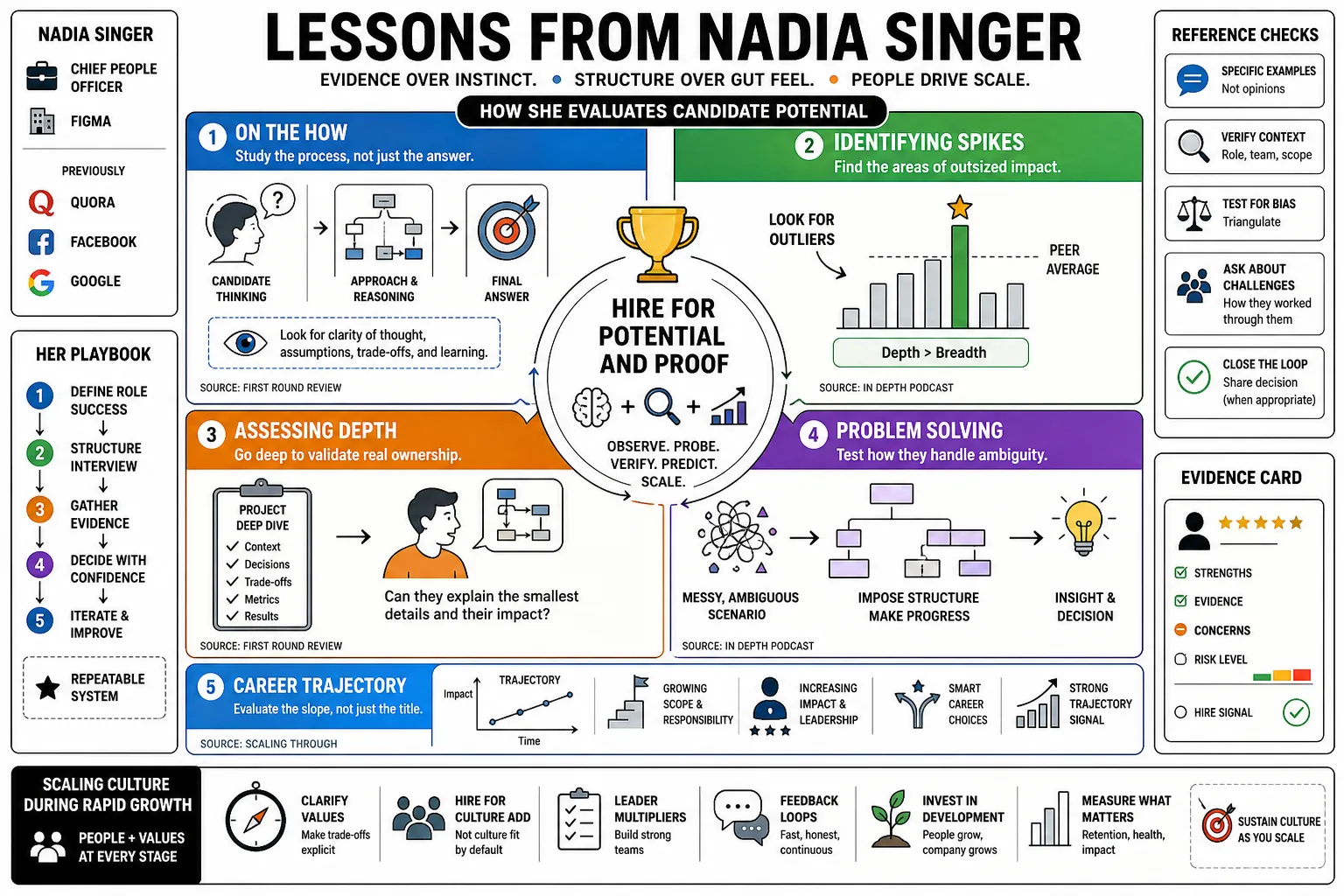
Lessons from Nadia Singer
Nadia Singer is Figma’s Chief People Officer, having previously led talent at Quora, Facebook, and Google. She specializes in replacing gut-feel hiring with structured evidence. This profile breaks down her exact methods for interviewing, checking references, and scaling culture during rapid growth.
Part 1: Evaluating Candidate Potential
- On the How: "You must study how a candidate reaches an answer rather than focusing solely on the final response they deliver." — Source: First Round Review
- On Identifying Spikes: "Look for the specific areas where a candidate significantly outperforms their peers, rather than seeking baseline competency across the board." — Source: In Depth Podcast
- On Assessing Depth: "Ask candidates to explain a past project down to the smallest detail to test if they actually did the work or just managed the periphery." — Source: First Round Review
- On Problem Solving: "Give candidates messy, ambiguous scenarios to see if they impose structure or get lost in the noise." — Source: In Depth Podcast
- On Career Trajectory: "Evaluate the slope of a candidate's career progression, not just the current title they hold." — Source: Scaling Through Chaos
- On Evaluating Impact: "Ask candidates what metric moved specifically because of their intervention." — Source: First Round Review
- On Identifying Drive: "Look for candidates who actively seek out feedback and demonstrate a history of self-correction." — Source: Figma Blog
- On Adaptability: "Ask how they handled a situation where the initial requirements were entirely wrong." — Source: In Depth Podcast
- On Technical vs Behavioral: "Technical skills get candidates in the door, but behavioral adaptability determines if they will survive high growth." — Source: HR Brew
Part 2: The Interview Process
- On Preparation: "Interviewers who show up without a specific questioning plan end up measuring likability instead of ability." — Source: First Round Review
- On Standardizing Questions: "Every candidate for a role must answer the same core questions so you can properly calibrate their responses." — Source: In Depth Podcast
- On Interviewer Calibration: "Hold sessions where interviewers review each other's scorecards to align on what a strong answer actually looks like." — Source: Scaling Through Chaos
- On Candidate Experience: "Treat the interview as a two-way evaluation where the candidate is also judging your internal organization." — Source: Figma Blog
- On Project-Based Assessments: "Move beyond test-based interviews toward project-based assignments that reflect the actual daily work." — Source: First Round Review
- On the Performative Trap: "Be wary of candidates who are professional interviewers; their polish can mask a lack of operational depth." — Source: HR Brew
- On Listening: "The interviewer should speak for less than twenty percent of the allotted time." — Source: In Depth Podcast
- On Follow-up Questions: "The third consecutive 'why' is usually where the true limits of a candidate's knowledge are revealed." — Source: First Round Review
- On the Debrief: "Require written feedback before the debrief meeting begins to prevent the most senior voice from swaying the room." — Source: Scaling Through Chaos
Part 3: Rethinking Reference Checks
- On Moving Beyond Check-the-Box: "A reference check should be an investigative conversation, not a final administrative hurdle." — Source: First Round Review
- On Superlative Questions: "Ask references: What is something this candidate is better at than anyone else you have worked with in this role?" — Source: First Round Review
- On Uncovering Weaknesses: "Instead of asking for weaknesses, ask: Under what specific conditions does this person struggle to perform?" — Source: In Depth Podcast
- On Peer References: "Peers often provide a more accurate assessment of a candidate's daily work habits than their direct managers." — Source: Figma Blog
- On Manager Alignment: "Ask references what management style brings out the best in the candidate to see if it matches your environment." — Source: Scaling Through Chaos
- On the Backchannel: "Use backchannels carefully and ethically to verify information that formal references might polish over." — Source: First Round Review
- On Validating Spikes: "Use the reference call to confirm the specific strengths you identified during the interview process." — Source: HR Brew
- On Timing of References: "Conduct references before extending the offer, using the information to shape the closing conversation." — Source: In Depth Podcast
- On Reference Skepticism: "If a reference cannot provide a single area for improvement, discount their positive feedback as overly guarded." — Source: First Round Review
- On Calibration: "Ask the reference where this candidate ranks among the top people they have managed." — Source: Scaling Through Chaos
Part 4: Scaling the Organization
- On Early Stage Hiring: "The first fifty hires set the cultural DNA that the next five hundred will inherit." — Source: Scaling Through Chaos
- On the Tension of Scale: "There is no magic solution to managing the balance between chaos and order; it is an inevitable consequence of high growth." — Source: Index Ventures
- On Apparent Disorder: "Do not interpret the apparent disorder around you as a sign of failure; it means the organization is stretching." — Source: Index Ventures
- On Transitioning Processes: "Processes that work for a team of fifty will break entirely when the team reaches two hundred." — Source: First Round Review
- On Bootstrapped HR: "You have to evolve from DIY operations to structured frameworks without losing the speed of the early days." — Source: HR Brew
- On Specialization: "As you scale, generalists must either specialize or move into management, which requires active coaching." — Source: Scaling Through Chaos
- On Maintaining Quality: "The greatest risk in hyper-growth is lowering the hiring bar just to fill open headcount." — Source: In Depth Podcast
- On Onboarding at Scale: "A structured onboarding program becomes the primary vehicle for transmitting culture as you grow." — Source: Figma Blog
- On Institutional Memory: "Document decision-making frameworks early so new hires understand how choices are made." — Source: Scaling Through Chaos
Part 5: Preserving Company Culture
- On Cultural Fragility: "Company culture is fragile and requires deliberate reinforcement every time you add new people." — Source: HR Brew
- On Evolving Values: "For a set of values to create lasting cultural influence, they must be continuously revised and tested against reality." — Source: HR Brew
- On Leadership Example: "Values mean nothing if leadership and employees do not carry them forward in their daily interactions." — Source: HR Brew
- On Employee Advocacy: "You want employees to feel they are building the culture, not just existing within it." — Source: In Depth Podcast
- On Rituals: "Establish recurring rituals that force cross-functional teams to interact outside of transactional requests." — Source: Figma Blog
- On Transparency: "Share the reasons behind difficult decisions to build trust, even when the news is unpopular." — Source: First Round Review
- On Addressing Toxicity: "Culture is defined by the worst behavior that leadership is willing to tolerate." — Source: Scaling Through Chaos
- On Cultural Add vs Fit: "Hire for cultural add—people who bring perspectives you lack—rather than cultural fit, which breeds uniformity." — Source: In Depth Podcast
- On Remote Culture: "Distributed teams require more explicit documentation of norms that collocated teams learn through osmosis." — Source: Figma Blog
- On Communication Norms: "Define exactly how and where communication happens to prevent information silos from forming." — Source: Scaling Through Chaos
Part 6: Mitigating Bias in Hiring
- On Pattern Matching: "Interviewers naturally gravitate toward candidates who remind them of themselves; you must actively train against this." — Source: First Round Review
- On Structured Rubrics: "Use detailed scoring rubrics to force interviewers to justify their gut feelings with specific evidence." — Source: In Depth Podcast
- On Affinity Bias: "Beware of feedback that focuses on how well a candidate 'clicked' with the team." — Source: First Round Review
- On Diverse Panels: "Ensure the interview panel reflects the diversity you want to see in the company." — Source: HR Brew
- On Challenging Assumptions: "During debriefs, explicitly ask interviewers to state the assumptions driving their negative feedback." — Source: Scaling Through Chaos
- On Pedigree: "Over-indexing on recognizable company names on a resume blinds you to raw, unconventional talent." — Source: First Round Review
- On Inclusive Language: "Audit your job descriptions to remove language that unintentionally deters qualified candidates from applying." — Source: Figma Blog
- On Objective Scoring: "Force interviewers to rate candidates on a four-point scale to eliminate the non-committal middle option." — Source: In Depth Podcast
- On Tracking Metrics: "Monitor your hiring funnel to identify exactly where underrepresented candidates are dropping out." — Source: HR Brew
Part 7: Managing Performance
- On Setting Expectations: "A new hire cannot succeed if the definition of success is kept a secret in their manager's head." — Source: Scaling Through Chaos
- On Continuous Feedback: "Performance reviews should never contain surprises; feedback must happen in real time." — Source: In Depth Podcast
- On Managing Low Performers: "Delaying action on a low performer damages the morale of the high performers picking up the slack." — Source: First Round Review
- On Recognizing Excellence: "Make sure your compensation and recognition structures disproportionately reward your absolute best people." — Source: Scaling Through Chaos
- On Goal Alignment: "Tie individual performance goals directly to company-wide objectives so everyone understands their impact." — Source: Figma Blog
- On Upward Feedback: "Managers must be evaluated by their direct reports to ensure they are actually developing their teams." — Source: HR Brew
- On Role Ambiguity: "In fast-growing companies, roles blur; you must frequently redefine responsibilities to prevent dropped balls." — Source: Index Ventures
- On Calibration Sessions: "Use performance calibration meetings to ensure managers are grading on the same curve." — Source: In Depth Podcast
- On PIPs: "A performance improvement plan should be a genuine tool for course correction, not just legal cover for termination." — Source: HR Brew
Part 8: Leadership and Human Connection
- On Earnest Conversations: "Managers must have earnest, human conversations with their reports to understand what drives them outside of work." — Source: HR Brew
- On Manager Training: "Promoting an individual contributor to management without training is a disservice to both them and their team." — Source: Scaling Through Chaos
- On Psychological Safety: "Create an environment where people can admit they made a mistake without fear of immediate retaliation." — Source: Figma Blog
- On Delivering Feedback: "Deliver critical feedback with the clear intent of helping the person improve, not just pointing out flaws." — Source: In Depth Podcast
- On Career Development: "Ask your team members what job they want next, even if that job is at a different company." — Source: First Round Review
- On Vulnerability: "Leaders who admit what they do not know build more credibility than those who pretend to have all the answers." — Source: HR Brew
- On Retention: "People leave managers, not companies; retention strategies must focus on management quality." — Source: Scaling Through Chaos
- On Exit Interviews: "Treat exit interviews as a goldmine of data regarding where your culture is failing." — Source: Figma Blog
- On Trust: "Trust is built in small moments of follow-through, not grand declarations during all-hands meetings." — Source: First Round Review
- On the Role of People Operations: "HR should function as a strategic partner to the business, not just an administrative compliance arm." — Source: Index Ventures