Lessons from Naomi Gleit
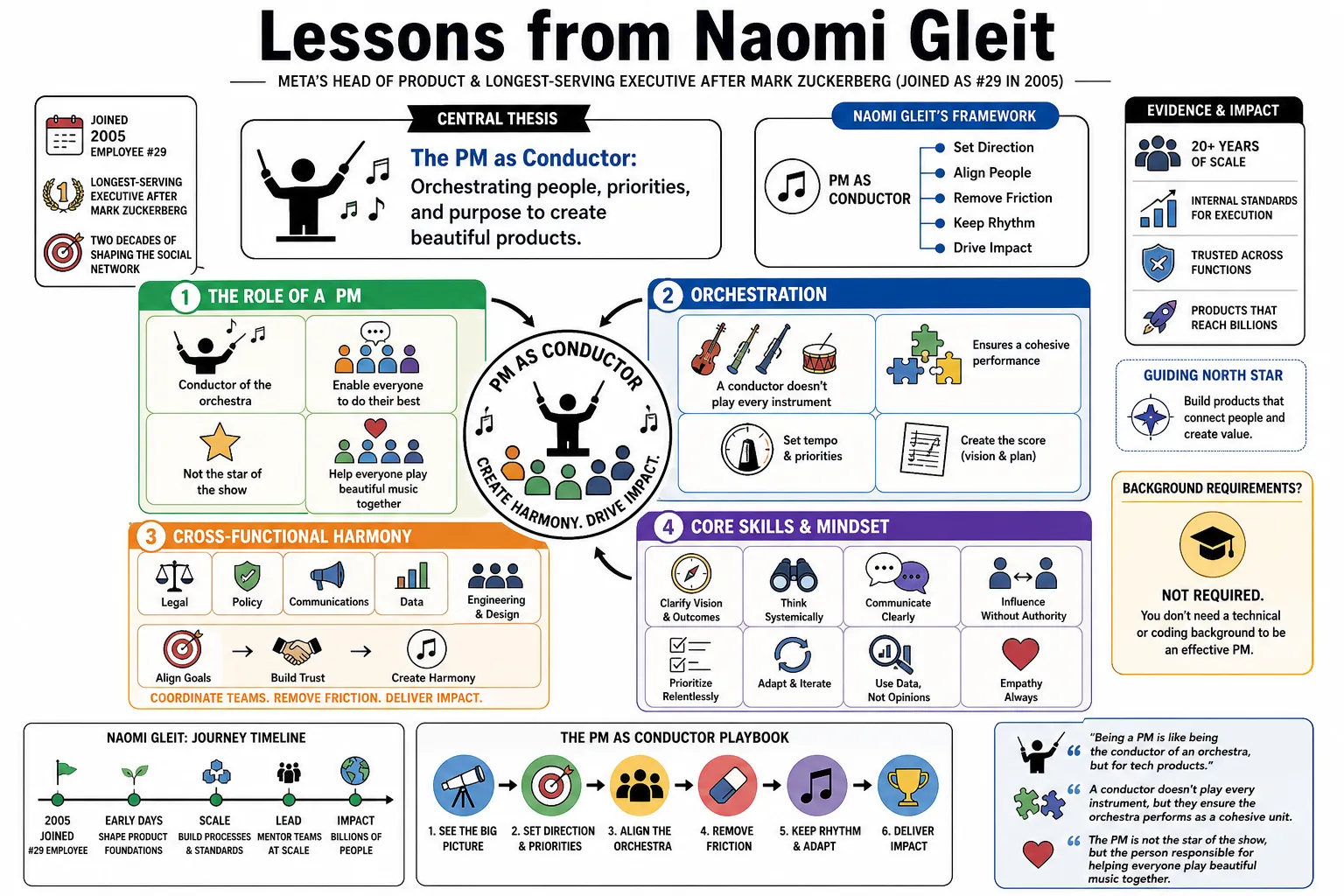
Naomi Gleit is Meta's Head of Product and its longest-serving executive after Mark Zuckerberg. Since joining as the 29th employee in 2005, she has developed the "PM as Conductor" framework and set the company's internal standards for execution. This profile catalogs her specific approaches to communication, cross-functional leadership, and product strategy drawn from two decades of shaping the social network.
Part 1: The Product Manager as Conductor
- On The Role of a PM: "Being a PM is like being the conductor of an orchestra, but for tech products." — Source: [naomi.com]
- On Orchestration: "A conductor doesn't play every instrument, but they ensure the orchestra performs as a cohesive unit." — Source: [Lenny's Podcast]
- On Ego: "The PM is not the star of the show, but the person responsible for helping everyone play beautiful music together." — Source: [naomi.com]
- On Background Requirements: "You don't need a technical or coding background to be an effective product manager." — Source: [naomi.com]
- On Cross-Functional Harmony: "Your job is to coordinate cross-functional teams—legal, policy, communications, data—to create harmony." — Source: [Lenny's Podcast]
- On Core Skills: "A product manager's core skill is building products with people." — Source: [naomi.com]
- On Measuring Success: "Don't let the role feed your ego; your success is measured by the team's unified outcome." — Source: [Bustle]
- On Cohesion: "A PM must coordinate the moving parts to ensure the final product reflects a single, coherent vision." — Source: [Lenny's Podcast]
- On Alignment: "Your primary responsibility is alignment, ensuring everyone works effectively toward a common goal." — Source: [naomi.com]
- On Leadership Style: "The best product managers act as facilitators, not dictators." — Source: [Lenny's Podcast]
Part 2: Execution and Strategy
- On The Necessity of Execution: "Perfect execution is critical because if you don't execute perfectly on the strategy, you don't know if the strategy was right or wrong." — Source: [naomi.com]
- On Achieving Success: "Right strategy plus perfect execution equals success." — Source: [naomi.com]
- On Evaluating Strategy: "Wrong strategy plus perfect execution is a failure, but you learn the strategy was wrong." — Source: [naomi.com]
- On The Danger of Poor Execution: "Right or wrong strategy plus imperfect execution is a failure, and you don't know why." — Source: [naomi.com]
- On Identifying Metrics: "A metric does not need to be perfect; it needs to be something the entire team can rally around." — Source: [Lenny's Podcast]
- On Team Focus: "Good execution requires a common goal that provides focus and direction." — Source: [Lenny's Podcast]
- On Critical Thinking: "Don't outsource your critical thinking; carve out time to think deeply about strategies." — Source: [Lenny's Podcast]
- On Deep Work: "Avoid reacting to the influx of daily tasks by scheduling solitary quiet hours." — Source: [Lenny's Podcast]
- On Validating Assumptions: "The execution phase is where you validate your underlying assumptions about the user." — Source: [naomi.com]
- On Clean Data: "If execution fails, the data you gather is useless for future strategic planning." — Source: [naomi.com]
Part 3: Extreme Clarity in Communication
- On Extreme Clarity: "Extreme clarity does not mean everyone agrees; it means everyone shares a uniform understanding of the facts." — Source: [naomi.com]
- On Single Sources of Truth: "Use a 'Canonical Document' as the single source of truth to drive clarity in complex projects." — Source: [naomi.com]
- On Preventing Confusion: "A canonical document prevents the frustration of receiving inconsistent information from different team members." — Source: [Lenny's Podcast]
- On Ambiguity: "Stop wasting time talking past each other by eliminating ambiguity like 'I thought you meant X'." — Source: [Facebook]
- On Formatting Feedback: "Use numbered lists rather than bullet points so people can refer to specific points by number." — Source: [naomi.com]
- On Presentation Design: "Keep slides minimalist and avoid flashy design to ensure the focus remains on the content." — Source: [naomi.com]
- On Link Hygiene: "Practice link hygiene by using descriptive text to avoid visual clutter." — Source: [naomi.com]
- On Documenting Process: "Document work streams, owners, processes, and meeting norms centrally so teams don't reinvent the wheel." — Source: [naomi.com]
- On Standardizing Reviews: "Efficient product reviews demand standardized formats, like simple Google Docs." — Source: [naomi.com]
Part 4: Building High-Performing Teams
- On Hiring: "Hire 'disagreeable givers'—people committed to the organization's success but unafraid to challenge the status quo." — Source: [Lenny's Podcast]
- On Feedback Loops: "Disagreeable givers ensure the team maintains an accurate, honest feedback loop." — Source: [Lenny's Podcast]
- On Groupthink: "Voicing differing perspectives helps leadership avoid groupthink and drives innovation." — Source: [Lenny's Podcast]
- On Pushing Back: "You want team members who push back against leadership when the direction feels wrong." — Source: [Lenny's Podcast]
- On Team Velocity: "A culture of continuous feedback is essential for maintaining team health and velocity." — Source: [India Times]
- On Meeting Standards: "Meetings must have rigorous standards to remain productive and avoid draining team energy." — Source: [Lenny's Podcast]
- On Agreeableness: "Value commitment to the collective output over individual agreeableness." — Source: [Lenny's Podcast]
- On Decision Quality: "If a team lacks dissenting voices, the quality of its decision-making will eventually degrade." — Source: [Lenny's Podcast]
- On Psychological Safety: "A high-performing team thrives when individuals feel safe to debate ideas rigorously." — Source: [Lenny's Podcast]
Part 5: Building for Social Good
- On Crisis Response: "Building tools for crisis response, like Safety Check, requires prioritizing real-world action over direct profits." — Source: [Business Insider]
- On Disaster Relief: "Social impact features must be designed to facilitate the rapid sharing of resources during natural disasters." — Source: [Facebook]
- On Charitable Giving: "Allowing users to raise money for nonprofits directly through the platform can unlock billions in charitable giving." — Source: [Facebook]
- On Teen Safety: "Designing for teen safety requires intentional friction, parental controls, and thoughtful platform changes." — Source: [Raising Boys & Girls Podcast]
- On Product Integrity: "A product's integrity is measured by how it responds to emergencies and community needs." — Source: [Business Insider]
- On Human Nature: "Features like Community Help are built on the premise that people inherently want to assist each other in crises." — Source: [Facebook]
- On User Well-Being: "Balancing engagement with user well-being is a core responsibility of modern product development." — Source: [Raising Boys & Girls Podcast]
- On Rigor in Social Good: "Product initiatives aimed at social good must be treated with the same rigorous execution as core revenue products." — Source: [PBS]
- On Global Philanthropy: "The success of fundraising tools proves that social networks can be powerful engines for global philanthropy." — Source: [Facebook]
Part 6: Problem Solving and Decision Making
- On Project Status: "Use the 'Traffic Light' approach to accurately gauge project status and make necessary adjustments." — Source: [naomi.com]
- On Problem Solving: "Apply the 'Understand, Identify, Execute' framework to break down and solve complex product challenges." — Source: [naomi.com]
- On Meeting Alignment: "Make sure everyone shares an understanding of the options and next steps before leaving a meeting." — Source: [naomi.com]
- On Functional Metrics: "Don't let the pursuit of a perfect metric delay the implementation of a functional rallying point." — Source: [Lenny's Podcast]
- On Relitigating Issues: "Decisions should be documented and accessible to prevent relitigating the same issues." — Source: [naomi.com]
- On Meeting Purpose: "Clarify whether a meeting is for brainstorming, reviewing, or deciding, and stick to that purpose." — Source: [naomi.com]
- On Evaluating Options: "When evaluating options, clearly lay out the facts rather than relying on persuasive rhetoric." — Source: [naomi.com]
- On Broken Processes: "If a process isn't working, define the problem explicitly before trying to design a new workflow." — Source: [naomi.com]
- On Root Causes: "The best solutions emerge from a disciplined approach to defining the underlying problem." — Source: [naomi.com]
- On Cross-Functional Reviews: "Avoid making decisions in a vacuum; ensure all cross-functional partners have reviewed the canonical documentation." — Source: [naomi.com]
Part 7: Career Growth and Creating Luck
- On Creating Luck: "Create your own luck by not giving up, cold-calling, and volunteering for tasks until you get the role you want." — Source: [Lenny's Podcast]
- On Earning the Title: "Perform the job of a product manager before you are officially given the title." — Source: [Lenny's Podcast]
- On Choosing Work: "Do things that are impactful, with people you can learn from." — Source: [naomi.com]
- On Status versus Impact: "Don't obsess over the specific 'seat' on the rocket ship; focus instead on joining impactful projects." — Source: [Facebook]
- On Taking Risks: "Recognize significant opportunities early and be willing to take calculated risks on nascent platforms." — Source: [Facebook]
- On Pressure: "Pressure is a privilege; use high-stakes situations as an opportunity to elevate performance." — Source: [Lenny's Podcast]
- On Stressful Moments: "View stressful moments as chances to grow rather than burdens to avoid." — Source: [Lenny's Podcast]
- On Identity: "Identity is a source of strength; identifying as 'fully both' of your cultural backgrounds provides a unique perspective." — Source: [Wikipedia]
- On Resilience: "Your career trajectory is shaped by your resilience and willingness to adapt to shifting landscapes." — Source: [Facebook]
Part 8: Navigating Scale and Cultural Shifts
- On Platform Shifts: "Translate fundamental product principles, like onboarding and engagement, to new platforms as technology evolves." — Source: [Facebook]
- On Scaling Culture: "Maintaining culture during massive scale requires a commitment to lifelong learning and resilience." — Source: [India Times]
- On Evolving Processes: "As companies grow, established processes must evolve, but the core need for clarity remains constant." — Source: [naomi.com]
- On Data and Growth: "Moving from a college website to a global social network necessitates a shift from intuition-driven to data-informed product development." — Source: [Facebook]
- On New Eras: "Entering eras like the metaverse and AI requires anchoring new experiences in fundamental human needs." — Source: [Facebook]
- On Adaptable Leadership: "Leadership must model adaptability when the organizational structure expands rapidly." — Source: [India Times]
- On the Cost of Errors at Scale: "A growing user base means the impact of both good and bad execution is magnified exponentially." — Source: [naomi.com]
- On Preserving Values: "Culture is preserved not by keeping things the same, but by rigorously upholding core values during periods of change." — Source: [Lenny's Podcast]
- On Avoiding Chaos: "The transition from a startup to a tech giant relies on standardizing communication to prevent organizational chaos." — Source: [naomi.com]