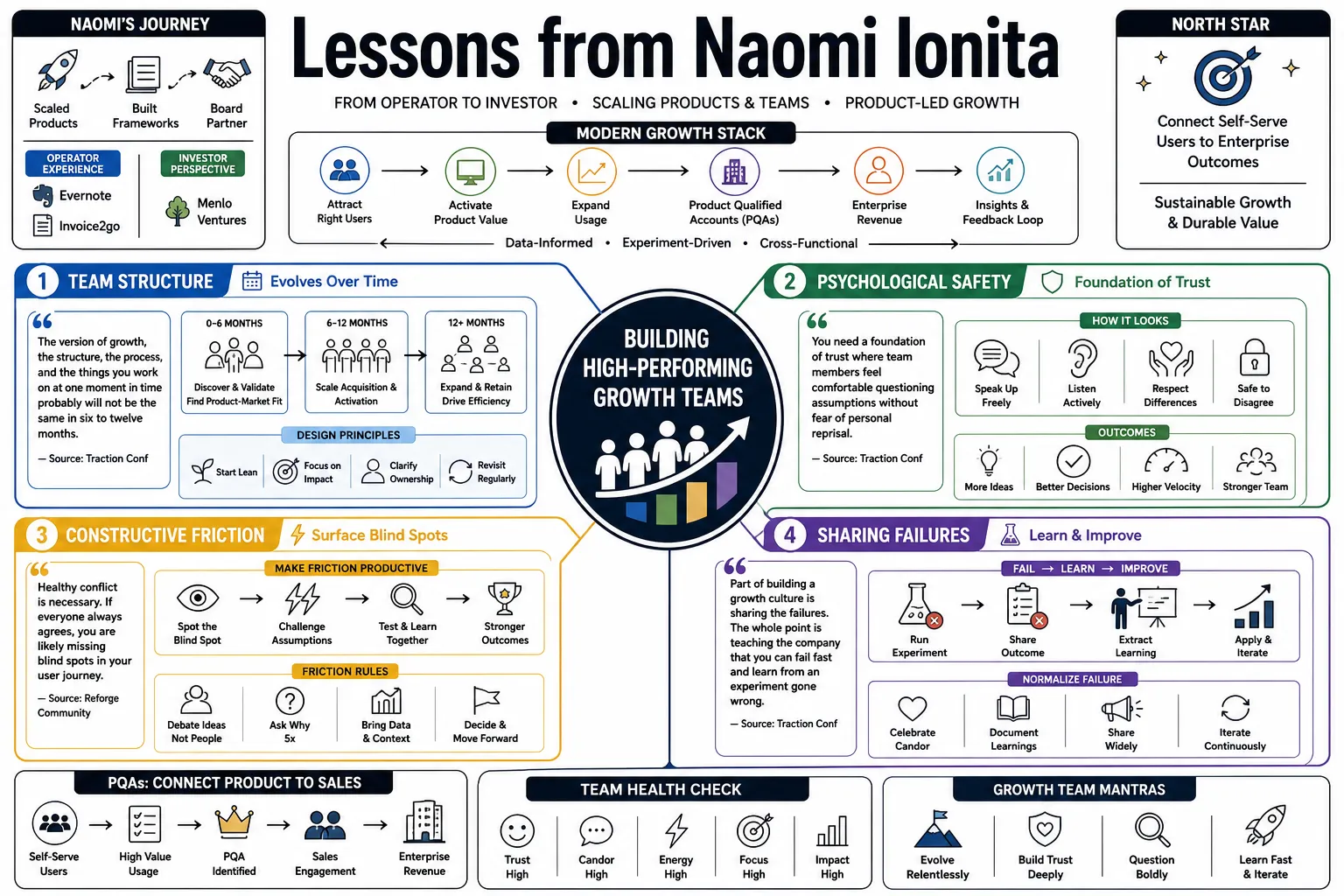
Lessons from Naomi Ionita
Before joining Menlo Ventures as a Board Partner, Naomi Ionita scaled products at Evernote and Invoice2go. She is known for mapping out the "Modern Growth Stack" and developing practical frameworks for Product Qualified Accounts (PQAs) to connect self-serve users with enterprise sales. This collection details her specific methods for monetization, team design, and product-led strategy.
Part 1: Building High-Performing Growth Teams
- On Team Structure: "The version of growth, the structure, the process, and the things you work on at one moment in time probably will not be the same in six to twelve months." — Source: Traction Conf
- On Psychological Safety: "You need a foundation of trust where team members feel comfortable questioning assumptions without fear of personal reprisal." — Source: Traction Conf
- On Constructive Friction: "Healthy conflict is necessary. If everyone always agrees, you are likely missing blind spots in your user journey." — Source: Reforge Community
- On Sharing Failures: "Part of building a growth culture is sharing the failures. The whole point is teaching the company that you can fail fast and learn from an experiment gone wrong." — Source: Traction Conf
- On Organizational Agility: "Growth teams must have the discipline to know when to operate in optimization mode versus innovation mode." — Source: Traction Conf
- On Evangelizing Growth: "A core responsibility of any growth leader is evangelizing the discipline internally and making sure the rest of the company understands what the team actually does." — Source: Traction Conf
- On Cross-Functional Composition: "True growth requires full-stack teams spanning product, data, engineering, design, and marketing to execute independently." — Source: Menlo Ventures Insights
- On The Role of Data: "Data should answer questions, but it is the team's job to ask the right questions in the first place." — Source: SaaStr Annual
- On Hiring for Curiosity: "When recruiting for growth, look for an inherent curiosity about why users behave the way they do." — Source: Reforge Community
Part 2: The Fundamentals of Product-Led Growth
- On Defining Growth: "Growth is an ongoing, long-term value exchange between the customer and the business." — Source: Menlo Ventures Insights
- On Value Exchange: "Value creation requires rapidly increasing the active user base, but it falls flat without a parallel commitment to monetization." — Source: Menlo Ventures Insights
- On The Reality of B2B PLG: "B2B buyers now expect the same frictionless, self-serve experiences they get from their consumer applications." — Source: Lenny's Podcast
- On User Centricity: "You cannot growth-hack a product that does not fundamentally solve a burning problem for the end user." — Source: First Round Review
- On Bottom-Up Dynamics: "The most effective enterprise software enters the organization through individual contributors before ever reaching the executive buyer." — Source: Menlo Ventures Insights
- On Friction as a Filter: "Friction during onboarding is entirely bad unless it serves as a deliberate filter to qualify high-intent users." — Source: Reforge Community
- On Onboarding Discipline: "Onboarding must be treated as a continuous state rather than a one-time tutorial that ends after the first session." — Source: SaaStr Annual
- On Time to Value: "Your primary metric for a new user should be the time it takes them to experience their first core utility moment." — Source: Menlo Ventures Insights
- On The Utility Baseline: "Growth tactics act as a multiplier, but the underlying product utility is the baseline you are multiplying." — Source: Lenny's Podcast
- On Sustainable Scaling: "Rapid acquisition is a vanity metric if those users churn out before their second billing cycle." — Source: Reforge Community
Part 3: Mastering Monetization and Pricing
- On Pricing as a Product Feature: "Monetization strategy and packaging should be treated as a living part of your product roadmap." — Source: Menlo Ventures Insights
- On The Underused Lever: "Improving monetization is mathematically one of the most efficient ways to build business value compared to driving top-of-funnel acquisition." — Source: Lenny's Podcast
- On Value Segmentation: "Segment your user base by what they value and what they are willing to pay rather than selecting a generic price point for everyone." — Source: Menlo Ventures Insights
- On Iterative Packaging: "Teams should revisit and test their monetization strategy every six to twelve months." — Source: Lenny's Podcast
- On Assessing Willingness to Pay: "You have to run data-driven pricing experiments. For enterprise, that often means increasing quoted prices until prospects finally push back." — Source: Business Insider
- On The Van Westendorp Method: "Frameworks like the Van Westendorp Price Sensitivity Meter help identify the exact thresholds where a product becomes too cheap or too expensive." — Source: Menlo Ventures Insights
- On Designing Tiers: "Your pricing tiers must align cleanly with the specific feature adoption milestones of your different buyer personas." — Source: Reforge Community
- On The Fear of Charging: "Startups frequently make the mistake of waiting too long to charge or deliberately underpricing out of fear." — Source: Lenny's Podcast
- On Aligning Price to Outcomes: "Customers do not pay for features. They pay for the specific business outcomes those features enable." — Source: SaaStr Annual
Part 4: Product-Led Sales and PQAs
- On Defining the PQA: "A Product Qualified Account is a free-tier organization that has demonstrated sufficient behavioral tells to warrant direct sales outreach." — Source: Menlo Ventures Insights
- On Evolving Past MQLs: "In product-led models, PQAs replace traditional Marketing Qualified Leads because product usage is a far stronger indicator of intent than downloading a whitepaper." — Source: Menlo Ventures Insights
- On Timing the Outreach: "Contacting users immediately upon signup often wastes resources. Sales should wait for the data to indicate the account is ready." — Source: Menlo Ventures Insights
- On Usage Velocity: "The sheer volume and frequency of product usage within an account is the foundational metric for qualification." — Source: Reforge Community
- On Feature Walls: "Hitting a paywall for an enterprise-gated feature is a massive buying signal that sales teams must monitor." — Source: Menlo Ventures Insights
- On Administrative Tells: "Actions like transferring administrative rights to another user or visiting the billing page frequently signal organizational readiness." — Source: Menlo Ventures Insights
- On Bridging PLG and SLG: "Companies must thoughtfully bridge self-serve models with high-ACV enterprise sales to avoid internal channel conflict." — Source: Menlo Ventures Insights
- On Preventing Cannibalization: "Clear rules of engagement are required so your sales team does not disrupt users who are perfectly happy in the self-serve funnel." — Source: SaaStr Annual
- On Empowering Account Executives: "Sales reps succeed in a PLG motion when they act as consultants helping power users unlock more value across their team." — Source: Lenny's Podcast
- On Shared KPIs: "Product leadership should co-own monetization KPIs like free-to-paid conversion alongside the sales organization." — Source: Menlo Ventures Insights
Part 5: The Modern Growth Stack
- On Defining the Stack: "The Modern Growth Stack represents the underlying infrastructure required to drive, measure, and monetize user behavior at scale." — Source: Menlo Ventures Insights
- On Experimentation Infrastructure: "Having dedicated tooling for experimentation determines your velocity of learning and your ability to drive metrics." — Source: Menlo Ventures Insights
- On Billing Engines: "Flexible billing infrastructure is non-negotiable for companies trying to test different monetization and usage-based pricing models." — Source: Menlo Ventures Insights
- On PLS Software: "Product-led sales platforms are emerging specifically to help revenue teams identify and act on PQA signals." — Source: Menlo Ventures Insights
- On The Build vs. Buy Decision: "Unless infrastructure is your core competency, buy your growth stack components so your engineers can focus on your actual product." — Source: Reforge Community
- On Democratized Data: "Growth tools only work if product managers and marketers can query data without waiting in a long engineering queue." — Source: Menlo Ventures Insights
- On Real-Time Telemetry: "Modern growth requires event-based analytics that show exactly what users are doing in the product right now." — Source: SaaStr Annual
- On Technical Debt: "Cobbling together homegrown growth tools early on often leads to massive technical debt when the company attempts to scale." — Source: Lenny's Podcast
- On Tooling as a Multiplier: "Investing in tools like Eppo or Orb acts as a force multiplier for the entire go-to-market organization." — Source: Menlo Ventures Insights
Part 6: Experimentation and Data-Driven Development
- On Experiment Velocity: "Success in growth directly hinges on the velocity of learning, iterating, and testing new hypotheses." — Source: Menlo Ventures Insights
- On Qualitative Context: "You must marry qualitative user research with quantitative experimentation throughout the product development lifecycle." — Source: Menlo Ventures Insights
- On Validating Assumptions: "Never assume you know what the customer will pay for until you have tested it in the wild." — Source: Lenny's Podcast
- On The Shipping Mindset: "Ship small changes quickly to learn what works, rather than waiting quarters for a massive redesign." — Source: Traction Conf
- On The Danger of Averages: "Looking at blended average metrics often obscures the specific behavioral pockets where true growth is happening." — Source: Reforge Community
- On Embracing the Fast Fail: "A failed A/B test is a successful learning moment if it prevents you from building the wrong feature." — Source: Traction Conf
- On Iterative Cycles: "Growth is an iterative loop of hypothesis, execution, measurement, and refinement." — Source: Menlo Ventures Insights
- On Small Wins: "Compound growth comes from stacking tiny, seemingly insignificant optimization wins over a long period." — Source: SaaStr Annual
- On Avoiding Bias: "Design your experiments to disprove your assumptions, not just to confirm what you already believe." — Source: Reforge Community
- On A Culture of Testing: "Every team member should feel empowered to propose an experiment if they have the data to back up their hypothesis." — Source: Traction Conf
Part 7: Retention, CAC, and Sustainable Unit Economics
- On The Retention Imperative: "If you can acquire users efficiently through virality, you can afford flexibility with CAC, but high spending is unsustainable without strong retention." — Source: Menlo Ventures Insights
- On Day 1 vs. Day 100: "Founders must look beyond the initial acquisition event and focus on the user experience at day one hundred." — Source: Lenny's Podcast
- On Compounding Utility: "High retention rates are achieved when a product delivers compounding value the longer a customer uses it." — Source: Reforge Community
- On Blended Acquisition Costs: "Relying heavily on blended CAC metrics can hide the fact that your paid channels are completely unprofitable." — Source: Menlo Ventures Insights
- On Evaluating LTV: "Lifetime Value estimates are often overly optimistic in early-stage startups until you have historical churn data." — Source: SaaStr Annual
- On Reality Checks on Economics: "Growth at all costs is over. Companies must prove they have a path to sustainable unit economics early on." — Source: Menlo Ventures Insights
- On Efficient Channels: "The most resilient companies build growth engines on organic, product-led channels rather than relying purely on paid ads." — Source: Reforge Community
- On Churn Diagnostics: "When analyzing churn, look at what the user did in their first week, as that often predicts their exit months later." — Source: Lenny's Podcast
- On Balancing the Equation: "Growth requires constantly balancing acquisition costs against the actual cash generated by user retention and monetization." — Source: Menlo Ventures Insights
Part 8: Venture Capital and the Future of AI Enterprise Software
- On Enterprise AI Realities: "The narrative has shifted from overnight AI success to the hard reality of enterprise implementation and security hurdles." — Source: VentureBeat
- On Moving Beyond Demos: "We are looking for AI products that go beyond impressive demos to solve core, unsexy operational problems." — Source: Menlo Ventures Insights
- On Hard ROI: "To navigate modern procurement, an AI-enabled product must provide clear, measurable, and hard ROI to the buyer." — Source: Menlo Ventures Insights
- On Developer-First Tooling: "There is massive opportunity in funding the picks and shovels that help developers deploy AI securely within their organizations." — Source: Forbes
- On The Threat of Commoditization: "Startups must build deep workflow moats to protect against the commoditization of foundational AI models." — Source: Menlo Ventures Insights
- On Evaluating Founders: "I look for founders who obsess over the customer's workflow as much as they obsess over the underlying technology." — Source: Lenny's Podcast
- On Investing in Workflows: "The winners in AI will be the companies that seamlessly integrate intelligence into the daily habits of workers." — Source: Menlo Ventures Insights
- On The Post-Overnight Phase: "The market is maturing. Buyers are demanding actual productivity gains rather than paying for AI novelty." — Source: The Information
- On Long-Term Value Creation: "Enduring venture returns come from companies that use new technology to fundamentally restructure how an industry operates." — Source: Menlo Ventures Insights