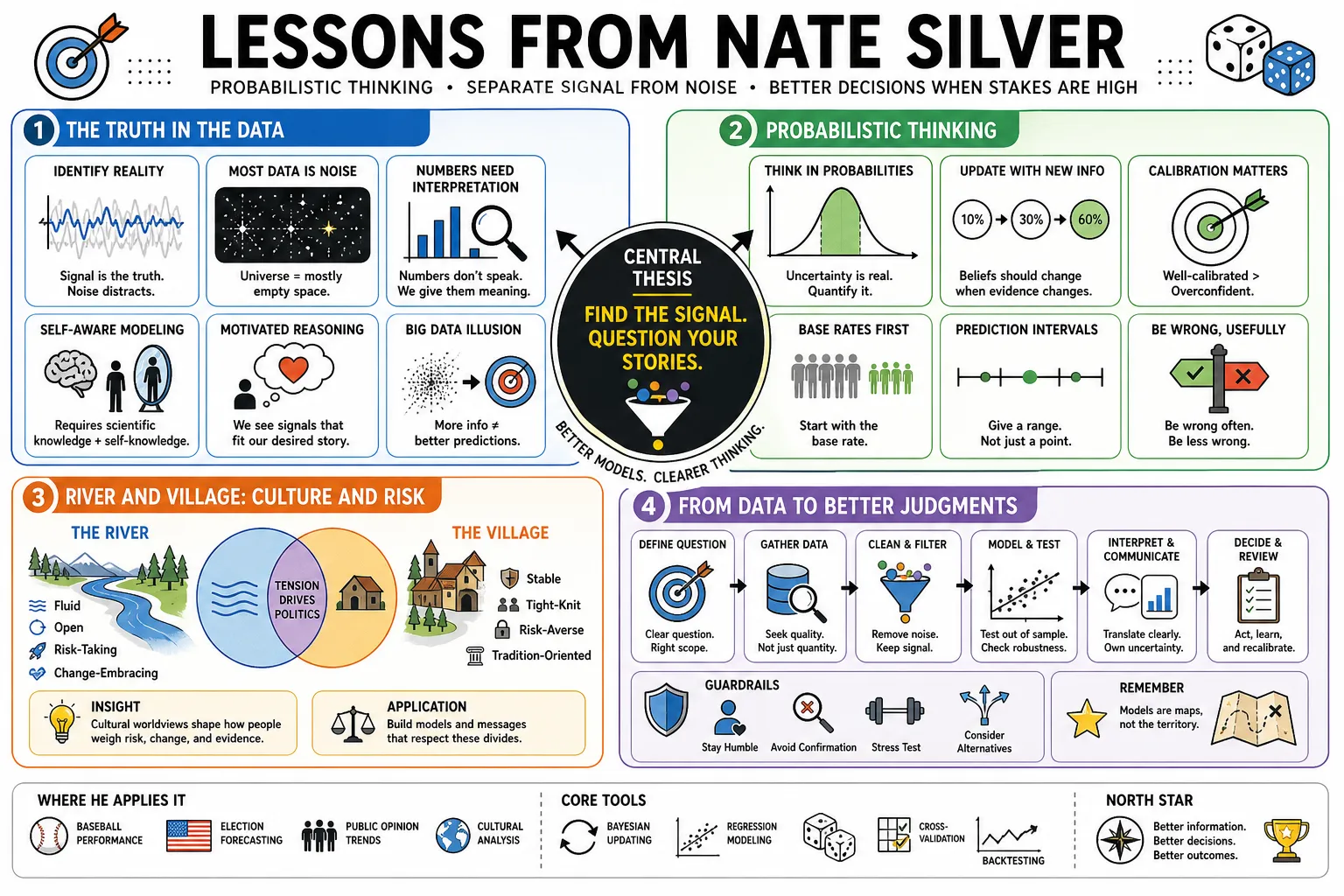
Lessons from Nate Silver
Statistician and writer Nate Silver built his career forecasting baseball performance and national elections. He is known for bringing probabilistic thinking to politics and mapping cultural divides in risk-taking through the concepts of the "River" and the "Village." This profile outlines his approach to separating meaningful data from background noise when the stakes are high.
Part 1: The Truth in the Data
- On identifying reality: "The signal is the truth. The noise is what distracts us from the truth." — Source: [The Signal and the Noise]
- On the volume of information: "Most of the data is just noise, as most of the universe is filled with empty space." — Source: [The Signal and the Noise]
- On interpreting numbers: "The numbers have no way of speaking for themselves. We speak for them. We imbue them with meaning." — Source: [The Signal and the Noise]
- On self-awareness in modeling: "Distinguishing the signal from the noise requires both scientific knowledge and self-knowledge." — Source: [The Signal and the Noise]
- On motivated reasoning: "We focus on those signals that tell a story about the world as we would like it to be, not how it really is." — Source: [The Signal and the Noise]
- On big data's illusion: "Having more information does not automatically lead to better predictions; it often just provides more noise to feed our biases." — Source: [The Signal and the Noise]
- On objectivity: "I'm of the view that we can never achieve perfect objectivity, rationality, or accuracy in our beliefs. Instead, we can strive to be less subjective, less irrational, and less wrong." — Source: [The Signal and the Noise]
- On ignored threats: "People routinely ignore the risks that are hardest to measure, even when those unmeasured risks pose the greatest threats." — Source: [The Signal and the Noise]
- On context: "A piece of data without context is a meaningless starting point for any serious forecast." — Source: [FiveThirtyEight]
- On the scientific method: "The best forecasters test their hypotheses against new data rather than bending the data to fit their initial hypotheses." — Source: [The Signal and the Noise]
Part 2: Poker, Probability, and Expected Value
- On defining risk: "Say that you'll win a poker hand unless your opponent draws to an inside straight: the chances of that happening are exactly 1 chance in 11.46. This is risk." — Source: [The Signal and the Noise]
- On expected value: "Decision-making in any uncertain environment comes down to finding situations with positive expected value, where the long-term payoff outweighs the cost." — Source: [On the Edge]
- On bad beats: "A low-probability event occurring does not mean the initial probability estimate was incorrect; it simply means the dice rolled differently this time." — Source: [Risky Business]
- On imperfect information: "Poker is fundamentally a game of making rapid decisions under conditions of uncertainty with incomplete information, much like managing a trading desk or running an election model." — Source: [Conversations with Tyler]
- On managing tilt: "Emotional bias and winner's tilt are the biggest threats to objective analysis, whether you are sitting at a card table or commenting on national politics." — Source: [On the Edge]
- On betting your beliefs: "If you are not willing to attach a wager or a specific probability to a claim, you have not actually made a falsifiable prediction." — Source: [Silver Bulletin]
- On the gambler's fallacy: "Recognizing that independent events do not owe you a specific outcome is the first step toward thinking probabilistically." — Source: [The Signal and the Noise]
- On finding edges: "In highly competitive markets, the edge doesn't come from a magical formula but from consistently making slightly better decisions than the consensus." — Source: [On the Edge]
- On sizing bets: "Knowing you have an advantage is useless if you mismanage your bankroll and take on ruinous risk." — Source: [On the Edge]
- On luck versus skill: "It is necessary to decouple the quality of your decision-making from the immediate outcome of the event." — Source: [Risky Business]
Part 3: Forecasting and Election Modeling
- On the limits of models: "A model should output a range of probabilities, not a definitive declaration of who will win." — Source: [FiveThirtyEight]
- On interpreting forecasts: "Giving a candidate a thirty percent chance of winning means they will win nearly one out of every three times you run the scenario. It does not mean they are guaranteed to lose." — Source: [Silver Bulletin]
- On polling averages: "Aggregating multiple polls reduces the noise and margin of error associated with any single survey's methodology." — Source: [FiveThirtyEight]
- On correlated errors: "If polls systematically miss in one state, they are highly likely to miss in demographically similar states in the exact same direction." — Source: [Silver Bulletin]
- On fundamentals versus data: "Economic indicators and incumbency matter greatly months before an election, but their predictive value shrinks as Election Day approaches and polling data becomes denser." — Source: [The Signal and the Noise]
- On primary elections: "Polling in primaries is inherently more volatile than in general elections because voters share ideological similarities and are more willing to change their minds." — Source: [FiveThirtyEight]
- On the illusion of momentum: "Media narratives often confuse a candidate's polling bump from favorable news coverage with permanent structural momentum." — Source: [The Signal and the Noise]
- On model transparency: "Publishing the underlying assumptions of a forecasting model is a requirement for it to be evaluated scientifically." — Source: [FiveThirtyEight]
- On forecasting as a baseline: "Models do not account for unprecedented black swan events; they provide the mathematical baseline for what happens if normal conditions hold." — Source: [Silver Bulletin]
- On the certainty trap: "The public desires a level of certainty in political forecasts that the underlying data simply cannot support." — Source: [The Signal and the Noise]
Part 4: The River vs. The Village
- On defining the River: "The River is a sprawling ecosystem of people, including poker players and tech founders, who prioritize expected value and quantitative risk-taking." — Source: [On the Edge]
- On defining the Village: "The Village consists of mainstream institutions, traditional media, and consensus-driven elites who prioritize social norms and risk aversion." — Source: [On the Edge]
- On cultural friction: "Conflicts often arise because the Village values social cohesion and narrative, while the River values analytical correctness, even if it is socially awkward." — Source: [On the Edge]
- On institutional trust: "The River views legacy institutions with skepticism, preferring decentralized networks, prediction markets, and open-source data." — Source: [On the Edge]
- On credentialism: "The Village heavily weights academic degrees and prestige, whereas the River tends to judge individuals strictly by their track record and financial success." — Source: [On the Edge]
- On contrarianism: "Members of the River actively look for areas where the Village consensus is mathematically wrong, viewing those gaps as opportunities for arbitrage." — Source: [On the Edge]
- On the limits of the River: "The highly quantitative mindset of the River can sometimes blind its members to the unquantifiable human factors that drive history." — Source: [On the Edge]
- On groupthink: "The Village frequently falls victim to groupthink because diverging from the accepted narrative carries a heavy social penalty." — Source: [On the Edge]
- On status games: "The River plays status games based on wealth and raw intelligence, while the Village plays status games based on institutional affiliation and moral signaling." — Source: [On the Edge]
Part 5: Prediction Markets and Economics
- On the wisdom of crowds: "Prediction markets often outperform individual pundits because they aggregate information and force participants to put skin in the game." — Source: [Silver Bulletin]
- On market efficiency: "A market is only useful for forecasting if there is enough liquidity to incentivize smart people to correct inaccurate pricing." — Source: [The Signal and the Noise]
- On the efficient market hypothesis: "The idea that markets are perfectly efficient is flawed, but they are usually hard enough to beat that amateur investors should not try." — Source: [The Signal and the Noise]
- On financial modeling: "The 2008 financial crisis was a failure to account for correlated risks; models treated regional housing collapses as independent events when they were highly connected." — Source: [The Signal and the Noise]
- On rating agencies: "When institutions are paid by the entities they are evaluating, their forecasts and ratings will inherently skew optimistic." — Source: [The Signal and the Noise]
- On expert consensus: "When all economic forecasters agree, they are often wrong in the exact same direction due to shared blind spots." — Source: [The Signal and the Noise]
- On betting markets vs. polls: "Betting markets can be overly influenced by sudden news events, while polls provide a slower, more grounded measure of public sentiment." — Source: [FiveThirtyEight]
- On liquidity: "The accuracy of any prediction market is directly proportional to how much real money is moving through it." — Source: [Silver Bulletin]
- On irrational exuberance: "Markets can stay irrational for long periods, which is why having an accurate long-term forecast does not protect you from short-term margin calls." — Source: [The Signal and the Noise]
Part 6: Media, Narratives, and Punditry
- On the pundit's incentive: "Television pundits are rewarded for being entertaining and expressing absolute certainty, not for being accurate." — Source: [The Signal and the Noise]
- On narrative fallacy: "Humans are wired to connect dots that should not be connected, crafting neat stories out of random variance." — Source: [The Signal and the Noise]
- On accountability: "Unlike gamblers who lose money when they are wrong, traditional commentators suffer very little penalty for making consistently poor predictions." — Source: [FiveThirtyEight]
- On journalistic bias: "The press suffers from a structural bias toward novelty, conflict, and the assumption that the current moment is entirely unprecedented." — Source: [Silver Bulletin]
- On the desire for closure: "Media outlets often call races or declare trends prematurely because their audience demands immediate answers to complex situations." — Source: [FiveThirtyEight]
- On false balance: "Treating a ten percent probability and a ninety percent probability as equally valid viewpoints is a failure of analytical journalism." — Source: [Silver Bulletin]
- On qualitative versus quantitative: "A good reporter on the ground provides necessary context, but their anecdotes should not override large-sample survey data." — Source: [The Signal and the Noise]
- On social media bubbles: "Social media heavily distorts the perception of public opinion, acting as an echo chamber for the most highly engaged political partisans." — Source: [Silver Bulletin]
- On reading the news: "If you consume information designed to reinforce what you already believe, you are destroying your ability to accurately forecast the future." — Source: [The Signal and the Noise]
Part 7: Bayesian Thinking and Updating Beliefs
- On Bayes' Theorem: "We must constantly update our initial beliefs as new evidence arrives, rather than stubbornly clinging to our first guess." — Source: [The Signal and the Noise]
- On holding priors loosely: "An effective forecaster starts with a baseline probability but is entirely willing to adjust it if the incoming data dictates a change." — Source: [The Signal and the Noise]
- On admitting error: "Changing your mind when the facts change is not a sign of weakness; it is the fundamental requirement of mathematical reasoning." — Source: [The Signal and the Noise]
- On absolute certainty: "If you assign a 100 percent or 0 percent probability to any event, Bayesian updating becomes mathematically impossible because no amount of new data can change your mind." — Source: [The Signal and the Noise]
- On the danger of ideology: "Ideologues fail as forecasters because their priors are so heavily weighted that they refuse to let new evidence alter their worldview." — Source: [The Signal and the Noise]
- On incremental adjustments: "True learning happens through small, continuous adjustments to our probability estimates rather than sudden, dramatic shifts in worldview." — Source: [The Signal and the Noise]
- On evaluating evidence: "Not all new data deserves equal weight; we have to mathematically assess how reliable a new piece of information actually is before we let it change our minds." — Source: [The Signal and the Noise]
- On prior probabilities in science: "A surprising experimental result is more likely to be a statistical anomaly if the prior probability of that result was extremely low." — Source: [The Signal and the Noise]
- On human nature: "We are naturally poor Bayesians; evolution wired us to spot patterns instantly rather than calculate probabilities carefully over time." — Source: [The Signal and the Noise]
Part 8: Technology, AI, and the Future
- On the AI button: "I wouldn't push the button... I believe in optionality, giving ourselves more choice in the future rather than fewer." — Source: [On the Edge]
- On AI risk versus reward: "Assessing the development of artificial intelligence requires balancing the potentially massive economic gains against the non-zero probability of existential catastrophe." — Source: [On the Edge]
- On technological stagnation: "One argument for pursuing risky technologies like AI is that secular stagnation in the broader economy forces us to take larger gambles to maintain growth." — Source: [On the Edge]
- On computers playing chess: "The success of computers in chess came from relying on raw calculating power to evaluate millions of probabilities, rather than attempting to mimic human thought." — Source: [The Signal and the Noise]
- On the limits of algorithms: "An algorithm is only as effective as the assumptions coded into it by its human creators." — Source: [The Signal and the Noise]
- On machine learning in sports: "Systems like PECOTA succeeded because they stripped the emotional bias out of scouting and relied strictly on historical similarities in player data." — Source: [FiveThirtyEight]
- On AI as an assistant: "While language models can help synthesize information rapidly, they lack the ground-level contextual judgment required to generate novel statistical forecasts." — Source: [Silver Bulletin]
- On technological determinism: "It is a mistake to assume that the development curve of any new technology will continue exponentially without hitting physical or societal constraints." — Source: [The Signal and the Noise]
- On the future of forecasting: "As computing power increases, the bottleneck for accurate prediction will no longer be data processing, but the human ability to interpret that data without bias." — Source: [The Signal and the Noise]