Nesrine Changuel is a product leader, coach, and author who spent over a decade at Google, Spotify, and Skype focusing on how software makes people feel. She is best known for formalizing "product delight" as a strategic framework, most notably through her 50-40-10 rule and the Delight Grid, which shifts product management away from purely functional metrics toward emotional resonance. This profile breaks down her practical methods for balancing utility with human connection, making it a valuable resource for anyone building digital products today.
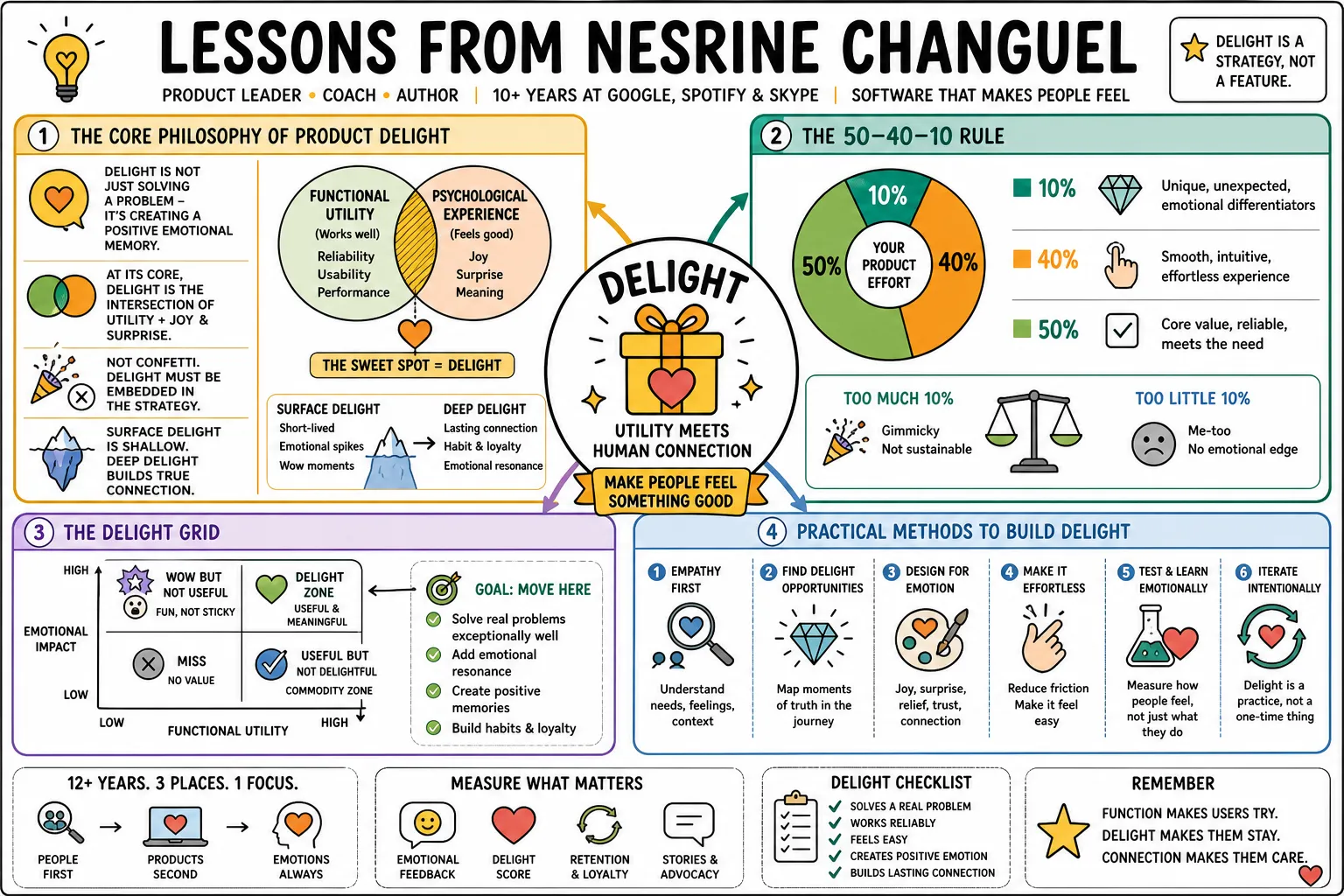
Part 1: The Core Philosophy of Product Delight
- On defining delight: "Delight is not just solving a problem – it's creating a positive emotional memory." — Source: [Usersnap Blog]
- On the formula for delight: "At its core, a delightful experience is often the intersection of functional utility and a psychological mix of joy and surprise." — Source: [Nesrine Changuel's Website]
- On avoiding superficiality: "Delight is not about sprinkling confetti or adding aesthetic polish at the end of a build. It must be embedded in the strategy." — Source: [Lenny's Podcast]
- On surface versus deep delight: "Surface delight targets only emotional reactions, like occasional surprises, whereas deep delight is the true fusion of functional and emotional user needs." — Source: [Professor Game Podcast]
- On consistency in experience: "What makes me happy today may not surprise me tomorrow. You need continuity." — Source: [Usersnap Blog]
- On emotional resonance: "When a product fulfills functional requirements while creating a genuine emotional connection, it makes users feel understood on a human level." — Source: [Lenny's Newsletter]
- On removing friction: "The first pillar of creating delight is simply removing friction. You have to streamline processes to reduce user stress before you can add joy." — Source: [Product Mastery Now]
- On anticipating needs: "The second pillar is proactive feature design. Anticipating what a user needs before they ask for it saves them time and builds immense trust." — Source: [Agile Mentors Podcast]
- On exceeding expectations: "The final pillar of delight is going beyond what is expected, creating moments of genuine care that users want to talk about." — Source: [Talking Roadmaps Podcast]
- On the business case for emotion: "In a crowded market where most products function well, emotional connection is a key competitive differentiator that drives retention, revenue, and referrals." — Source: [Kameleoon Blog]
Part 2: Moving Beyond Functionality
- On the limits of functionality: "In a world where basic functionality is table stakes, emotional connection is the true differentiator for software." — Source: [Nesrine Changuel's Website]
- On functional excellence: "Low delight is when a product is purely functional. It works, but it leaves no lasting positive impression on the person using it." — Source: [Professor Game Podcast]
- On the dedicated delight role: "Having a dedicated 'delight PM' ensures that emotional engagement is treated with the same rigor as technical performance." — Source: [Lenny's Podcast]
- On solving the right problem: "You have to look beyond the immediate jobs to be done and ask how the user is feeling before, during, and after they use your tool." — Source: [Product Thinking Podcast]
- On the Chrome inactive tabs feature: "Grouping and hiding inactive tabs solved a technical problem of memory load, but it also relieved the user's emotional shame over having a cluttered browser." — Source: [Agility Evolved]
- On building trust: "Trust is established when a product works reliably, but loyalty is forged when a product makes the user feel smart and capable." — Source: [Product Founder Podcast]
- On the danger of feature factories: "Shipping features without considering their emotional impact leads to bloated products that users tolerate rather than love." — Source: [Talking Roadmaps Podcast]
- On the psychology of software: "Every interaction with an interface triggers a psychological response. Our job is to design those responses intentionally." — Source: [Lenny's Newsletter]
- On retaining users: "Users come for the utility, but they stay because the experience respects their time and emotional energy." — Source: [Kameleoon Blog]
Part 3: Understanding the Emotional User (B2H)
- On the B2H framework: "Whether B2B or B2C, delight is essential in every B2H (business-to-human) industry." — Source: [Product Mastery Now]
- On Enterprise users: "Enterprise software is ultimately used by humans who crave emotional connection, trust, and understanding just as much as consumers do." — Source: [Agile Mentors Podcast]
- On motivational segmentation: "Teams should segment users based on why they use a product and their emotional motivators, rather than just their job titles or demographics." — Source: [Product Thinking Podcast]
- On user anxiety: "If your product is used in high-stress situations, designing to reduce anxiety is the highest form of delight you can offer." — Source: [Nesrine Changuel's Website]
- On emotional empathy: "Empathy in design means recognizing that your user might be tired, frustrated, or rushed, and adapting the interface to support them in that state." — Source: [Professor Game Podcast]
- On making users feel successful: "The best products disappear into the background and make the person using them feel like the hero of their own story." — Source: [Product Founder Podcast]
- On humanizing data: "Data tells you what users are doing, but understanding their emotional state tells you why they are doing it." — Source: [Talking Roadmaps Podcast]
- On the cost of ignored emotions: "When you ignore the emotional state of your users, you invite churn at the exact moment they experience friction." — Source: [Usersnap Blog]
- On qualitative feedback: "Listening to the tone of voice in user interviews often reveals more about the product experience than the actual words being spoken." — Source: [Lenny's Podcast]
Part 4: The 50-40-10 Rule and Roadmap Strategy
- On roadmap balance: "A healthy product portfolio balances different types of value to ensure both stability and growth." — Source: [Product Mastery Now]
- On the 50 percent allocation: "Allocate 50 percent of your roadmap to core functional features and technical debt to ensure the product remains reliable." — Source: [Lenny's Podcast]
- On the 40 percent allocation: "Dedicate 40 percent of your efforts to deep delight, building features that serve both functional needs and emotional resonance." — Source: [Talking Roadmaps Podcast]
- On the 10 percent allocation: "Leave 10 percent of your capacity for innovation and experimental features that can push the boundaries of what users expect." — Source: [Product Mastery Now]
- On prioritizing delight: "When delight is formalized as 40 percent of the roadmap, it stops being an afterthought and becomes a measurable engineering commitment." — Source: [Agile Mentors Podcast]
- On avoiding the functional trap: "Teams that spend 100 percent of their time on functional requests eventually lose their market share to competitors who invest in the user experience." — Source: [Product Thinking Podcast]
- On selling the roadmap to leadership: "You justify the 50-40-10 split by tying the 40 percent delight allocation directly to retention metrics and customer lifetime value." — Source: [Nesrine Changuel's Website]
- On experimental features: "The 10 percent innovation bucket is where you test wild ideas; some will fail, but the ones that succeed often become tomorrow's core functionality." — Source: [Lenny's Newsletter]
- On disciplined execution: "Having a framework like 50-40-10 prevents the loudest customer from dictating the entire product direction." — Source: [Kameleoon Blog]
Part 5: Navigating Chaos at Scale (Google & Spotify)
- On scale and perfection: "Large tech organizations like Google and Spotify are not perfectly tuned machines; they are complex systems that require managing chaos." — Source: [Product Founder Podcast]
- On working at Google: "My time as a delight PM at Google taught me that even at a massive scale, you can engineer moments that feel deeply personal to the individual user." — Source: [Lenny's Podcast]
- On the reality of hyper-growth: "In hyper-growth environments, systems will break. The goal is to build resilience into the team so you can fix things without passing the stress onto the user." — Source: [Product Founder Podcast]
- On cross-functional alignment: "At companies like Spotify, delight is achieved because engineering, design, and product are aligned on the emotional goal of the release, not just the technical spec." — Source: [Atlassian]
- On legacy products: "Working on established products like Skype requires finding ways to introduce modern delight without alienating a massive, entrenched user base." — Source: [Nesrine Changuel's Website]
- On Google Meet's evolution: "During critical periods for Google Meet, the focus shifted rapidly to removing friction, proving that utility is the foundation of any positive experience." — Source: [Agility Evolved]
- On internal communication: "When navigating chaos, clear communication about what we are not doing is just as important as outlining what we are building." — Source: [Talking Roadmaps Podcast]
- On scaling empathy: "The challenge of a billion-user product is figuring out how to scale empathy so the interface feels helpful rather than mechanical." — Source: [Lenny's Newsletter]
- On adapting to change: "Rigid roadmaps fail in dynamic environments. You have to be willing to scrap a quarter's worth of planning if user needs suddenly shift." — Source: [Product Thinking Podcast]
- On the illusion of control: "Product leaders must accept that they cannot control every variable; they can only build teams capable of responding to the unexpected with grace." — Source: [Product Founder Podcast]
Part 6: Tools and Frameworks for Teams
- On the Delight Grid: "The Delight Grid is a tool designed to help teams visually map out both the functional requirements and the emotional motivators of a feature." — Source: [Talking Roadmaps Podcast]
- On mapping motivators: "By placing features on the Delight Grid, teams can clearly see if they are over-investing in utility while starving the emotional experience." — Source: [Usersnap Blog]
- On the Delight Excellence Checklist: "Before shipping, the Delight Excellence Checklist validates whether a solution actually impacts the user emotionally and drives business value." — Source: [Kameleoon Blog]
- On operationalizing emotion: "Frameworks take the subjectivity out of design. They give engineers and product managers a shared vocabulary to discuss how a product should feel." — Source: [Product Mastery Now]
- On Delight Enhancers: "Delight Enhancers are small, low-effort adjustments that can elevate a standard feature into something that creates a positive memory." — Source: [Nesrine Changuel's Website]
- On auditing the product: "Teams should regularly audit their existing product surface area using the Delight Grid to identify areas where the experience has become stale." — Source: [Agile Mentors Podcast]
- On collaborative mapping: "The best use of these frameworks is in cross-functional workshops, where engineering and design can debate the emotional weight of a feature together." — Source: [Lenny's Podcast]
- On preventing feature creep: "Using a structured checklist prevents teams from adding surface-level animations and calling it delight, forcing them to focus on core user needs." — Source: [Talking Roadmaps Podcast]
- On continuous integration: "Delight frameworks should be integrated into the standard sprint planning process, not reserved for special offsite meetings." — Source: [Product Thinking Podcast]
Part 7: Measuring and Validating Delight
- On the necessity of metrics: "If you cannot measure the impact of a delightful feature, it will be the first thing cut when budgets get tight." — Source: [Kameleoon Blog]
- On qualitative and quantitative balance: "You need quantitative data to see what is happening at scale, and qualitative insights to understand the human emotion behind those numbers." — Source: [Usersnap Blog]
- On retention as a proxy: "The most reliable lagging indicator of deep delight is long-term retention. Users do not stick around for years if they hate the experience." — Source: [Lenny's Newsletter]
- On measuring friction: "Track the time it takes for a user to recover from an error state; a fast, painless recovery is a measurable form of delight." — Source: [Product Mastery Now]
- On referral rates: "When users proactively recommend your product to their peers, it is strong validation that you have successfully created a positive emotional memory." — Source: [Nesrine Changuel's Website]
- On leading indicators: "Task completion rate and reduced support tickets are excellent leading indicators that you have successfully removed friction from the system." — Source: [Agile Mentors Podcast]
- On the limitations of NPS: "Net Promoter Score is a blunt instrument. It needs to be paired with specific behavioral metrics to truly understand user sentiment." — Source: [Product Thinking Podcast]
- On iterative testing: "You validate emotional resonance the same way you validate a technical feature: through rigorous A/B testing and direct user observation." — Source: [Talking Roadmaps Podcast]
- On defining success upfront: "Before writing a single line of code for a delight feature, the team must agree on the specific metric that will prove the hypothesis." — Source: [Professor Game Podcast]
Part 8: Leadership and Career Resilience
- On career resilience: "Like aerial sports, you could fall and get up, just be careful not to break your neck." — Source: [Women in Agile Europe]
- On taking calculated risks: "Building innovative products requires stepping out of your comfort zone, but you must always protect your core stability while doing so." — Source: [Product Founder Podcast]
- On coaching teams: "A product leader's primary job is to create an environment where the team feels safe enough to advocate for the user's emotional experience." — Source: [Nesrine Changuel's Website]
- On defending the user: "When engineering pushes for speed and business pushes for revenue, product management must stand firm as the defender of the user's time and feelings." — Source: [Lenny's Podcast]
- On continual learning: "The technology landscape changes constantly, but human psychology remains stable. Mastering the latter provides a durable career advantage." — Source: [Product Substack]
- On overcoming failure: "A failed feature launch is just a high-fidelity data point. The only true failure is refusing to learn why it did not resonate with the market." — Source: [Agility Evolved]
- On leading through influence: "As a product manager, you rarely have direct authority over engineering or design. You lead by building a compelling, evidence-based narrative." — Source: [Atlassian]
- On maintaining perspective: "When the pressure of a roadmap becomes overwhelming, step back and talk to a single user. It immediately clarifies what actually matters." — Source: [Product Thinking Podcast]
- On personal branding: "Establishing a distinct philosophy, like product delight, allows you to attract teams and organizations that align with your core values." — Source: [Nesrine Changuel's Website]
- On the long game: "Building a successful career in product is not about one massive launch; it is about consistently shipping small moments of value over a decade." — Source: [Product Founder Podcast]