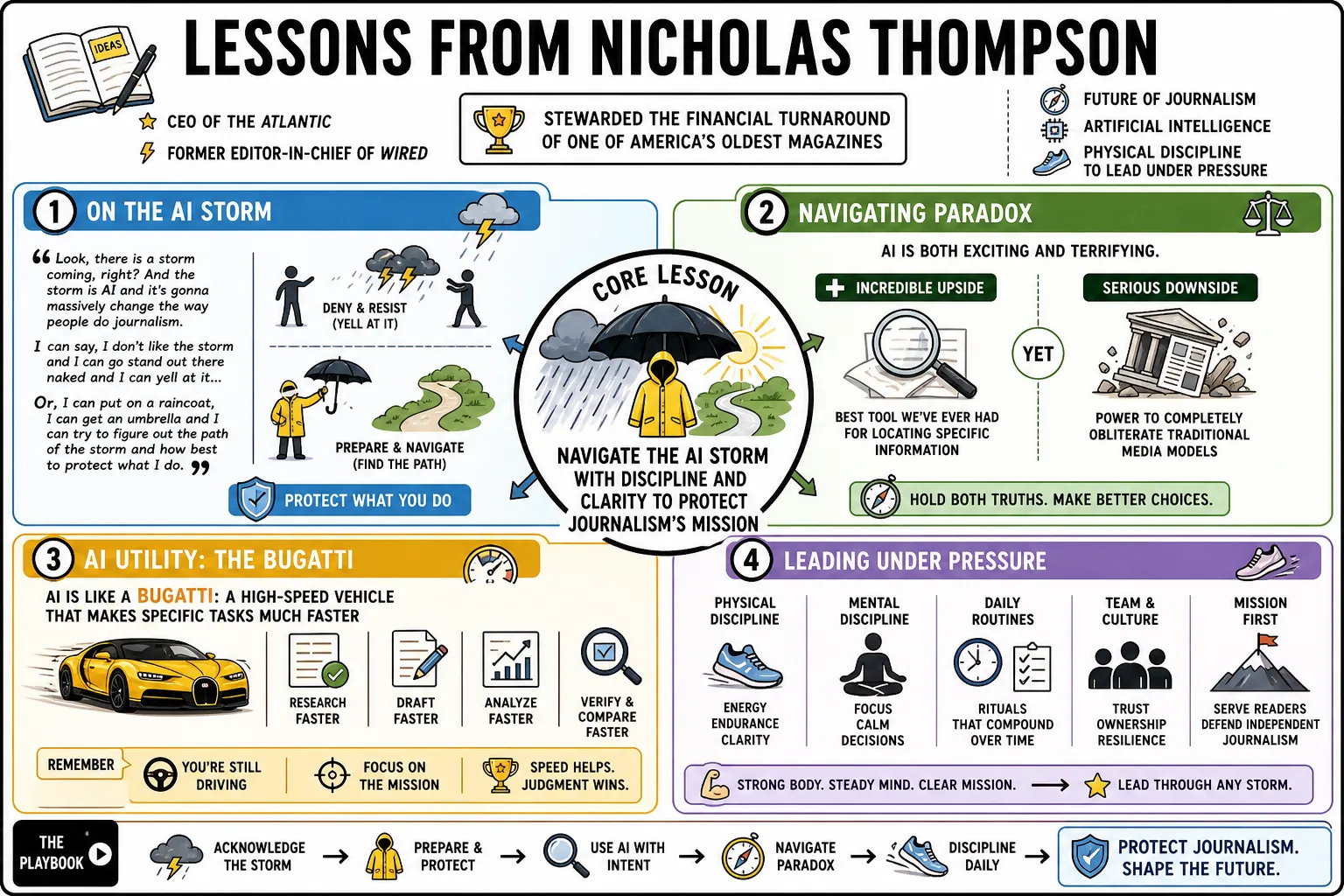
Lessons from Nicholas Thompson
Nicholas Thompson, CEO of The Atlantic and former editor-in-chief of Wired, steered the financial turnaround of one of America's oldest magazines. This collection gathers his writing on the future of journalism and artificial intelligence, alongside his views on the physical discipline required to lead under pressure.
Part 1: Artificial Intelligence & The Future of Technology
- On the AI Storm: "Look, there is a storm coming, right? And the storm is AI and it's gonna massively change the way people do journalism. I can say, I don't like the storm and I can go stand out there naked and I can yell at it... Or, I can put on a raincoat, I can get an umbrella and I can try to figure out the path of the storm and how best to protect what I do." — Source: Beyond the Prompt
- On Navigating Paradox: The current era of artificial intelligence is both exciting and terrifying; it represents the best tool we've ever had for locating specific information, yet possesses the power to completely obliterate traditional media models. — Source: Nicholas Thompson on Substack
- On AI Utility: In a Possible short, Thompson argues that AI should be aimed at specific challenges, such as protein folding or more transparent mortgage algorithms, rather than only chasing human-like AGI. — Reference: Possible short on targeting AI toward specific challenges
- On Intellectual Property: AI companies violated terms of service, likely violated copyright law, took all our content, fed it into machines, and built a model that competes with publishers without offering anything in return. — Source: World Economic Forum
- On Architectural Shifts: Once you change how search works, you have changed the entire architecture of the internet, posing an existential risk to the financial and editorial ecosystems of journalism. — Source: American Bazaar
- On Human Constraints: Thompson describes AI as a tool that can help people learn languages and process more information faster, while the conversation still centers human judgment, democracy, journalism, and empathy. — Reference: Possible live conversation on AI and human judgment
- On Generic Outputs: A lot of the prose that generative AI spits out is generic and clichéd because it has been fundamentally trained on generic, average prose. — Source: Beyond the Prompt
- On Doomsday Scenarios: In the Possible discussion, Thompson treats AI as a technology with real civic and journalistic stakes, but his emphasis is on governance, incentives, and human choices rather than fatalistic inevitability. — Reference: Possible live conversation on AI risks and governance
- On Practical Engagement: Students and professionals must embrace the opportunities presented by new technology while remaining acutely aware of its current limitations, such as hallucinations. — Source: Student Life
- On Information Retrieval: The technology functions as the best tool journalism has ever possessed for locating needles in haystacks, enabling reporters to synthesize vast troves of data efficiently. — Source: Nicholas Thompson on Substack
Part 2: The Evolving Landscape of Journalism
- On Audience Commitment: "If your primary commitment is to your audience, you’re a journalist. If it’s to your guest or an advertiser, you’re something else." — Source: Dialectic Podcast
- On Algorithm Chasing: "My view on journalism is that you shouldn't create content to please the algorithms." — Source: El País
- On Ground Reporting: Journalism and deep investigative reporting happen in hallways, not prompts; AI cannot replace the human element of doorstopping a hostile attorney general. — Source: Dialectic Podcast
- On Institutional Standards: "The New Yorker doesn't have the luxury of sucking... what's the point of going into something new if you can't do it really well." — Source: Digiday
- On The Autocracy Playbook: Democracy relies entirely on shared stories and facts, which is why the autocracy playbook systematically targets this foundation by arresting journalists and buying out publications. — Source: Dialectic Podcast
- On the Journalism Reset: Media outlets have historically struggled to shift their business models from maximizing clicks to driving long-term subscriptions, a necessary transition for survival. — Source: OM
- On Traffic Replacement: Cloudflare TV frames Thompson's interview around the future of content, rapid AI growth, and the challenge of protecting content creators from AI crawlers. — Reference: Cloudflare TV interview on AI and content
- On Financial Constraints: Financial constraints are often a gift for media institutions, as forced choices about what to cut and what to subsidize drive the production of great, long-term work. — Source: Dialectic Podcast
- On the Role of the Editor: The job of an editor is not merely to fix commas, but to identify the core argument of a piece and ensure every paragraph serves that central thesis. — Source: Nicholas Thompson on LinkedIn
- On Competing Priorities: The fundamental tension in digital publishing is balancing the immediate gratification of going viral with the slow, difficult work of building enduring reader trust. — Source: Press Gazette
Part 3: Running, Endurance & Physical Discipline
- On Pain: "Pain is mandatory but suffering is optional." — Source: Reddit
- On Aging: "You don't stop running because you get old. You get old because you stop running." — Source: Next Big Idea Club
- On Forward Motion: WIRED describes The Running Ground as a book about Thompson's commitment to running, recovery, training, family, and the long work of getting better through repeated effort. — Reference: WIRED Big Interview on The Running Ground
- On Discipline: The Learning Leader episode notes Thompson's view that running hard builds discipline, summarizing the lesson as discipline building on itself over time. — Reference: Learning Leader episode with Nicholas Thompson
- On Simplicity: "Running strips you down. The less clothing you wear, the faster you go. The lighter your shoes, the faster you go. As you go faster, your head empties too." — Source: CBS News
- On Training Intensity: If you enjoy all of your training runs, you are simply not training hard enough to reach your potential. — Source: Reddit
- On Personal Accountability: "When you run, it's just you. If you succeed, it's your success. If you fail, it's your failure." — Source: The Lavin Agency
- On the Central Governor Theory: In WIRED, Thompson discusses how his running breakthrough was tied to deeper internal limits after illness, making performance as much about hidden constraints as mileage. — Reference: WIRED Big Interview on running and internal limits
- On Grief and Motion: Physical endurance can serve as a powerful mechanism for processing grief, untangling complex family legacies, and channeling inherited ambition. — Source: NickThompson.com
- On Longevity in Sport: It is possible to continue improving physical performance and setting personal records well into your 40s if you apply rigorous discipline and awareness. — Source: Watermark Books
Part 4: Leadership & Strategic Management
- On Strategic Discomfort: "The way you get better is by going at an uncomfortable speed." — Source: The Lavin Agency
- On the "Edge" in Hiring: When building teams, look for generosity, strong ideas, hard work, and an "edge"—a productive level of anxiety or drive that pushes individuals to produce impactful work. — Source: Tomorrow's Publisher
- On Decisiveness and Humility: Effective leadership requires balancing the ability to be highly decisive with the humility to remain open to the possibility of being entirely wrong. — Source: Learning Leader
- On Challenging Authority: A successful CEO builds a team that feels actively empowered to challenge their thinking without allowing that friction to devolve into organizational chaos. — Source: Learning Leader
- On Consistency vs. Intensity: While occasional intense efforts are necessary, it is the daily, consistent commitment to pushing boundaries that drives long-term improvement and success. — Source: Learning Leader
- On Institutional Values: The primary responsibility of a CEO is to ensure the organization moves in a direction that aligns with its core values while future-proofing its mission. — Source: Strong Skills
- On Organizational Pace: A healthy organization should operate at a pace that is deliberate and moving forward, avoiding both frenetic burnout and stagnant complacency. — Source: Tomorrow's Publisher
- On Ambitious Goal Setting: Leaders must compress timelines and explore entirely new strategies rather than settling for comfort, predictability, and incremental gains. — Source: The Lavin Agency
- On Defining Non-Goals: Strategic clarity comes just as much from defining what the organization will deliberately choose not to do, as it does from defining what it will pursue. — Source: World Economic Forum
Part 5: Big Tech, Algorithms & Society
- On Corporate Power: GZERO frames Thompson's conversation with Ian Bremmer around a digital world where a few technology companies exercise influence so large that they can resemble nation-states. — Reference: GZERO podcast on Big Tech power
- On the Internet's Evolution: The internet was once heralded as a tool to promote democracy and win-win interactions, but it has evolved into a double-edged sword that frequently amplifies humanity's worst instincts. — Source: OM
- On Social Media Politics: "The actual recommendation I make... is to take more of your politics offline and into your community. National politics is a shitty form of entertainment. It makes you feel bad. It's disempowering." — Source: Muck Rack
- On Algorithmic Amplification: Social platforms are designed to reward extreme voices, creating a distorted view of public consensus that damages civic discourse. — Source: The Lavin Agency
- On Tech Regulation: The GZERO episode asks whether governments can still rein in Big Tech, grounding the lesson in the gap between national authority and fast-moving digital platforms. — Reference: GZERO podcast on policing the digital world
- On the Attention Economy: The competition for human attention has forced platforms to optimize for outrage rather than understanding, fundamentally altering how societies process information. — Source: Chautauqua Daily
- On Digital Optimism: Despite the harms of the modern web, we must retain the foundational optimism that technology can be harnessed to solve complex logistical and scientific problems. — Source: OM
- On Platform Responsibility: Platforms can no longer claim to be neutral arbiters of information; their algorithmic choices represent editorial decisions with massive societal consequences. — Source: El País
- On Privacy Trade-offs: GZERO describes the digital space as where much of daily life now happens, supporting a lesson about the political and personal costs of letting platforms mediate that space. — Reference: GZERO podcast on digital life and governance
Part 6: Media Economics & Institutional Survival
- On Data-Driven Subscriptions: Long-term sustainability in publishing requires abandoning the pursuit of fleeting traffic in favor of building a rigorous, data-driven subscription business. — Source: Press Gazette
- On Pragmatic Partnerships: Cloudflare quotes Thompson supporting permission-based AI crawling, showing a publisher posture that combines business pragmatism with protection for the open web. — Reference: Cloudflare press release quoting Thompson on AI crawlers
- On the Value of Archives: A publication's historical archive is not just a record of the past, but a highly valuable asset that must be protected and leveraged in the era of large language models. — Source: World Economic Forum
- On Financial Turnarounds: Achieving profitability in modern media requires making difficult, precise cuts while simultaneously investing heavily in the core editorial product that drives loyalty. — Source: Timeless Partners
- On Brand Integrity: In a landscape flooded with synthetic content, a publication's brand and its reputation for rigorous fact-checking become its primary commercial differentiator. — Source: Digiday
- On Advertising Shifts: As advertising dollars continue to migrate toward tech platforms, publishers must develop direct financial relationships with their readers to survive. — Source: OM
- On Media Consolidation: The economic pressures of the digital age naturally drive media consolidation, making it harder for independent, mid-sized publications to weather technological shifts. — Source: Nicholas Thompson on Substack
- On Paywall Strategy: A successful paywall does not merely block access; it communicates the inherent value of the journalism and invites the reader into a community of ideas. — Source: Press Gazette
- On Future-Proofing: Surviving the next decade in media means building a business model that is resilient to both algorithmic changes and macroeconomic downturns. — Source: Strong Skills
Part 7: History, Power & The Cold War
- On Intellectual Friction: The most profound historical strategies often emerge not from consensus, but from the intellectual bonding and clashing politics of individuals with divergent personalities. — Source: NickThompson.com
- On Paul Nitze and George Kennan: Understanding the Cold War requires examining the contrary temperaments of its key architects—one an analytical strategist, the other a philosophical observer. — Source: NickThompson.com
- On Strategic Patience: The policy of containment was born from the recognition that some geopolitical conflicts cannot be won quickly, but must be managed with extreme patience over decades. — Source: Target Reviews
- On Ideological Flexibility: Effective statecraft requires the ability to adjust one's ideological stance when confronted with new evidence or shifting global power dynamics. — Source: Institute for Asian Studies
- On the Danger of Absolutism: Viewing international relations purely through the lens of absolute moral struggles often blinds policymakers to pragmatic, diplomatic solutions. — Source: AZ Quotes
- On Historical Empathy: To write about history accurately, one must present protagonists in a convincing and respectful way, while remaining unsparing about their profound mistakes. — Source: AZ Quotes
- On the Cost of Defense: The militarization of foreign policy exacts a heavy domestic toll, forcing nations to constantly balance their democratic values against the perceived requirements of national security. — Source: Institute for Asian Studies
- On Policy Documents as Literature: Thompson's The Hawk and the Dove centers Paul Nitze and George Kennan in Cold War strategy, while NSC-68 is treated as a consequential document in that strategic conflict. — Reference: Macmillan page for The Hawk and the Dove
- On Legacy: The true impact of a statesman is rarely measured by their immediate victories, but by the enduring geopolitical architecture they leave behind for their successors. — Source: NickThompson.com
Part 8: Personal Philosophy & Growth
- On Managing Anxiety: Instead of trying to eliminate anxiety entirely, one should channel that nervous energy into a productive edge that fuels deep, focused work. — Source: Tomorrow's Publisher
- On the Illusion of Limits: Most of the limits we perceive in our professional and physical lives are artificially constructed by our own minds to keep us safely within our comfort zones. — Source: 3 Takeaways
- On Self-Reflection: True personal growth requires stripping away the distractions of daily life and forcing oneself to confront the quiet, uncomfortable thoughts that emerge in isolation. — Source: CBS News
- On Generosity in Success: The most effective professionals are those who combine an intense drive for personal excellence with a genuine generosity toward the ideas and careers of their colleagues. — Source: Tomorrow's Publisher
- On Adapting to Change: When faced with massive technological or personal disruption, the only viable response is active engagement and preparation, rather than nostalgic resistance. — Source: Beyond the Prompt
- On the Value of Hard Choices: Constraints and forced choices—whether financial, physical, or temporal—are often the catalysts required to break through complacency and achieve greatness. — Source: Dialectic Podcast
- On Ambition and Family: Understanding one's own ambition often requires a deeply unsparing examination of family legacy, parental expectations, and the traits we subconsciously inherit. — Source: NickThompson.com
- On Continuous Improvement: WIRED presents Thompson's late-career running gains and book as evidence that mastery can come from sustained training, coaching, and daily attention rather than one final breakthrough. — Reference: WIRED Big Interview on running improvement
- On Meaningful Work: Ultimately, the work that matters most is that which attempts to distill complex, messy human realities into shared stories that help us understand each other better. — Source: Dialectic Podcast