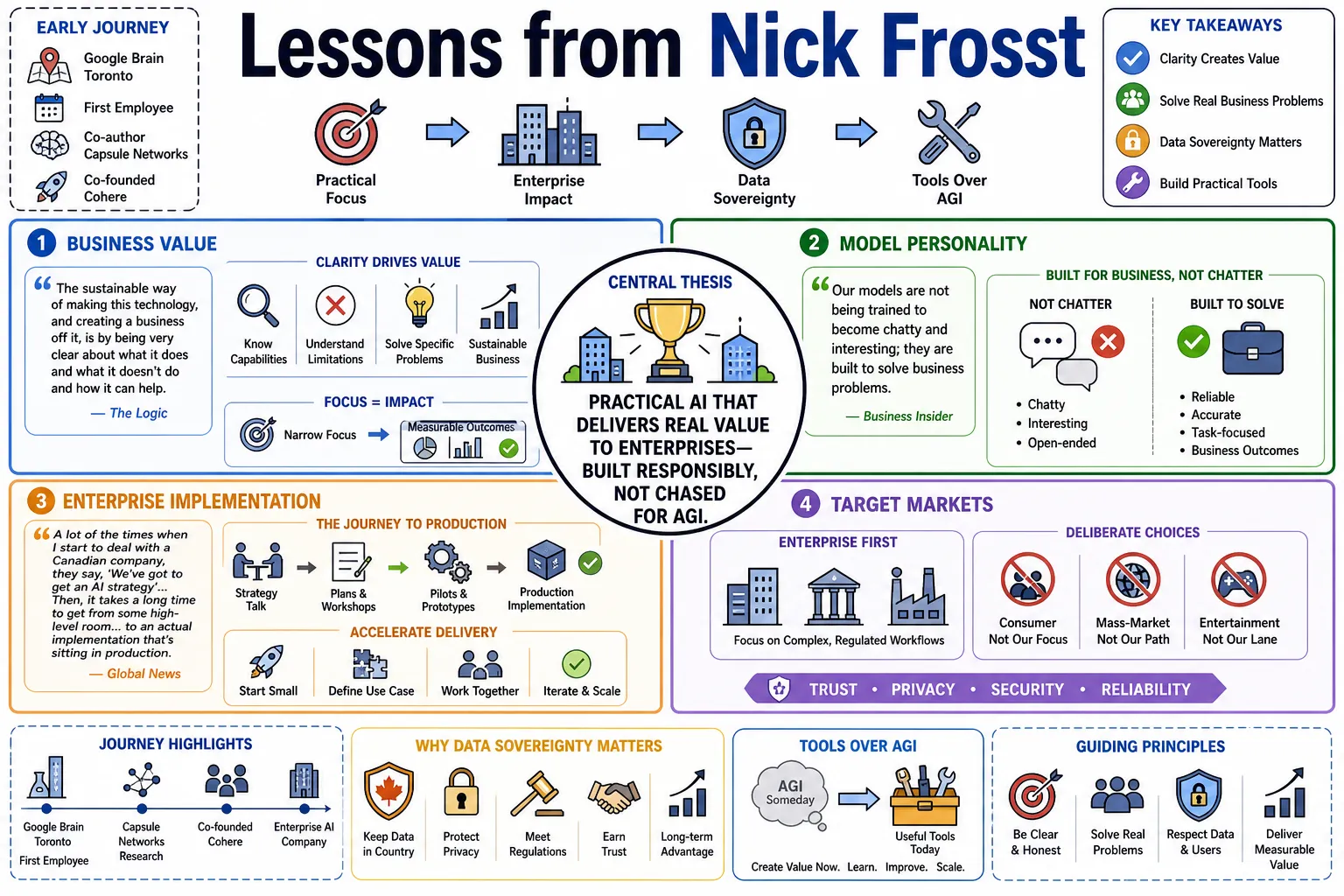
Lessons from Nick Frosst
As the first employee at Geoffrey Hinton's Google Brain lab in Toronto, computer scientist Nick Frosst co-authored early research on capsule networks before co-founding the enterprise language model company Cohere. This profile covers his views on the limitations of current AI architectures, the business case for data sovereignty, and why he prefers building practical corporate tools over chasing artificial general intelligence.
Part 1: Building Cohere and Enterprise AI
- On Business Value: "The sustainable way of making this technology, and creating a business off it, is by being very clear about what it does and what it doesn't do and how it can help." — Source: The Logic
- On Model Personality: "Our models are not being trained to become chatty and interesting; they are built to solve business problems." — Source: Business Insider
- On Enterprise Implementation: "A lot of the times when I start to deal with a Canadian company, they say, 'We've got to get an AI strategy'... Then, it takes a long time to get from some high-level room... to an actual implementation that's sitting in production." — Source: Global News
- On Target Markets: Cohere deliberately avoids chasing mass-market consumer adoption, prioritizing instead the strict data privacy and compliance needs of businesses. — Source: Tech Talent
- On Product Utility: Frosst says Cohere trains business tools to augment work rather than to act like consumer chat companions. — Reference: Observer interview coverage on Cohere's enterprise focus
- On Competing with OpenAI: Frosst frames Cohere's path around enterprise deployment and ROI rather than a race to announce AGI. — Reference: Eye on AI episode on enterprise AI, not AGI
- On Data Security: In the enterprise market, Frosst emphasizes private data and secure deployment for sectors such as banking and healthcare. — Reference: Eye on AI episode on private data and secure deployment
- On Practical Bridging: Frosst's enterprise framing treats retrieval, agents, and grounded workflows as practical deployment problems rather than abstract model demos. — Reference: Eye on AI episode on enterprise LLM deployment
- On Corporate Pacing: The transition from a boardroom AI strategy to a functional production deployment remains the largest bottleneck for corporate adoption. — Source: Global News
- On Avoiding Hype: Building useful, reliable tools for real-world business problems should always take precedence over catering to consumer hype cycles. — Source: Maclean's
Part 2: Skepticism of AGI
- On Scaling to AGI: "I don't think this technology is going to scale with AGI, I don't think we can keep throwing money at that." — Source: The Logic
- On Scientific Realism: "As a scientist, I really don't think that's ever going to happen." — Source: The Logic
- On Digital Gods: The industry must stop trying to build a "digital god" and return to the discipline of solving tangible, scoped software problems. — Source: Canadian Affairs
- On AGI Scaremongering: The tech sector's focus on existential risk distracts from building useful tools and solving present-day issues regarding data and privacy. — Source: Maclean's
- On Public Perception: The general public's understanding of AI is heavily distorted by science fiction narratives rather than the mathematical realities of the technology. — Source: Canadaland
- On Industry Distractions: The "AGI race" is a massive distraction from the practical, immediate benefits that machine learning can provide to organizations right now. — Source: BetaKit
- On Human Intelligence: Frosst argues that AI is powerful and useful, but not a science-fiction mind or god inside a computer. — Reference: BetaKit report on Frosst's AI-hype stance
- On Architectural Limits: Frosst argues that simply scaling transformers does not automatically produce AGI. — Reference: Eye on AI episode on scaling transformers and AGI
- On AI Critics: Many critics fundamentally misunderstand AI by assuming it is on an inevitable path to AGI, rather than evaluating it simply as a computational tool. — Source: Canadaland
- On Existential Dread: Frosst rejects the idea that current LLMs are an existential threat, while still treating AI as economically important. — Reference: BetaKit report from the Vector Institute conference
Part 3: AI Sovereignty and Global Dependence
- On Vendor Lock-in: "If your entire technology is coming from a single country, and that country decides that every now and again they're going to shut off access to you, that's not a foundation you can build on." — Source: Let's Data Science
- On Intelligence Ownership: "The world is building its future on AI systems that offer no guarantee of control." — Source: Financial Content
- On Renting AI: It is critical to prioritize sovereignty now to ensure organizations can own their intelligence layer instead of indefinitely renting it. — Source: Financial Content
- On Corporate Influence: When only a few major companies control AI technology, the public loses the ability to shape how these systems work or evolve. — Source: Financial Content
- On Defining Sovereignty: Frosst connects AI sovereignty to building technology outside a single Silicon Valley worldview and strengthening Canada's AI ecosystem. — Reference: BetaKit report on Canadian AI sovereignty
- On Silicon Valley's Vision: "The view of the way the world should be coming out of Silicon Valley is not really the one that a lot of the world wants." — Source: BetaKit
- On Global Capital: Raising international funding does not compromise a company's sovereign status; it provides necessary roots to expand globally while maintaining operational independence. — Source: BNN Bloomberg
- On Air-Gapped Systems: The ability to deploy models in completely private, air-gapped environments is a non-negotiable requirement for sovereign AI. — Source: Canadian AI Tech
- On National Infrastructure: Countries must develop their own foundational AI capabilities rather than outsourcing their cognitive infrastructure to a handful of foreign tech giants. — Source: Tech Talent
- On Independence: Sovereign AI means operating a technology stack that cannot be disrupted by the policy shifts or political whims of a third-party API provider. — Source: Maclean's
Part 4: The Intersection of Music and AI
- On Dual Careers: Balancing life as an AI researcher and the frontman for the indie rock band Good Kid requires shifting between entirely different modes of creative thinking. — Source: Inovia Capital
- On Band Origins: The band name "Good Kid" was derived from a memorable line of dialogue in the 1994 Jim Carrey film The Mask. — Source: Seattle Spectator
- On Lyrical Complexity: Good Kid's lyrics frequently explore themes of confusion and intent, such as navigating a "tangled mess of knots." — Source: TV Tropes
- On Internet Culture: The band intentionally integrates internet and gaming culture into their music, allowing them to resonate deeply with a digitally native audience. — Source: CBC
- On Creative Escape: Good Kid began as a University of Toronto hobby among computer-science friends before growing into a serious second career. — Reference: TechCrunch profile of Good Kid and Nick Frosst
- On Collaborative Dynamics: The creative process within a band is highly collaborative and immediate, differing from the often solitary and prolonged nature of academic AI research. — Source: Birthday Cake Records
- On Programming and Music: There is a strong historical and cognitive intersection between the structured logic of programming and the composition of music. — Source: CBC
- On Community Building: By leaning into a distinct aesthetic and introducing characters like their mascot "Nomu Kid," the band built a dedicated community rather than just a listener base. — Source: Wikipedia
- On Pop-Punk Energy: Playing high-octane indie pop serves as a grounding mechanism against the intense seriousness of the enterprise AI sector. — Source: Boston University News
Part 5: Time at Google Brain and Working with Hinton
- On Early Beginnings: Being hired as the very first employee at Geoffrey Hinton's Google Brain lab in Toronto set the trajectory for his entire career in deep learning. — Source: University of Toronto
- On Mentorship: The relationship with Geoffrey Hinton successfully evolved from a traditional student-teacher dynamic into a peer collaboration in a corporate lab. — Source: Digital Journal
- On Capsule Networks: Working alongside Hinton and Sara Sabour, Frosst co-authored the 2017 paper "Dynamic Routing Between Capsules" to address structural flaws in neural networks. — Source: arXiv
- On Overcoming CNN Limits: The capsule network research specifically aimed to solve convolutional neural networks' inability to handle spatial relationships and geometric invariance. — Source: Alibaba Cloud
- On Neural Architecture: Capsule networks model hierarchical relationships and parse the visual world more effectively than traditional scalar activations by using vectors. — Source: Fritz AI
- On Explainability: Early research at Google Brain also focused heavily on adversarial examples, probing how and why neural networks make incorrect decisions. — Source: Nick Frosst Blog
- On Subsequent Research: The collaboration on capsule networks continued for years, eventually leading to further architectural refinements like matrix capsules with EM routing. — Source: Google Scholar
- On Diverging Views: Despite their shared history, Frosst and Hinton often hold differing public views regarding the imminent threat of AI and the nature of machine consciousness. — Source: BetaKit
- On the Toronto Lab Culture: Frosst's path into Google Brain Toronto ran through undergraduate research, Google Waterloo, and a deliberate effort to work with Geoffrey Hinton. — Reference: University of Toronto profile on Frosst and Google Brain
Part 6: LLM Architecture and Training Philosophy
- On Routing by Agreement: The mechanism developed for capsule networks proves that allowing internal representations to communicate before passing signals forward yields richer data. — Source: University of Toronto
- On Representing Entities: Using vectors that contain both probability and pose information provides a significantly more robust representation than standard neural network outputs. — Source: Data Assessment
- On Biological Inspiration: Taking architectural inspiration from neuroscience can offer valid alternatives to the standard deep learning models dominating the industry. — Source: Spiria
- On Model Utility: An AI model's underlying architecture should be strictly dictated by its intended use case, rather than attempting to build a one-size-fits-all brain. — Source: Business Insider
- On the RAG Advantage: Frosst treats grounded enterprise workflows as the test for business AI, especially where private data and internal knowledge matter. — Reference: Eye on AI episode on enterprise deployment and private data
- On Training Data: Cohere's business focus includes training and data choices aimed at workforce augmentation rather than consumer entertainment. — Reference: Observer coverage of Frosst's business-AI strategy
- On Specialization: Frosst says Cohere has chosen smaller, custom business models instead of larger do-everything frontier models. — Reference: BetaKit report on Cohere's specialized model strategy
- On Targeted Performance: Frosst points to efficiency and customer ROI as the reason Cohere can compete without chasing the biggest possible model. — Reference: BetaKit report on efficiency and ROI
- On Over-Engineering: Throwing massive amounts of compute at a model without a clear, use-case-driven architectural goal is a scientifically lazy approach to AI development. — Source: The Logic
Part 7: The Canadian AI Ecosystem
- On National Champions: "In the rarefied air of foundation model companies, [as] the only one in Canada, we take it enormously seriously, and are aware of how much work there is to do." — Source: BetaKit
- On Canadian Independence: Canada must foster its own AI vision rather than defaulting to the cultural and technological paradigms dictated by California. — Source: BetaKit
- On Retaining Talent: Building successful domestic AI companies is the only reliable way to stem the brain drain of Canadian engineering talent to the United States. — Source: Inovia Capital
- On Government Support: Public policy and active government procurement play a critical role in establishing a viable, sovereign AI infrastructure in Canada. — Source: BNN Bloomberg
- On Toronto's AI Hub: The decades of academic groundwork laid by the University of Toronto were instrumental in making the city a global center for deep learning. — Source: University of Toronto
- On Cultural Differences: The Canadian approach to AI development tends to prioritize practical application, safety, and enterprise utility over aggressive consumer hype. — Source: Canadaland
- On Local Implementation: A persistent hurdle for Canadian businesses is the slow transition from recognizing the need for AI to actually deploying it. — Source: Global News
- On Public Education: The Canadian public's understanding of AI must be actively grounded in reality rather than imported tech-utopian narratives. — Source: Canadaland
- On Stereotypes: When joked that a Canadian LLM would just constantly apologize to the user, Frosst simply replied, "We won't." — Source: Digg
Part 8: The Future of AI Adoption in Business
- On Data Privacy: Businesses will increasingly demand AI solutions that allow them to keep their proprietary data completely on-premises and out of public training sets. — Source: Tech Talent
- On Regulatory Compliance: Frosst highlights banking and healthcare as examples where deployment, privacy, and ROI constraints shape what enterprise AI must do. — Reference: Eye on AI episode on regulated industries
- On Practical Benchmarks: Frosst criticizes benchmark theater and pushes evaluation toward whether systems solve real enterprise workflows. — Reference: Eye on AI episode on misleading benchmarks
- On AI as Infrastructure: Frosst expects enterprise AI to become embedded infrastructure rather than a headline novelty. — Reference: Apple Podcasts page for Eye on AI episode
- On Strategy Execution: Companies that succeed will be the ones that effectively bridge the gap between high-level executive AI strategies and the engineering realities of deployment. — Source: Global News
- On Customization: Cohere's strategy is built around customized business deployments rather than generic consumer-facing chatbot behavior. — Reference: BetaKit report on Cohere's customized enterprise approach
- On Avoiding Distractions: Businesses should ignore the noise around AGI and focus entirely on how current models can improve efficiency and reduce costs today. — Source: Maclean's
- On Long-Term Value: The true commercial value of AI lies in its ability to quietly and reliably augment human work, not in its ability to replace human intelligence. — Source: The Logic
- On Sovereign AI Demand: As geopolitical tensions rise over the next decade, the global demand for independent, sovereign AI platforms will accelerate rapidly. — Source: Canadian AI Tech