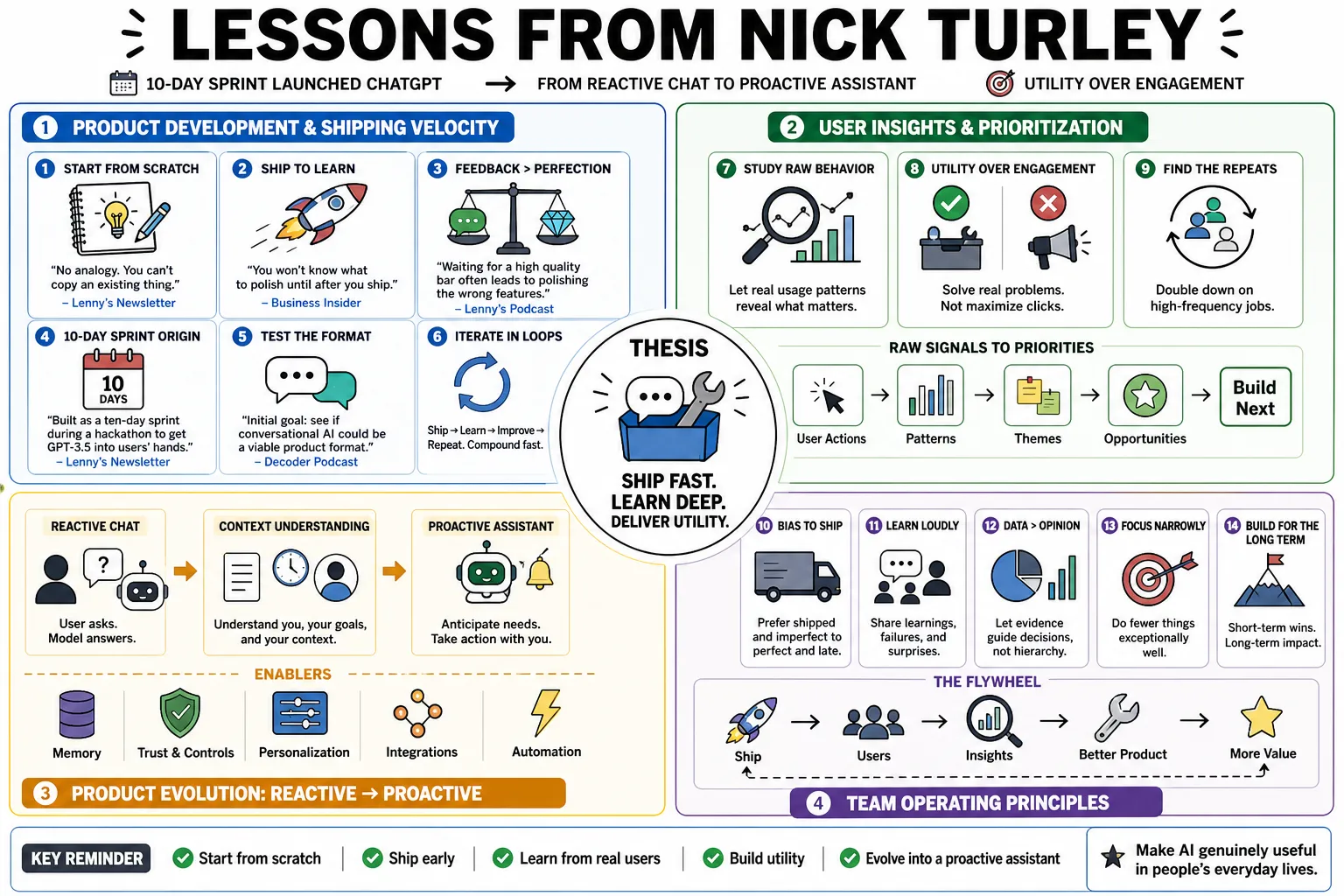
Lessons from Nick Turley
As OpenAI's Head of ChatGPT, Nick Turley helped launch the original product during a ten-day sprint and now guides its development into a proactive assistant. This collection details his practical approach to building AI tools. It highlights his focus on shipping fast and studying raw user behavior to prioritize clear utility over artificial engagement.
Part 1: Product Development and Shipping Velocity
- On starting from scratch: "Approaching each scenario from scratch is so important in this space. There is no analogy for what we're building. You can't copy an existing thing." — Source: Lenny's Newsletter
- On shipping speed: "You won't know what to polish until after you ship." — Source: Business Insider
- On prioritizing feedback over perfection: "Waiting for a high quality bar often leads to polishing the wrong features." — Source: Lenny's Podcast
- On the origin of ChatGPT: "It was originally built as a ten-day sprint during a hackathon to get GPT-3.5 into the hands of users." — Source: Lenny's Newsletter
- On the first iteration: "The initial goal was simply to see if conversational AI could be a viable product format." — Source: Decoder Podcast
- On iterative learning: "The fastest way to discover what an AI product should be is to let users break it." — Source: BG2Pod
- On feature intuition: "In an unprecedented product category, you have to rely heavily on rapid prototyping rather than long design cycles." — Source: Lenny's Podcast
- On internal culture: "The hackathon mentality that built ChatGPT still drives how new features are tested and deployed." — Source: Lenny's Newsletter
- On balancing research and product: "Product teams must work tightly with researchers to translate raw capabilities into accessible user interfaces." — Source: BG2Pod
- On avoiding over-engineering: "The temptation to build complex scaffolding around an AI model should be resisted until user behavior proves it necessary." — Source: Business Insider
Part 2: Unconventional User Research
- On finding signal in the noise: "Monitoring TikTok comments was a primary source of early user research for understanding how people actually used the tool." — Source: Lenny's Newsletter
- On qualitative feedback: "Often, the most valuable insights come from observing organic conversations on social media rather than formal surveys." — Source: Lenny's Podcast
- On community testing: "Running pricing and feature surveys directly within Discord helped validate early monetization strategies." — Source: Lenny's Newsletter
- On ignoring the haters: "The team knew the initial model-chooser dropdown was ugly, but accepted the criticism to prioritize gathering core behavioral data." — Source: Business Insider
- On the value of raw usage data: "Seeing what users actually type into the prompt box is far more instructive than asking them what they want." — Source: Decoder Podcast
- On identifying use cases: "Many of ChatGPT’s most popular use cases were discovered by users, not predicted by the product team." — Source: BG2Pod
- On adapting to feedback: "You have to be willing to drastically change the UI based on how people organically try to accomplish tasks." — Source: Lenny's Podcast
- On the limits of traditional research: "Standard user testing struggles when users don't even know what the underlying technology is capable of." — Source: Lenny's Newsletter
- On continuous listening: "Building feedback loops directly into the conversational interface allows for real-time sentiment analysis." — Source: Decoder Podcast
Part 3: Growth and Infrastructure Reality
- On handling unprecedented demand: "Scaling to hundreds of millions of weekly active users required entirely new paradigms in infrastructure management." — Source: BG2Pod
- On managing outages: "The implementation of a Red Alert mechanism was necessary to triage severe capacity constraints during hypergrowth." — Source: BG2Pod
- On prioritizing uptime: "When compute is limited, keeping the core chat functionality accessible is more important than deploying new secondary features." — Source: BG2Pod
- On the reality of GPU constraints: "Product roadmaps must remain flexible because they are ultimately bound by hardware availability." — Source: BG2Pod
- On global reach: "A conversational interface naturally scales across borders because it doesn't rely on heavily localized UI elements." — Source: Lenny's Newsletter
- On the surprise of success: "Nobody on the original sprint team expected the product to become a cultural phenomenon overnight." — Source: Lenny's Podcast
- On balancing growth with stability: "There is a constant tension between releasing the next frontier model and ensuring current systems don't buckle." — Source: Decoder Podcast
- On the necessity of throttling: "Implementing usage caps was a difficult but necessary product decision to maintain service quality for everyone." — Source: BG2Pod
- On infrastructure as a product constraint: "You cannot separate product strategy from engineering reality when working with large language models." — Source: Lenny's Podcast
Part 4: Defining the Super Assistant
- On the evolution of AI: "ChatGPT is moving away from being a simple chatbot toward becoming a proactive assistant." — Source: BG2Pod
- On future interfaces: Turley tells TechCrunch that ChatGPT is moving from today's command-line-like chat surface toward an operating-system-like platform where users can open apps for writing, coding, services, and other everyday workflows. — Reference: TechCrunch interview on Turley's operating-system-like vision for ChatGPT apps and workflows
- On action-oriented AI: "The next major leap in value comes from models executing long-horizon tasks, not just answering questions." — Source: BG2Pod
- On proactive help: "A true assistant shouldn't just wait for a prompt; it should anticipate what the user needs based on context." — Source: BG2Pod
- On moving beyond text: "Integrating voice, vision, and deep ecosystem access is required to fulfill the super assistant vision." — Source: Decoder Podcast
- On reducing friction: "The goal is to shrink the distance between a user's intent and the final execution of a complex workflow." — Source: Lenny's Newsletter
- On qualitative model upgrades: "Users care less about technical parameter counts and more about clear leaps in writing, coding, and reasoning." — Source: 36kr
- On agentic workflows: "The product must evolve to manage multi-step processes where the AI breaks down and handles sub-tasks autonomously." — Source: BG2Pod
- On the definition of an assistant: On Decoder, Turley frames ChatGPT's future as moving beyond a chatbot: the episode centers on the future of ChatGPT, solving hallucinations, and why the product eventually will not look like a chatbot at all. — Reference: Decoder Apple Podcasts episode description on ChatGPT's future beyond the chatbot form factor
- On building trust for autonomy: "Users will only hand over complex tasks to AI if the product consistently demonstrates reliability on small tasks." — Source: Decoder Podcast
Part 5: Rethinking Metrics and Retention
- On long-term value: "Product success is measured by long-term retention and actual utility, not just initial viral growth." — Source: BG2Pod
- On the smiling retention curve: "Users often try the product, churn because they don't immediately get it, but return later as they learn how to collaborate with AI." — Source: Lenny's Newsletter
- On the learning curve: "The primary barrier to retention isn't the model's capability, but the user's ability to write effective prompts." — Source: Lenny's Podcast
- On measuring success: "Traditional metrics can be misleading when applied to AI; frequency of high-value interactions matters more than daily logins." — Source: BG2Pod
- On churn analysis: "Understanding why a user leaves often reveals a failure in onboarding rather than a failure of the core technology." — Source: Lenny's Newsletter
- On finding value: "Retention spikes dramatically once a user finds a specific, repeatable workflow that saves them significant time." — Source: Decoder Podcast
- On shifting baselines: "As models improve, user expectations rise immediately, meaning what drove retention yesterday won't suffice tomorrow." — Source: Lenny's Podcast
- On cohort behavior: "Later adopters require more structured interfaces to see value compared to early adopters who enjoyed open-ended prompting." — Source: BG2Pod
- On defining active usage: "An active user isn't just someone who visits the site; it's someone who successfully completes a task." — Source: BG2Pod
Part 6: Navigating AI Interfaces and Design
- On the blank canvas problem: "An empty text box is intimidating for new users who don't know what the system can do." — Source: Lenny's Podcast
- On accepting ugly design: "We get a lot of crap for early UI choices, but prioritizing function and feedback is more critical than aesthetics at the start." — Source: Business Insider
- On conversational UI: "The chat interface is intuitive, but it is likely just a stepping stone to more multimodal interactions." — Source: Decoder Podcast
- On model selection friction: "Forcing users to choose between models creates cognitive load that a consumer product should eventually abstract away." — Source: Lenny's Newsletter
- On feature discovery: "Designing an interface that teaches the user its own capabilities is one of the hardest challenges in AI product design." — Source: Lenny's Podcast
- On the danger of over-designing: "If you build too much UI around a specific model capability, a future model update might render that UI entirely obsolete." — Source: BG2Pod
- On accessibility: "The interface must remain simple enough for a novice while providing the depth required by a developer." — Source: Decoder Podcast
- On guiding user intent: "Suggested prompts and UI scaffolding are necessary training wheels to help users cross the smiling retention curve faster." — Source: Lenny's Newsletter
- On mitigating errors through UI: "Product design can help manage technical flaws by encouraging users to verify information or cite sources." — Source: Decoder Podcast
Part 7: Business Models and Monetization
- On the future of ads: "I am humble enough not to rule ads out categorically for the future, though they are not a current focus." — Source: Decoder Podcast
- On ad integration standards: "If ads are ever introduced, they would need to be thoughtful and tasteful to preserve the core user experience." — Source: LiveMint
- On subscription constraints: "The era of unlimited usage subscriptions for frontier AI models will likely evolve due to extreme compute costs." — Source: Business Insider
- On willingness to pay: "The massive adoption of ChatGPT Plus proved that consumers will pay a premium for tools that offer clear productivity gains." — Source: BG2Pod
- On pricing research: "Conducting pricing surveys early in Discord communities was vital to establishing initial consumer tiering." — Source: Lenny's Newsletter
- On value alignment: "The monetization strategy must align with the user achieving their goals, rather than merely extracting attention." — Source: Decoder Podcast
- On enterprise versus consumer: "A successful AI product must balance a simple consumer-friendly subscription with robust enterprise compliance needs." — Source: BG2Pod
- On the cost of compute: "Product managers in AI must think like economists, constantly weighing the value of a feature against the inference cost it incurs." — Source: BG2Pod
- On freemium economics: "Offering a powerful free tier is necessary for widespread adoption, but it requires ruthless efficiency in model serving." — Source: Lenny's Podcast
- On shifting business models: "As AI becomes more agentic, monetization may shift from monthly subscriptions to value-based or outcome-based pricing." — Source: BG2Pod
Part 8: The Human-AI Relationship
- On user attachment: "The goal is not to keep users in the product for as long as possible or for the AI to become a user's best friend." — Source: Decoder Podcast
- On the purpose of AI: "The tool should exist to help people achieve their long-term goals and then get out of their way." — Source: Reddit AMAs
- On emotional dependency: "The product team actively avoids designing features that exploit human loneliness or encourage unhealthy attachment." — Source: Decoder Podcast
- On maximizing human time: "A successful interaction with ChatGPT should result in the user spending less time on their screen, not more." — Source: Decoder Podcast
- On the tool paradigm: "Despite its conversational nature, users should always understand they are interacting with a highly capable tool, not a sentient entity." — Source: Lenny's Podcast
- On the psychology of prompting: "Users project human communication styles onto the model, which dictates how the product must handle error states and apologies." — Source: Lenny's Newsletter
- On anthropomorphism: "While a friendly tone is helpful for accessibility, leaning too hard into an AI persona can distort user expectations." — Source: Decoder Podcast
- On user trust: "The product must consistently demonstrate competence before users will feel comfortable delegating high-stakes decisions to an assistant." — Source: BG2Pod
- On the future of work: In Lenny's Podcast notes, Turley points to the product vision for AI assistants, the future of chat interfaces, emergent use cases, and ChatGPT's role in writing, coding, reasoning, and other work people return to over time. — Reference: Lenny's Podcast notes on Turley discussing AI assistants, future chat interfaces, emergent use cases, and work use cases