Nico Laqua is the co-founder and CEO of Corgi, a fully licensed AI-native insurance carrier tailored for technology startups. He is known for building high-speed infrastructure that automates commercial underwriting, and for maintaining an unapologetically intense, seven-days-a-week work culture. This collection curates his perspectives on startup velocity, rejecting corporate comfort, and applying lessons from computational biology and gaming to modern financial systems.
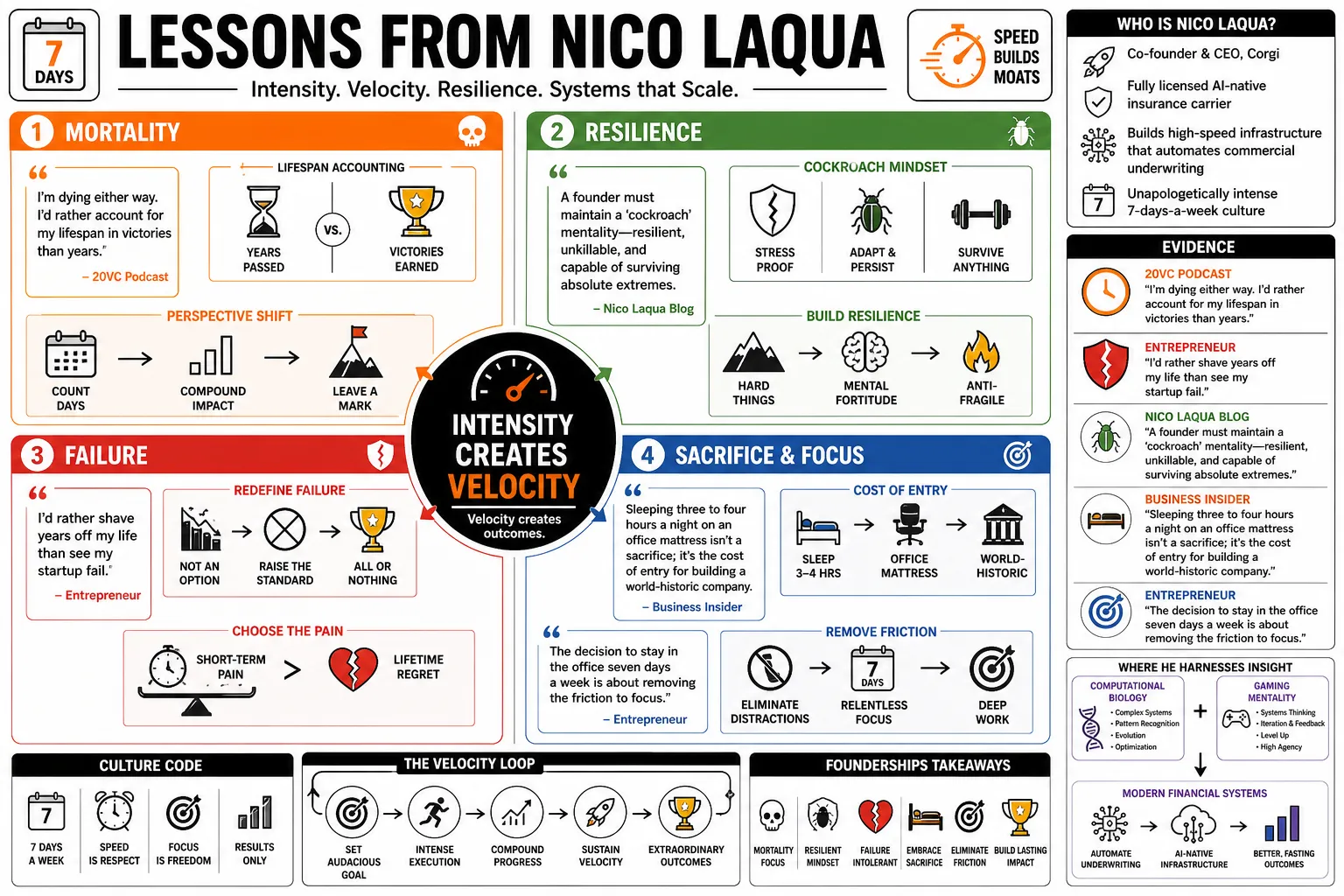
Part 1: The Intensity of the Founder
- On Mortality: Laqua frames founder sacrifice in unusually stark terms: the work is worth compressing around outcomes he can count as victories, not around a conventional long-life optimization. — Reference: Business Insider on Laqua measuring lifespan in victories
- On Failure: "I'd rather shave years off my life than see my startup fail." — Source: Entrepreneur
- On Resilience: "A founder must maintain a 'cockroach' mentality—resilient, unkillable, and capable of surviving absolute extremes." — Source: Nico Laqua Blog
- On Sacrifice: "Sleeping three to four hours a night on an office mattress isn't a sacrifice; it's the cost of entry for building a world-historic company." — Source: Business Insider
- On Focus: "The decision to stay in the office seven days a week is about removing the friction of transitions. Every hour away from the problem is an hour you cede to entropy." — Source: 20VC Podcast
- On Expectations: Corgi sets expectations around an always-on operating rhythm, with seven-day weeks treated as part of the company identity rather than an occasional push. — Reference: 20VC episode page on Corgi workplace intensity
- On Weekends: "If your days off happen to be Saturday and Sunday every week, then you will not have a place at Corgi." — Source: Entrepreneur
- On Velocity: Laqua treats startup speed as compounding pressure: Corgi doubled its valuation weeks after becoming a unicorn, then aimed the capital at faster commercial-insurance expansion. — Reference: Corgi Series B1 announcement on fast financing and expansion
- On Balance: "You do not achieve unicorn status by striving for balance; you achieve it by throwing your entire physical and mental weight into a single focal point." — Source: Forbes
- On Burnout: Laqua does not pitch Corgi as a balanced workplace; the operating model accepts very low sleep, office-centered life, and an expectation that builders push beyond ordinary work rhythms. — Reference: Business Insider on office sleeping and seven-day work
Part 2: Rethinking Corporate Culture
- On Pampering: Laqua rejects comfort-first startup culture; he wants Corgi to select for people who respond to pressure, intensity, and shared obsession with the company mission. — Reference: Business Insider on Laqua rejecting conventional workplace comfort
- On Excellence: Corgi uses intensity as a talent filter: work trials, long weeks, and office-centered rituals are meant to reveal who actually wants the highest-pressure version of the mission. — Reference: 20VC episode page on hiring trials and founder mindset
- On Dedication: "A company is not a family. It is a high-performance sports team that demands absolute dedication and exacts heavy tolls for mediocrity." — Source: Business Insider
- On Filtering: "The most intense workplace culture in America isn't an accident—it's a filtering mechanism for those who genuinely want to build something unprecedented." — Source: Entrepreneur
- On Distractions: "Amenities and work-life balance initiatives are often distractions from the fundamental truth that the work itself should be the primary motivation." — Source: NDTV
- On Survival: Laqua sees young startups as survival contests, so he resists copying large-company workplace norms before the company has earned the right to slow down. — Reference: Business Insider on high-growth startup weekend culture
- On Comfort: "If you are optimizing for comfort, you are optimizing for failure." — Source: Nico Laqua Blog
- On Competition: "You cannot build a two-year moat that nobody can bet against by working the same hours as your competitors." — Source: EO Magazine
- On Hiring: "We hire people who view extreme challenges as a feature, not a bug, of their career trajectory." — Source: 20VC Podcast
- On Camaraderie: "True camaraderie is born in the trenches of a seven-day workweek, not at corporate retreats." — Source: Forbes
Part 3: The Architecture of Insurance
- On Delays: "Startups should not need to spend weeks to get insurance." — Source: Fintech Global
- On Brokers: Corgi’s insurance thesis starts with removing broker handoffs: owning underwriting and issuance directly lets the company reduce friction instead of merely reskinning legacy workflows. — Reference: Y Combinator on Corgi not being a broker
- On Modernization: Laqua’s modernization target is the manual insurance stack itself: underwriting, claims, and embedded coverage have to become faster and more operationally efficient. — Reference: Corgi Series B1 announcement on rebuilding commercial insurance infrastructure
- On Risk Models: "AI-native insurance isn't just about faster processing; it's about fundamentally re-evaluating risk models for digital-first businesses." — Source: Corgi Blog
- On Logic: "Becoming a fully licensed carrier was necessary because you cannot enforce speed and logic when you are merely the frontend for a slow backend." — Source: EO Magazine
- On Underwriting: "Coverage for AI Liability and Cyber risks requires underwriters who understand the technology at a granular level, not just actuarial tables." — Source: Today in AI
- On Latency: Corgi attacks latency by cutting intermediaries, issuing policies directly, and pricing startup risk through a tighter full-stack workflow. — Reference: Y Combinator on fewer handoffs and less friction
- On Intuition: "To build financial infrastructure for the future, you have to tear down the assumption that complex risk requires human intuition." — Source: Y Combinator
- On Compliance: "Startups move too fast to be bogged down by analog compliance structures. We built Corgi to match their velocity." — Source: Fintech Global
Part 4: AI and the Speed of Execution
- On LLMs: Laqua’s AI-insurance bet is operational: use language models to read documents, assess risk, and handle claims so insurance work moves closer to software speed. — Reference: Today in AI on Corgi using LLMs in insurance operations
- On Architecture: "AI is not a tool we use; it is the fundamental architecture upon which the company is built." — Source: Executive Moves
- On Scalability: Corgi’s scalability argument is that automation plus carrier ownership can let a small team support revenue and policy volume that normally require much heavier insurance operations. — Reference: Today in AI on Corgi revenue, team size, and automation
- On Moats: "Training models to understand the specific liabilities of technology startups creates a moat that traditional insurers cannot easily replicate." — Source: Today in AI
- On Policy Structure: "We don't just use machine learning to predict risk; we use it to actively structure the policies dynamically." — Source: Corgi Blog
- On Iteration: Laqua wants insurance products to iterate more like software: modular coverage, faster changes, and product updates that do not depend on endless paperwork cycles. — Reference: Today in AI on treating insurance contracts as software objects
- On Computation: "We view underwriting as a computational problem, not a financial one." — Source: Nico Laqua Blog
- On Trust: Corgi’s trust proposition is operational accountability: one full-stack team handles the policy workflow instead of leaving customers to navigate fragmented insurance handoffs. — Reference: Corgi Series B1 announcement on full-stack underwriting and claims
- On Adaptation: "AI allows us to underwrite the unknown. As startups invent new categories, our models adapt faster than human regulators." — Source: Y Combinator
Part 5: Lessons from Gaming to Fintech
- On Systems: "The transition from gaming to insurance is less jarring than it seems; both are fundamentally about managing massive, concurrent systems and user state." — Source: EO Magazine
- On Peak Load: "Scaling Basket Entertainment to 200 million monthly active users taught us that infrastructure must be built for peak load, not average load." — Source: Nico Laqua Blog
- On Churn: Laqua applies consumer-product urgency to insurance: if startup customers get speed, modularity, and useful coverage, retention can become a product outcome rather than a broker relationship. — Reference: Today in AI on Corgi churn and modular coverage
- On Pivoting: "Pivoting from a social app like Picnic to a gaming publisher taught the hard lesson of cutting losses quickly when the data doesn't support the thesis." — Source: Forbes
- On Feedback Loops: Corgi’s feedback loop comes from owning more of the stack: the company can see how startups operate, adjust coverage, and price risk without waiting on intermediary layers. — Reference: Y Combinator on tailoring coverage and pricing risk efficiently
- On UI: "Engaging users in a game requires an intuitive UI. There is no reason buying D&O insurance shouldn't be equally frictionless." — Source: Y Combinator
- On Value: "The mechanics of retaining a gamer are similar to retaining a startup client: provide immediate, tangible value without unnecessary onboarding steps." — Source: Entrepreneur
- On Foundations: "Building a working business in gaming was difficult, but we pivoted to Corgi because we wanted to build a foundational infrastructure, not just a hit product." — Source: EO Magazine
- On Backend Scaling: "You learn more about scaling backend systems from supporting millions of gamers than you do from traditional enterprise software development." — Source: Business Insider
Part 6: Biology, Systems, and AI
- On Frameworks: "Studying computational biology and neuroscience provided the mathematical framework for understanding complex, interconnected risk." — Source: Nico Laqua Blog
- On Simulation: "Working on protein folding taught me that the hardest problems require simulating outcomes at an extreme scale." — Source: Columbia University
- On Resilience: "Biological systems are incredibly resilient because they are decentralized and adaptive. Software architecture should mimic this." — Source: Nico Laqua Blog
- On Datasets: "Oyster genetics might seem far removed from AI underwriting, but the process of parsing massive datasets for subtle markers is identical." — Source: Executive Moves
- On Sequential Data: "Early work with LSTMs in 2018 showed that sequential data holds the key to predictive accuracy, a principle we apply to startup growth metrics." — Source: Today in AI
- On Efficiency: Laqua’s systems background shows up in the insurance model: Corgi looks for repeatable computational work inside documents, risk assessment, and claims rather than treating every policy as bespoke labor. — Reference: Today in AI on Laqua background and AI-native insurance operations
- On Capital Flows: "The jump from VR research to insurance was driven by a desire to apply complex systems thinking to massive real-world capital flows." — Source: Nico Laqua Blog
- On Adaptation: "Biological entities survive by iterating rapidly under stress. Startups that fail to adapt their DNA to market conditions die." — Source: Forbes
- On Ecosystems: "You can view an insurance pool as an ecosystem; if you don't model the interactions between the agents accurately, the system collapses." — Source: Corgi Blog
Part 7: Infrastructure Over Reselling
- On Reselling: "I don't think you can change the world if you're reselling someone else's product. So in our case, we decided to become the infrastructure." — Source: EO Magazine
- On Disruption: Laqua chose the harder disruption path by becoming the carrier, not just a software vendor to carriers, because deeper stack ownership creates more room to change the product. — Reference: Today in AI on Corgi becoming a full-stack carrier
- On APIs: "Startups that rely on third-party APIs for their core value proposition are renting their moat. We built our own." — Source: Y Combinator
- On Control: Corgi bought control through regulation: acquiring a licensed insurer and completing the approval work gave the company authority to launch products instead of waiting on incumbents. — Reference: Today in AI on Corgi acquiring a carrier and regulatory approval
- On Margins: "If you are just a wrapper on an existing legacy product, your margins will eventually be squeezed to zero." — Source: Business Insider
- On Value Capture: "Infrastructure companies capture the most value because they become the indispensable layer upon which others operate." — Source: Entrepreneur
- On Time: Laqua’s time tradeoff is to spend longer on the regulated foundation if it creates a business that can move faster afterward as an actual carrier. — Reference: Today in AI on regulatory work before launch
- On Plumbing: "We looked at the insurance market and realized the plumbing was broken. You can't fix plumbing by painting the walls." — Source: Corgi Blog
- On Speed: Corgi’s speed comes from stack ownership: direct underwriting and issuance let the company set the workflow pace instead of inheriting broker and carrier delays. — Reference: Y Combinator on direct policy issuance
- On Autonomy: "True autonomy as a founder only comes when you are not dependent on an incumbent's backend systems to service your users." — Source: EO Magazine
Part 8: Navigating Controversy and Scale
- On Growth: "Scaling to a $2.6 billion valuation in two years requires making decisions that will inevitably anger the establishment." — Source: Forbes
- On Inspiration: "When you move fast, you draw fire. Distinguishing between genuine inspiration and the replication of code is a nuance often lost in public discourse." — Source: Y Combinator
- On Detractors: "Public controversy is often a trailing indicator that you have built something people care enough to argue about." — Source: Business Insider
- On Defensibility: "Accusations of copying UI or concepts are common in software; the real defense is having a backend infrastructure that nobody can replicate." — Source: Nico Laqua Blog
- On Feedback: Laqua absorbs public criticism through the lens of obsession: outside debate matters less than whether the team stays locked onto the problem it is trying to solve. — Reference: Business Insider on Laqua responding to criticism
- On Unicorn Status: Laqua treats unicorn status as a platform for harder work, not an endpoint: the next move was faster expansion into more commercial-insurance verticals. — Reference: Corgi Series B1 announcement on valuation and expansion
- On Scrutiny: "We operate under extreme scrutiny because our methods defy the consensus of what a modern workplace should look like." — Source: Entrepreneur
- On Compounding: Laqua’s compounding focus is visible in Corgi’s financing rhythm: each round is framed as fuel for faster platform expansion, not as a victory lap. — Reference: Corgi Series B1 announcement on funding cadence and revenue growth
- On Friction: Corgi defines market friction as handoffs, forms, and slow coverage cycles; the product tries to remove that friction with instant quotes and direct carrier workflows. — Reference: Y Combinator on reducing handoffs and instant quotes