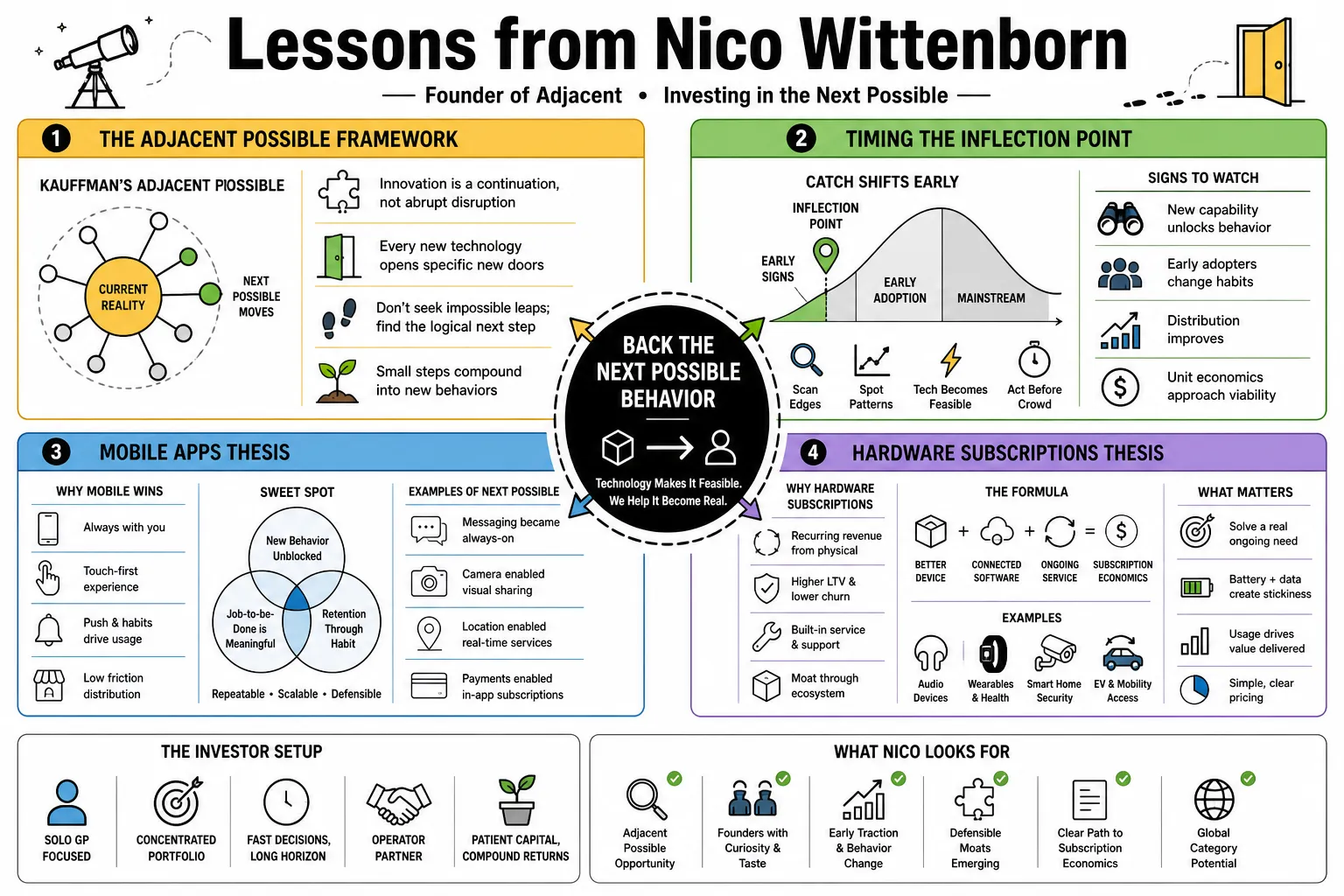
Lessons from Nico Wittenborn
Nico Wittenborn is the founder of Adjacent, a venture capital firm focused on early-stage consumer subscriptions. He approaches software investing through Stuart Kauffman’s "adjacent possible" theory, looking to back new consumer behaviors the exact moment they become technologically feasible. This profile details his investment framework, his setup as a solo general partner, and his specific theses on mobile apps and hardware subscriptions.
Part 1: The Adjacent Possible Framework
- On the origin of his thesis: "Innovation rarely happens through abrupt, isolated disruption. It emerges as a continuation of existing ideas, representing the next step made possible by current foundations." — Source: [Invest Like the Best]
- On timing: "You have to look at what is right beyond the current environment, catching technological shifts at their inflection points before they hit the mainstream." — Source: [Adjacent Medium Blog]
- On evolutionary biology in tech: "Stuart Kauffman’s biological theories apply perfectly to startups. Every new technology opens up a specific set of new doors that were previously locked." — Source: [The Twenty Minute VC]
- On incremental advancements: "Do not look for the impossible jump. Look for the logical next step that suddenly became feasible because a platform or behavior changed yesterday." — Source: [Invest Like the Best]
- On identifying frontiers: "True frontier investing is about seeing how a new API enables a completely new consumer behavior on mobile devices." — Source: [Adjacent Medium Blog]
- On market readiness: "If an idea requires three separate behavioral shifts from the consumer to work, it is too far from the adjacent possible." — Source: [The Twenty Minute VC]
- On adjacent markets: "When a core platform like mobile matures, the adjacent possible naturally expands into specialized verticals like digital health and wellness." — Source: [Adjacent Medium Blog]
- On compounding innovation: "Every successful startup creates a new baseline. The next great company builds on the adjacent space created by that new baseline." — Source: [Invest Like the Best]
- On avoiding consensus: "The adjacent possible is visible to those paying close attention to the edges, but it remains hidden from the consensus until it is already working." — Source: [The Twenty Minute VC]
- On technological evolution: "Technologies evolve exactly like biological organisms. They combine existing traits to survive in new environments." — Source: [Invest Like the Best]
Part 2: Consumer Subscription Mechanics
- On the evolution of software payments: "First we paid for a license once for a product on a CD and now we pay on a monthly basis. Subscription is simply the natural evolution of software purchasing." — Source: [Adjacent Medium Blog]
- On global reach: "Consumer subscription apps are inherently global from day one, allowing founders to scale across borders faster than enterprise software." — Source: [Invest Like the Best]
- On SaaS margins in consumer apps: "Despite app store fees, a mature consumer subscription business can reach seventy percent gross margins as it expands cross-platform." — Source: [Adjacent Medium Blog]
- On consumer stickiness: "While initial churn is higher than enterprise software, consumer subscription revenue becomes surprisingly sticky and compounds over multiple renewal cycles." — Source: [The Twenty Minute VC]
- On trial conversions: "A product's true value is revealed by the precise percentage of users who convert after a free trial, rather than top-of-funnel downloads." — Source: [Invest Like the Best]
- On the freemium balance: "Giving away too much prevents monetization, but giving away too little chokes off the virality needed for consumer scale." — Source: [The Twenty Minute VC]
- On App Store economics: "The thirty percent take rate is a tax on distribution, but it also provides a frictionless payment rail that makes impulse subscriptions possible globally." — Source: [Adjacent Medium Blog]
- On category creation: "The best consumer subscriptions, like Calm, create a new daily habit rather than capturing existing demand." — Source: [Invest Like the Best]
- On lifetime value calculations: "Early-stage consumer startups often overestimate LTV by assuming year-one retention curves will hold steady in years three and four." — Source: [The Twenty Minute VC]
- On recurring value: "To justify a recurring fee, the app must provide a continually updating experience or a habit-forming utility." — Source: [Adjacent Medium Blog]
Part 3: The Solo GP Model
- On decision velocity: "Operating as a solo GP allows you to move at the speed of the founder, bypassing the slow consensus-building of traditional partnership meetings." — Source: [The Twenty Minute VC]
- On portfolio concentration: "A solo GP model forces discipline. You cannot build a massive portfolio, so you must have extreme conviction in a concentrated number of bets." — Source: [Invest Like the Best]
- On avoiding the mega-fund trap: "Smaller, targeted funds can deliver exceptional returns without needing every single company to become a decacorn." — Source: [The Twenty Minute VC]
- On closeness to the truth: "Doing the due diligence yourself keeps you infinitely closer to the reality of the business than reading a memo prepared by an associate." — Source: [Invest Like the Best]
- On collaborative venture: "Solo GPs act as specialized scouts for specific verticals, collaborating with massive multi-stage funds instead of competing against them." — Source: [The Twenty Minute VC]
- On accountability: "When you are the sole decision-maker, every win and every loss is entirely yours. This sharply hones your investment intuition over time." — Source: [Invest Like the Best]
- On fund sizing: "The moment a fund gets too large, the strategy inevitably shifts from finding the best companies to finding companies that can absorb enough capital." — Source: [The Twenty Minute VC]
- On founder alignment: "Founders often prefer dealing with a single, highly engaged decision-maker who truly understands their niche." — Source: [Adjacent Medium Blog]
- On institutional overhead: "Stripping away the firm infrastructure allows a solo GP to spend the vast majority of their time on investments rather than internal firm management." — Source: [Invest Like the Best]
Part 4: Lessons from Point Nine & Insight Partners
- On the craft of venture: "Point Nine Capital provided the foundational education on how to rigorously evaluate early-stage software metrics and cohort data." — Source: [The Twenty Minute VC]
- On scaling up: "Insight Partners demonstrated what aggressive scaling looks like and how to inject capital into companies that have found clear product-market fit." — Source: [Invest Like the Best]
- On transatlantic investing: "Working in both Berlin and New York revealed that great consumer software companies can be built anywhere, but scaling them often requires tapping into US capital markets." — Source: [The Twenty Minute VC]
- On early-stage vs. growth: "Early-stage investing is about judging the potential of a behavior shift. Growth investing is about accelerating a spreadsheet that is already working." — Source: [Invest Like the Best]
- On pattern recognition: "Seeing thousands of pitches across two highly active firms builds a mental database that allows you to quickly filter out structurally flawed business models." — Source: [The Twenty Minute VC]
- On the value of associates: "The heavy lifting of data analysis is essential, but it must always be paired with human intuition." — Source: [Invest Like the Best]
- On B2B vs. B2C: "Rigorous B2B SaaS frameworks can be adapted and applied to consumer subscription apps to measure their true underlying health." — Source: [The Twenty Minute VC]
- On data maturity: "Eventually, every successful company transitions from running on founder intuition to running on cold, hard data infrastructure." — Source: [Invest Like the Best]
- On launching a new firm: "After mastering the mechanics at larger firms, the logical next step was to build a firm uniquely tailored to a specific thesis." — Source: [Adjacent Medium Blog]
Part 5: Assessing Founders & Building Trust
- On the un-trackable metric: "Trust is the most important non-metric growth lever. It cannot be directly A/B tested, but its presence is glaringly obvious in word-of-mouth growth." — Source: [Invest Like the Best]
- On stakeholder venture capital: "Success requires looking at the long-term well-being of employees, customers, and the society the product operates within." — Source: [Adjacent Medium Blog]
- On founder empathy: "Empathy is a structural requirement for building consumer products that actually resonate with people's daily struggles." — Source: [The Twenty Minute VC]
- On evaluating conviction: "The best founders are obsessed with solving a highly specific problem that they encountered in the adjacent possible." — Source: [Invest Like the Best]
- On raw intelligence vs. adaptability: "Raw intelligence gets a founder to the starting line. Adaptability, the ability to pivot when the data contradicts the thesis, is what wins the race." — Source: [The Twenty Minute VC]
- On transparent relationships: "The most productive investor-founder relationships are those where bad news travels faster than good news." — Source: [Invest Like the Best]
- On reference checks: "The most valuable reference check is speaking to the customers who churned, rather than the ones who stayed." — Source: [The Twenty Minute VC]
- On mission-driven teams: "When a company hits a severe roadblock, a purely financially motivated team shatters, while a mission-driven team unites." — Source: [Adjacent Medium Blog]
- On organic traction: "If a founder builds initial trust organically without paid marketing, they possess a fundamental understanding of their user that capital cannot buy." — Source: [Invest Like the Best]
Part 6: Hardware as a Subscription (Oura & Beyond)
- On the Oura investment: "Oura succeeded by transitioning the value from the physical ring to the recurring software insights." — Source: [Invest Like the Best]
- On the hardware trap: "Most hardware companies fail because they rely on one-time sales. The future of hardware is a low-margin physical entry point for high-margin software." — Source: [The Twenty Minute VC]
- On data utility: "A wearable device is useless if it simply displays raw data. The subscription is justified when the software synthesizes that data into actionable behavioral changes." — Source: [Adjacent Medium Blog]
- On hardware retention: "When a physical device is tied to a software subscription, retention rates outperform pure-play software apps due to the physical reminder on the user's body." — Source: [Invest Like the Best]
- On the continuous update: "The magic of the Oura model is that the ring improves over time via software updates, changing consumer expectations of what hardware should be." — Source: [The Twenty Minute VC]
- On defensibility: "Combining a proprietary hardware sensor with a massive software dataset creates a moat that pure software companies struggle to cross." — Source: [Invest Like the Best]
- On the adjacent health market: "Devices like Oura sit perfectly in the adjacent space between consumer wellness and clinical medical devices." — Source: [Adjacent Medium Blog]
- On shifting business models: "Transitioning a user base from free software to a paid subscription requires delicate communication and overwhelming added value." — Source: [The Twenty Minute VC]
- On the future of wearables: "We are moving from devices that track what happened yesterday to systems that predict what your body will need tomorrow." — Source: [Invest Like the Best]
Part 7: Evolution, Biology, & Tech Trends
- On biological frameworks: "Treating startup ecosystems like biological ecosystems helps explain why certain companies thrive while others instantly die in the exact same market conditions." — Source: [The Twenty Minute VC]
- On mutation in startups: "Most startup pivots are like biological mutations. Most are fatal, but the rare successful one creates an entirely new dominant species." — Source: [Invest Like the Best]
- On environmental shifts: "A change in Apple's privacy policy is an environmental shock. It wipes out the companies that cannot adapt and clears the canopy for new models." — Source: [Adjacent Medium Blog]
- On speciation in software: "As software matures, broad horizontal tools naturally splinter into highly specialized vertical tools, mimicking evolutionary speciation." — Source: [The Twenty Minute VC]
- On survival of the fittest: "The startups that survive economic downturns are usually the ones with the leanest, most adaptable operating structures." — Source: [Invest Like the Best]
- On cross-pollination: "The best ideas often come from taking a working model from enterprise software and applying it to consumer mindfulness." — Source: [The Twenty Minute VC]
- On extinction events: "When a platform owner builds your feature into the OS, it is an extinction-level event. Your only defense is to have evolved further up the value chain." — Source: [Invest Like the Best]
- On organic growth: "Forced, paid marketing is like fertilizer that works temporarily. Organic growth is a deep root system that sustains the company through droughts." — Source: [Adjacent Medium Blog]
- On complex systems: "Complexity arises naturally. Simple atomic APIs inevitably combine to create complex, unexpected consumer behaviors." — Source: [The Twenty Minute VC]
Part 8: The Future of Consumer Software
- On digital touchpoints for seniors: "The population is aging, and yet senior citizens are still digitally underserved. Products like Patronus seamlessly integrate a digital touchpoint into their daily lives." — Source: [Adjacent Medium Blog]
- On the AI inflection point: "Generative AI is currently unlocking a massive new wave of the adjacent possible, drastically lowering the cost of creating personalized consumer experiences." — Source: [Invest Like the Best]
- On Photoroom's success: "Photoroom succeeded because it used AI to remove a highly specific, painful friction point for small businesses." — Source: [The Twenty Minute VC]
- On shifting away from ads: "The consumer internet is steadily migrating from an ad-supported model that exploits attention to a subscription model that aligns with user goals." — Source: [Adjacent Medium Blog]
- On mental health tech: "The success of Calm proved that consumers are willing to pay directly for software that improves their mental state." — Source: [Invest Like the Best]
- On consumer fintech: "Investments like Revolut show that the structural boundaries of traditional banking are artificially rigid. Software naturally breaks those borders down." — Source: [The Twenty Minute VC]
- On the definition of an app: "The app is no longer merely a destination on a phone screen. It is becoming an invisible layer that interacts with wearables, audio, and the physical environment." — Source: [Invest Like the Best]
- On niche communities: "The next massive consumer companies will be highly monetized, deeply engaged vertical communities rather than broad social networks." — Source: [Adjacent Medium Blog]
- On consumer expectations: "Users now expect enterprise-grade reliability paired with game-like interfaces. Failing on either front guarantees churn." — Source: [The Twenty Minute VC]
- On the ultimate goal: "The best consumer software eventually disappears into the background. It becomes a utility so reliable you only notice it when it is gone." — Source: [Invest Like the Best]