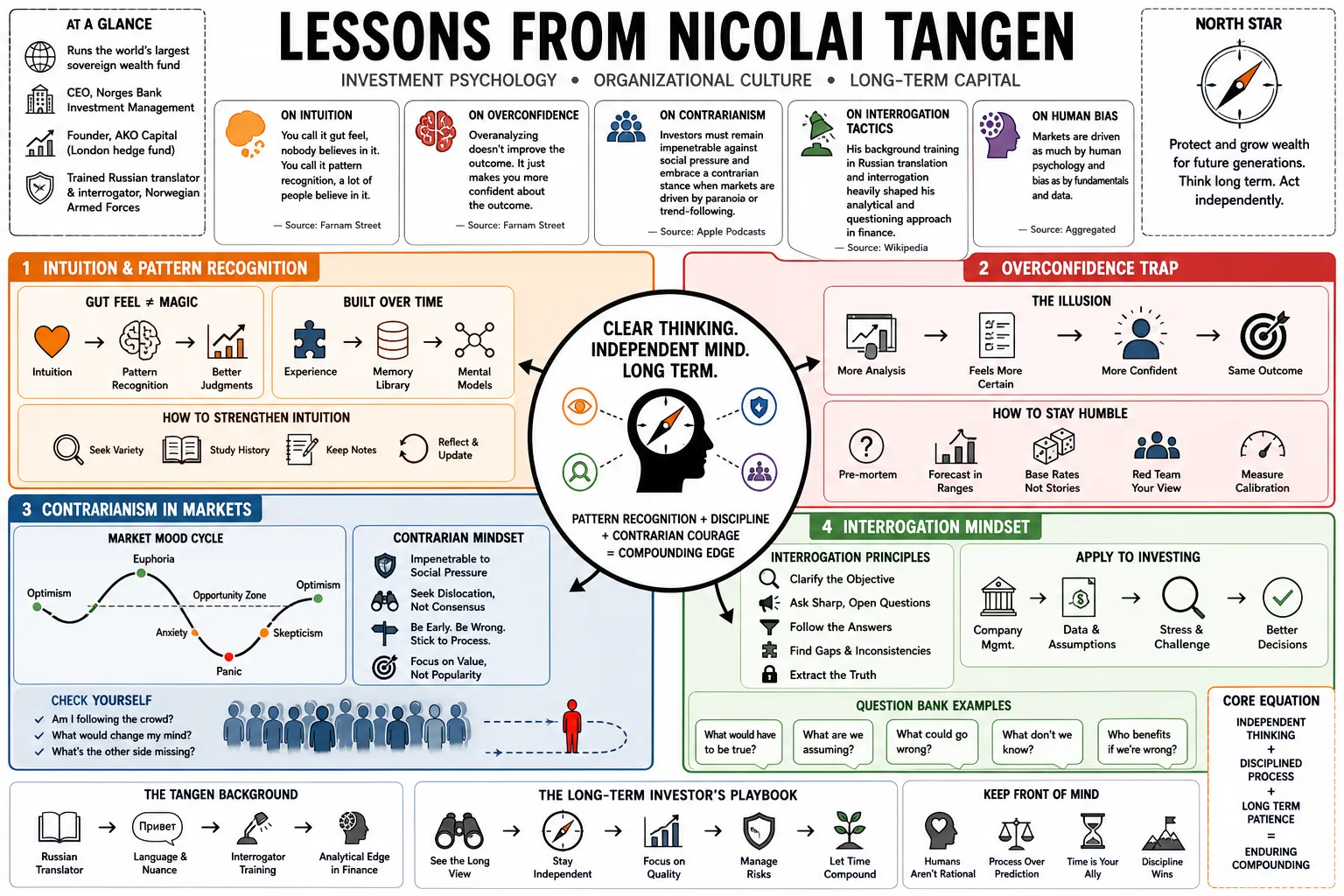
Lessons from Nicolai Tangen
Nicolai Tangen runs the world's largest sovereign wealth fund as CEO of Norges Bank Investment Management. He previously founded the London hedge fund AKO Capital and trained as a Russian translator and interrogator for the Norwegian Armed Forces. This profile collects his specific approaches to investment psychology, organizational culture, and managing long-term capital.
Part 1: The Psychology of Decision-Making
- On Intuition: "You call it gut feel, nobody believes in it. You call it pattern recognition, a lot of people believe in it." — Source: Farnam Street
- On Overconfidence: "Overanalyzing doesn't improve the outcome. It just makes you more confident about the outcome." — Source: Farnam Street
- On Contrarianism: Tangen frames contrarianism as a social and psychological discipline: resist pressure from the crowd, but change quickly when the evidence changes. — Reference: Farnam Street Knowledge Project notes on contrarian thinking and evidence
- On Interrogation Tactics: His background training in Russian translation and interrogation for the Norwegian Armed Forces heavily shaped his analytical and questioning approach in finance. — Source: Wikipedia
- On Human Bias: Markets are driven as much by human psychology and behavioral biases as they are by mathematical models and financial metrics. — Source: SDG News
- On Information Gathering: Deep, systematic information gathering is required to understand the psychological drivers of market participants. — Source: Wikipedia
- On Independent Thinking: To prevent cognitive biases and ensure high conviction, portfolio managers must document and justify the reasoning behind every investment decision. — Source: Wikipedia
- On Self-Reflection: You have to look at your mistakes before you can press the button, which is why utilizing investment simulators can objectively review past decisions. — Source: Nordic Business Forum
- On Emotional Control: Investors should aim to maintain the exact same level of risk appetite regardless of whether they have just experienced a massive win or a crushing loss. — Source: Farnam Street
- On Patience: Patience does not mean passivity for Tangen; it means slowing down the wrong decisions, doing nothing when that is the best option, and moving quickly when new evidence is decisive. — Reference: Farnam Street Knowledge Project notes on doing nothing and decision speed
Part 2: Investing, Risk, and Doing Nothing
- On Inaction: "Doing nothing is often the best option." Excessive trading typically detracts from performance rather than enhancing it. — Source: Farnam Street
- On Long-Term Focus: The most effective way to generate strong, risk-adjusted returns is to identify and own the best assets for the long term. — Source: AKO Capital
- On Compounding: Sometimes the best thing is not to do very much because compounding itself is just amazing. — Source: Goldman Sachs
- On Bottom-Up Research: Rigorous, proprietary research, including forensic accounting to scrutinize financial statements, is essential to ensure the true quality of earnings. — Source: Wikipedia
- On Risk Limits: The fund treats risk as a governed system: identify it, measure it, set benchmark-deviation limits, and stress-test the portfolio rather than relying on confidence alone. — Reference: NBIM risk-management page on limits, tracking error, and stress testing
- On Adaptability: "Speed and agility are the only hedge in a world you can't predict." — Source: Farnam Street
- On Quality Assets: A successful strategy requires building a portfolio of companies that exhibit excellent economic characteristics and are led by great management teams. — Source: AKO Capital
- On Future Returns: Speed in responding to new evidence is critical; while patience in strategy is required, investors must react swiftly when the facts change. — Source: Farnam Street
- On Evaluation: Continuous evaluation of leadership competence and long-term ownership are non-negotiable elements of effective capital allocation. — Source: London Business School
Part 3: Leadership and The "Straight Puck"
- On Directness: Tangen links direct communication to credibility: leaders should say what they know, admit what they do not know, and avoid pretending certainty they do not have. — Reference: Nordic Business Forum summary of Tangen on honest leadership communication
- On Healthy Disagreement: Tangen treats questioning as a leadership craft; critical thinking and careful inquiry help a team surface better information before conviction hardens. — Reference: Nordic Business Forum summary of Tangen on critical thinking and questioning
- On Listening: For Tangen, listening starts with curiosity; without genuine curiosity, a leader misses the information that changes decisions. — Reference: Farnam Street Knowledge Project notes on curiosity and listening
- On Vulnerability: Admitting one’s own mistakes as a leader is crucial because it generates trust and professional support from the broader team. — Source: Medium
- On Humanity in Leadership: Tangen presents leadership as less heroic certainty and more honest human judgment: communicate clearly, show humility, and be open about uncertainty. — Reference: Nordic Business Forum summary of Tangen on humility and uncertainty
- On Delegation: Tangen's uncertainty playbook puts people and feedback at the center; leaders create more leverage by clarifying, listening, and developing others than by trying to own every answer. — Reference: Nordic Business Forum summary of Tangen on people, feedback, and uncertainty
- On Transparency: Radical transparency, including openly broadcasting interviews with global CEOs, helps build credibility and long-term trust. — Source: London Business School
- On Skepticism: Tangen treats skepticism as protection against blind spots: stay open to disagreement, update quickly when evidence changes, and accept that not everyone will agree. — Reference: Farnam Street Knowledge Project notes on evidence, blind spots, and disagreement
- On Innovation Culture: Tangen connects ambition with tolerance for discomfort: high standards, outsiders, AI adoption, and long cultural time horizons all matter more than comfortable consensus. — Reference: Farnam Street Knowledge Project notes on ambition, outsiders, AI, and culture
- On Questioning: Asking employees what they have learned in the last six months is a practical way to determine if a team is genuinely growing. — Source: PodScripts
Part 4: Learning, Mistakes, and Resilience
- On Ambition: "If you have really high ambitions, you achieve great things even if you fail. If you have low ambitions, you achieve nothing even if you succeed." — Source: Farnam Street
- On Repeating Errors: "Why make the same mistakes when there are so many to choose from? Find some new ones." — Source: Farnam Street
- On Fear of Failure: Tangen argues that mistakes become useful only in a safe environment where people can learn from them instead of hiding them. — Reference: Nordic Business Forum summary quoting Tangen on safe environments for mistakes
- On Regional Mindsets: "You go bust in America, you get another chance. In Europe, you’re dead." A higher tolerance for failure gives the U.S. an innovation advantage. — Source: Kathimerini
- On Post-Mortems: Tangen's mistakes-machine idea turns decision review into data-driven learning: show past errors clearly enough that people can improve the next decision. — Reference: Nordic Business Forum summary of Tangen on the mistakes-machine simulator
- On Sports Psychology: Integrating sports psychology into a financial organization helps staff manage the extreme stress of high-stakes decision-making. — Source: IPE
- On Taking Risks After Losses: Mental resilience means maintaining the psychological capacity to take rational, calculated risks immediately after suffering a loss. — Source: IPE
- On Psychological Safety: Leaders must explicitly create a safe environment where people can learn from their mistakes without fear of retribution. — Source: Oslo Business Forum
- On Inevitability of Being Wrong: In complex asset management environments, being wrong is a mathematical certainty; the key is managing the fallout constructively. — Source: Oslo Business Forum
Part 5: Speed, Communication, and Focus
- On Email Efficiency: "The faster you reply, the less you need to say. If you reply in a minute, you can say two words. If you wait a day, it's a paragraph." — Source: Farnam Street
- On Time Management: "Well, today is Sunday, and the markets are closed. And a day has 24 hours." — Source: Medium
- On Creating Urgency: Tangen pushes against unnecessary delay: things should not take longer than they need to, especially when speed and agility are the hedge against unpredictability. — Reference: Farnam Street Knowledge Project notes on speed and agility
- On Being in Motion: He has been described as the image of a modern Viking, always in motion, constantly active, and busy. — Source: PodScripts
- On Prioritization: Tangen separates motion from judgment: do nothing when that is best, slow down poor decisions, and move fast when evidence justifies a change. — Reference: Farnam Street Knowledge Project notes on prioritization and evidence
- On Bureaucracy: Prolonged deliberation often disguises a lack of conviction rather than reflecting genuine analytical depth. — Source: Farnam Street
- On Promptness: Tangen treats fast replies as an organizational efficiency tool: the quicker the response, the less explanation is usually required. — Reference: Farnam Street Knowledge Project note on reply speed
- On Directness: Tangen's communication rule is to strip away performative certainty: be honest, be open, and protect credibility by not pretending to know more than you do. — Reference: Nordic Business Forum summary of Tangen on honest and open communication
- On Continuous Activity: Rest is necessary, but extreme productivity stems from leveraging the margins of the day when others are inactive. — Source: Medium
Part 6: Talent, Passion, and Hiring
- On Financial Motivation: If someone is entering finance purely for the money, they should go elsewhere, as they will never outwork those who are truly passionate about the game. — Source: PodScripts
- On Organizational Success: The ultimate secret to a fund's success lies in the type of people they hire, succession planning, training, and doing the right thing for their employees. — Source: London Business School
- On Persistence: Young professionals should consider relentlessly bugging mentors until they agree to take them on. — Source: PodScripts
- On Embracing Technology: Employees who actively shun new technologies like artificial intelligence will never be promoted. — Source: Crain Currency
- On Scaling with AI: The increased reliance on artificial intelligence means organizations can expand their capabilities without necessarily needing to hire more people. — Source: Crain Currency
- On Outsiders: "The people who feel weird, different, and misunderstood are the ones who change the world." — Source: Farnam Street
- On Networking: Tangen's In Good Company project turns access into learning infrastructure: talk directly with leaders, ask practical questions, and make the lessons public. — Reference: NBIM page describing In Good Company as leadership and ownership interviews
- On Long-Term Traits: Tangen looks for traits that compound: integrity, humility, purpose, and evidence that a person is actively trying to improve. — Reference: Nordic Business Forum summary of Tangen on integrity, humility, and improvement
- On Curiosity: Tangen treats curiosity as a practical work trait because it determines whether someone will actually listen, learn, and update. — Reference: Farnam Street Knowledge Project note on curiosity and listening
- On Humility: Tangen tests humility by looking for active self-improvement; the useful signal is not polished confidence, but whether someone can name what they are working on. — Reference: Nordic Business Forum summary of Tangen on identifying humility
Part 7: Wealth, Philanthropy, and Art
- On Stewardship: "We feel that we are not owners but stewards of our assets... this is not about [us], it is about the sort of world we should be living in." — Source: The Giving Pledge
- On Inheritance: "I want to die with zero. People who want to die with a lot of wealth, they have completely misunderstood the whole thing." — Source: The Guardian
- On Happiness: "I have hardly met a really happy person who has inherited a lot." — Source: The Guardian
- On the Measure of Success: Tangen's broader scorecard goes beyond money: ambition, learning, long-term stewardship, and not exploiting people in difficulty all shape what success means. — Reference: Farnam Street Knowledge Project notes on ambition, learning, and stewardship
- On Art and Personal Taste: When building the Tangen Collection, he was not concerned with what was considered correct, but with what he actually liked and what felt right for him. — Source: Kunstsilo
- On Collecting as Learning: The journey of building the world's largest collection of Nordic Modernism was driven primarily by a profound desire to learn. — Source: Kunstsilo
- On Reproductions vs. Originals: "We basically made a copy of what we had and hung it there instead. Is it less beautiful to look at? No it's not. So it's just about the mindset you have." — Source: Observer
- On Fair Societies: Capital should ultimately be deployed to help build a world that is fair, creates opportunities, and in which everyone shares. — Source: The Giving Pledge
- On Generosity: True philanthropy requires transferring wealth during one's lifetime to maximize its active societal impact. — Source: The Guardian
Part 8: Culture and Systemic Perspectives
- On Cultural Change: "Changing a culture is a ten-year project." It requires immense patience and systemic reinforcement. — Source: Farnam Street
- On Global Capital: Convening global capital requires influencing long-term thinking through credibility and ownership rather than engaging in simple market spectacle. — Source: SDG News
- On Competitive Advantage: Artificial intelligence, technology, and superior data utilization will serve as the core competitive advantages for sovereign wealth funds in the coming decade. — Source: Norges Bank
- On Market Fragmentation: As global markets fragment, investors must rely on deep systemic resilience rather than expecting historical correlations to hold. — Source: PodScripts
- On Active Ownership: Being the world's largest sovereign wealth fund demands active, transparent engagement with the boards of portfolio companies to enforce good governance. — Source: Norges Bank
- On Public Perception: While a high public profile can draw criticism, transparently sharing learning processes ultimately strengthens institutional credibility. — Source: IPE
- On Environmental Risk: Assessing climate risk does not necessarily require massive headcount expansion; advanced AI models can now process these systemic variables effectively. — Source: Crain Currency
- On Information Sharing: The "In Good Company" podcast was designed specifically as an open-source tool to share leadership principles and strategic outlooks with the public. — Source: London Business School
- On Winning Cultures: Tangen's culture model combines purpose, integrity, honest communication, feedback, and a safe way to learn from mistakes. — Reference: Nordic Business Forum summary of Tangen on people, purpose, integrity, and learning from mistakes