Nikesh Arora is the Chairman and Chief Executive Officer of Palo Alto Networks, a role he has held since June 2018. Before joining the cybersecurity leader, Arora served as president and chief operating officer of SoftBank Group Corp., and spent a decade at Google holding multiple leadership roles, including Chief Business Officer. Under his leadership, Palo Alto Networks has grown significantly, continuing to expand its comprehensive cybersecurity platform with a strong focus on digital resilience, cloud security, and AI-driven innovation.
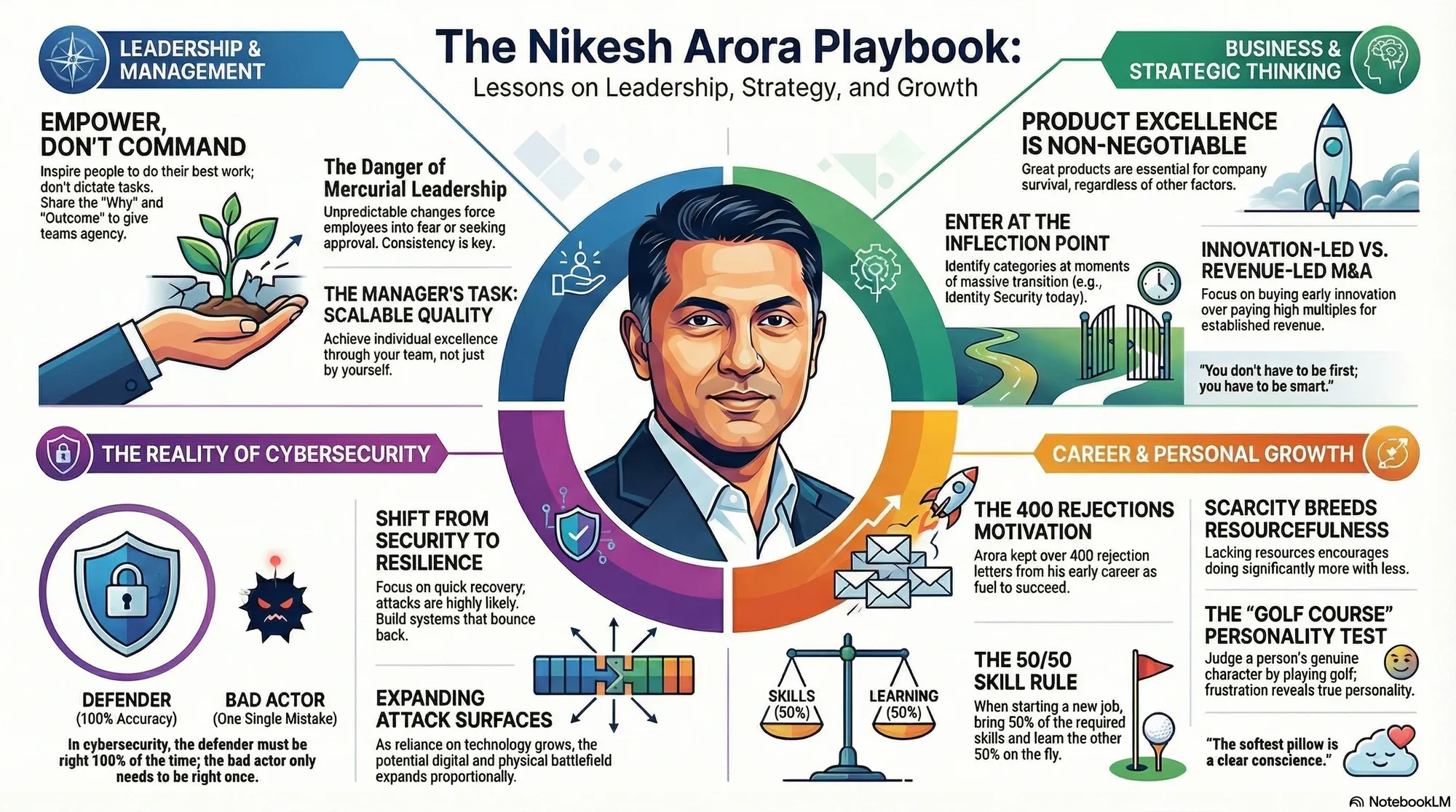
On Leadership and Management
- On Enabling Best Work: "I've realized part of my job is to get people to do their best work, not tell them what to do." [1]
- On Predictable Leadership: "If you're a mercurial leader who changes his mind on a dime, who behaves unpredictably...after a while people end up in two different scenarios. One is that they have to get your approval for every single decision...Or alternately they get scared." [2]
- On Explaining Why and Outcomes: "Don't tell people what to do, tell them why you're doing it. And what outcome you want." [3]
- On Scaling Quality Through Others: "We all get to where we get to...by being individually excellent...[but as a manager] your task is not to do a great job yourself, your task is to get the same level of quality on three people that are going to work for you." [4]
- On Listening at Scale: "I think culture for me is that, and that's the way to build a culture. It's not rocket science, but a lot of the time you see leaders thinking, oh, there's so many people. I don't have time to listen to all of them, so I'm just not going to listen to any of them." [1]
- On Winning the First Believer: "You only have to convince one set of people at any point in time to get a job in order to convince the rest of the world." [1]
- On Getting Things Done: "I don't see myself as someone trying to push the envelope. I see myself as somebody trying to get stuff done." [5]
- On Functional Boards: "My board structure is very functional, very expertise oriented." [2]
- On Returning to Basics: "You're always known by your last act...your past success...helps you get the job. But...the question is how are you going to keep it and how are you doing amazing at it and that requires you to go back to basics." [6]
- On Compensating for Domain Gaps: "If you don't have domain expertise, then it's critical that the other skills you bring to the table are world-class." [2]
- On Turning Ideas into Execution: Leaders must define the North Star, fund an achievable plan, communicate it repeatedly, and remove whatever blocks execution. — Sequoia Training Data
- On the Outsider Perspective: Entering a new industry without preconceived notions or established dogma allows leaders to question fundamental assumptions and bring innovative thinking to a company. — Sequoia Capital Podcast
On Business and Strategy
- On Product Quality: "If you don't build a great product, your company will eventually die." [7]
- On Changing a Working Strategy: "One of the hardest things to do is to change a strategy that is working." [8]
- On Entering at Inflection Points: "Our market entry strategy has always been to enter categories at their inflection point, and we believe that moment for Identity Security is now." [9]
- On Avoiding Crowded Markets: "I don't like competitive markets. I find in a customer acquisition costs to hire your retention is lower it takes more in terms of brand spend it takes better product marketing...you have less pricing power." [4]
- On Empty Markets: "If you find a market where nobody wants to build a product, you're either a genius or totally stupid." [4]
- On Pursuing 10x Change: "If you're looking for a 10, 20% improvement, don't bother, because things are about to move 10x." [10]
- On Being Smart, Not First: "You don't have to be first; you have to be smart." [7]
- On Ethics as Table Stakes: "Ethics is table stakes for a good business." [5]
- On Buying Innovation Early: "Our review on Acquisitions is we buy Innovation we buy product we buy early because if you buy later you're paying multiples for Revenue which I don't believe." [4]
- On What an Acquisition Really Buys: A strategic acquisition is not merely an asset purchase; it brings in a direction, an execution plan, and the team capable of completing the journey. — Sequoia Training Data
- On Resolving Integration Before Closing: Before completing an acquisition, the two sides should agree on the joint product plan and organization instead of spending the next six months arguing after the deal. — Sequoia Training Data
- On Swinging Big Early: Early-stage founders should prioritize building products based on a strong, original vision rather than just iterating on immediate customer feedback. — Sequoia Capital Podcast
On Cybersecurity
- On Defender Asymmetry: "The bad actor has to be right once, and we have to be right 100% of the time. That's hard to do." [11]
- On Expanding Attack Surfaces: "Cybersecurity is a growing market. The more we rely on technology, the more our attack surface expands." [7]
- On Cyber Resilience: "When you think about cyber security think about cyber resilience...the possibility that you can get attacked hacked or brought down to your knees is reasonably high." [11]
- On Digital Battlefields: "The future wars will be fought both in the digital battlefield and the physical one." [11]
- On Securing Action-Capable AI: Once AI can act on a company's behalf, leaders must add their own guardrails and controls regardless of the protections built into the underlying model. — Sequoia Training Data
- On Real-Time Cyber Defense: Detecting novel attacks requires ingesting broad telemetry, finding anomalous patterns, and analyzing events continuously at machine speed. — Sequoia Training Data
On AI, Technology and Innovation
- On Technology Leverage: "The wave of technology that's coming will enable people to build businesses faster, with greater agility, using fewer people, and with a fundamental rethinking of how things are done." [10]
- On Responsible Technology: "Every technology has a good side and potential for misuse or abuse if it's not implemented right." [13]
- On Identity Privilege Controls: "The future of security must be built on the vision that every identity requires the right level of privilege controls." [12]
- On Safe AI Experimentation: Companies should test AI aggressively in constrained environments before giving models control over systems or processes. — Sequoia Training Data
- On High-Consequence AI Models: Mission-critical enterprise applications need better models trained on more precise domain data because their tolerance for errors is far lower than consumer use cases. — Sequoia Training Data
- On AI and Engineering Demand: The idea that AI-driven productivity gains will inevitably lead to mass layoffs is a misconception; companies will instead use these gains to tackle complex, long-delayed technical projects. — Business Insider
On Career and Personal Growth
- On Resourcefulness Through Scarcity: "Scarcity encourages you to be resourceful. It allows you to do a lot more with a lot less." [1]
- On Learning Half the Job: "Every job you get into, you bring 50 percent of the skills you need, and you learn the other 50 percent if you're lucky enough." [5]
- On Using Rejection as Motivation: "I sent 400-plus applications and got rejected 400-plus times. I saved all the rejection letters. They're my motivation." [7]
- On Leaving the Comfort Zone: "Go out there and live outside your comfort zone...If you don't jump you're not going to land on your feet." [15]
- On Saying Yes First: "Learn how to keep saying yes, embrace yes, don't say no. Once you say yes you always have the option of saying no later. When you say no it's very hard to go back and say yes." [15]
- On Rejecting the Status Quo: "I've never been able to settle with status quo...I've actually never had a plan charted out." [2]
- On Creating Joy Through Work: "As you leave here...make sure you bring joy to others through your work. Your most profound joy will come from them." [7]
- On Anticipating Unmet Needs: "Give the world what it doesn't even know it needs." [7]
- On Fixing What Is Missing: "If you see it as a problem, it is a problem. If you find a flaw, go out and fix it. If you believe it's missing, go out and invent it." [7]
- On Solving Problems of Scale: "You cannot make progress if you're not willing to solve problems of scale. You have to laugh at the impossible." [7]
- On Keeping Work Enjoyable: "As we grow older, we're taught the concept of work. Work has to be serious and boring. If you're having too much fun at work, you're not working." [7]
- On Legacy and Purpose: "I want to make a difference. I want to leave a legacy. I want to inspire people. That's my why." [5]
- On Revealing Character: "You can tell if people are genuine or not (on the golf course). It's very hard to fake your personality for five hours; golf is a very frustrating sport." [5]
- On Investing in Relationships: "I only invest in founders who are willing to be my friends, hang out with me and build large companies." [5]
- On Taking Life Less Seriously: "Don't take life too seriously focus on making sure that you're going to enjoy it it's going to work out for you and it's going to work out for everybody else." [3]
- On a Clear Conscience: "The softest pillow is a clear conscience." [3]
Learn more:
- Rejected 400 times, now steering a $130 billion company: Palo Alto CEO Nikesh Arora's unique journey - The Indian Express
- Nikesh Arora: On romanticizing the past - YouTube
- Nikesh Arora & Shailesh Rao - Grandkeynote | TiEcon2024 - YouTube
- Nikesh Arora | All-In Summit 2024 - YouTube
- Nikesh Arora on Leadership, Listening, and Non-Linear Thinking - Culture Partners
- Nikesh Arora: Lessons from $102BN Market Cap & How to Create & Sustain Competitive Advantage | E1155 - YouTube
- Remarks by Dr. Nikesh Aurora - Northeastern Global News
- Nikesh Arora, CEO of Palo Alto: The Morgan Stanley Interview
- Nikesh Arora Says Staying True To The Spirit Of Innovation Is The Need Of The Hour
- Nikesh Arora at the Danish Top Exec Summit - YouTube
- Nikesh Arora: Transforming Palo Alto Networks with Visionary Leadership - Nit Infotech
- “We're planting the flag”: Palo Alto's Arora sees CyberArk as key to AI era | Ctech
- Leadership in Challenging Times: A Discussion with Nikesh Arora, Palo Alto Networks
- Graduate ceremony commencement speaker: Nikesh Arora - Northeastern Global News
- 2013 Graduate Commencement Ceremony - YouTube
- Palo Alto Networks’s Nikesh Arora: AI, Security, and the New World Order — Sequoia Training Data
- Palo Alto Networks CEO Nikesh Arora on the Virtues of Being an Outsider — Sequoia Capital
- Palo Alto Networks CEO says AI won't mean fewer engineers — Business Insider