Lessons from Nikhyl Singhal
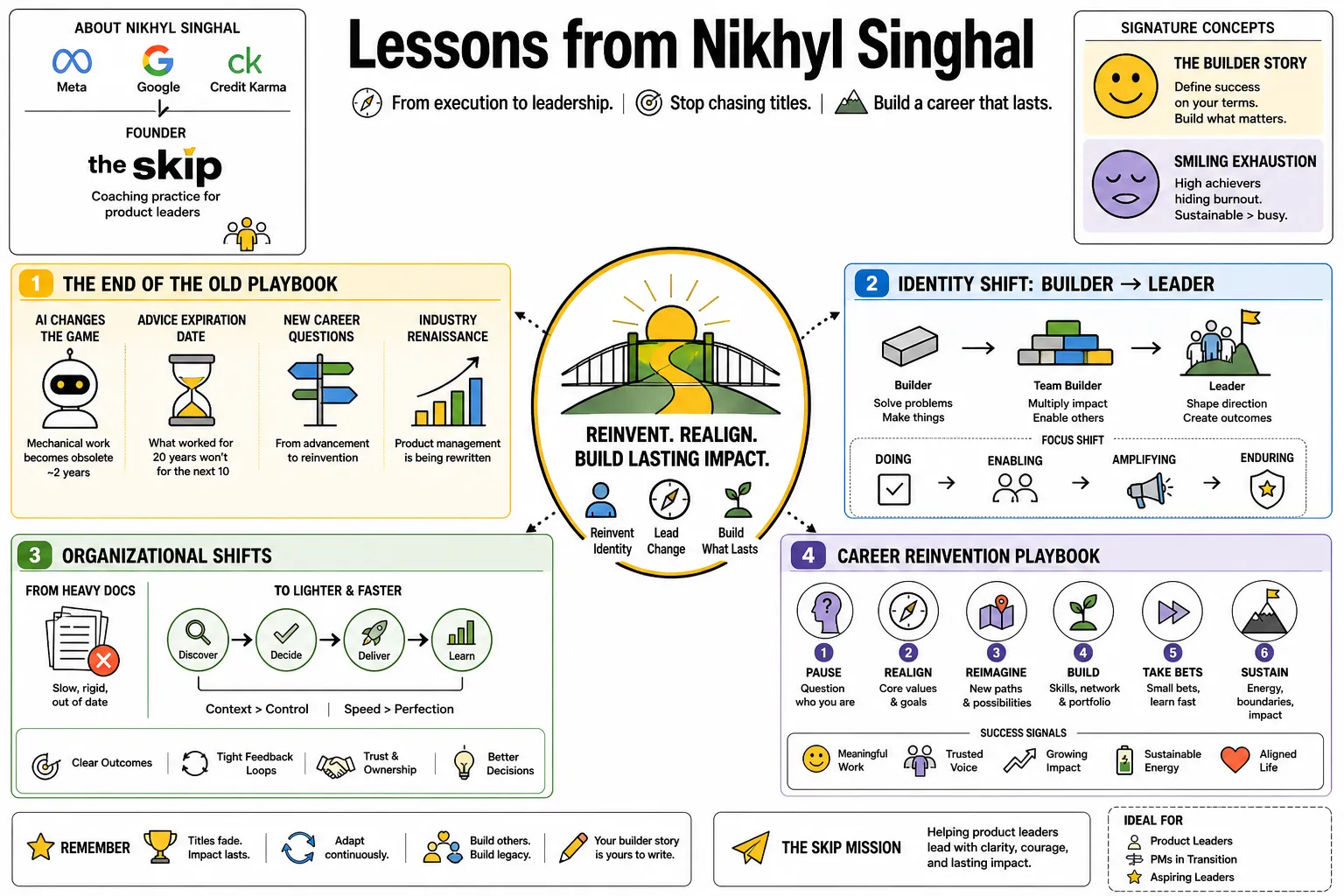
Nikhyl Singhal led product teams at Meta, Google, and Credit Karma before founding The Skip, a coaching practice for product leaders. Using concepts like "the builder story" and "smiling exhaustion," he helps professionals stop chasing titles and start building durable careers. This profile collects his advice on moving from execution to leadership as AI and industry shifts redefine the job.
Part 1: Career Reinvention in the AI Era
- On the end of the old playbook: "The mechanical aspects of product development are expected to become obsolete in the next two years due to AI advancements." — Source: Crypto Briefing
- On changing career questions: "A year ago, the typical question I received was how do I get promoted? Now it is whether I am still who I thought I was. The language has moved from advancement to reinvention." — Source: Lenny's Newsletter
- On industry renaissance: "We are in the middle of a product management renaissance. The advice that worked for the past twenty years will not work for the next ten." — Source: The Skip
- On organizational shifts: "Companies are fundamentally changing how they manage product by moving away from heavy documentation like PRDs toward AI-driven agents and rapid prototyping." — Source: Nikhyl Singhal on Substack
- On AI as a force multiplier: "AI will act as a massive force multiplier, meaning companies can do much more with significantly smaller, tighter product teams." — Source: Lenny's Podcast
- On surviving AI disruption: "If you view AI solely as a threat to your job, you will miss the opportunity to let it automate the most tedious parts of your day." — Source: Lenny's Newsletter
- On moments of joy: "Product managers need to actively engage with AI tools to discover where it brings them moments of joy in their daily workflow." — Source: Business Insider
- On shifting headcount: "We are entering a chaotic period with significant shifts in product headcount as tech companies reorganize around AI-first models." — Source: Lenny's Podcast
- On rapid prototyping: "The distance between an idea and a testable prototype has collapsed, meaning PMs must get faster at validating rather than relying on coordination." — Source: The Skip Podcast
- On continuous adaptation: "Reinvention is no longer a one-time pivot you make mid-career; it is the core skill you must master to stay relevant." — Source: The Skip
Part 2: The Builder Story
- On rejecting the ladder: "Many companies today would rather hire the builder than the manager. Stop obsessing over the corporate ladder." — Source: Creator Economy
- On true career capital: "Your real resume is your builder story, meaning what you actually built, the impact you had, and the specific challenges you overcame to get there." — Source: Creator Economy
- On company prestige: "Relying on a brand name on your resume is a fragile strategy. What matters is the muscle you built while you were there." — Source: The Skip
- On finding the right environment: "The fastest way to advance is to find an environment where your superpowers are on display and you feel seen." — Source: Creator Economy
- On authentic work: "You do your best building when you can be your true self at work, rather than contorting to fit a specific corporate mold." — Source: Creator Economy
- On narrative over titles: "When you interview, interviewers are not buying your past titles; they are buying the narrative of how you solve hard problems." — Source: The Skip Podcast
- On tracking impact: "Do not wait until you leave a job to figure out what you built. Track your builder story in real-time." — Source: The Skip
- On avoiding vanity metrics: "A strong builder story focuses on actual product shipped and customer behavior changed, rather than the number of people you managed." — Source: Nikhyl Singhal on Substack
- On the execution phase: "Before you can innovate or lead a massive division, you must prove you can execute reliably and ship." — Source: First Round Review
- On shifting focus: "Shift your focus from how to get promoted to what is the most interesting problem you can help solve right now." — Source: Lenny's Newsletter
Part 3: The Skip Philosophy and Career Longevity
- On marathon thinking: "A career is more of a marathon than a sprint. People often think very short-term about their next role." — Source: Creator Economy
- On the skip definition: "Instead of obsessing over your immediate next job, you should think about how to set yourself up well for that skip role, which is the job after next." — Source: Creator Economy
- On networking authenticity: "If you invest 30 minutes a week in authentic and meaningful networking, that results in 40 to 50 conversations over a year. That is a lot of luck to present to the world." — Source: Medium
- On avoiding short-term optimization: "Taking a job purely for a slight bump in title or compensation often derails your trajectory toward your true skip role." — Source: The Skip
- On building optionality: "Your goal in the first half of your career should be maximizing learning and optionality over climbing a rigid ladder." — Source: Lenny's Podcast
- On intentional pacing: "It is perfectly acceptable to spend time in a role simply executing and learning rather than constantly angling for the next promotion." — Source: The Skip
- On mentor relationships: "The best mentors do not give you answers; they help you calibrate your compass so you can navigate toward your skip role." — Source: Nikhyl Singhal on Substack
- On career transitions: "The hardest career transitions are the ones where you must abandon the metrics that previously made you successful." — Source: The Skip Podcast
- On long-term value: "Optimize for the skills and relationships that will compound over a decade, rather than the quick wins that fade in a year." — Source: The Skip
- On defining success: "Define your own criteria for a successful career early on, or you will default to the industry criteria, which is usually just seeking more." — Source: Creator Economy
Part 4: Smiling Exhaustion
- On the definition: "Smiling exhaustion is the state where PMs feel highly engaged and energized by their work, yet completely burned out by the volume and pressure." — Source: Business Insider
- On AI's dual nature: "AI is making the role more engaging by simplifying coordination, but it has simultaneously increased expectations and stress." — Source: Crypto Briefing
- On the productivity trap: "When tools allow you to do things twice as fast, the expectation quickly becomes that you will do twice as much." — Source: Lenny's Newsletter
- On hidden burnout: "Many leaders miss burnout in their top performers because the exhaustion is masked by enthusiasm and a genuine love for the product." — Source: The Skip Podcast
- On setting boundaries: "In an era where the mechanics of PM work are faster, setting boundaries around strategic thinking time is a survival requirement." — Source: Nikhyl Singhal on Substack
- On emotional toll: "The emotional toll of product management, specifically absorbing ambiguity and shielding the team, cannot be automated away." — Source: The Skip
- On managing energy: "You have to manage your energy portfolio as rigorously as you manage your product roadmap." — Source: Business Insider
- On the pace of change: "The exhaustion stems from the hours worked and the relentless pace of adapting to new paradigms every few months." — Source: The Skip Podcast
- On recognizing the signs: "If you find yourself constantly excited by the work but unable to disconnect or recover on weekends, you are in the smiling exhaustion phase." — Source: The Skip
Part 5: Navigating Ambiguity
- On the types of ambiguity: Singhal argues that senior PM work is defined by bigger ambiguous problems, and he breaks that ambiguity into six categories: product, growth, domain, market, organizational, and team. — Reference: The Skip article on six PM ambiguity categories: product, growth, domain, market, organizational, and team
- On specialized problem solving: Singhal says no PM can be expert in every ambiguity category, so an elite career comes from making one or two of those categories true superpowers while avoiding clear weakness in the rest. — Reference: The Skip article on specializing in one or two PM superpowers without being deficient elsewhere
- On the PM's core job: "A product manager's primary function is to absorb organizational and market ambiguity and translate it into clarity for the engineering team." — Source: The Skip
- On organizational chaos: "You cannot build a great product if you are distracted by organizational ambiguity. You must resolve the internal chaos first." — Source: Nikhyl Singhal on Substack
- On market uncertainty: "When market ambiguity is high, your product strategy must shift from rigid roadmaps to highly adaptable learning cycles." — Source: The Skip Podcast
- On defining responsibility: "Ambiguity around responsibilities often leads to misalignment. You must aggressively clarify who owns what." — Source: Nikhyl Singhal on Substack
- On finding comfort in the unknown: "The best product leaders actively seek out ambiguity because that is where the most value is created, rather than merely tolerating it." — Source: The Skip
- On communicating uncertainty: "Never hide ambiguity from your team. Frame it clearly so they understand the exact risks you are trying to mitigate." — Source: Lenny's Newsletter
- On growth ambiguity: For growth ambiguity, Singhal distinguishes the work from 0-to-1 product crafting: growth PMs translate an existing product into more usage through acquisition, retention, usage, churn, data science, marketing, short cycles, and clear accountability. — Reference: The Skip article on growth expertise, acquisition, retention, usage, churn, and scaled-product ambiguity
Part 6: Superpowers and Their Shadows
- On identifying strengths: "Your superpower is the specific capability that allows you to uniquely solve problems better than anyone else in the room." — Source: Creator Economy
- On the shadow concept: "Every superpower casts a shadow. The traits that make you exceptional in one area will inevitably cause blind spots in another." — Source: Creator Economy
- On execution shadows: "If your superpower is relentless execution, your shadow might be steamrolling peers and ignoring long-term strategic debt." — Source: The Skip
- On big-picture shadows: "If your superpower is big-picture thinking, your shadow is often a lack of operational rigor and an inability to finish what you start." — Source: The Skip Podcast
- On self-awareness: "Career advancement at the senior level is less about acquiring new skills and more about mitigating the shadows of your existing superpowers." — Source: Nikhyl Singhal on Substack
- On building teams: "You build a resilient leadership team by hiring people whose superpowers perfectly cover your own shadows." — Source: Creator Economy
- On unlearning habits: "What gets you to the Director level, which is often brute-force execution, is exactly what will cause you to fail as a VP." — Source: The Skip
- On receiving feedback: "When peers give you tough feedback, they are usually reacting to your shadow. Listen to them without getting defensive." — Source: The Skip Podcast
- On adapting style: "You cannot rely on your superpower in every situation. You must learn to modulate your approach based on the context." — Source: The Skip
Part 7: The Hiring Market and Head of Product
- On hiring criteria: "Founders hiring their first Head of Product must clearly define accountability versus influence to ensure the leader succeeds." — Source: Nikhyl Singhal on Substack
- On company growth stages: "The company maturity, whether it is in the drunken walk, finding fit, or hypergrowth, dictates the exact profile of the product leader you need." — Source: Nikhyl Singhal on Substack
- On the drunken walk: "In the earliest stages, you do not need a manager of managers; you need an obsessive builder who can navigate the drunken walk to product-market fit." — Source: Nikhyl Singhal on Substack
- On scaling leadership: "The PM who helps you find product-market fit is rarely the same person who can scale the organization to a thousand employees." — Source: The Skip
- On evaluating talent: "When interviewing product leaders, spend less time on their frameworks and more time on the specific scars they acquired from failures." — Source: The Skip Podcast
- On alignment: "A Head of Product will fail quickly if their definition of success is fundamentally misaligned with the founder's vision." — Source: Nikhyl Singhal on Substack
- On the job search: "The old job-search playbook is broken. You can no longer rely on recruiters coming to you; you must proactively craft your narrative." — Source: The Skip Podcast
- On hiring for adaptability: "In the current market, I would rather hire a fast learner who can adapt to new AI tools than someone with a decade of static domain expertise." — Source: Lenny's Newsletter
- On founder relationships: "The Head of Product is a unique role because it requires mind-melding with the founder while simultaneously building independent operational structures." — Source: The Skip
Part 8: Execution, Teams, and Company Growth
- On PM as project manager: "Particularly in early-stage startups, product management is essentially project management. You have to get things done." — Source: First Round Review
- On team sizing: "In the current environment, smaller, highly focused teams consistently outperform large, heavily resourced divisions." — Source: Creator Economy
- On organizational velocity: "Speed is the ultimate competitive advantage. If your product process is slowing down engineering, you are doing it wrong." — Source: The Skip Podcast
- On shipping culture: "A culture of shipping beats a culture of endless strategizing. You only learn what works when the product hits the market." — Source: First Round Review
- On avoiding bloat: "As companies grow, there is a natural gravity toward process bloat. Product leaders must fight constantly to keep operations lean." — Source: The Skip
- On the reality of hypergrowth: "Hypergrowth breaks every process you have. You must be willing to tear down and rebuild your team structure every six months." — Source: Nikhyl Singhal on Substack
- On engineering partnerships: "Your most important relationship is with engineering. If there is friction there, the product will inevitably suffer." — Source: The Skip Podcast
- On strategy vs. tactics: "Great product strategy is useless without the tactical rigor to execute it. Most companies fail on the tactics rather than the vision." — Source: Nikhyl Singhal on Substack
- On maintaining focus: "The hardest word for a product leader to say is no. However, if you do not say it often, your team will drown in competing priorities." — Source: The Skip