Lessons from Nilan Peiris
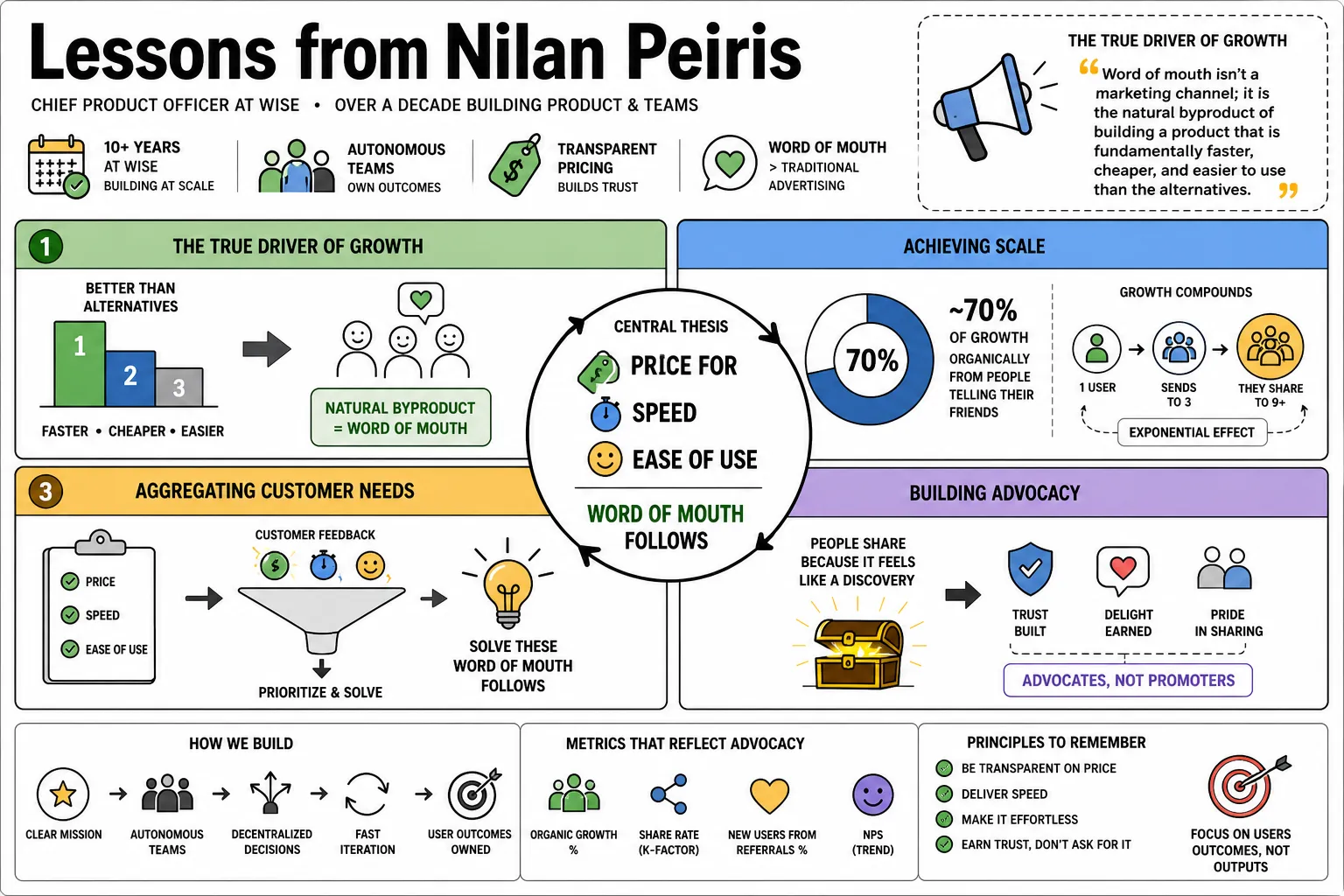
Nilan Peiris is the Chief Product Officer at Wise, where he spent over a decade defining how the company builds software and structures teams. He proved that transparent pricing and ease of use drive more word-of-mouth growth than traditional advertising. This profile details his approach to scaling businesses with autonomous teams and tracking the metrics that actually reflect user advocacy.
Part 1: The Mechanics of Word of Mouth
- On The True Driver of Growth: "Word of mouth isn’t a marketing channel; it is the natural byproduct of building a product that is fundamentally faster, cheaper, and easier to use than the alternatives." — Source: [Lenny's Podcast]
- On Achieving Scale: "When we looked at the data, we realized roughly 70 percent of our growth was coming organically from people telling their friends." — Source: [Lenny's Podcast]
- On Aggregating Customer Needs: "When you talk to customers and analyze the feedback, they always bring up price, speed, and ease of use. If you solve for those, word of mouth follows." — Source: [Lenny's Podcast]
- On Building Advocacy: "Customers don't recommend you because you asked them to. They recommend you because they feel they've discovered a secret they want to share." — Source: [Mind the Product]
- On Marketing vs. Product: "If your product is ten times better, your customers become your marketing department." — Source: [20VC]
- On Defining a 10x Product: "A 10x improvement isn't just a slightly better UI; it's fundamentally restructuring the cost and delivery of the service." — Source: [Medium]
- On The Limits of Growth Hacks: "There are no silver bullets or growth hacks that will save a fundamentally average product." — Source: [20VC]
- On Identifying Evangels: "The customers who experience a flawless, instant transaction are the ones who turn around and tell five people at a dinner party." — Source: [Lenny's Podcast]
- On Product Iteration: "We didn't start with a perfect referral engine. We started by fixing the core product loop until people couldn't stop talking about it." — Source: [Mind the Product]
- On Emotional Resonance: "When you save someone a significant amount of money that they would have otherwise lost to hidden fees, it creates a deeply emotional response." — Source: [Boss Level Podcast]
Part 2: Autonomous Teams and Empowerment
- On Team Structure: "The most effective way to move fast is to organize into small, autonomous teams that sit as close to the customer as possible." — Source: [Mind the Product]
- On Top-Down Directives: "We deliberately avoid top-down roadmaps. If leadership is dictating what to build, you aren't trusting the people closest to the data." — Source: [Lenny's Podcast]
- On Accountability: "Autonomy doesn't mean doing whatever you want; it means you own the outcome and the metrics associated with your specific customer problem." — Source: [Sifted]
- On Speed of Execution: "Bureaucracy is the enemy of growth. Empowering teams to ship and test without seeking constant approval is how you find winners faster." — Source: [Mind the Product]
- On Cross-Functional Alignment: "Engineers, designers, and product managers must sit together and share the exact same KPIs to avoid localized thinking." — Source: [Lenny's Podcast]
- On Decision Making: "We try to push the decision-making power down to the individual contributors who actually talk to the users every day." — Source: [20VC]
- On Failure: "If an autonomous team doesn't fail occasionally, they aren't pushing the boundaries hard enough." — Source: [Sifted]
- On Hiring: "You have to hire people who are comfortable with ambiguity and who don't need a manager to tell them what their goals should be." — Source: [Boss Level Podcast]
- On Scaling Culture: "Maintaining autonomy gets exponentially harder as headcount grows, which is why strict adherence to our core values is mandatory." — Source: [Mind the Product]
Part 3: The Conviction Framework
- On Deep Understanding: "You have to move past analytical guessing. Spreadsheets will only tell you what happened, not why it happened." — Source: [Lenny's Podcast]
- On Building Conviction: "Conviction comes from obsessing over customer interactions, reading the support tickets, and understanding the raw pain points." — Source: [Mind the Product]
- On Data vs. Insight: "Data is critical, but without the qualitative insight gained from direct customer conversations, it's just noise." — Source: [Lenny's Podcast]
- On Prioritization: "When you have deep conviction about a customer problem, prioritizing the roadmap becomes a natural, obvious process." — Source: [20VC]
- On Customer Empathy: "If the product team isn't feeling the frustration of the user, they will never build a solution that truly resonates." — Source: [Mind the Product]
- On Validating Ideas: "The best way to validate an idea isn't a long debate in a meeting room; it's putting a rough version in front of a user and watching their reaction." — Source: [Medium]
- On False Certainty: "A meticulously planned spreadsheet can give you a false sense of certainty. Real conviction is messier but much more accurate." — Source: [Lenny's Podcast]
- On Iterative Learning: "Conviction isn't static. It evolves as you ship features, gather new feedback, and realize your initial assumptions were slightly off." — Source: [20VC]
- On Trusting Your Gut: "Sometimes the data is murky, and that's when you have to rely on the intuition you've built through hundreds of customer interviews." — Source: [Mind the Product]
Part 4: Pricing as a Product Feature
- On Cost-Plus Pricing: "We treat pricing as a feature. By adopting a transparent, cost-plus model, we align our success entirely with the customer's success." — Source: [Lenny's Podcast]
- On Building Trust: "Hidden fees destroy trust. When you show people exactly what they are paying for, you turn a transaction into a relationship." — Source: [20VC]
- On Margin Structure: "Most financial institutions use margin as a way to hide inefficiency. We use thin margins as a forcing function to become more efficient." — Source: [Mind the Product]
- On Long-Term Value: "Extracting maximum revenue on day one is a terrible strategy. Lowering prices over time maximizes long-term retention." — Source: [Lenny's Podcast]
- On Transparency: "Radical transparency in pricing isn't just ethical; it's a structural advantage that incumbents struggle to replicate." — Source: [Medium]
- On Price Elasticity: "When you drop prices, volume goes up. The challenge is ensuring your unit economics can support the surge in demand." — Source: [20VC]
- On The Psychology of Fees: "People hate feeling cheated. The moment they realize a bank has been hiding exchange rate markups, they become incredibly loyal to the alternative." — Source: [Boss Level Podcast]
- On Pricing as Marketing: "Our transparent pricing model is our most effective marketing campaign. It speaks louder than any billboard." — Source: [Mind the Product]
- On Continuous Optimization: "We don't set a price and forget it. As our infrastructure gets cheaper to run, we pass those savings directly back to the customer." — Source: [Lenny's Podcast]
- On Competitive Moats: "A lower, transparent price point that is structurally supported by better tech is the hardest moat for competitors to cross." — Source: [20VC]
Part 5: Rethinking Traditional Marketing
- On Scaling Channels: "No marketing channel scales infinitely. Eventually, the cost of acquisition on paid channels will outpace the lifetime value of the customer." — Source: [Business of Software]
- On Paid Acquisition: "Relying purely on Google and Facebook ads is a dangerous game because you are renting your audience instead of owning it." — Source: [20VC]
- On Perceived vs. Actual Value: "Marketing can bridge the gap between perceived and actual value, but it cannot fix a product that lacks actual value." — Source: [20VC]
- On Sustainable Growth: "If you want sustainable growth, you have to invest the money you would have spent on ads into making the product fundamentally better." — Source: [Lenny's Podcast]
- On Viral Loops: "A true viral loop isn't forced through aggressive pop-ups; it occurs naturally when a user wants their friend to experience the same benefit." — Source: [Mind the Product]
- On Brand Building: "Brand isn't what you say about yourself; it's the collective sum of every interaction a customer has with your core product." — Source: [Medium]
- On Referrals: "A monetary referral bonus helps, but it only works if the user genuinely believes they are doing their friend a favor by recommending you." — Source: [Lenny's Podcast]
- On Education vs. Promotion: "Our marketing focuses on educating the market about hidden fees rather than just promoting our own app." — Source: [Boss Level Podcast]
- On PR Stunts: "Early on, we did stunts to get attention, but attention only converts to retention if the underlying service is flawless." — Source: [20VC]
Part 6: Measuring Growth and NPS
- On The Importance of NPS: "NPS is a critical leading indicator of growth. We use it aggressively to identify friction points and potential advocates." — Source: [Lenny's Podcast]
- On The 8-to-9 Leap: "Moving a customer's Net Promoter Score from an 8 to a 9 can literally double their likelihood of referring someone else." — Source: [Refound AI]
- On Asking The Right Questions: "We track word of mouth directly by simply asking users 'How did you hear about us?' during the onboarding flow." — Source: [Medium]
- On Qualitative Feedback: "The score itself is less important than the verbatim comments users leave. The text box is where the real insights live." — Source: [Lenny's Podcast]
- On Detractors: "Detractors are a gift. They are telling you exactly where your product is breaking down and losing trust." — Source: [Mind the Product]
- On Metric Obsession: "Don't just measure for the sake of measuring. Tie every metric directly to a customer outcome." — Source: [20VC]
- On Leading vs. Lagging Indicators: "Revenue is a lagging indicator. User delight and successful task completion are the leading indicators you need to manage." — Source: [Lenny's Podcast]
- On Closing the Loop: "If a user gives you a bad score, someone on the team needs to follow up, understand the issue, and ideally fix the root cause." — Source: [Mind the Product]
- On Segmentation: "Look at NPS across different cohorts and corridors. An aggregate score can mask severe localized problems." — Source: [Medium]
- On Goal Setting: "We set team goals based on improving specific customer metrics rather than chasing arbitrary financial targets." — Source: [Lenny's Podcast]
Part 7: Navigating the Startup Grind
- On The Inevitable Wall: "The thing I've learned about startups is that they always get ridiculously hard, and you will hit a wall." — Source: [Boss Level Podcast]
- On Resilience: "The only way you get through that wall of hardship is with strong core values and a team that fundamentally believes in the mission." — Source: [Boss Level Podcast]
- On Scaling Pain: "Every time the company doubles in size, processes break. You have to constantly reinvent how you communicate and operate." — Source: [Mind the Product]
- On Focus: "In the early days, you have to ruthlessly prioritize the one or two things that will actually move the needle and ignore the rest." — Source: [20VC]
- On Founder Mentalities: "The best founders don't just build products; they build systems that allow other people to build great products." — Source: [Medium]
- On Burnout: "Sustained high performance requires a culture where people feel supported to take time off and disconnect." — Source: [Sifted]
- On Adapting to Scale: "The skills that get you from zero to one are entirely different from the management skills required to go from one to a hundred." — Source: [Lenny's Podcast]
- On Making Mistakes: "If you aren't making mistakes, you are moving too slowly. The goal is to make small mistakes and learn from them instantly." — Source: [Mind the Product]
- On Staying Humble: "Success can breed complacency. You have to actively fight the urge to stop listening to your earliest, most critical users." — Source: [20VC]
Part 8: Mission-Driven Culture
- On The Core Mission: "Customers become advocates when they feel they are part of a movement to solve a real-world problem, like making finance fair." — Source: [Boss Level Podcast]
- On Values as a Filter: "Values aren't posters on a wall. They are the strict filters you use for hiring, firing, and making difficult product decisions." — Source: [Mind the Product]
- On Rallying the Team: "A clear, compelling mission is the best retention tool a company has. People want to work on things that matter." — Source: [Lenny's Podcast]
- On Authenticity: "You can't fake a mission. If your internal decisions contradict your external messaging, customers and employees will see right through it." — Source: [20VC]
- On Customer Alignment: "When your mission is purely focused on removing friction for the user, your business goals naturally align with their needs." — Source: [Medium]
- On Long-Term Thinking: "A strong mission prevents you from making short-sighted decisions to hit a quarterly target at the expense of user trust." — Source: [Mind the Product]
- On Evangelism: "Employees who deeply believe in the mission are the ones who build the features that turn customers into evangelists." — Source: [Boss Level Podcast]
- On Challenging the Status Quo: "You have to be willing to be the antagonist to an industry's bad habits. That friction is what creates your brand identity." — Source: [Lenny's Podcast]
- On Defining Success: "Ultimately, success isn't just a high valuation; it's looking back and realizing you permanently changed an industry for the better." — Source: [20VC]