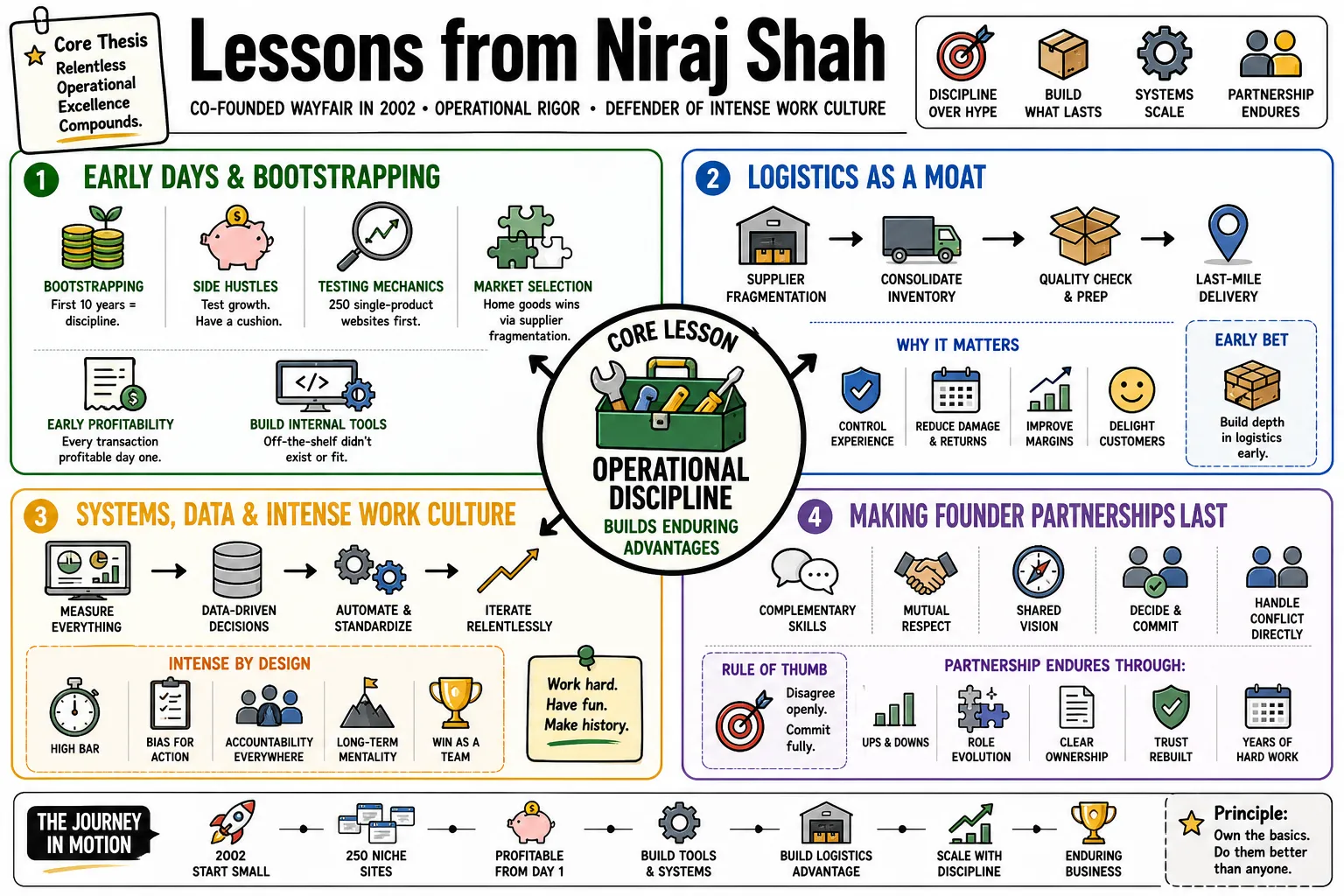
Lessons from Niraj Shah
Niraj Shah co-founded Wayfair in 2002, turning a network of niche websites into a massive home goods retailer. He brings a strictly operational approach to e-commerce and is unapologetic in his defense of intense work cultures. This profile covers his views on bootstrapping, logistics, and making founder partnerships last.
Part 1: Early Days and Bootstrapping
- On Bootstrapping: "Bootstrapping for the first ten years forces discipline; you learn to survive on revenue rather than venture capital." — Source: [Zinnov Podcast]
- On Side Hustles: "Before committing fully, evaluate if the business shows consistent growth and whether you have a financial cushion." — Source: [How I Built This]
- On Testing Mechanics: "We started with 250 single-product websites, learning the mechanics of search and supply before consolidating into one brand." — Source: [How I Built This]
- On Market Selection: "The home goods category is uniquely attractive compared to other physical goods because it relies heavily on supplier fragmentation." — Source: [Invest Like the Best]
- On Early Profitability: "When you have no external money, every transaction has to be profitable from day one." — Source: [Zinnov Podcast]
- On Building Internal Tools: "We built our own early systems because off-the-shelf software could not handle the weird dimensions and shipping requirements of furniture." — Source: [Invest Like the Best]
- On Capital Constraints: "Having fewer resources early on prevents you from masking bad unit economics with excessive marketing spend." — Source: [Zinnov Podcast]
- On Baseline Demand: "Taking an idea full-time requires a clear understanding of the demand you have already proven in the market." — Source: [How I Built This]
- On Staying Close to the Buyer: "The first hundred hires all took customer calls, which built a strong foundation in understanding what buyers actually needed." — Source: [Zinnov Podcast]
Part 2: Co-founder Dynamics
- On Shared Foundations: "We were friends in college first. We had a strong personal relationship and valued each other's judgment." — Source: [Zinnov Podcast]
- On Direct Communication: "We both learned early on that we like to work hard, be straightforward, and stay direct with each other." — Source: [Zinnov Podcast]
- On Productive Arguments: "Disagreement is a path to finding the truth. You have to be willing to argue it out until you align on the fundamentals." — Source: [Zinnov Podcast]
- On Checking Ego: "Our partnership works because neither of us insists on having the last word." — Source: [Zinnov Podcast]
- On Splitting Duties: "As we grew, we naturally gravitated toward different operational areas based on what the company needed rather than formal titles." — Source: [How I Built This]
- On Ground Truth: "When the business gets complicated, you have to rely on a shared belief in the ground truth." — Source: [Zinnov Podcast]
- On Crisis Communication: "Building a business with someone you already know deeply reduces the friction of figuring out how to communicate under pressure." — Source: [Zinnov Podcast]
- On Debating Execution: "We both understand the underlying math of the business, which means our debates are about execution, not basic facts." — Source: [How I Built This]
- On Long-term Horizons: "Building a durable company is a decades-long process. You need a partner who views it as a continuous journey." — Source: [Zinnov Podcast]
Part 3: Scaling the Organization
- On Brand Consolidation: "We realized that hundreds of niche sites made it impossible to build a cohesive identity, prompting the shift to a single platform." — Source: [Invest Like the Best]
- On Strategic Risks: "Consolidating our sites was a massive risk at half a billion in sales, but it was required to grow further." — Source: [Invest Like the Best]
- On Founder Evolution: "As a company scales, founders have to actively unlearn the hands-on habits that made them successful in the early days." — Source: [Spencer Stuart]
- On Hiring Experts: "You have to bring in people who possess far deeper domain expertise than you do, and then actually let them run their areas." — Source: [Zinnov Podcast]
- On Systematizing Logic: "You have to build systems that allow thousands of employees to operate with the same logic the founders used when they were ten people." — Source: [Spencer Stuart]
- On the Reality of Scale: "Progress at scale often feels much slower than expected; maintaining operational discipline is how you push through the mud." — Source: [Invest Like the Best]
- On Shifting Focus: "Your role shifts from managing every specific transaction to managing the architecture of how decisions are made." — Source: [Spencer Stuart]
- On Firing Quickly: "When you realize a specific hire is not working out, act faster. Waiting always makes the situation worse." — Source: [Zinnov Podcast]
- On Mainstream Appeal: "Customers need a unified identity to understand what you stand for and why they should return." — Source: [Invest Like the Best]
- On Outgrowing Structures: "Whenever a system becomes too complicated for new hires to grasp quickly, it usually needs to be rebuilt." — Source: [Zinnov Podcast]
Part 4: Work Ethic and Intensity
- On Blending Work and Life: "Working long hours, being responsive, blending work and life, is not anything to shy away from." — Source: [Business Insider]
- On Success and Effort: "There is not a lot of history of laziness being rewarded with success." — Source: [Inc. Magazine]
- On Ambition: "Ambitious people find ways to blend and balance their personal lives with intense work." — Source: [Business Insider]
- On Setting Expectations: "The rumor that I discourage people from working late is laughably false." — Source: [Inc. Magazine]
- On Project Execution: "Hard work is essential for success, and a key part of actually pushing projects across the finish line." — Source: [Business Insider]
- On Competition: "Retail is fundamentally a zero-sum game in many categories; outworking the competition is a basic requirement." — Source: [Inc. Magazine]
- On Communication Tempo: "Being highly responsive to colleagues and partners sets a tempo for the entire organization." — Source: [Business Insider]
- On Complacency: "When you reach a certain scale, the biggest threat is people assuming the machine will just run itself." — Source: [Inc. Magazine]
- On Personal Schedules: "Everyone deserves to have a great personal life, but everyone has to manage that integration in their own way." — Source: [Business Insider]
- On Modeling Behavior: "Leaders must demonstrate the level of dedication they expect from their teams." — Source: [Spencer Stuart]
Part 5: Frugality and Resource Management
- On Company Funds: "Think of any company money you spend as your own." — Source: [Inc. Magazine]
- On Vendor Negotiation: "Employees should question expenses and negotiate costs aggressively, down to the price of ethernet cables." — Source: [Business Insider]
- On Challenging Bureaucracy: "You will encounter some things that do not make sense. Question them." — Source: [Inc. Magazine]
- On Operational Efficiency: "Identifying and eliminating small, recurring inefficiencies is how you protect margins in a low-margin industry." — Source: [Business Insider]
- On Extreme Ownership: "An employee who acts like an owner does not wait for permission to fix a broken process." — Source: [Inc. Magazine]
- On Smart Spending: "Frugality is not about being cheap; it is about ensuring capital is only deployed where it generates actual returns." — Source: [Business Insider]
- On Employee Traits: "We look for people who are aggressive, pragmatic, frugal, agile, and customer-oriented." — Source: [Inc. Magazine]
- On Corporate Bloat: "As organizations grow, they naturally accumulate unnecessary layers; it is everyone's job to cut through them." — Source: [Business Insider]
- On Unit Economics: "Profitability in e-commerce is often decided by pennies on shipping and packaging; no cost is too small to review." — Source: [Inc. Magazine]
Part 6: Logistics and Customer Experience
- On Retail Showrooms: "Opening physical locations creates a 'halo effect' that enhances brand visibility and gathers data to improve both online and offline sales." — Source: [Business of Home]
- On Supply Chain Moats: "Building a proprietary logistics network was necessary because standard carriers are not optimized for delivering bulky furniture." — Source: [Invest Like the Best]
- On Loyalty Programs: "Initiatives like Wayfair Rewards are designed strictly to increase repeat purchase rates and deepen loyalty." — Source: [Customer Experience Dive]
- On Delivery Metrics: "In furniture delivery, minimizing damage rates through specialized handling is more important than absolute speed." — Source: [Invest Like the Best]
- On Product Variety: "Offering millions of products ensures the customer does not have to visit five different sites to furnish a single room." — Source: [Invest Like the Best]
- On Staying Grounded: "Reviewing actual order receipts regularly helps leadership stay connected to what real customers are buying." — Source: [Zinnov Podcast]
- On the Final Mile: "The transaction does not end at checkout; the delivery experience dictates whether they will ever buy from you again." — Source: [Customer Experience Dive]
- On Fighting Generalists: "To win against generalist retailers, you have to offer a category-specific experience that they cannot easily replicate." — Source: [Invest Like the Best]
- On Platform Dynamics: "E-commerce platforms must serve the supplier's needs for distribution just as effectively as the consumer's need for selection." — Source: [Invest Like the Best]
- On Store Inventory: "Physical stores are less about holding massive inventory and more about letting customers experience the quality and scale of the brand." — Source: [Business of Home]
Part 7: Decision Making and First Principles
- On Stripping Down Complexity: "When things get complicated, strip the issue back to the basic, underlying truths of the business." — Source: [Zinnov Podcast]
- On No-Regret Choices: "Make 'no-regret decisions'—choices that improve the business fundamentally, regardless of how macroeconomic factors play out." — Source: [How I Built This]
- On Backing Instinct with Data: "We are very data-driven. Even when instinct plays a role, we pair it heavily with quantitative metrics." — Source: [Zinnov Podcast]
- On Testing Disagreements: "When there is internal disagreement, the best approach is to test the opposing ideas through small experiments before rolling anything out." — Source: [Zinnov Podcast]
- On the Nature of Conflict: "Healthy conflict is not personal; it is a mechanical process for arriving at the correct operational answer." — Source: [Zinnov Podcast]
- On Ignoring Momentum: "Avoid making decisions based solely on market momentum; always anchor back to your core first principles." — Source: [Zinnov Podcast]
- On Incremental Wins: "Innovation in retail rarely comes from one massive leap; it comes from thousands of incremental adjustments based on data." — Source: [Spencer Stuart]
- On Abandoning Bad Ideas: "If the data proves your hypothesis wrong, you have to abandon the idea immediately rather than trying to force it." — Source: [Zinnov Podcast]
- On Measuring Success: "Every team needs a highly specific metric that defines their success, otherwise effort gets confused with results." — Source: [Spencer Stuart]
Part 8: Navigating Turbulence
- On Market Volatility: "Volatility is not your enemy. Doing nothing is." — Source: [How I Built This]
- On Pandemic Communication: "During a sudden market disruption, leadership must over-communicate to maintain a cohesive culture while operations rapidly change." — Source: [Spencer Stuart]
- On Overnight Success Myths: "Wayfair was not built in a day. It was built slowly and deliberately over decades." — Source: [Zinnov Podcast]
- On Decisive Action: "In uncertain times, making a swift, reasonably informed decision is better than waiting for perfect clarity." — Source: [How I Built This]
- On Macro Environments: "You cannot control the macro environment, but you can control how efficiently your supply chain operates within it." — Source: [Invest Like the Best]
- On External Noise: "When you run a public company, you have to tune out external noise and focus on the mechanics of your actual business." — Source: [Inc. Magazine]
- On Leadership Continuity: "Retaining core leaders who have navigated previous crises with you provides an invaluable anchor when the market shifts." — Source: [Spencer Stuart]
- On Peacetime Discipline: "A company's ability to survive turbulence is dictated by the discipline it practiced during the good times." — Source: [Zinnov Podcast]
- On Enjoying the Process: "Persistence matters. This is not a quick journey, and you have to find joy in the daily act of building." — Source: [Zinnov Podcast]