Noah Desai Weiss is the Chief Product Officer at Slack and formerly led product teams at Foursquare and Google. He is recognized for his frameworks on product-led growth, defining product "taste," and using operational tactics like the complaint storm to help teams overcome stagnation. This profile gathers his approaches to balancing data with intuition, managing complex roadmaps, and designing artificial intelligence tools that users actually trust.
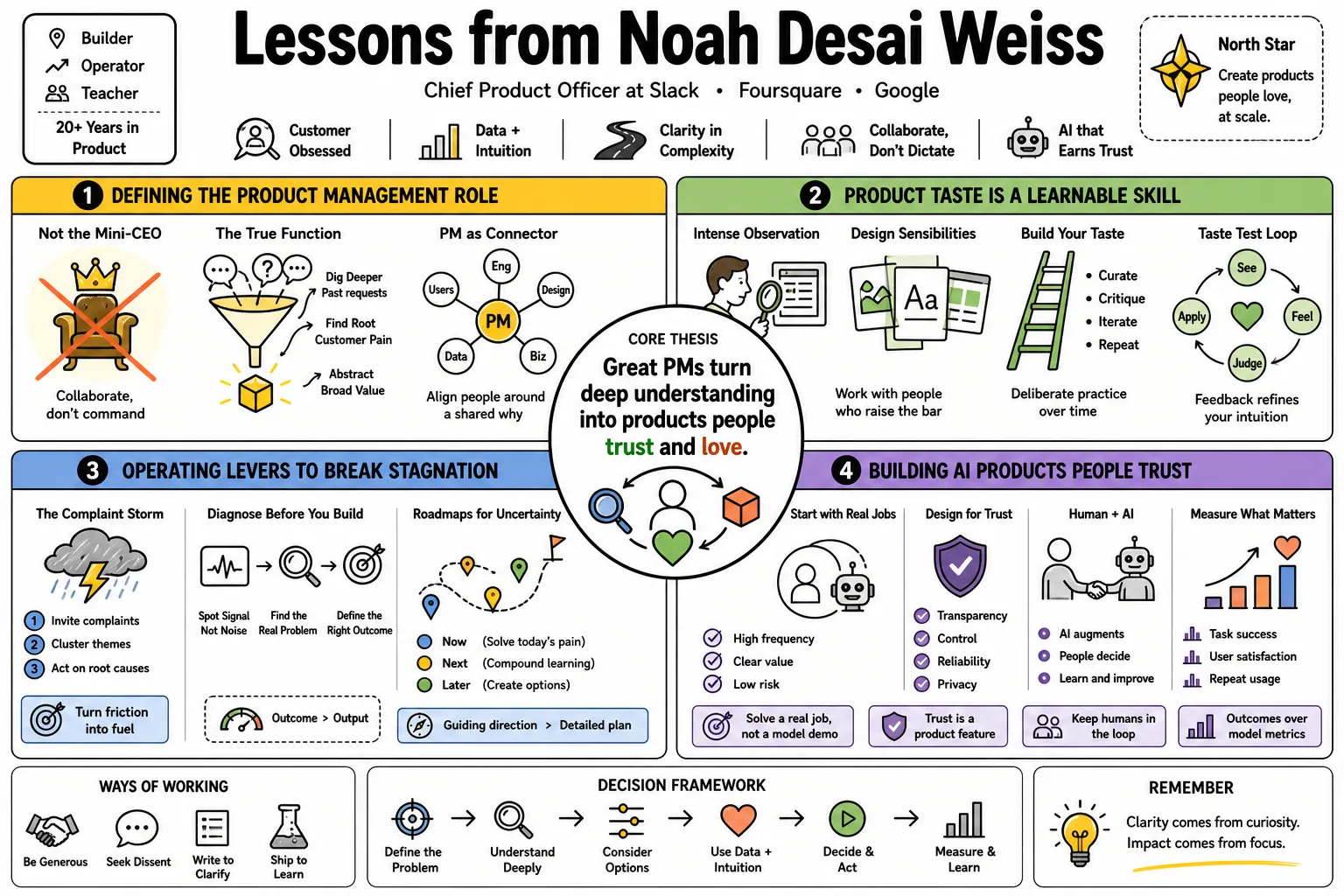
Part 1: Defining the Product Management Role
- On the PM Myth: "The most dangerous myth is that a product manager is the mini-CEO of their product. It implies a level of authority that simply doesn't exist and distracts from the collaborative nature of the job." — Source: Medium
- On Product Taste: "Product taste isn't an innate talent; it is a learnable skill. It comes from intensely observing how people interact with software and working alongside those with highly developed design sensibilities." — Source: Lenny's Podcast
- On the True Function of a PM: "You are not there to dictate. You are there to dig below surface-level feature requests, understand the underlying customer pain, and abstract that into something broadly valuable." — Source: Substack
- On Data Fluency vs. Data Dependency: "Data is incredibly effective for solving easy, well-defined problems, but it can quickly become a crutch that prevents teams from thinking deeply about the underlying 'why'." — Source: First Round Review
- On Optimizing for Learning: "Great product managers optimize for the speed of learning. They prioritize fast iterations that yield insights over slow, monolithic launches." — Source: Medium
- On Technical Immersion: "You don't need to write production code, but you must immerse yourself in the underlying technology to earn the respect of engineering and collaborate effectively on feasibility." — Source: Medium
- On Impeccable Execution: "Strategy means very little without execution. A great PM ensures that the plan is carried out with an unrelenting attention to the small details." — Source: Medium
- On the 'Workflow' Fallacy: "You might think that the organizational chart dictates how work actually gets done, but workflow often has very little to do with the official hierarchy." — Source: Forbes
- On Cross-Functional Collaboration: "The best product work happens when the boundaries between engineering, design, and product blur, rather than everyone staying rigidly in their defined swim lanes." — Source: First Round Review
- On Recognizing Customer Needs: "Users will almost always ask for a faster horse. Your job is to look at why they want to move faster and build the engine instead." — Source: Lenny's Podcast
Part 2: Product-Led Growth (PLG) & Scaling
- On the PLG Mindset: "Product-led growth is more than offering a free trial; it is about making the product itself the primary driver of acquisition, retention, and expansion." — Source: The Twenty Minute VC
- On the PLG to Enterprise Transition: "Scaling from PLG to an enterprise motion is painful because the skills that got you early traction, like frictionless signups and viral loops, do not automatically translate to navigating procurement departments." — Source: The Twenty Minute VC
- On the 'North Star' Metric: "When Slack hit a plateau, we stopped looking at just daily active users and shifted to 'Successful Teams', defined as five people using the product for a majority of the work week." — Source: Liminary
- On Metric Correlation: "We found that achieving our definition of a Successful Team increased their likelihood of upgrading to a paid tier by 400 percent." — Source: Liminary
- On Avoiding the Local Maximum: "It is easy to get stuck optimizing a small hill. Sometimes you have to take a giant step back to realize there are much larger mountains just out of sight." — Source: First Round Review
- On Project Day One: "Ripping up a stagnant onboarding process can feel risky, but it is often the only way to generate the momentum needed to reach a higher baseline of growth." — Source: First Round Review
- On Self-Service Limitations: "Self-serve funnels are fantastic for volume, but eventually, you need sales-assist motions to help users connect the dots on how the product solves their specific organizational problems." — Source: The Twenty Minute VC
- On the First Product Hire: "A startup should hire a PM when the founder feels development teams are slowing down because they are waiting on the CEO for directional decisions." — Source: Hyperact
- On Scaling Empathy: "As your user base grows from early adopters to mainstream enterprise workers, the product has to evolve to require less inherent technical curiosity from the user." — Source: First Round Review
Part 3: The Art of Decision-Making
- On Balancing Pace and Accuracy: "Effective leadership is recognizing which decisions require a slow, deliberate consensus and which ones you can make rapidly with incomplete information." — Source: First Round Review
- On Thinking in Bets: Weiss applies Annie Duke's Thinking in Bets idea to product work: avoid judging a team from one launch outcome, use outcomes over time as a signal, and make incremental decisions that keep producing useful learning for the next call. — Reference: First Round interview/article on Thinking in Bets, product outcomes, risk, and incremental learning
- On the Danger of A/B Testing: "Relying exclusively on experimentation means you are outsourcing your product strategy to a statistical test rather than developing a coherent thesis." — Source: How They Grow
- On Intuition: "Intuition is just pattern recognition built over years of observing user behavior. It should be tested, but never ignored." — Source: Lenny's Podcast
- On Consensus Culture: "Seeking complete consensus often results in watered-down features. Someone ultimately has to break the tie and own the outcome." — Source: First Round Review
- On Framing Decisions: "When a team is stuck, the problem usually isn't a lack of ideas; it is a lack of clarity on what specific problem they are actually trying to solve." — Source: First Round Review
- On Changing Your Mind: "Strong opinions, weakly held. If new data or a better argument presents itself, you have to be willing to abandon your previous stance without ego." — Source: Lenny's Podcast
- On Launching vs. Learning: "A decision isn't finalized when a feature ships. The decision loop only closes when you measure the impact and adjust accordingly." — Source: First Round Review
- On Portfolio Diversification: "When reviewing roadmaps, ensure your teams aren't all making the same type of bet. You need a mix of incremental wins, foundational debt payoff, and big swings." — Source: Startup Stash
Part 4: Managing Roadmaps & Execution
- On the 'Now, Next, Later' Framework: "Traditional roadmaps fail because they treat software like construction. Using a Now, Next, Later format communicates priorities without locking you into fictitious timelines." — Source: Medium
- On the Purpose of Roadmaps: "A roadmap is a communication document, not a project plan. Its primary job is to align the broader company on where you are heading and why." — Source: Strategic Thinking Now
- On Estimating Time: "The further out a project is, the less accurate your time estimates will be. Don't waste cycles agonizing over the exact launch date of a feature planned for next year." — Source: Medium
- On Killing Features: "The hardest part of execution is looking at a feature you've spent months on and having the discipline to kill it before launch because it doesn't meet the quality bar." — Source: First Round Review
- On the Execution Gap: "The distance between a good idea and a shipped product is filled with thousands of micro-decisions. Great execution is about making those micro-decisions correctly and quickly." — Source: Lenny's Podcast
- On Managing Stakeholders: "You manage stakeholders by bringing them into the context of the problem, rather than simply showing them the proposed solution." — Source: Medium
- On Prioritization: "Prioritization means deciding what you are explicitly choosing to ignore right now, rather than merely organizing a to-do list." — Source: Lenny's Podcast
- On Dealing with Tech Debt: "If you don't schedule time to pay down technical debt, it will schedule the time for you, usually right in the middle of an important launch." — Source: First Round Review
- On the Reality of Planning: "No roadmap survives contact with real users. Build enough flexibility into your plans to pivot when the initial assumptions prove wrong." — Source: Medium
- On Outcome vs. Output: "Celebrate the business impact and user behavior change, rather than the sheer fact that engineering merged the code." — Source: First Round Review
Part 5: User Experience & Customer Empathy
- On the Complaint Storm: "We use a 'complaint storm' to bypass polite filtering by holding an unedited, exhaustive session of airing every grievance about a product area." — Source: Transcripts Wiki
- On Acting on Complaints: "It's vital to treat the voicing of a complaint purely as a data-gathering exercise, not as an immediate demand for the participant to fix the issue." — Source: Transcripts Wiki
- On Customer Love Sprints: "After identifying our prioritized problem inventory, we run sprints to tackle the most fixable annoyances within a few weeks." — Source: Transcripts Wiki
- On Creative Selection: "Studying the product design process teaches you that excellence comes from iterative refinement and holding a relentlessly high standard for the final polish." — Source: First Round Review
- On Friction in UX: "Not all friction is bad. Sometimes adding a step in the flow forces the user to make a deliberate choice, which reduces confusion later down the line." — Source: LogRocket
- On the Nuance of Design: "The difference between a tool people tolerate and a tool people love often comes down to milliseconds of latency and the subtlety of a transition." — Source: Lenny's Podcast
- On Listening to Users: "Pay closer attention to what users do than what they say. Their stated preferences often conflict with their revealed behaviors in the product." — Source: Lenny's Podcast
- On Defining Empathy: "Empathy extends beyond feeling bad when a user is frustrated; it requires the operational discipline to trace that frustration back to a root cause in your architecture." — Source: Substack
- On Onboarding: "A user's first five minutes in your product will dictate their next five months. If you lose them in the setup, the core value proposition doesn't matter." — Source: First Round Review
Part 6: AI, Trust, and the Future of Work
- On the Confidence Problem in AI: "Current large language models often appear supremely confident even when they are hallucinating. This tone mismatch severely damages long-term user trust." — Source: Refound
- On Acknowledging AI Uncertainty: "AI tools need to be designed to be less faultless. They should explicitly signal to the user when they are unsure or lack sufficient context." — Source: Refound
- On the UX of Failure: "Because AI can sound correct when it is entirely wrong, product managers must deliberately design the UX of failure so users know how to recover." — Source: Medium
- On Transparency as Credibility: "To build durable trust with AI, the interface must provide transparency regarding its data sources and clearly state its limitations to the user." — Source: Refound
- On Redefining Productivity: "Evaluating AI requires looking past time savings to see how well it frees up cognitive space for deep work, which requires complete trust in the tool's output." — Source: Refound
- On Offloading Cognitive Labor: "You cannot effectively offload a complex task to an AI system if you constantly feel the need to micromanage and double-check its every move." — Source: Refound
- On Integrating AI into Workflows: "Instead of bolting a chatbot onto your product, the goal is to embed intelligence into the existing places where users already try to solve problems." — Source: Lenny's Newsletter
- On the UI Promise: "The visual polish and authority of the user interface must align accurately with the actual reliability of the underlying AI model." — Source: Medium
- On Managing Expectations: "If an AI feature is experimental, label it as such. Users are remarkably forgiving of beta software if you set the right expectations upfront." — Source: Lenny's Lightning Round
Part 7: Leadership & Building Teams
- On Interviewing: "When hiring, I look for candidates who demonstrate high self-awareness and can articulate clearly what they learned from a product launch that failed." — Source: Lenny's Newsletter
- On Humility in PMs: "The best product managers possess a deep humility. They know that their success relies entirely on the output of the engineers and designers they work with." — Source: Lenny's Newsletter
- On Structuring Teams: "Organize teams around customer problems or specific business metrics, rather than organizing them around technical components of the codebase." — Source: First Round Review
- On Handling Disagreement: "A healthy team argues about the best way to solve a problem. A dysfunctional team argues about whose fault it is that the problem exists." — Source: First Round Review
- On Psychological Safety: "People will only participate in exercises like a complaint storm if they trust that their honesty won't be used against them in a performance review." — Source: Transcripts Wiki
- On Delegating Outcomes: "Don't delegate tasks to your senior leaders; delegate outcomes and give them the autonomy to figure out the specific path to get there." — Source: The Twenty Minute VC
- On Scaling Culture: "Culture is entirely defined by the behavior you tolerate when deadlines are tight and things go wrong." — Source: The Twenty Minute VC
- On Setting Context: "A leader's primary job is to consistently provide context. When teams make bad decisions, it is usually because they lacked the broader strategic picture." — Source: First Round Review
- On Peer Feedback: "Feedback works best when it flows horizontally between peers, rather than strictly vertically from a manager." — Source: First Round Review
- On Managing High Performers: "Retaining top talent requires more than compensation; it demands giving them hard, ambiguous problems that stretch their capabilities." — Source: Lenny's Newsletter
Part 8: Navigating Career & Personal Growth
- On Career Transitions: "Moving from a PM to a leader of PMs requires fundamentally rewiring how you derive satisfaction, from shipping features to building high-functioning teams." — Source: Lenny's Podcast
- On Seeking Mentorship: "Don't ask someone to be your mentor. Bring them a specific, difficult problem you are facing, and ask how they would approach it." — Source: Lenny's Newsletter
- On Developing Judgment: "You build judgment by making predictions about outcomes, writing them down, and then ruthlessly reviewing why you were right or wrong after the fact." — Source: Lenny's Podcast
- On Foursquare to Slack: "Transitioning between different product environments, like moving from consumer social to enterprise SaaS, forces you to break habits and learn new mental models." — Source: The Twenty Minute VC
- On the Value of Writing: "Writing is nature's way of showing you how fuzzy your thinking is. If you can't articulate the strategy in a document, you don't actually have a strategy." — Source: First Round Review
- On Staying Grounded: "No matter how senior you get, you have to find ways to occasionally get your hands dirty in the actual product experience so you don't lose your edge." — Source: First Round Review
- On Handling Failure: "A failed launch is only a waste if you immediately move on without extracting the structural reasons why it missed the mark." — Source: Medium
- On Managing Energy: "Product management is an exercise in managing your own psychology. You have to maintain enthusiasm for the vision even when the daily reality is grinding through bugs." — Source: Lenny's Newsletter
- On the End Goal: "Building software should give people their time back and reduce friction in their day, making their work environment slightly more human." — Source: Refound